
In 2026, relying on legacy econometric tools like ARIMA is no longer a strategic choice; it's a liability that erodes bottom-line margins. Financial volatility continues to disrupt procurement cycles, leaving high-level decision makers struggling with inaccurate forecasts and suboptimal contract timing. You likely recognize that the gap between traditional analysis and AI-driven precision is widening, making the selection of sophisticated commodity price forecasting models a primary driver for financial growth and operational efficiency.
This article delivers a clinical framework to master the technical architectures and strategic applications of these models to mitigate price risk. You'll gain the expertise needed to secure a competitive advantage during high-stakes negotiations and enhance C-suite reporting for spend under management. We examine the shift toward hybrid deep learning systems, such as LSTM-MHA networks, providing the logical rigor required to choose the right model for your specific industrial commodity categories. By aligning technical execution with high-level strategy, you can transform market intelligence into a relentless engine for margin protection.
Key Takeaways
- Transition from reactive cost tracking to proactive predictive modeling to safeguard enterprise margins against 2026 market volatility.
- Analyze the technical architectures of advanced commodity price forecasting models, including SVR and XGBoost, to select the most precise tool for your specific procurement categories.
- Establish clinical data standards to prevent analytical errors and ensure that forecasting outputs drive reliable, data-backed decision-making.
- Integrate market price trending directly into RFP management and supplier negotiations to secure a strategic advantage and set accurate price benchmarks.
- Deploy professional price risk management services to transform complex market data into actionable procurement strategies that prioritize financial growth.
The Evolution of Commodity Price Forecasting Models in Enterprise Sourcing
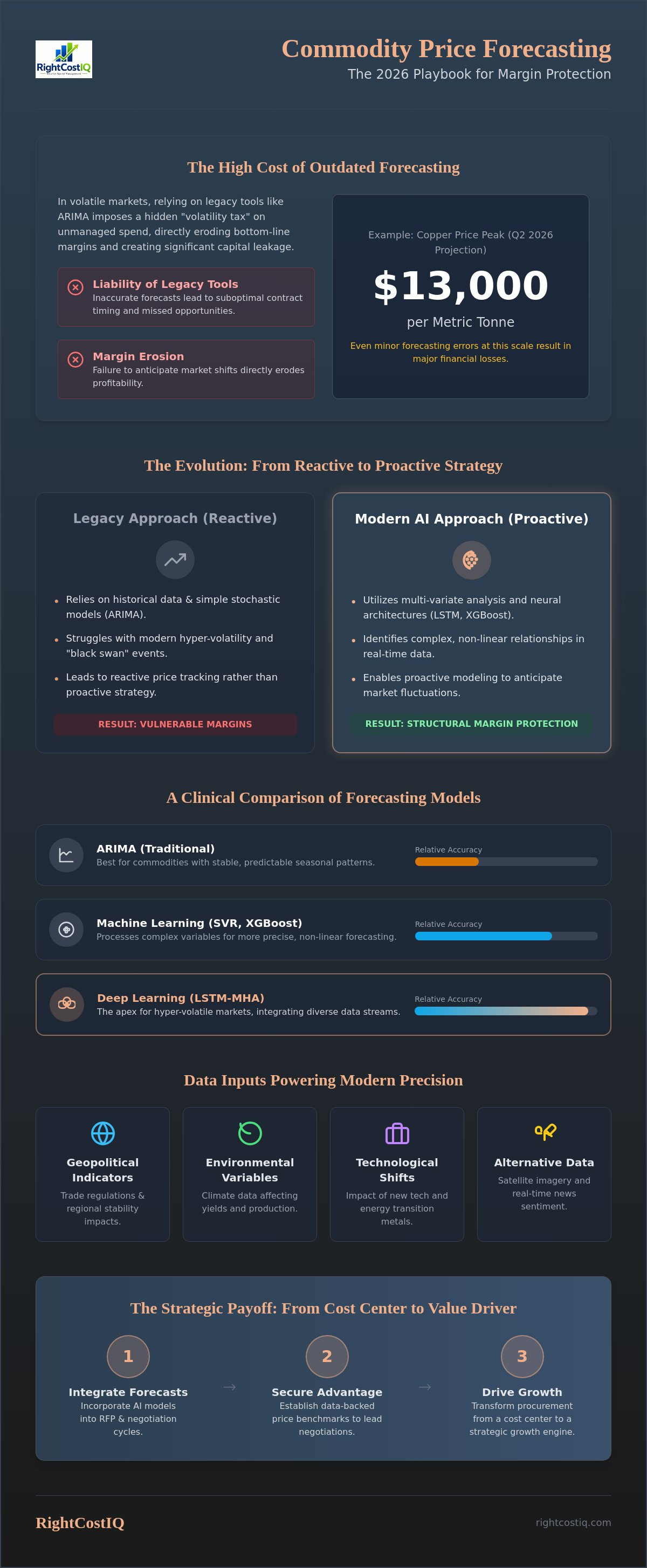
Commodity price forecasting is the clinical application of historical data and exogenous variables to predict future cost basis. Within the 2026 procurement environment, this function has transitioned from reactive price tracking to proactive predictive modeling. Procurement leadership that waits for market signals before adjusting strategy is failing to protect enterprise margins. Success now requires a Strategic Architect persona; an analytical entity that views market intelligence as a tool for financial growth rather than a mere reporting requirement. This shift represents a move toward structural margin protection where commodity price forecasting models serve as the primary engine for negotiation leverage. The goal isn't just to understand the market but to anticipate its fluctuations with enough lead time to lock in favorable rates and mitigate financial exposure.
From Stochastic Models to Neural Architectures
Linear forecasting once relied on simple stochastic processes to project future trends based on past performance. These models struggle with modern hyper-volatility and "black swan" events that defy historical patterns. Modern commodity price forecasting models now utilize multi-variate analysis, incorporating complex datasets such as a broad Commodity Price Index, geopolitical shifts, and climate-driven supply constraints. This transition toward neural architectures allows for the identification of non-linear relationships that traditional econometric tools cannot detect. Accuracy in 2026 depends on integrating diverse data streams:
- Geopolitical Indicators: Real-time monitoring of trade regulations and regional stability impacts on supply chains.
- Environmental Variables: Climate data affecting agricultural yields and energy production cycles.
- Technological Shifts: Impact of energy transition metals on global demand and price floors.
The integration of alternative data, including satellite imagery and real-time news sentiment, is now a standard requirement for maintaining accuracy in volatile sectors like energy and industrial metals. Strategic architects use these inputs to build a resilient sourcing framework that survives market shocks.
The Economic Impact of Forecasting Inaccuracy
Forecasting inaccuracy imposes a "volatility tax" on unmanaged spend, directly eroding the bottom line. In an environment where copper prices may peak at $13,000 per metric tonne in Q2 2026, even minor errors in cost basis projections lead to significant capital leakage. Accurate modeling bridges the gap between raw market intelligence and actionable procurement analytics. By integrating these projections into spend under management reporting, procurement teams transform from cost centers into strategic value drivers. This alignment ensures that high-level financial growth targets remain achievable despite the inherent unpredictability of global markets. Clinical execution in this area reduces price risk and ensures that contract negotiations are grounded in data-driven reality rather than supplier-led narratives. High-level decision makers use these frameworks to secure a competitive procurement advantage that competitors relying on intuition simply cannot match.
Technical Architectures: ARIMA, Machine Learning, and Deep Learning
Selecting commodity price forecasting models requires a clinical understanding of data density and market behavior. The choice isn't merely academic; it dictates the accuracy of your cost basis and the resilience of your enterprise margins. Sourcing at an elite level demands a transition from basic trend analysis to sophisticated technical architectures capable of processing multi-dimensional variables. Each model architecture offers specific strengths that must be matched to the volatility profile of your procurement categories.
Traditional Stochastic Modeling (ARIMA)
Autoregressive Integrated Moving Average (ARIMA) models remain a foundational tool for commodities exhibiting stable, seasonal patterns. These models rely on the assumption of data stationarity, meaning statistical properties like mean and variance remain constant over time. While effective for predictable cycles, ARIMA often fails to capture non-linear dynamics or sudden market shocks. A World Bank study on forecasting models highlights that while traditional suites provide a baseline, they lack the agility required for today's hyper-volatile industrial markets. For instance, recent 2026 data indicates that ARIMA models struggled to accurately forecast the significant gold price surge, which has pushed toward the $5,000 per troy ounce threshold. This limitation makes ARIMA a secondary choice for high-volatility energy and metal sectors.
For mid-market analytics where computational resources are balanced against accuracy, Support Vector Regression (SVR) and Extreme Gradient Boosting (XGBoost) serve as powerful alternatives. XGBoost excels in handling structured data and identifying complex interactions between exogenous variables without the heavy overhead of deep learning. These models provide a bridge between legacy statistics and modern neural networks.
Advanced Deep Learning: LSTM and GRU
Deep learning has redefined precision in 2026, particularly for commodities with long-term dependencies and high volatility. Long Short-Term Memory (LSTM) networks are the current gold standard because they effectively "remember" historical price drivers over extended periods. This capability is critical when forecasting metals or energy where past supply disruptions have lingering effects on current pricing. Gated Recurrent Units (GRU) are a streamlined neural architecture that excels in capturing temporal patterns with fewer parameters than LSTM. GRUs offer a high-efficiency alternative, balancing predictive power with faster processing speeds for real-time market intelligence.
Implementing the wrong commodity price forecasting models leads to inaccurate contract timing and financial leakage. To ensure your technical selection aligns with your financial growth targets, consider a procurement cost diagnostic to identify gaps in your current modeling strategy. Clinical precision in model selection is the only way to transform raw data into a competitive procurement advantage.
A Clinical Comparison: Choosing the Right Model for Your Category
Effective procurement resilience relies on a clinical framework for mapping specific categories to the appropriate commodity price forecasting models. High-level decision makers must prioritize a model's ability to process relevant datasets without introducing unnecessary complexity that obscures operational interpretability for stakeholders. The clinical reality of "garbage in, garbage out" remains the primary barrier to accuracy; without high-fidelity historical data and real-time exogenous inputs, even the most advanced neural network will fail to deliver actionable intelligence. Success requires balancing sophisticated technical architecture with the pragmatic need for clear, data-backed reporting that drives financial growth.
High-Volatility vs. Stable Category Strategies
High-volatility sectors like energy and metals demand deep learning architectures capable of processing complex temporal dependencies. These categories are highly sensitive to exogenous variables, including currency fluctuations and fuel cost basis shifts. For instance, forecasting copper prices in 2026 requires models that can integrate global supply chain constraints and energy transition demand spikes. Conversely, for more stable categories like industrial components or MRO supplies, machine learning commodity price forecasting models such as Random Forest or XGBoost provide the necessary precision without the high computational overhead of deep learning. Integrating tail spend management insights into your broader predictive framework ensures that low-value, high-frequency categories don't aggregate into significant financial liabilities. This granular approach allows for a more precise allocation of analytical resources based on the specific risk profile of each category.
Hybrid Modeling: The Future of Procurement Intelligence
The next evolution in procurement intelligence is the hybrid model. By combining the linear trend analysis of ARIMA with the non-linear pattern recognition of neural networks, strategic architects can capture both long-term seasonality and sudden market shocks. This ensemble approach provides a clinical safety net that single-model strategies lack. Research from the IMF on futures-based forecasting indicates that market-implied prices often lag behind actual volatility, necessitating a more robust internal modeling capability. Evaluating vendor performance tracking against these forecasted benchmarks allows procurement teams to identify discrepancies in supplier pricing and secure a competitive advantage during contract renegotiations. This alignment between technical execution and financial strategy is the primary driver for sustained margin expansion in a volatile global market. By focusing on models that incorporate weather patterns, fuel indices, and currency trends, you transform raw market intelligence into a resilient engine for operational efficiency.
Actionable Guidance: Integrating Forecasts into RFP and Negotiation Cycles
Sophisticated procurement teams don't treat forecasting as a passive reporting exercise. They use it as a clinical lever to dismantle supplier-led pricing narratives during the sourcing cycle. By weaponizing commodity price forecasting models, you transform market intelligence into a tangible negotiation advantage. This strategic application ensures that every contract is grounded in future cost realities rather than historical averages. High-level decision makers use these insights to dictate terms, forcing suppliers to justify deviations from forecasted market benchmarks. Clinical execution in this area is the primary driver for sustained margin protection.
Forecasting in the RFP Lifecycle
Integrating forecast data into RFP management allows you to set realistic "Should-Cost" benchmarks before the first bid arrives. This proactive approach identifies supplier price padding, where vendors inflate quotes to hedge against future market volatility. By comparing incoming bids against your internal commodity price forecasting models, you can pinpoint exactly where a supplier's margin exceeds the market reality. For a detailed breakdown of these processes, refer to our guide on RFP Management: Strategic Frameworks. Using predictive analytics during supplier selection ensures that you aren't just buying at the current price, but securing a cost basis that remains competitive throughout the contract lifecycle.
Mitigating Price Volatility in Contract Negotiations
Predictive modeling serves as a psychological tool in the negotiation coach framework. When you present data-backed projections, you shift the power dynamic from intuition to evidence. With copper projected to hit an average of $12,125 per metric tonne in 2026, procurement leaders must use these forecasts to design dynamic price adjustment clauses. These clauses protect the enterprise from sudden spikes while ensuring you benefit from market downturns. Forecasts also dictate the optimal contract duration. In a bull market, locking in long-term rates is essential; in a volatile or bearish environment, shifting to spot-heavy strategies may be the superior move. Clinical execution of price risk management requires this level of granular, time-sensitive decision making.
To determine if your current sourcing strategy is optimized for the 2026 market, you should perform a procurement cost diagnostic. Aligning your technical modeling with your negotiation strategy is the only way to secure a relentless competitive advantage. Don't let market volatility dictate your margins when you can use predictive intelligence to control the outcome.
RightCostIQ: The Intersection of Innovation and Financial Optimization
RightCostIQ operates as a strategic architect for global enterprise procurement, bridging the gap between raw market data and clinical execution. Our proprietary commodity price forecasting models are integrated directly into traditional business functions to drive structural margin expansion. Unlike generic market intelligence providers, we offer a specialized Market Price Trending and Forecasting Service that transforms financial volatility into a quantifiable competitive advantage. By deploying our Price Risk Management and Tracking Service, high-level decision makers move beyond passive observation to achieve proactive financial optimization. This framework ensures that procurement departments function as a relentless engine for financial growth rather than a mere cost center.
Strategic Benchmarking and Analytics
The foundation of our methodology is the integration of predictive intelligence into every sourcing event. Our should-cost analysis utilizes advanced modeling to establish precise cost benchmarks that reflect real-time market shifts and exogenous variables. This clinical precision allows procurement teams to quantify ROI through improved negotiation outcomes and significant risk mitigation. We prioritize strategic urgency, ensuring that your category managers have the data-driven leverage required to challenge supplier price padding with objective evidence. This approach redefines the strategic importance of the procurement department, positioning it as a primary driver for enterprise financial growth and operational efficiency.
The Path to Procurement Maturity
Achieving procurement excellence in 2026 requires a departure from manual spreadsheets and legacy trending tools. Partnering with RightCostIQ provides access to a high-level strategic architecture where AI-led forecasting and human expertise converge. We assist in the clinical execution of RFP management cycles and provide a Procurement and Vendor Performance Tracking Service that ensures contract compliance against forecasted benchmarks. This transition from reactive cost tracking to proactive price risk management is the final step in achieving procurement maturity. Organizations that fail to adopt these advanced commodity price forecasting models risk significant capital leakage in an increasingly volatile global market. Our solutions bridge the divide between traditional business functions and cutting-edge digital innovation, ensuring your supply chain remains resilient against unforeseen shocks.
Secure your competitive procurement advantage by aligning your technical execution with our proprietary frameworks. Optimize your procurement outcomes today through a partnership focused on relentless efficiency and structural margin protection. Let RightCostIQ transform your procurement data into a strategic asset for long-term financial stability.
Engineering Procurement Resilience Through Predictive Intelligence
Procurement success in 2026 depends on the clinical integration of advanced commodity price forecasting models into the sourcing lifecycle. High-level decision makers must pivot from reactive cost tracking toward proactive predictive modeling to safeguard enterprise margins. By mastering technical architectures and weaponizing forecast data during RFP cycles, you transform market intelligence into a relentless engine for financial growth. It's no longer enough to monitor trends; you must anticipate them to maintain structural margin protection.
RightCostIQ provides the strategic architecture required for this transition. Our proprietary "Should-Cost" modeling architecture and global cost benchmarking precision ensure your procurement outcomes are optimized for the current market. We specialize in high-stakes negotiation assistance, providing the data-driven leverage needed to dismantle supplier-led narratives and secure a competitive advantage. Don't let market volatility dictate your bottom line when clinical precision is within reach.
Secure your margins with RightCostIQ predictive analytics
Frequently Asked Questions
What are the most accurate commodity price forecasting models in 2026?
Hybrid architectures integrating Long Short-Term Memory (LSTM) with Multi-Head Attention (MHA) are the most accurate commodity price forecasting models in 2026. These systems outperform standalone models by identifying complex, non-linear relationships across global datasets. While ARIMA remains a baseline for stable categories, deep learning dominance is established in volatile sectors like energy and industrial metals. Strategic architects use these models to secure a competitive advantage through clinical cost benchmarking and margin protection.
How does LSTM differ from ARIMA in commodity price prediction?
LSTM networks process long-term temporal dependencies through a memory-cell architecture, whereas ARIMA relies on linear relationships and stationary data. Recent studies indicate that ARIMA models often fail during high-volatility regimes, such as the 2025-2026 gold bull market. LSTM provides the necessary precision to capture market shocks and non-linear shifts, making it superior for categories with complex price drivers. This distinction is critical for maintaining an accurate cost basis in hyper-volatile markets.
Why is forecasting essential for effective RFP management?
Forecasting is essential for RFP management because it establishes a data-driven "should-cost" benchmark to evaluate supplier bids. By comparing vendor quotes against forecasted market trends, procurement teams can identify price padding and secure more favorable contract terms. This clinical execution transforms the RFP process from a simple bidding exercise into a strategic lever for financial growth. It ensures that every negotiation is grounded in future market reality rather than historical averages.
Can forecasting models predict "black swan" market events?
Forecasting models cannot predict the specific occurrence of "black swan" events, but advanced architectures can identify high-risk volatility regimes and pre-event anomalies. By processing alternative data like news sentiment and geopolitical indicators, these models signal when market conditions deviate from historical norms. This early warning allows procurement leaders to implement price risk management strategies before the full impact of a market shock is realized, providing a critical window for strategic adjustment.
What data is required to build a reliable commodity price forecast?
Reliable commodity price forecasting models require three primary data pillars: historical price series, macroeconomic exogenous variables, and alternative unstructured data. Historical data provides the baseline trend, while variables like fuel indices and currency rates account for external cost drivers. Integrating real-time news sentiment and satellite imagery further enhances predictive accuracy. This ensures the resulting forecast is grounded in the clinical reality of global supply chains and macroeconomic shifts.
How do exogenous variables like weather impact agricultural forecasting models?
Weather variables impact agricultural forecasting models by directly influencing supply yields and regional production capacity. Changes in precipitation or temperature shift the supply curve, creating price floors or spikes that traditional models often miss. Deep learning models incorporating weather data achieve higher accuracy in categories like grains and soft commodities. In these sectors, climate-driven supply constraints are the primary driver of price volatility, necessitating the inclusion of environmental data for clinical precision.
What is the role of machine learning in procurement risk management?
Machine learning automates the identification of cost-saving opportunities and provides a clinical framework for price risk management. By analyzing large datasets in real-time, ML models detect emerging price trends and supplier performance discrepancies that manual processes overlook. This automation enhances procurement agility, allowing for the rapid adjustment of sourcing strategies. It transforms risk management from a reactive function into a proactive driver of operational efficiency and margin expansion.
How can I integrate forecasting into my existing procurement platform?
You can integrate forecasting into your existing procurement platform through API-first architectures or by partnering with a specialized Market Price Trending and Forecasting Service. Modern platforms support seamless data exchange, allowing you to feed predictive insights directly into your RFP and negotiation workflows. This integration ensures that high-level strategy and technical execution are perfectly aligned. It drives operational efficiency by making predictive intelligence accessible across all spend under management.


