
By 2026, procurement workloads are projected to rise by 8% even as departmental headcounts continue to contract. This efficiency gap leaves no room for negotiation strategies based on intuition or legacy relationships. You likely struggle with information asymmetry where suppliers leverage superior market data to dictate terms, resulting in sourcing cycles that delay critical outcomes. It's difficult to translate these "soft" negotiation wins into the hard financial metrics your C-suite demands.
Mastering advanced procurement negotiation tactics requires a transition from conversational persuasion to a clinical, data-driven framework. This article provides a repeatable methodology to eliminate information gaps and secure optimal contract terms through precise category cost benchmarking. We'll examine how to integrate market price trending and risk management into a strategic sourcing engine that drives measurable financial growth.
Key Takeaways
- Transition from transactional haggling to a clinical alignment between supplier capabilities and organizational financial objectives for superior value creation.
- Utilize should-cost modeling and category cost benchmarking to deploy high-impact procurement negotiation tactics that neutralize supplier information advantages.
- Implement a structured 7-stage execution framework to ensure technical baseline setting and methodical opening protocols during complex RFP cycles.
- Neutralize aggressive hardball tactics by leveraging Best Alternative to a Negotiated Agreement (BATNA) strategies backed by objective market intelligence.
- Quantify negotiation wins for C-suite reporting by integrating precision RFP management and professional negotiation assistance into your existing procurement infrastructure.
The Architecture of Strategic Procurement Negotiation
Implementing advanced procurement negotiation tactics is the clinical alignment of supplier capabilities with organizational financial objectives. It's a rigorous execution, not a series of concessions. Traditional models often degrade into transactional haggling, which ignores the broader strategic potential of the partnership. Modern sourcing requires a shift toward value-based methodologies that prioritize long-term margin expansion over immediate, superficial price cuts. Organizations can't afford inefficiency; procurement workloads are projected to rise by 8% in 2026 while headcounts continue to contract.
In the current market, effective negotiation strategies depend on your ability to close the information gap. Suppliers traditionally hold the upper hand because they possess granular data on their own cost structures, manufacturing efficiencies, and market benchmarks that procurement teams often lack. This lack of visibility creates a structural disadvantage. Utilizing professional Negotiation Assistance allows organizations to re-engineer these interactions, turning procurement into a strategic architect of financial growth.
Overcoming Information Asymmetry
Information asymmetry occurs when suppliers utilize proprietary market intelligence and opaque cost structures to maintain price premiums that exceed fair market value. They rely on your lack of visibility into their raw material fluctuations and labor efficiencies. Identifying these specific data points is the first step in reclaiming leverage. For example, the Fiscal Year 2026 National Defense Authorization Act (NDAA) now mandates expanded supply chain visibility, requiring multi-tier supplier identification. This regulatory shift provides a clinical opening for procurement teams to demand the level of transparency previously hidden behind commercial sensitivity excuses.
Transparency serves as a primary tactical advantage in high-value contracts. By demanding detailed cost breakdowns and utilizing objective benchmarking, you force a shift in the discussion power dynamic. In the 2026 landscape, information asymmetry is defined as the structural imbalance where a supplier's possession of superior market data or internal cost metrics creates an unearned economic advantage during contract finalization.
Strategic Intent: Beyond Price Reduction
Superior procurement negotiation tactics focus on total value, not just the unit price. While cost reduction remains a core metric, it must be balanced against supply chain resilience and consistent vendor performance. A low-cost contract that fails during a geopolitical disruption is a financial liability, not a win. By 2026, 70% of organizations are expected to incorporate ESG criteria into supplier scorecards, adding another layer of complexity to the value equation during the sourcing process.
Within the framework of Category Management, value is defined as the optimal intersection of cost efficiency, risk mitigation, and operational reliability. Negotiation is the primary tool for securing these multi-dimensional benefits. When executed with precision, these tactics drive long-term margin expansion by stabilizing supply lines and ensuring that every dollar of spend is anchored to a verifiable market baseline. Strategic sourcing isn't about winning a single argument; it's about building a resilient financial foundation.
Data-Driven Tactics: Leveraging Benchmarking and Analytics
Effective procurement negotiation tactics in 2026 rely on the elimination of guesswork. Negotiation is a calculation, not a conversation. By 2026, over 80% of organizations are expected to integrate predictive analytics and AI into their procurement processes, shifting the power dynamic toward those who control the most granular data. High-performing teams utilize Should-Cost Modeling to establish an objective baseline before the first engagement occurs. This technical preparation ensures that every supplier proposal is measured against a rigorous financial standard rather than a subjective market average.
Integrating price risk management into your bargaining framework allows for the neutralization of market volatility. By utilizing historical market price trending, procurement architects can forecast future supplier cost structures and bake these projections into contract terms. This foresight prevents suppliers from using temporary inflationary spikes to justify permanent price increases. Data-backed forecasting turns potential price risks into quantifiable negotiation levers, ensuring that contract terms remain aligned with actual market movement throughout the agreement lifecycle.
The Power of Should-Cost Analysis
Should-cost analysis allows procurement teams to deconstruct supplier quotes into their fundamental components: raw materials, labor, and overhead. This granular visibility exposes hidden margins that suppliers often fail to disclose in standard RFP responses. When you identify that a supplier's overhead allocation exceeds industry standards, you pivot the discussion from "what you charge" to "what it costs." This shift forces suppliers to defend their margins against objective data, often resulting in immediate price corrections. It's a clinical dismantling of the supplier's price umbrella, leaving no room for arbitrary premiums.
Benchmarking as a Tactical Lever
Quantifying market competitive rates requires sophisticated Procurement Analytics to move beyond internal historical spend. Benchmarking identifies category savings with clinical precision by isolating price variances from legitimate cost drivers across fragmented supply markets. By leveraging peer data and cross-industry cost benchmarks, you can challenge non-competitive pricing with technical authority. This approach transforms benchmarking from a passive reporting tool into an active tactical lever during high-stakes sourcing events.
Successful execution depends on the quality of your intelligence. If your team lacks the internal capacity to generate these benchmarks, consider accessing a diagnostic cost assessment to identify immediate savings opportunities. Relying on supplier-provided market data is a strategic failure; true leverage comes from proprietary benchmarking that validates every line item in your category spend. Precision in data leads to precision in outcomes.
Hardball vs. Integrative Tactics: A Clinical Comparison
Distributive bargaining, often characterized by "hardball" tactics, operates as a fixed-sum game where one party's gain is the other's loss. In the complex supply chains of 2026, this model introduces significant systemic risk. Relying solely on distributive procurement negotiation tactics can alienate strategic partners and lead to service degradation. Instead, sophisticated architects utilize integrative negotiation to create value through multi-issue trade-offs, ensuring that contract terms support both immediate margin goals and long-term supply resilience.
Effective BATNA (Best Alternative to a Negotiated Agreement) management is the cornerstone of this approach. In a market where supply continuity has surpassed cost reduction as the top procurement objective, your BATNA must be a quantified reality backed by real-time market intelligence. If a supplier realizes your alternative is a vague "other vendor" rather than a cost-benchmarked, ready-to-deploy competitor, your leverage evaporates. A clinical BATNA provides the confidence to walk away from non-competitive terms without jeopardizing operational continuity.
Defusing Hardball Strategies with Metrics
Suppliers frequently employ extreme demands or "take-it-or-leave-it" ultimatums to force concessions. These hard-bargaining maneuvers are designed to exploit emotional stress and information gaps. Clinical objectivity is your primary defense. By utilizing robust RFP Management, you establish a structured environment where every supplier claim is cross-referenced against real-time market price trending. When a supplier presents an ultimatum, you don't react; you provide the data that proves their position is non-competitive.
- Deploy should-cost data to refute claims of "unavoidable" price hikes.
- Use multi-tier supplier identification to expose the supplier's own dependency risks.
- Leverage category cost benchmarking to demonstrate where the supplier sits in the market quartiles.
The Mechanics of Integrative Bargaining
Integrative bargaining moves the conversation from a single variable, usually price, to a matrix of value drivers. This doesn't mean compromising on financial growth; it means optimizing the total cost of ownership. You might trade a slightly higher unit price for significantly better payment terms or tiered volume rebates that scale with your organizational growth. This creates a multi-dimensional agreement that is harder for competitors to replicate.
Using vendor performance tracking as a negotiation incentive creates a self-correcting contract. By linking margin incentives to verified KPIs, you align the supplier's profit motives with your operational efficiency. Mutually beneficial risk-sharing clauses ensure that neither party is unfairly penalized by market volatility, building the resilience required in the 2026 economic landscape. Precision in these trade-offs ensures that "win-win" outcomes are backed by hard financial logic rather than conversational compromise.
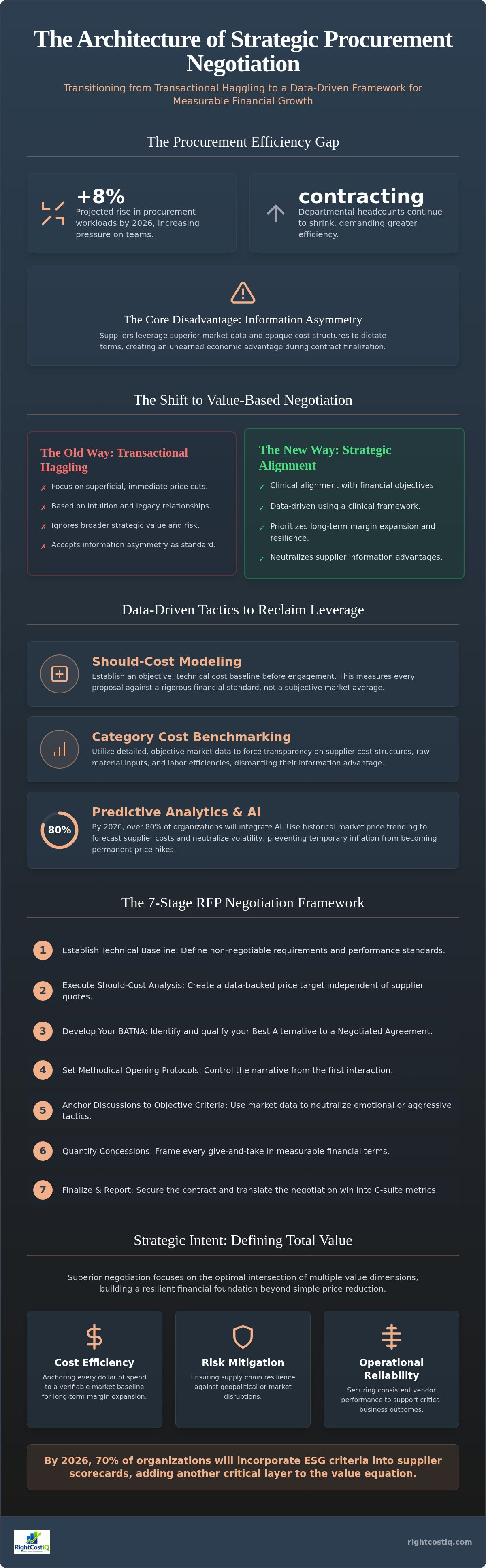
The 7-Stage Execution Framework for RFP Negotiations
Execution of advanced procurement negotiation tactics requires a methodical transition from data analysis to contractual finalization. By 2026, it's estimated that 75% of large enterprises will utilize AI-driven procurement solutions to manage these complex lifecycles. A clinical framework ensures that strategic intent isn't lost during the transition from sourcing to agreement. This process begins with Stage 1: Analytical Preparation, where teams utilize Should-Cost modeling and benchmarking data to establish a non-negotiable financial baseline. This preparation neutralizes supplier information advantages before the first engagement occurs.
Stage 2: The Opening focuses on setting the technical baseline for the discussion, ensuring the supplier understands that the evaluation is anchored in objective cost components rather than subjective market rates. During Stage 3: Testing & Probing, procurement architects validate supplier RFP responses against verified market trends and historical cost structures. Stage 4: Tactical Bargaining involves executing trade-offs based on financial growth metrics, such as payment terms and volume rebates. Finally, Stage 5: Agreement & Closure ensures that every negotiated win is hard-coded into contractual compliance protocols and performance KPIs.
Optimizing the RFP-to-Contract Transition
Ensuring negotiation wins are captured requires a seamless RFP Management workflow. Many organizations suffer from "leakage," where negotiated savings vanish due to poor contractual translation or lack of post-negotiation oversight. Automating compliance tracking prevents this erosion by linking contract terms directly to procurement execution systems. Establishing a feedback loop for future category management cycles ensures that every negotiation informs the next sourcing event, creating a continuous engine for margin expansion.
Leveraging the Negotiation Coach
Real-time assistance through a specialized Negotiation Coach improves outcome consistency across decentralized procurement teams. By standardizing tactical execution for enterprise-level sourcing, organizations eliminate the variance caused by individual negotiator skill levels. This technological integration transforms the procurement function into a strategic architect of financial stability. Professional negotiation assistance in high-stakes RFPs delivers a measurable ROI by identifying hidden cost variances that traditional sourcing methods routinely overlook.
Strategic sourcing is an exercise in financial precision. To identify the specific gaps in your current category spend and strengthen your bargaining position, access a free diagnostic cost assessment today. Precision in preparation is the only reliable driver of superior contract terms.
Maximizing ROI: RightCostIQ’s Precision Negotiation Assistance
The integration of RightCostIQ into your existing procurement infrastructure acts as a technical force multiplier. It replaces anecdotal bargaining with a structured methodology centered on financial precision. Professional negotiation assistance significantly increases the percentage of spend under management by equipping teams with the category-specific intelligence needed to dismantle complex supplier cost structures. This shift moves the department toward proactive financial optimization, where sourcing events are triggered by market opportunity rather than contract expiration. By leveraging price risk management and tracking services, organizations eliminate the uncertainty of price volatility, ensuring that every procurement execution contributes directly to the bottom line.
Transitioning from reactive sourcing requires a clinical focus on the total cost of ownership. Traditional models often fail because they treat negotiation as an isolated event. Modern procurement negotiation tactics view the contract as a living financial instrument that must be managed with the same rigor as an investment portfolio. This proactive stance allows procurement architects to secure optimal terms that remain resilient against shifting economic conditions, such as the regionalization of supply networks or evolving trade tensions.
The Role of Vendor Performance Tracking
Negotiated savings are theoretical until they're realized in day-to-day operations. Implementing a rigorous Procurement and Vendor Performance Tracking Service ensures that supplier compliance remains absolute throughout the contract lifecycle. These performance metrics serve as clinical leverage for future contract renewals, identifying where suppliers have failed to meet technical or financial obligations. Addressing Tail Spend through automated tracking systems eliminates the fragmented, unmanaged spend that often erodes total procurement ROI. When every dollar is tracked against negotiated benchmarks, margin leakage becomes impossible to hide.
Future-Proofing Sourcing with Market Intelligence
Navigating 2026 market volatility requires an intersection of AI-led analytics and human negotiation expertise. Price risk management isn't a passive observation; it's an active tactical component of modern procurement negotiation tactics. Using market price trending and forecasting services allows procurement architects to anticipate supply chain disruptions and adjust bargaining strategies accordingly. This foresight is critical when dealing with new regulatory requirements, such as the EU Carbon Border Adjustment Mechanism (CBAM), which demands verified emissions data as a standard component of supplier oversight.
Implementation of a clinical negotiation framework requires a commitment to data integrity and strategic alignment. Utilizing advanced analytics allows your team to navigate global sourcing complexities with technical authority. The next step for high-level decision-makers is the standardization of these tactics across the entire enterprise sourcing engine. By anchoring every negotiation in objective market intelligence, you transform procurement from a back-office function into a primary engine for sustained financial growth.
Transitioning to a Clinical Sourcing Engine
Success in the 2026 landscape requires a fundamental shift from intuition-led bargaining to data-centric execution. Advanced procurement negotiation tactics are the primary driver for eliminating information asymmetry and reclaiming financial leverage from dominant suppliers. By integrating specialized category cost benchmarking and advanced price risk management, your team can transform every RFP from a transactional event into a strategic architect for margin expansion.
Maintaining clinical objectivity across the entire sourcing lifecycle ensures that negotiated wins aren't lost during the transition to operational execution. Utilizing clinical RFP management frameworks allows for the standardization of high-stakes outcomes, ensuring consistency regardless of departmental headcount constraints. It's time to move beyond reactive cost-cutting and establish a repeatable, data-backed methodology for procurement excellence.
Optimize your next sourcing cycle with the RightCostIQ Negotiation Coach to identify hidden savings and secure optimal contract terms. You have the framework; now deploy the intelligence required to dominate your market.
Frequently Asked Questions
What are the most effective procurement negotiation tactics for 2026?
The most effective procurement negotiation tactics for 2026 prioritize the elimination of information asymmetry through proprietary benchmarking and predictive analytics. High-performing teams move beyond conversational persuasion to a clinical alignment of supplier capabilities with financial growth metrics. This approach utilizes should-cost modeling to establish an objective baseline, ensuring that every contract term is anchored to verifiable market data rather than arbitrary supplier premiums.
How does should-cost modeling improve negotiation outcomes?
Should-cost modeling improves negotiation outcomes by deconstructing supplier quotes into fundamental components like raw materials, labor, and overhead. This granular visibility allows procurement architects to identify hidden margins and pivot the discussion from "what you charge" to "what it costs." By establishing a technical cost baseline, you force suppliers to defend their pricing against objective data, which often leads to immediate price corrections and long-term margin expansion.
What is the difference between distributive and integrative negotiation in sourcing?
Distributive negotiation is a zero-sum, win-lose model focused on dividing a fixed amount of value, whereas integrative negotiation seeks to create value through multi-issue trade-offs. In modern sourcing, distributive tactics can introduce supply chain risk by alienating strategic partners. Integrative bargaining utilizes vendor performance tracking and risk-sharing clauses to build long-term resilience, ensuring that contract terms support both immediate savings and operational reliability.
How can procurement teams counter hardball tactics from powerful suppliers?
Procurement teams counter hardball tactics by maintaining clinical objectivity and leveraging real-time market intelligence. When faced with extreme demands or "take-it-or-leave-it" ultimatums, you must provide the data that proves the supplier's position is non-competitive. Utilizing a robust RFP management framework ensures that every supplier claim is cross-referenced against category cost benchmarking, effectively neutralizing emotional pressure with technical authority and quantified market realities.
Why is market price trending essential for contract negotiations?
Market price trending is essential because it allows procurement professionals to forecast future supplier cost structures and anticipate market volatility. This foresight prevents suppliers from leveraging temporary inflationary spikes to justify permanent price increases in long-term contracts. By integrating price risk management into the bargaining framework, you ensure that procurement negotiation tactics remain aligned with actual market movement, securing price stability throughout the agreement lifecycle.
How does RFP management software assist in the negotiation process?
RFP management software assists by automating compliance tracking and ensuring that every negotiated win is captured in the final contract workflow. This technology prevents post-negotiation "leakage" where savings vanish due to poor contractual translation or lack of oversight. By establishing a digital feedback loop, the software ensures that data from previous sourcing events informs future category management cycles, creating a continuous engine for financial optimization.
What role does BATNA play in modern procurement strategy?
BATNA serves as the primary source of leverage by providing a quantified reality that allows procurement teams to walk away from non-competitive terms. In 2026, a strong BATNA isn't just a backup plan; it's a cost-benchmarked, ready-to-deploy alternative. This clinical alternative provides the confidence needed to hold firm on strategic objectives, ensuring that supply continuity is never sacrificed for sub-optimal contract terms.
How do you quantify the success of a procurement negotiation?
Quantifying the success of a procurement negotiation requires linking outcomes to hard financial growth metrics and spend under management. You must move beyond "soft" wins and report on tangible margin expansion, reduced price volatility, and improved vendor performance KPIs. Success is measured by the clinical alignment of procurement negotiation tactics with the organization's broader financial objectives, proving the function's role as a strategic driver of corporate value.


