
A Request for Proposal is not an administrative task; it's a clinical financial instrument that dictates your long-term operational viability. Most organizations treat procurement as a clerical hurdle, yet the average RFP response time has reached 25 hours, often yielding results that lack deep market intelligence. When you decide to hire someone to manage RFP process requirements, you aren't merely outsourcing paperwork. You're deploying specialized expertise to eliminate inefficient sourcing cycles and the uncertainty of market price volatility.
You likely recognize that internal expertise gaps often lead to suboptimal vendor selection and delayed project timelines. This guide demonstrates how professional RFP management transforms procurement from a resource drain into a high-yield strategic asset. You'll discover how data-driven benchmarking and assertive negotiation frameworks generate quantifiable cost savings. We provide a methodical preview of streamlined, compliant selection processes that mitigate risk while leveraging the latest 2026 federal procurement threshold updates to your competitive advantage.
Key Takeaways
- Professional RFP management shifts procurement from a clerical burden to a high-yield strategic asset focused on clinical execution.
- Choosing to hire someone to manage RFP process cycles integrates advanced cost benchmarking and market analytics into your vendor selection framework.
- Clinical expertise provides the critical data interpretation that standalone software platforms cannot offer during complex negotiations.
- Implementing a "Should-Cost" analysis during the RFP lifecycle identifies precise market price benchmarks to eliminate financial volatility.
- Integrated performance tracking ensures that selected vendors maintain operational efficiency and deliver long-term financial growth.
The Strategic Necessity of Professional RFP Management
Professional procurement is not a back-office administrative function. It's a high-stakes financial operation. A Request for Proposal (RFP) serves as the primary mechanism for value extraction in the supply chain. While generic administrative handling focuses on document organization, strategic RFP management prioritizes clinical execution and financial optimization. Inefficient sourcing cycles directly erode enterprise liquidity by tying up capital in suboptimal contracts. When you decide to hire someone to manage RFP process workflows, you transition from reactive purchasing to proactive strategic sourcing. Strategic sourcing serves as the necessary precursor to professional intervention, aligning procurement with broader corporate financial goals.
Beyond Documentation: The Value of Clinical Precision
Subjective decision-making creates systemic risk. Internal teams often succumb to vendor bias or historical preferences that inflate costs. Professional oversight replaces intuition with data-driven benchmarking and market analytics. It ensures that every requirement aligns with long-term business objectives rather than immediate tactical needs. By integrating managed RFP services, decision-makers gain access to specialized cost analysis that internal departments rarely possess. This precision prevents the common trap of selecting the lowest bid without considering the total cost of ownership. RFP management is a strategic financial asset for 2026 that secures competitive advantage through rigorous vendor performance tracking.
The Cost of Internal Inefficiency
Utilizing non-specialized internal staff for procurement is an expensive error. These employees lack the specialized negotiation assistance required to secure market-leading rates. The hidden costs are substantial and often outweigh the perceived savings of keeping the process in-house.
- Extended Sourcing Cycles: Delays in vendor selection stall critical projects and delay revenue generation.
- Scope Creep: Poorly defined requirements lead to unforeseen expenses and mid-contract renegotiations.
- Compliance Failures: Inadequate documentation increases regulatory risk and supply chain volatility.
Professionals ensure supply chain compliance from day one by adhering to rigorous audit standards. They utilize market price trending and forecasting to protect against financial volatility. Organizations that hire someone to manage RFP process tasks often recover the cost of the service through immediate, quantifiable savings in vendor contracts. This approach transforms the procurement department from a cost center into a driver of financial growth. It replaces administrative burden with a clinical focus on the bottom line.
Key Criteria for Evaluating RFP Management Partners
Selecting a procurement partner is a strategic investment in your organization’s margin expansion. A high-level partner must demonstrate core competencies that go beyond document coordination. They require deep technical descriptors and specialized jargon to navigate complex supply chains with authority. When you hire someone to manage RFP process requirements, their ability to track vendor performance post-selection is just as critical as the initial sourcing. Clinical precision in evaluating these partners ensures your procurement infrastructure remains resilient and cost-effective.
Data-Driven Benchmarking Capabilities
Access to integrated cost benchmarking and market analytics is the primary differentiator between generic consultants and strategic architects. Your partner must possess granular data on category costs to validate vendor pricing against real-world market intelligence. Static pricing models are insufficient in volatile markets. Instead, professional management utilizes market price trending to forecast future contract costs and mitigate financial risk. RightCostIQ leverages advanced Procurement Analytics to identify immediate savings opportunities that internal teams frequently overlook. This data-first approach replaces guesswork with clinical certainty.
Assertive Negotiation and Strategic Coaching
A sophisticated partner doesn't merely facilitate communication; they actively drive the negotiation process toward favorable financial outcomes. You must evaluate their track record in price risk management and their ability to execute high-stakes discussions with clinical precision. Utilizing a specialized Negotiation Coach is essential for finalizing high-value contracts where marginal percentage shifts translate into significant enterprise liquidity. This coaching ensures your team maintains an assertive stance while navigating complex vendor terms and multi-year service agreements.
Effective partners bridge the gap between initial selection and long-term delivery. They implement vendor performance tracking services to ensure operational efficiency doesn't degrade after the contract is signed. This continuous monitoring protects your investment and ensures compliance with negotiated terms. Deciding to hire someone to manage RFP process workflows provides a clinical framework for sustained financial growth. You can review our managed RFP solutions to see how these evaluation criteria translate into tangible results.
Software vs. Managed Services: Why Clinical Expertise Wins
Technology is a facilitator, not a strategist. While 69% of procurement teams utilized RFP software in 2025, the proliferation of these tools hasn't eliminated the need for human-led financial oversight. Automation excels at streamlining the administrative burden of data ingestion, yet it lacks the clinical precision required to execute complex negotiations. Software can aggregate responses, but it cannot interpret the strategic intent behind a vendor's pricing model. When you decide to hire someone to manage RFP process workflows, you're investing in the interpretation of data, not just its collection. Managed services bridge the critical gap between raw data collection and the assertive execution of a contract.
The Limitations of Sourcing Automation
AI-led procurement optimization requires a professional framework to be effective. Without strategic oversight, automated RFP platforms often suffer from a "garbage in, garbage out" systemic risk. These systems categorize data points but fail to identify the qualitative nuances that signal long-term financial volatility. A software algorithm won't flag a vendor's subtle shift in service-level agreements that could lead to significant cost overruns. Professional managers identify these proposal nuances that software misses. They scrutinize every response for hidden escalation clauses and predatory terms that an automated scoring system would likely overlook.
Hybrid Architectures: Technology Meets Strategy
The ideal procurement model is a hybrid architecture where professional management is backed by advanced analytics. This approach ensures that technology serves as a clinical instrument for strategic architects rather than a standalone solution. Integrating RFP Management tools into a broader procurement strategy allows for real-time data processing without sacrificing human expertise. The ROI of hiring expertise to manage your technology stack is realized through the translation of raw data into actionable negotiation leverage.
- Strategic Data Interpretation: Professionals analyze software outputs to find leverage points for cost benchmarking.
- Assertive Negotiation: Human experts utilize technical descriptors to challenge vendor assumptions in ways AI cannot.
- Contextual Risk Mitigation: Managed services evaluate geopolitical and market-specific risks that software isn't programmed to detect.
RightCostIQ’s platform acts as a sophisticated tool that empowers our consultants to deliver quantifiable cost savings. We don't rely on automation to make financial decisions; we use it to provide the market intelligence our experts need to win. This synergy ensures that your procurement infrastructure remains both technologically advanced and strategically sound.
Executing the RFP Lifecycle with Precision
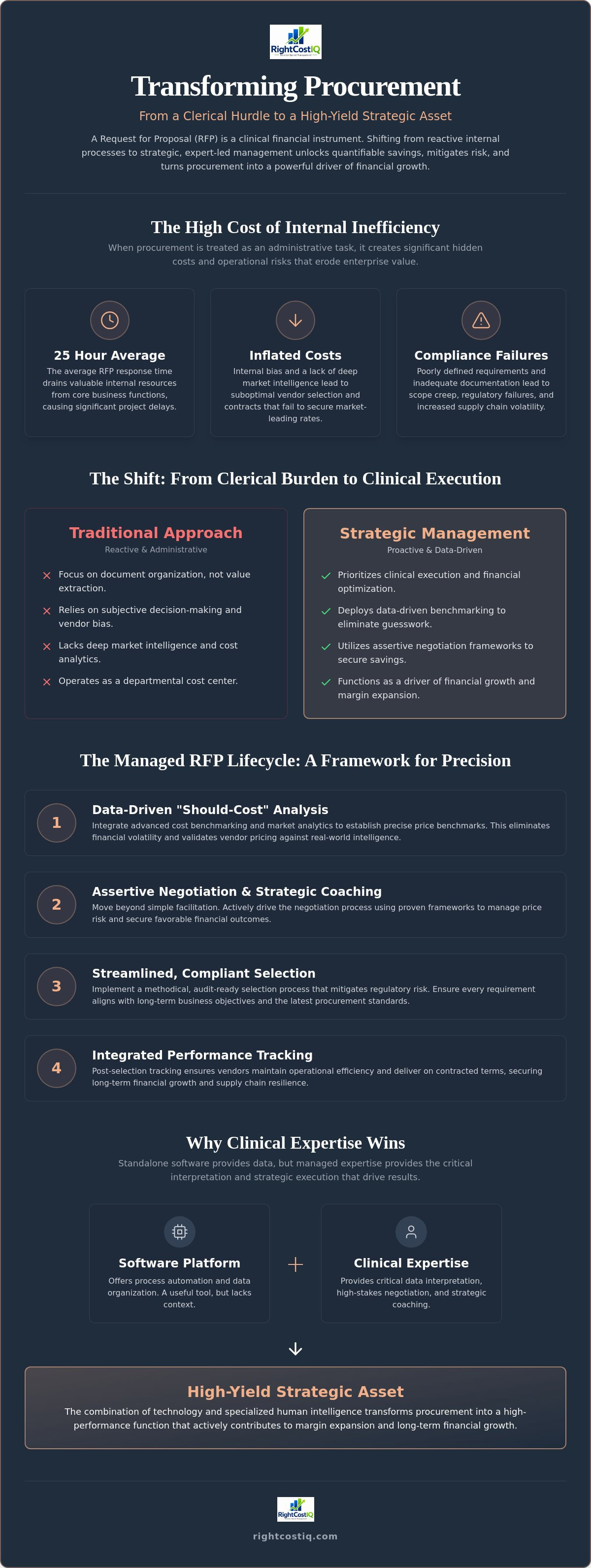
Professional RFP execution requires a methodical approach that eliminates administrative friction while maximizing financial leverage. Most internal procurement attempts fail because they lack a structured sequence of analytical stages. When you hire someone to manage RFP process cycles, you're implementing a rigorous framework designed to secure market-leading terms through clinical execution. This lifecycle moves beyond simple document distribution; it functions as a strategic engine for margin expansion. Precision at every stage ensures that vendor selection is based on quantifiable data rather than subjective preference.
Phase 1: Market Intelligence and Should-Cost Analysis
The lifecycle begins with deep-dive category research and market intelligence gathering. This stage is critical for establishing a clinical baseline before any vendor contact occurs. Using Should-Cost Analysis allows your organization to set realistic budget expectations based on granular cost components like raw materials, labor, and overhead. This data-driven preparation defines specific, measurable KPIs that will govern the entire selection process. It prevents vendors from dictating market terms by arming your team with assertive, evidence-based benchmarks.
Phase 2: Auditing, Scoring, and Final Negotiation
Once proposals are received, the transition from auditing to assertive negotiation begins. A clinical approach to scoring utilizes objective data to filter candidates through a multi-dimensional matrix. Leveraging RFP Management: Precision Frameworks ensures that the filtering process remains immune to vendor bias or sales rhetoric. This stage identifies the gap between the best proposal and the actual market price ceiling discovered during the intelligence phase.
- Proposal Auditing: Scrutinizing bid structures for hidden costs and escalation clauses.
- Objective Scoring: Applying weightings to vendor responses based on technical competence and financial stability.
- Contract Finalization: Closing the value gap through assertive negotiation assistance that targets specific margin improvements.
The final stage involves the formalization of vendor performance tracking metrics. These KPIs are embedded directly into the contract to ensure long-term operational efficiency. This methodical transition from selection to management protects your enterprise liquidity from the start. Deciding to hire someone to manage RFP process requirements provides the strategic architecture needed to navigate these phases with clinical precision. Access our Procurement Diagnostic to evaluate your current RFP lifecycle efficiency and identify immediate leverage points.
RightCostIQ: Optimizing Procurement through Managed RFP Services
RightCostIQ operates as a strategic architect for enterprise procurement infrastructure. We don't merely facilitate vendor selection; we engineer financial growth through clinical execution. By integrating cost benchmarking and market analytics into every engagement, we eliminate the administrative burden of sourcing. When you hire someone to manage RFP process requirements through our firm, you gain access to a specialized framework that prioritizes margin expansion. Our data-driven methodology ensures that every contract aligns with your long-term financial objectives. We provide the technical competence required to navigate complex supply chain variables while maintaining a relentless focus on the bottom line.
A Holistic Approach to Sourcing and Procurement
Effective procurement requires more than managing high-value contracts. It demands oversight of the entire sourcing lifecycle to ensure operational efficiency. RightCostIQ manages this complexity by applying clinical precision to both major acquisitions and fragmented categories. The integration of Tail Spend Management within the RFP context is a critical differentiator. This approach captures value in low-volume categories that internal teams often ignore due to resource constraints. We position your firm as a sophisticated market participant capable of leveraging market price trending and forecasting to mitigate financial volatility. Our vendor performance tracking service ensures that negotiated savings are realized throughout the contract's duration, protecting enterprise liquidity against operational degradation.
Contact RightCostIQ for a Strategic Assessment
Engagement begins with a rigorous evaluation of your current procurement maturity. Integrating professional management into existing workflows is seamless and designed for immediate impact. You can explore our RightCostIQ Landing Page to understand how our technical analysis frameworks align with your specific industry needs. Our firm provides the assertive negotiation assistance and price risk management necessary to secure a sustainable competitive advantage. We act as a high-level consultant that bridges the gap between traditional business functions and cutting-edge digital innovation.
The 2026 procurement landscape requires a move away from static, administrative models toward data-centric execution. Organizations that fail to adapt risk significant margin erosion in an era of rapid regulatory shifts and technological advancement. Review our Pricing and Services to determine the optimal engagement model for your organization. Deciding to hire someone to manage RFP process cycles is the first step toward transforming procurement from an administrative task into a high-yield strategic asset. We invite you to partner with an entity focused on technical upskilling and long-term financial optimization.
Securing Competitive Advantage in the 2026 Procurement Landscape
Professional RFP management serves as a clinical instrument for enterprise margin expansion. By transitioning from administrative handling to strategic sourcing, organizations eliminate inefficient cycles and secure market-leading terms. The integration of advanced market price forecasting and risk management ensures that supply chain volatility doesn't erode liquidity. Organizations that hire someone to manage RFP process cycles gain a sophisticated partner capable of executing complex negotiations with data-driven authority. This strategic shift secures your financial growth metrics through precise, expert-led execution.
RightCostIQ remains specialized in procurement category cost benchmarking and the clinical execution of negotiation cycles. We replace the uncertainty of subjective vendor selection with objective analytics and rigorous performance tracking. This strategic architecture provides the foundation for long-term operational efficiency and quantifiable financial growth. Your procurement department must function as a primary driver of profit rather than a drain on internal resources. We are ready to help you implement a more resilient and cost-effective sourcing infrastructure.
Optimize your procurement outcomes with RightCostIQ RFP Management and secure your organization's financial future today.
Frequently Asked Questions
What is the primary benefit of hiring someone to manage the RFP process?
The primary benefit is the transformation of procurement from an administrative burden into a high-yield strategic asset. Professional oversight eliminates inefficient sourcing cycles and ensures that vendor selection is based on clinical financial data rather than subjective bias. This approach secures a competitive advantage by aligning procurement with long-term margin expansion goals.
How does professional RFP management differ from using procurement software?
Professional management provides the strategic interpretation that standalone software lacks. While tools automate data ingestion, managed services apply clinical precision to identify nuances in vendor proposals. When you hire someone to manage RFP process cycles, you gain human-led negotiation assistance that software algorithms cannot replicate. Human experts leverage technical descriptors to challenge vendor assumptions in ways AI cannot.
Can an external RFP manager help with vendor negotiation?
External managers actively execute assertive negotiation frameworks to secure market-leading contract terms. They act as a sophisticated partner that challenges vendor assumptions using proprietary cost benchmarking. This intervention ensures that the final contract reflects the true market price ceiling discovered during the intelligence phase. Strategic coaching during this phase is essential for finalizing high-value contracts where marginal shifts impact enterprise liquidity.
How much does it cost to hire an RFP management consultant?
Costs are typically structured around the project scope or the complexity of the procurement category. Some firms utilize project-based fees while others adopt performance-linked models that align with quantifiable cost savings. Investing in professional management often yields a significant return through the immediate extraction of value during the negotiation phase. You should review specific service tiers to determine the optimal engagement model for your organization.
What industries benefit most from professional RFP management?
Industries with high-volume procurement needs or complex supply chains benefit most from clinical RFP management. This includes manufacturing, technology, and logistics sectors where marginal cost shifts significantly impact the bottom line. Any organization facing market price volatility or regulatory compliance requirements finds value in professional sourcing architectures. These sectors require the specialized cost analysis and market intelligence that internal departments rarely possess.
How long does a professionally managed RFP process typically take?
A professionally managed cycle typically spans several weeks to months depending on the category complexity. While the average time for a vendor to respond to an RFP is 25 hours according to 2025 industry data, the issuer's lifecycle includes market intelligence, auditing, and final negotiation. Choosing to hire someone to manage RFP process workflows ensures that this timeline remains focused on efficiency without sacrificing clinical precision. A structured framework prevents the delays common in poorly managed internal processes.
Does RightCostIQ provide benchmarking data as part of their service?
RightCostIQ integrates procurement category cost benchmarking and analytics as a foundational component of our service. We utilize market price trending and forecasting to identify immediate savings and mitigate financial volatility. This data-driven approach ensures that every vendor proposal is validated against real-world market intelligence. We don't rely on generic data; we provide granular analysis tailored to your specific sourcing requirements.
How do you measure the ROI of hiring an RFP management firm?
ROI is measured through quantifiable cost savings and the reduction of procurement risk. Success is tracked via benchmarking against the "Should-Cost" baseline and the elimination of scope creep in vendor contracts. Professional management also provides long-term value through vendor performance tracking. This ensures that negotiated efficiencies are maintained throughout the contract lifecycle, protecting your investment from operational degradation.


