

A vendor's reported annual revenue is a lagging indicator that frequently masks the systemic insolvency risks currently being scrutinized under the 2026 Basel III endgame proposals. Relying on superficial credit reports leaves your operations vulnerable to the unforeseen disruptions that continue to plague global supply chains. You've likely experienced the friction of inaccurate risk scoring or the frustration of procurement teams lacking specialized financial expertise. These gaps don't just threaten continuity; they actively diminish your leverage during high-stakes contract negotiations.
Mastering how to evaluate vendor financial stability requires a transition from point-in-time audits to a model of continuous data verification and clinical risk analysis. This article provides a sophisticated, repeatable framework designed to mitigate supply chain volatility and optimize procurement outcomes through rigorous due diligence. We will detail the execution of supplier financial assessments, the integration of market price trending, and the application of procurement analytics to ensure your vendor portfolio remains an asset rather than a liability. You'll gain the technical upskilling necessary to turn financial transparency into a driver for operational efficiency and cost optimization.
Key Takeaways
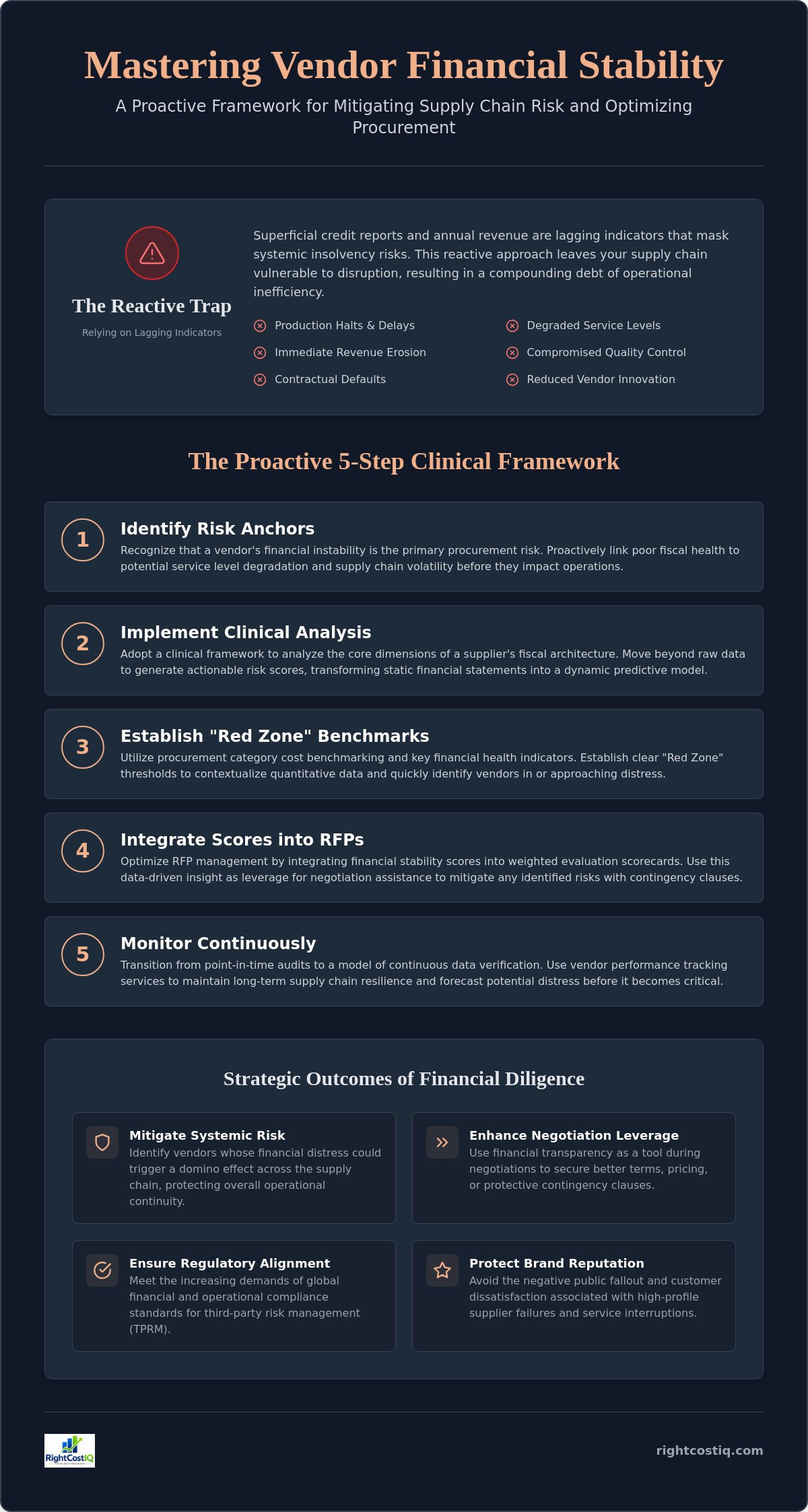
- Identify why financial instability serves as a primary procurement risk anchor, linking poor fiscal health to service level degradation and supply chain volatility.
- Master how to evaluate vendor financial stability through a clinical framework that analyzes five core dimensions of a supplier's fiscal architecture.
- Utilize procurement category cost benchmarking to establish "Red Zone" thresholds and contextualize quantitative financial health indicators.
- Optimize RFP management by integrating financial stability scores into weighted scorecards and leveraging negotiation assistance to mitigate identified risks.
- Transition to continuous monitoring using vendor performance tracking services to maintain long-term supply chain resilience and forecast potential distress.
The Strategic Imperative: Why Vendor Financial Stability is a Procurement Risk Anchor
Vendor financial stability isn't a static check-box item; it's a dynamic variable that dictates the structural integrity of your entire supply chain. When a critical supplier faces insolvency, the result is rarely a clean exit. It's a catastrophic failure that triggers production halts, contractual defaults, and immediate revenue erosion. However, the most insidious risks occur long before a bankruptcy filing. Poor financial health manifests as degraded service levels, compromised quality control, and a systematic reduction in innovation investment. Mastering how to evaluate vendor financial stability is a prerequisite for enterprise resilience in 2026. Procurement teams must shift from reactive auditing to proactive financial risk management to protect the bottom line and ensure long-term operational continuity.
Quantifying the Cost of Financial Oversight
The direct costs associated with switching vendors are often dwarfed by the indirect costs of production delays and market share loss. Financial distress within a vendor's organization leads to rapid staff turnover, which results in the immediate loss of tribal knowledge and operational expertise. When a supplier lacks the capital to maintain equipment or retain top-tier talent, your organization pays the price through increased defect rates and missed delivery windows. A financial risk anchor is the primary barrier to procurement optimization. Failure to identify these fiscal red flags early creates a compounding debt of operational inefficiency. Organizations that prioritize clinical financial assessments reduce their exposure to these hidden costs while maintaining a competitive edge in volatile markets.
The Role of Financial Health in Supply Chain Compliance
Regulatory frameworks for third-party risk management (TPRM) now demand rigorous oversight of supplier fiscal health. A vendor's instability doesn't just affect their performance; it impacts your own organization's credit rating and overall risk profile. In 2026, compliance isn't just about legal adherence; it's about the verifiable stability of the entities within your ecosystem. Strategic alignment between procurement strategy and corporate financial goals ensures that every sourcing decision strengthens the enterprise architecture. Understanding how to evaluate vendor financial stability allows procurement leaders to:
- Mitigate systemic risk: Identify vendors whose financial distress could trigger a domino effect across the supply chain.
- Enhance negotiation leverage: Use financial transparency to secure better terms or contingency clauses.
- Ensure regulatory alignment: Meet the increasing demands of global financial and operational compliance standards.
- Protect brand reputation: Avoid the fallout associated with high-profile supplier failures and service interruptions.
By treating financial health as a core pillar of the RFP process, procurement departments transform from cost centers into strategic architects of enterprise stability. This proactive approach eliminates the guesswork and replaces it with a data-driven protocol for selecting and managing high-value partnerships.
The Clinical Framework: 5 Core Dimensions of Supplier Financial Analysis
A standardized protocol for financial data collection is the only way to eliminate subjectivity in supplier selection. To master how to evaluate vendor financial stability, procurement teams must move beyond raw data and generate actionable risk scores. This clinical framework transforms static financial statements into a dynamic predictive model. Integrating this financial due diligence into your RFP management cycle ensures that only fiscally sound partners reach the final negotiation stage. It's a strategic filter that protects your enterprise from the hidden costs of supplier insolvency.
Data Acquisition for Public and Private Entities
Publicly traded suppliers offer high transparency through mandatory 10-K and 10-Q filings. These documents provide a clear view of debt structures and liquidity. However, private companies require a more assertive approach. You must demand audited financials or tax returns as a mandatory requirement for RFP participation. Use ironclad Non-Disclosure Agreements (NDAs) to secure this sensitive data. This transparency is non-negotiable. If a vendor refuses to provide financial visibility, they're likely hiding a risk anchor that will eventually disrupt your operations. Applying a diagnostic assessment to your current vendor list can quickly identify where these visibility gaps exist.
The 5-Step Evaluation Protocol
Standardizing these metrics allows teams to move beyond surface-level reviews. For instance, Understanding Credit Ratings helps contextualize how leverage and debt-to-equity ratios impact long-term default risk. Follow this methodical 5-step protocol to build a comprehensive risk profile:
- Step 1: Liquidity Assessment. Analyze the current and quick ratios. Can the vendor meet their short-term obligations without external financing? A ratio below 1.0 is an immediate red flag.
- Step 2: Leverage Analysis. Evaluate the debt-to-equity ratio. Is their debt load sustainable? High leverage in a rising interest rate environment often leads to rapid service degradation.
- Step 3: Profitability Trends. Examine gross and net margins over a three-year period. Are they generating consistent profits, or are they buying market share at the expense of their own stability?
- Step 4: Operational Cash Flow. Focus on cash from operations rather than net income. A self-sustaining business must generate enough cash to fund its own growth and maintenance.
- Step 5: External Risk Factors. Assess how market price trends impact their margins. A vendor with no price risk management strategy is vulnerable to commodity volatility that can quickly erode their solvency.
By executing this protocol, you transition from reactive auditing to proactive risk mitigation. This data-driven approach provides the objective evidence needed to justify vendor exclusion or to demand specific financial guarantees during contract negotiations. It ensures that your procurement strategy is grounded in the pragmatic realities of business finance.
Quantitative Benchmarking: Key Ratios and Financial Health Indicators
Ratios provide the quantitative backbone for any objective audit. However, a 1.5 current ratio in heavy manufacturing indicates different risk levels than the same figure in a software environment. You must utilize procurement category cost benchmarking to contextualize these figures against industry-specific norms. Static snapshots often hide underlying decay. Year-over-year (YoY) trend analysis is mandatory to distinguish between a temporary cash crunch and systemic insolvency. When determining how to evaluate vendor financial stability, the criticality of the procurement category dictates the weighting of each metric. A tier-1 component supplier requires more stringent 'Red Zone' thresholds than a non-essential service provider.
Liquidity and Solvency Ratios: The Survival Metrics
Liquidity metrics measure a vendor's immediate safety net. The Current Ratio and Quick Ratio indicate whether a supplier can meet short-term obligations without selling off long-term assets. A Current Ratio falling below 1.0 is an immediate Red Zone indicator. For long-term viability, the Debt-to-Equity (D/E) ratio is the primary predictor of bankruptcy risk. High leverage isn't always fatal, but it makes a vendor vulnerable to interest rate hikes and credit tightening. You must also analyze the Interest Coverage Ratio. If a vendor can't comfortably afford their cost of capital, they'll eventually sacrifice service quality to service their debt.
Profitability and Efficiency Metrics
Profitability ratios reveal a vendor's pricing power and operational efficiency. A shrinking Net Profit Margin suggests the vendor is struggling with rising input costs or intense competitive pressure. Return on Assets (ROA) is equally critical; it shows how effectively the supplier uses their infrastructure to generate value. Don't rely solely on net income. Paper profits can be deceptive if they aren't backed by real liquidity. Operating Cash Flow must be compared directly against net income to identify discrepancies. A Vendor Viability Checklist can supplement this quantitative data by providing qualitative signals like employee growth and funding history.
By standardizing these benchmarks, procurement teams eliminate the ambiguity that leads to inaccurate risk scoring. This clinical approach ensures that financial assessments are rooted in data-driven reality rather than vendor-provided narratives. It's the only way to ensure your supply chain remains resilient against unforeseen economic shifts. Accurate benchmarking allows you to set clear expectations during the RFP process and provides the objective evidence needed to demand financial transparency from every critical partner in your portfolio.
Execution Strategy: Integrating Financial Risk into RFP Management and Negotiations
Treating financial stability as a mere compliance check is a strategic error that ignores its potential as a powerful negotiation lever. In a clinical procurement environment, understanding how to evaluate vendor financial stability allows you to transform risk data into contractual advantages. This execution phase requires the seamless integration of financial risk scores into your RFP weighted scorecards and the tactical application of negotiation assistance to address identified red flags. By moving beyond a binary pass-fail mindset, procurement leaders can architect agreements that protect operational continuity while optimizing category costs.
Financial Stability as a Weighted RFP Metric
Appropriate weighting for financial health varies by sourcing event. For non-critical commodities, a 5-10% weight may suffice. However, for Tier-1 partners, this should increase to 20-30% to ensure fiscal resilience. Setting objective 'knock-out' criteria, such as a minimum interest coverage ratio, prevents high-risk entities from advancing. RightCostIQ's RFP management service automates this weighting for precision, ensuring that technical capabilities are never evaluated in isolation from fiscal reality. This data-driven approach eliminates subjectivity and provides a clear, mathematical justification for supplier selection or exclusion.
Negotiating with At-Risk vs. High-Stability Vendors
When how to evaluate vendor financial stability reveals a financially fragile partner with a unique capability, focus on securing supply continuity through structural safeguards. Performance bonds or escrow accounts provide a financial buffer against sudden insolvency. Conversely, a vendor's superior financial health is a justification for demanding long-term, fixed-price contracts that provide budget certainty. Integrating market price trending allows you to determine whether a cost-plus or fixed-fee structure is most advantageous. Stable vendors can absorb commodity volatility, making them ideal candidates for fixed-fee arrangements that lock in savings. High-stability vendors should be pushed for deeper volume discounts in exchange for the security of a long-term partnership, while at-risk vendors should be subject to more frequent performance audits.
Effective execution turns financial due diligence into a tool for value creation. Use these insights to drive harder bargains with stable suppliers and build protective barriers around vulnerable ones. Schedule a diagnostic assessment to identify which vendors in your current portfolio present the highest risk to your operations and where you have untapped negotiation leverage.
Optimizing Vendor Performance and Long-Term Supply Chain Resilience
Post-contract execution marks the beginning of a critical oversight phase where static assessments must evolve into dynamic surveillance. Implementing vendor performance tracking services ensures that the financial health established during the RFP process doesn't deteriorate unnoticed. Understanding how to evaluate vendor financial stability is a continuous requirement, not a one-time event. This ongoing vigilance allows procurement leaders to identify the intersection between internal supplier distress and external market volatility, creating a robust shield against supply chain disruption. By institutionalizing Early Warning Systems (EWS), organizations can detect financial volatility before it triggers a catastrophic service failure.
Continuous Monitoring vs. Annual Reviews
Periodic reviews fail in volatile markets. Relying on annual financial statements is a high-risk strategy that ignores the velocity of modern economic shifts, where a supplier's liquidity can evaporate between reporting cycles. High-level decision-makers must utilize real-time data feeds and market intelligence for ongoing oversight. This level of scrutiny is essential for maintaining margin expansion through clinical category management. Integrating financial tracking into a broader category management procurement strategy allows organizations to proactively adjust sourcing volumes or initiate contingency plans before a vendor reaches a point of no return. Continuous monitoring transforms vendor management from a clerical function into a strategic defensive asset.
Leveraging RightCostIQ for Financial Optimization
RightCostIQ provides the technical infrastructure to bridge the gap between market intelligence and internal vendor risk. Our analytics identify hidden savings by correlating market price forecasting with vendor financial stability. This synergy allows decision-makers to exploit pricing opportunities while simultaneously mitigating insolvency risks. When price risk management is integrated with performance tracking, procurement teams gain the foresight needed to predict vendor distress long before it impacts the balance sheet. This data-driven approach ensures that every sourcing decision is optimized for both cost efficiency and enterprise resilience. To secure your supply chain and drive financial growth, request a consultation for procurement optimization today. This action ensures your procurement strategy remains resilient, authoritative, and strictly focused on the bottom line.
Transforming Financial Risk into Strategic Advantage
Procurement excellence requires the transition from superficial checks to a clinical audit of supplier fiscal health. This framework provides the protocol for identifying insolvency risks before they disrupt your operations. You've learned the importance of the five core dimensions of analysis and the necessity of year-over-year trend benchmarking. Mastering how to evaluate vendor financial stability ensures that every contract is anchored by a partner capable of sustaining performance through market volatility. This same level of fiscal scrutiny is vital when pursuing external growth; for example, PP-X helps firms apply these due diligence principles to strategic acquisitions. By integrating these risk scores into your negotiation strategy, you turn vulnerability into leverage.
RightCostIQ provides the technical infrastructure to automate these assessments and drive margin expansion. Our data-driven procurement analytics and advanced price risk management tools predict future distress while identifying hidden savings. You can leverage our professional negotiation assistance for complex contracts to secure favorable terms and ensure long-term resilience. Optimize your sourcing outcomes with RightCostIQ’s expert RFP management and negotiation assistance. Take the first step toward a more resilient and efficient procurement architecture today.
Frequently Asked Questions
What are the most critical financial ratios for evaluating a vendor?
The most critical ratios include the Current Ratio for short term liquidity, the Debt-to-Equity ratio for long term solvency, and the Interest Coverage Ratio to determine if a supplier can service their debt. These metrics provide a clinical view of a vendor's ability to maintain operations during credit tightening. You must contextualize these figures against industry benchmarks to ensure accurate risk scoring and operational continuity.
How do I evaluate the financial stability of a private company that won't share data?
You must establish financial transparency as a non-negotiable requirement for RFP participation, protected by an ironclad Non-Disclosure Agreement. If a private entity refuses to share audited financials, look for secondary indicators like employee turnover rates and funding history. Understanding how to evaluate vendor financial stability in these scenarios requires a multi-dimensional approach that combines direct data requests with external market intelligence and reputation audits.
What should I do if a key supplier shows signs of financial distress?
Initiate an immediate financial audit and implement structural safeguards like performance bonds or escrow accounts to protect your organization's capital. You should also begin identifying alternative suppliers to establish a dual-sourcing strategy that mitigates the risk of a sudden bankruptcy. Use negotiation assistance to restructure the contract with protective clauses that ensure supply continuity while the vendor stabilizes their fiscal position through restructuring.
How often should vendor financial assessments be conducted?
Continuous monitoring is the standard for high-risk procurement categories in 2026. Periodic annual reviews are insufficient because they fail to capture rapid shifts in liquidity that occur between reporting cycles. High-stakes partnerships require real-time data feeds and quarterly deep dives to ensure that any financial volatility is identified before it manifests as a service disruption, a quality failure, or a complete supply chain collapse.
Can a vendor's credit score replace a full financial statement analysis?
A credit score cannot replace a full analysis because it serves as a lagging indicator of past performance rather than a predictor of future stability. Clinical financial assessments require a granular review of cash flow statements and debt structures to identify hidden risks. Relying solely on a third-party score leaves your supply chain vulnerable to the systemic insolvency issues that traditional credit models often overlook during rapid market shifts.
How does market price volatility affect a vendor's financial stability?
Rapid market price volatility erodes a vendor's margins if they lack a robust price risk management strategy. When input costs spike, financially fragile vendors often sacrifice quality or service levels to protect their dwindling cash reserves. You must evaluate whether a supplier utilizes market price trending to forecast these shifts, as this technical competence is a primary indicator of long-term operational resilience and fiscal health.
What is the difference between liquidity and solvency in vendor risk?
Liquidity refers to a vendor's immediate ability to meet short-term obligations using cash or liquid assets. Solvency measures their capacity to sustain operations over the long term by maintaining a healthy capital structure. A vendor can be solvent but face a temporary liquidity crisis, which still presents an immediate risk to your supply chain continuity if they can't pay their own subcontractors or maintain critical equipment.
How can RFP management software help in evaluating vendor financial health?
RFP management software automates the weighting and scoring of financial metrics to ensure objective supplier selection. This technology streamlines how to evaluate vendor financial stability by centralizing data collection and applying standardized risk thresholds across all sourcing events. It eliminates the subjectivity of manual reviews and provides procurement leaders with a data-driven justification for selecting the most fiscally resilient partners in their portfolio.


