
The global procurement software market is projected to reach 28 billion dollars by 2034, yet 86% of organizations scaling AI by 2026 still struggle with inefficient RFP cycles and price volatility. High-level decision-makers often discover that technical infrastructure lacks the clinical precision required for complex market intelligence. The strategic selection between procurement software vs managed services determines whether your department functions as a passive cost center or a primary driver of financial growth.
You recognize that under-resourced teams cannot effectively execute category cost benchmarking or navigate the 2026 FAR overhaul without specialized expertise. This article provides an analytical comparison to help you choose between internal technology investments and external expert execution. We examine a framework for achieving reduced category spend, higher contract compliance, and superior negotiation leverage. You will gain a methodical understanding of how to align your procurement architecture with the pragmatic realities of modern market dynamics.
Key Takeaways
- Distinguish between internal tool ownership and external outcome accountability to align procurement strategy with 2026 market dynamics.
- Analyze the critical differences between procurement software vs managed services to identify whether your organization requires data transparency or strategic execution.
- Leverage market price trending and expert negotiation assistance to convert raw spend analytics into measurable bottom-line results.
- Utilize a resource maturity framework to evaluate internal team bandwidth against the complexity of high-stakes category negotiations.
- Optimize financial outcomes by integrating proprietary benchmarking with professional RFP management to mitigate volatility and ensure total contract compliance.
The Sourcing Dilemma: Evaluating Procurement Software vs. Managed Services
High-stakes procurement in 2026 demands more than digital filing cabinets. The debate over procurement software vs managed services isn't a choice between tools; it's a choice between internal tool ownership and external outcome accountability. Procurement leaders often find themselves trapped in a "data-rich, insight-poor" cycle where expensive platforms provide visibility but fail to deliver actual savings. Strategic urgency dictates that procurement must move beyond administrative support to become a primary driver of financial growth. Data without execution remains a sunk cost. To protect the bottom line, you must determine if your team needs the infrastructure of a system or the expertise of a strategic architect.
Generic platforms are currently failing specialized categories. While 86% of organizations plan to scale AI by 2026, many discover that automation cannot replace the clinical precision required for complex negotiations. The 2026 regulatory environment, including the significant overhaul of the Federal Acquisition Regulation (FAR), increases the complexity of contract compliance. Software might flag a non-compliant vendor, but it won't navigate the legal nuances of a new executive order. Managed services provide the human intelligence needed to interpret these shifts. This ensures that your sourcing strategy remains resilient against external shocks. When you prioritize execution over mere visibility, you secure a competitive advantage that software alone cannot replicate.
What is Procurement Software Used For?
Modern e-procurement systems function as the digital backbone of the organization. These tools centralize spend data and automate the procure-to-pay lifecycle to reduce administrative friction. Software is essential for standardizing workflows and ensuring internal compliance across decentralized departments. It provides the necessary digital paper trail for vendor performance tracking. However, the software itself doesn't negotiate the contract. It merely records the result of the human effort behind the screen. It is a system of record that requires internal bandwidth to maintain and operate effectively.
The Core Function of Managed Procurement Services
Managed services operate as a system of action. Rather than providing a platform for your team to manage, these services deploy expert negotiators to execute complex RFP management cycles. This model leverages external benchmarking data to identify hidden category savings that internal teams often overlook. By utilizing specialized market forecasting models, managed services mitigate price risk and financial volatility. This approach transforms procurement from a reactive function into a sophisticated strategic operation. It focuses on tangible business outcomes, moving from seeing data to executing savings with professional precision.
Procurement Software: Building the Infrastructure of Data Transparency
Implementing procurement software establishes a centralized system of record. This digital foundation is essential for high-level decision-makers who require a single source of truth for spend analytics. Without this infrastructure, data remains fragmented across disparate ERP systems and manual spreadsheets. When evaluating procurement software vs managed services, it's critical to recognize that technology provides the visibility while services provide the execution. Software acts as a passive repository of information, capturing every transaction to create a comprehensive audit trail for C-suite review.
Spend Analytics and Visibility
Sophisticated platforms aggregate fragmented data from across the enterprise to generate real-time reporting. These systems utilize automated categorization engines to identify tail spend, which often accounts for a significant portion of unmanaged costs. By bringing this dark spend into the light, organizations can begin to apply strategic controls to previously ignored categories. Spend under management is the primary metric for software success, representing the percentage of total corporate expenditure processed through the authorized procurement system.
Workflow Automation and Compliance
Automation reduces administrative friction throughout the RFP management lifecycle. Platforms standardize workflows to ensure repeatable efficiency and internal compliance. These systems trigger automated vendor compliance checks and performance tracking alerts, maintaining supply chain integrity without manual intervention. Success requires integrating analytics into procurement infrastructure to ensure that data informs every stage of the requisitioning process. However, a software tool cannot negotiate a 15% margin expansion; it can only document the attempt.
Standalone tools carry significant financial and operational burdens. Monolithic enterprise deployments often require annual investments exceeding 500,000 dollars for large-scale organizations. Beyond license fees, organizations must account for lengthy implementation timelines and extensive internal training requirements. Cloud-based solutions now account for over 65% of digital procurement adoption, yet the risk of data inaccuracy remains high without expert oversight. The decision between procurement software vs managed services often hinges on whether you possess the internal expertise to drive results from the data provided. You can evaluate your current infrastructure's effectiveness through a strategic analytics benchmarking session to determine where technology gaps exist.
Managed Procurement Services: Engineering Strategic Execution and Negotiation
Managed procurement services function as a system of action, moving beyond the static reporting typical of software platforms. While software provides the transparency discussed in the previous section, managed services deliver the architecture for execution. High-level decision-makers utilize these services to bridge the gap between identifying a cost and capturing a saving. The fundamental difference in procurement software vs managed services lies in the accountability for results. A managed service provider uses market price trending as a primary lever to challenge supplier assumptions and secure bottom-line protection. This transition from "seeing" data to "executing" savings is what separates administrative procurement from strategic financial leadership.
Mitigating price volatility requires specialized price risk management services that static tools cannot offer. In an era of shifting global thresholds and trade regulations, software often fails to predict sudden market swings. Managed services integrate sophisticated forecasting models to lock in prices before volatility erodes your margins. This approach provides access to benchmarking data that exists entirely outside your internal software ecosystem. By leveraging market-wide intelligence, you gain the negotiation leverage needed to outperform competitors who rely solely on their own historical data.
Expert RFP Management and Negotiation
Professional negotiation assistance consistently outperforms automated bidding in complex, high-stakes categories. Software platforms often facilitate "race to the bottom" auctions that can damage supplier relationships or ignore critical service quality metrics. Clinical execution of sourcing cycles requires a negotiation coach to interpret vendor responses with expert precision. This human-led approach maximizes supplier competition while ensuring that technical requirements and compliance standards are met. It transforms the RFP from a clerical task into a strategic event designed for margin expansion.
Category Cost Benchmarking and Analytics
Internal software only analyzes your own data, creating a feedback loop that may ignore broader market opportunities. Managed services provide access to market-wide benchmarking to identify exactly where your current contracts deviate from industry standards. By identifying "should-cost" models, experts can pinpoint precisely where a contract renewal is overpriced. This ensures operational efficiency through external category management. You're no longer negotiating against your last price; you're negotiating against the actual market reality. This level of cost optimization provides a degree of financial protection that internal teams simply cannot reach without external support.
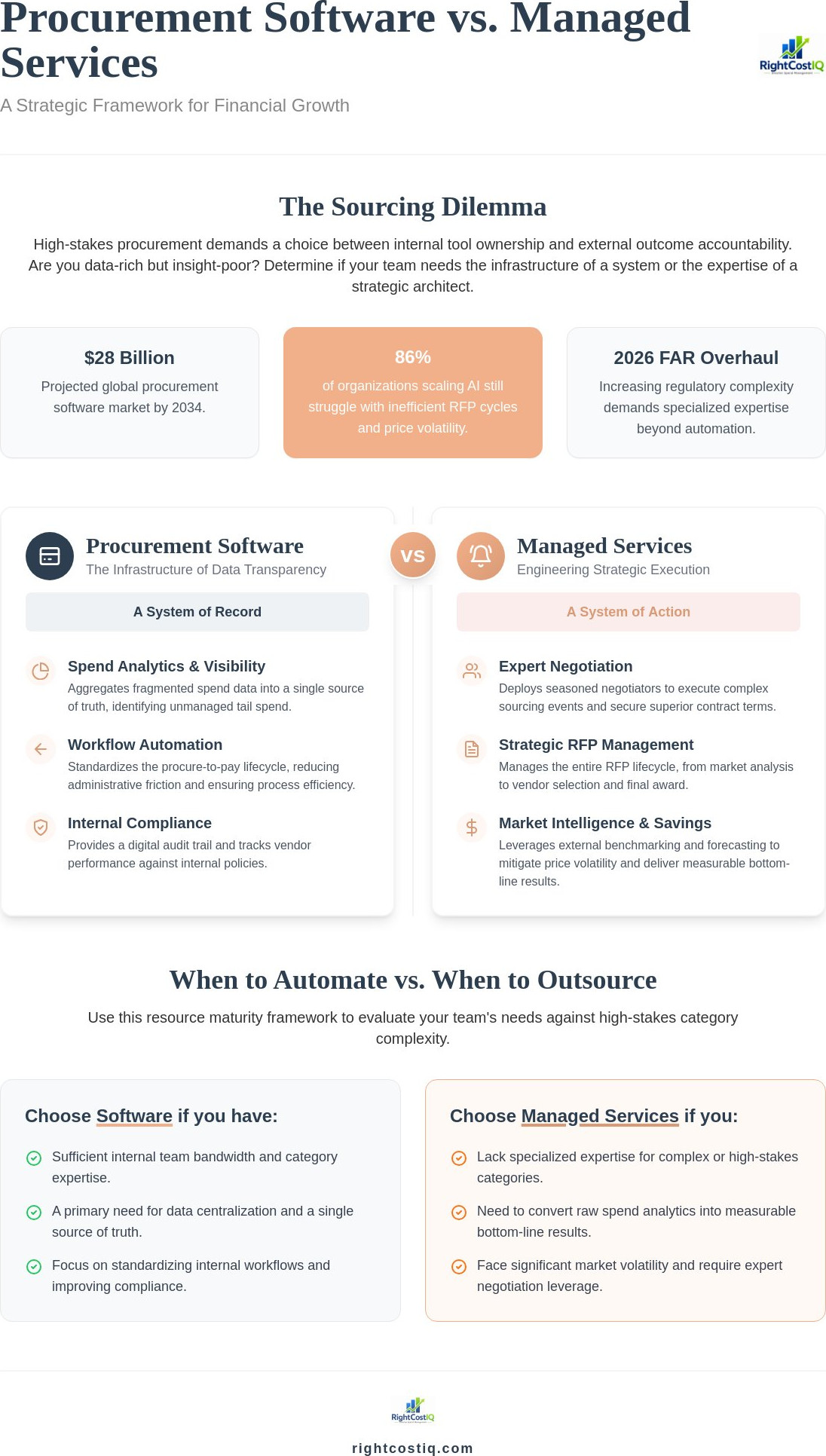
Comparative Analysis: When to Automate vs. When to Outsource
Strategic selection between procurement software vs managed services requires a clinical evaluation of your organizational maturity. Software provides the digital infrastructure for teams that possess high internal bandwidth and specialized category expertise. However, the presence of technology does not guarantee the capture of savings. Managed services offer a system of action for organizations facing under-resourced teams or high-stakes negotiations where margin protection is non-negotiable. Strategic urgency often dictates the choice. While software implementation and training cycles can span several quarters, managed services provide immediate execution capabilities to meet aggressive year-end financial targets.
Risk tolerance serves as a primary differentiator in this framework. In fluctuating market environments characterized by price volatility, relying solely on internal software can leave an organization exposed. Managed services integrate external market intelligence to hedge against these risks. This proactive approach ensures that your sourcing strategy remains resilient even when internal data is insufficient. Evaluating your resource maturity helps determine if your team can effectively manage a complex platform or if they require an external partner to drive the RFP process to completion.
The Decision Matrix for Procurement Leaders
- Procurement Software is ideal for: High-volume, low-complexity transactions and internal process standardization across decentralized departments. It excels at establishing a digital paper trail for transactional tail spend.
- Managed Services are ideal for: High-value, complex category RFPs and situations requiring specialized cost benchmarking. This model is essential for categories where market price trending is the primary negotiation lever.
- Hybrid Models: The emerging 2026 standard for enterprise optimization. This approach utilizes software as the system of record while deploying managed services for strategic execution in critical categories.
Quantifying the Cost-Benefit Ratio
Calculating the true cost of ownership is essential for a data-driven decision. Software expenses include not only SaaS license fees but also significant internal labor costs for implementation, maintenance, and user training. Conversely, managed service fees are typically tied to specific business outcomes and execution milestones. You must also measure value beyond simple savings, including vendor performance tracking and price risk mitigation. The execution gap is the measurable delta between the potential savings identified by spend analytics and the actual realized savings achieved through professional negotiation. Software without expert oversight often results in identified opportunities that never reach the bottom line. You can identify these gaps in your current strategy by requesting a clinical procurement diagnostic to analyze your execution efficiency.
Integrating Technology and Expertise: The RightCostIQ Approach
RightCostIQ functions as a strategic architect for procurement leaders who demand more than administrative visibility. We resolve the tension inherent in the procurement software vs managed services debate by deploying an integrated model that treats technology as the foundation and expert execution as the driver. This clinical approach ensures that high-level financial growth metrics aren't just projected but realized. By utilizing proprietary benchmarking and analytics, we inform every negotiation with market-wide intelligence that internal software cannot access. This methodology transforms procurement from a reactive support function into a sophisticated engine for margin expansion.
Operational efficiency requires a continuous commitment to vendor performance tracking and market price trending. We use these proactive tools to forecast and mitigate price risk before financial volatility impacts the bottom line. This level of foresight is essential in 2026, where global disruptions and regulatory shifts occur with increasing frequency. Our framework ensures that every sourcing decision aligns perfectly with the pragmatic realities of corporate finance and supply chain management. We don't seek to be a casual partner; we act as a powerful tool for high-level consultants and decision-makers.
Clinical Execution of RFP Cycles
Our RFP management service optimizes sourcing outcomes through extreme data precision. We move beyond simple bidding processes by leveraging 'should-cost' analytics to drive transparent and assertive supplier conversations. This clinical execution reduces the time-to-contract while simultaneously increasing the quality of the sourcing outcome. We don't just facilitate a transaction; we engineer a strategic event designed to capture maximum value. By identifying the intersection of technical requirements and market reality, we ensure that your contracts are both compliant and optimized for long-term savings.
Future-Proofing Your Procurement Strategy
Strategic leadership requires moving from reactive purchasing to proactive price risk management. RightCostIQ provides the high-level consulting needed to navigate complex market dynamics with confidence. We focus on tail spend optimization to capture the final 20% of savings that often remain hidden within unmanaged categories. This comprehensive approach ensures that no value is left on the table. As you scale your operations in 2026, the integration of advanced technology and professional expertise remains the only reliable path to sustained competitive advantage. Optimize your procurement outcomes with RightCostIQ.
Architecting a High-Yield Procurement Strategy for 2026
The strategic selection between procurement software vs managed services remains the defining factor in achieving margin expansion in a volatile economy. Technology alone establishes a system of record; however, clinical execution converts that data into tangible financial growth. Leaders must move from passive visibility to assertive action to protect the bottom line from market volatility. Success requires closing the execution gap between identified opportunities and realized savings through professional negotiation assistance.
RightCostIQ bridges this gap by deploying specialized price risk management models and sophisticated category cost benchmarking and analytics. Our framework provides the market intelligence needed to outperform competitors who rely solely on internal software data. Aligning your sourcing architecture with expert execution ensures long-term operational efficiency and unwavering contract compliance. You can secure a significant competitive advantage by transforming your procurement department into a primary driver of financial performance.
Request a Precision Benchmarking Analysis from RightCostIQ and start your transition toward data-driven procurement excellence today.
Frequently Asked Questions
What is the primary difference between procurement software and managed services?
The fundamental distinction in procurement software vs managed services lies in the accountability for results. Software acts as an internal infrastructure for data transparency, serving as a system of record. Managed services operate as a system of action where external experts execute sourcing cycles to deliver specific financial outcomes. While software provides the visibility to see costs, managed services provide the expertise to capture savings.
Can managed procurement services help with tail spend management?
Managed procurement services excel at identifying and capturing savings within unmanaged tail spend categories. While software categorizes fragmented data, experts apply strategic sourcing frameworks to the final 20% of expenditure. This systematic approach eliminates leakage and ensures that low-complexity transactions still contribute to corporate margin expansion through aggregated negotiation. It transforms dark spend into a source of measurable financial growth.
How do managed services improve contract negotiation outcomes?
Managed services improve negotiation outcomes by utilizing external benchmarking data and should-cost models that internal teams often lack. Experts act as a negotiation coach to challenge supplier pricing assumptions with clinical precision. This data-driven approach moves the conversation beyond historical price points toward current market realities. It secures superior contract terms and bottom-line protection that automated bidding platforms cannot replicate.
Is it better to buy a procurement platform or outsource RFP management?
The decision depends on category complexity and internal resource maturity. Standalone platforms are sufficient for high-volume, transactional purchasing and internal process standardization. However, outsourcing RFP management is superior for high-stakes, strategic categories where specialized market intelligence is required. Hybrid models often represent the most efficient 2026 strategy, utilizing software for records and managed services for strategic execution.
What is procurement category cost benchmarking, and why does it matter?
Procurement category cost benchmarking is the clinical analysis of internal contract pricing against external market-wide data. This process identifies exactly where an organization is overpaying relative to industry standards. It matters because it provides the necessary leverage for contract renewals. It ensures that every category is optimized for maximum financial growth and operational efficiency rather than relying on internal historical data.
How does price risk management protect a company's bottom line?
Price risk management protects the bottom line by utilizing forecasting models to mitigate financial volatility in fluctuating markets. Experts identify potential price swings before they erode margins, allowing for proactive contract adjustments or hedging strategies. This proactive stance ensures budget stability and supply chain resilience. It transforms procurement into a defensive shield for corporate finance against external economic shocks.
What are the hidden costs of implementing standalone procurement software?
Standalone procurement software involves significant hidden costs beyond SaaS license fees, including implementation labor, internal user training, and ongoing data maintenance. Organizations often face a high risk of poor data quality if they lack the internal expertise to manage the system. These operational burdens can delay the realization of ROI by several quarters compared to the immediate execution capabilities offered by managed services.
How do managed services track vendor performance and compliance?
Managed services track vendor performance through continuous compliance monitoring and systematic audit cycles. Unlike automated alerts that only flag deviations, experts analyze the root causes of non-performance to drive corrective actions. This rigorous oversight ensures supply chain integrity and total contract compliance. It protects the organization from the operational risks and financial leakage associated with vendor negligence or non-compliance.


