
The era of the "gut-feeling" negotiator is dead; modern margin expansion is a mathematical certainty, not a personality trait. Most procurement leaders struggle with opaque market pricing that leads to sub-optimal contracts and unmanaged financial risk. You've likely seen inefficient RFP cycles drain your internal resources while failing to provide the transparency required for true strategic sourcing. Selecting the right procurement negotiation services is no longer about finding a skilled talker. It's about deploying a clinical execution of market intelligence and benchmarking data to protect your bottom line.
This guide ensures you master the selection of professional services to drive margin expansion and mitigate financial volatility through data-driven precision. You'll learn how to transition from reactive haggling to a strategy that secures predictable cost savings and improves vendor performance compliance. We'll preview the essential frameworks for category cost analytics, market price trending, and price risk management necessary to navigate the complexities of the 2026 supply chain environment. Whether you're evaluating technology-backed firms or internal process overhauls, this analysis provides the technical roadmap for superior financial outcomes.
Key Takeaways
- Transition from reactive haggling to a proactive price risk management strategy that integrates real-time market intelligence for superior margin protection.
- Deploy "should-cost" models through category cost benchmarking to eliminate pricing opacity and establish objective negotiation baselines with vendors.
- Evaluate procurement negotiation services based on their integrated technology stack and ability to deliver granular, data-driven ROI metrics.
- Mitigate financial volatility by leveraging market price forecasting data to secure favorable terms during critical contract renewal cycles.
- Analyze the structural advantages of managed platforms over freelance models to ensure sustainable vendor performance and long-term data continuity.
The Strategic Evolution of Procurement Negotiation Services
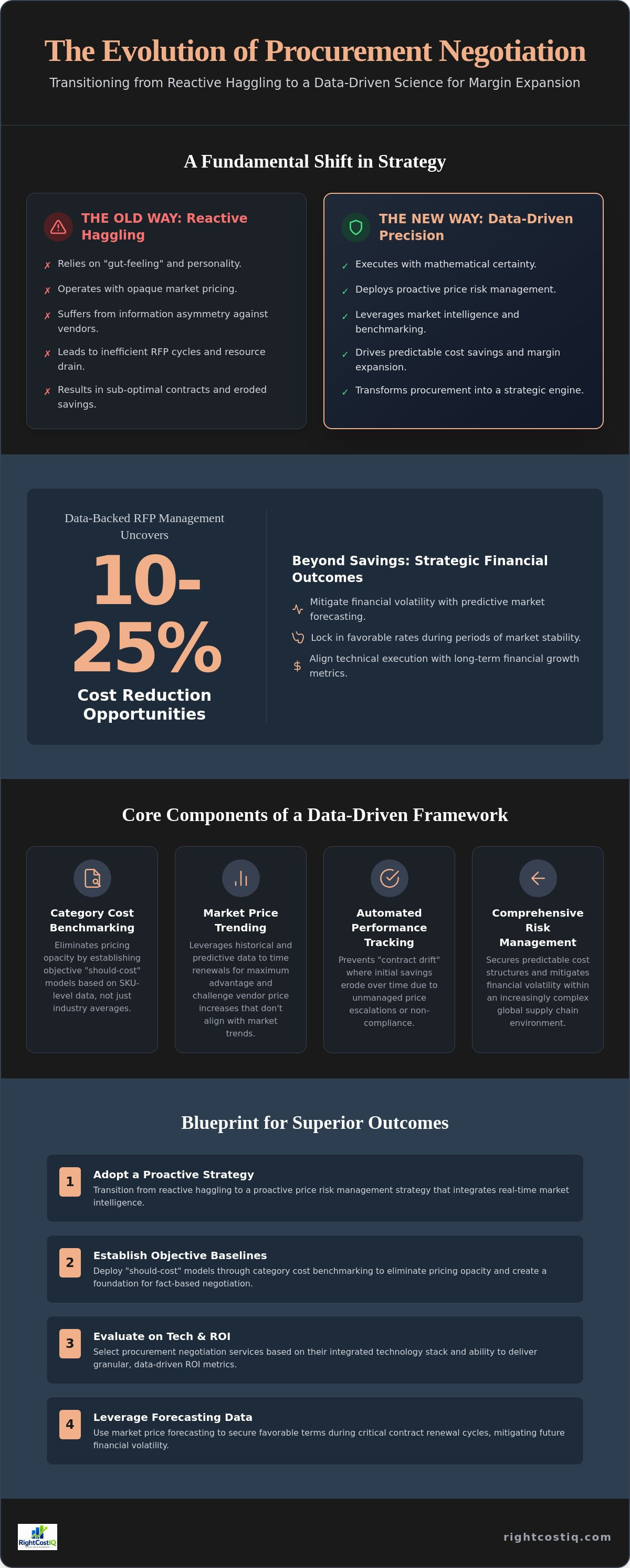
Procurement negotiation services represent the technical integration of market intelligence and contract optimization. In the 2026 economy, the paradigm has shifted from reactive haggling to proactive price risk management. This evolution requires a data-driven approach to high-stakes RFP management where success is measured by financial growth metrics. Professional negotiation is no longer a tactical event; it's a clinical process designed to drive sustainable margin expansion. By leveraging specialized intelligence, organizations can transform procurement from a cost center into a strategic engine for capital efficiency.
Why Internal Teams Struggle with Complex RFPs
Information asymmetry remains the primary obstacle for internal procurement departments. Specialized suppliers possess granular cost-structure data that buyers often lack, creating an imbalanced negotiation environment. Internal teams frequently operate without access to cross-category benchmarking, which limits their ability to identify "should-cost" targets. This gap often leads to agreements that favor the vendor's margin over the buyer's bottom line. Furthermore, without clinical performance tracking, organizations suffer from contract drift. This phenomenon occurs when initial savings erode due to unmanaged price escalations or non-compliance. Applying Strategic Sourcing Principles requires a level of market transparency that internal resources rarely achieve on their own.
The Financial Impact of Professional Negotiation Assistance
The application of professional benchmarking data consistently yields superior financial outcomes. While results vary by industry, some professionals report that data-backed RFP management and negotiation assistance can uncover cost reduction opportunities ranging from 10% to 25% of total category spend. These services mitigate financial volatility by utilizing market price trending and forecasting to predict shifts before they impact the P&L. This foresight allows decision-makers to lock in favorable rates during periods of market stability. Procurement negotiation services function as a primary driver for financial growth metrics by aligning technical execution with long-term corporate strategy. This precision ensures that every contract renewal serves the broader goal of operational efficiency and risk mitigation.
Core Components of a Data-Driven Negotiation Framework
High-performance procurement negotiation services operate on a framework of clinical precision. This architecture replaces intuition with a structured methodology centered on data-driven leverage. It integrates four critical pillars: category benchmarking, price forecasting, automated performance tracking, and comprehensive risk management. This systematic approach ensures that every contract reflects the actual market value rather than a vendor's opening bid. Organizations that fail to adopt this technical framework remain vulnerable to unmanaged price risks and margin erosion. By treating negotiation as a financial discipline rather than a soft skill, procurement leaders can secure predictable cost structures in an increasingly volatile global market.
Utilizing Category Cost Benchmarking and Analytics
Benchmarking is the clinical comparison of internal spend against market-wide pricing standards. It moves beyond high-level industry averages to analyze SKU-level data points. By utilizing should-cost models, negotiators gain an objective baseline for what a product ought to cost based on raw material inputs and overhead. This data eliminates the information asymmetry suppliers often exploit. Granular analytics allow teams to identify outliers, turning vague savings goals into actionable financial targets. It's the difference between asking for a discount and demanding a market-aligned price.
Market Price Trending as a Negotiation Lever
Effective negotiation requires strategic urgency. Market price trending provides this by forecasting future cost shifts, allowing organizations to time renewals for maximum advantage. Historical price trending reveals patterns of vendor overpricing that would otherwise remain hidden. When supplier increases don't align with raw material indices, data becomes a lever to demand adjustments. This intelligence also mitigates supply chain compliance risks by ensuring vendors adhere to agreed-upon pricing formulas. Forecasting tools allow procurement leaders to pivot from defensive cost-cutting to offensive margin expansion.
Integrating RFP cycles with automated vendor performance tracking creates a continuous loop of optimization. This ensures that the savings secured through professional procurement negotiation services actually manifest in the final invoices. Price risk management acts as the final safeguard, building long-term financial resilience against unpredictable economic shifts. This framework doesn't just lower costs; it improves vendor performance compliance and provides access to real-time market price trending data. To evaluate how these clinical components can optimize your current sourcing strategy, you might explore a preliminary cost analysis. This transition to a data-driven model is the primary driver for sustainable financial growth in 2026.
Freelance Procurement Negotiators vs. Strategic Managed Platforms
Decision-makers often weigh the merits of hiring an individual freelance procurement negotiator against partnering with a strategic managed platform. While the former offers a "hired gun" approach for immediate tactical relief, it lacks the technical infrastructure required for long-term financial resilience. Professional procurement negotiation services at the enterprise level require more than just individual expertise; they demand a scalable repository of market intelligence. A solo practitioner provides a temporary fix, but a platform functions as a strategic architect, integrating human intelligence with proprietary data systems to ensure sustainable margin protection. This shift from individual talent to institutionalized data is the primary driver for operational efficiency in 2026.
When to Hire a Freelance Procurement Negotiator
A solo negotiator is often appropriate for isolated, one-off tail spend projects where the complexity of the category doesn't justify a full-scale digital overhaul. These individuals can provide quick wins in specific niche areas where their personal network might offer leverage. However, limitations emerge when managing multi-category RFPs that require cross-functional data sets. Individual freelancers typically lack access to proprietary analytics tools and real-time market trending databases. Without this technological backing, the negotiator relies solely on personal experience, which is inherently limited and non-transferable. This creates a risk of information gaps that suppliers can easily exploit during high-stakes contract cycles. The lack of a long-term data infrastructure means that once the freelancer leaves, the institutional knowledge often leaves with them.
The Managed Platform Advantage: RightCostIQ
Managed platforms like RightCostIQ offer a distinct competitive edge by synthesizing human expertise with automated RFP management software. This synergy ensures that every negotiation is backed by a clinical analysis of "should-cost" models rather than anecdotal evidence. The primary advantage lies in centralized vendor performance tracking across the entire supply chain, preventing the "contract drift" that often erodes initial savings. By utilizing a Negotiation Coach supported by real-time benchmarking, organizations gain access to a level of precision that no solo freelancer can replicate. This model provides the scalability needed for enterprise-level sourcing, transforming procurement into a predictable driver of financial growth. It's not just about winning a single negotiation; it's about building a data-driven ecosystem where every contract is optimized for the bottom line.
Evaluating Negotiation Partners: A Clinical Selection Framework
Selecting procurement negotiation services requires an objective matrix that prioritizes technical competence over generic consulting promises. Decision-makers must look beyond surface-level relationships to evaluate a provider's ability to drive margin expansion through clinical execution. The selection framework focuses on three primary dimensions: measurable ROI metrics, the sophistication of the technology stack, and the depth of category-specific market intelligence. A provider's "spend under management" serves as a critical performance KPI, signaling their exposure to diverse market conditions and their capacity for cross-category benchmarking. This volume of data allows the partner to identify pricing outliers that internal teams might miss. Finally, seamless integration with existing procurement infrastructure is essential. A partner must bridge the gap between high-level financial strategy and granular technical analysis without disrupting established workflows.
Key Performance Indicators for Negotiation Services
Professional partners distinguish between "Cost Savings Realized," which are tangible reductions in baseline spend, and "Cost Avoidance," which mitigates projected price escalations. Both metrics are vital for financial growth, but they must be reported with clinical transparency to maintain stakeholder confidence. Measuring the "Velocity of RFP Cycles" provides an efficiency metric that quantifies how quickly a partner can move from market analysis to contract execution. Rapid cycles reduce the drain on internal resources and allow organizations to capitalize on favorable market windows before they close. It's about maximizing the "time-to-value" for every sourcing initiative. Continuous vendor performance tracking ensures the longevity of negotiated savings by identifying non-compliance before it impacts the P&L.
The Technology Stack Requirement
Advanced tail spend management tools are non-negotiable for organizations operating in the 2026 economic landscape. These systems automate the analysis of fragmented, low-value spend categories that often hide significant margin leakage. Automated compliance monitoring is equally critical; it acts as a digital safeguard against "contract drift" by cross-referencing invoices with negotiated terms in real time. When evaluating a provider, you must assess their forecasting accuracy for market price trending. A partner's ability to predict raw material fluctuations with precision is the primary driver for long-term financial resilience. This technology ensures that high-level strategy and technical execution are perfectly aligned.
To determine if your current vendor agreements align with market-wide pricing standards, you should access a clinical spend diagnostic. This tool provides the baseline data necessary to evaluate your current negotiation efficiency and identify immediate opportunities for margin expansion.
RightCostIQ: Precision Negotiation Assistance and Cost Optimization
RightCostIQ operates as the strategic architect for organizations demanding clinical precision in their supply chain operations. We provide procurement negotiation services that bridge the gap between traditional business functions and cutting-edge digital innovation. This approach prioritizes financial growth metrics and operational efficiency, positioning our firm as a sophisticated partner for high-level decision-makers. By integrating technical cost analysis with expert-led RFP management, we ensure every sourcing initiative delivers maximum margin expansion. Our firm doesn't just offer support; we provide a high-level tool for executives who require reliable, data-driven outcomes and a relentless focus on the bottom line.
The RightCostIQ Negotiation Ecosystem
The RightCostIQ ecosystem thrives on the synergy between institutional intelligence and technical execution. Combining Negotiation Coaching with deep analytics creates a rhythmic cadence of continuous optimization. We mitigate price volatility through proprietary forecasting models that identify market price trending with mathematical certainty. Our price risk management and tracking services allow the C-suite to secure predictable cost structures, directly impacting corporate financial health. This technical upskilling transforms your procurement department into a powerful engine for competitive advantage, ensuring that high-level strategy and technical analysis remain perfectly aligned.
Getting Started: From RFP to Result
The RightCostIQ framework is characterized by a fast-paced, methodical engagement process designed for maximum efficiency. It moves quickly from initial procurement category cost benchmarking to final contract execution. This process eliminates the inefficiencies typical of traditional RFP cycles, replacing them with a clinical execution of market intelligence. Our approach follows a logical progression:
- Phase 1: Technical Benchmarking. We utilize granular analytics to establish "should-cost" models based on real-time market data.
- Phase 2: Strategic RFP Management. Our team deploys automated vendor performance tracking to identify the most reliable and cost-effective partners.
- Phase 3: Precision Negotiation. We apply data-driven leverage to secure contracts that favor your long-term margin goals.
- Phase 4: Compliance Monitoring. Continuous tracking ensures that negotiated savings aren't lost to contract drift or vendor non-compliance.
This structured methodology ensures that every dollar of spend is optimized for financial growth. The speed and efficiency of our framework allow your organization to pivot quickly in response to market shifts. It's time to move beyond tactical haggling and embrace a data-driven sourcing strategy. Optimize your procurement outcomes with RightCostIQ.
Securing Long-Term Margin Resilience Through Clinical Execution
The transition from tactical procurement to strategic financial optimization is a mandate for the 2026 fiscal landscape. Organizations must move beyond the limitations of information asymmetry by deploying clinical RFP management frameworks and proprietary category cost benchmarking analytics. Successfully navigating these complexities requires a shift from individual intuition to institutionalized data precision. Professional procurement negotiation services act as the primary driver for this evolution; they ensure every vendor agreement is a calculated step toward sustainable margin expansion. It's no longer enough to rely on legacy processes when market volatility demands a technical response.
Founded in 2023 with a rigorous focus on high-stakes healthcare financial analytics, RightCostIQ provides the technical infrastructure necessary to mitigate price risk. Our methodology replaces reactive decision-making with proactive market intelligence, protecting your bottom line through data-driven leverage. By aligning high-level strategy with granular technical execution, we empower decision-makers to transform their supply chain into a predictable engine for financial growth. You've now established the roadmap for superior sourcing outcomes. Take the final step toward institutionalizing these efficiencies within your organization.
Master your next negotiation with RightCostIQs professional assistance.
Frequently Asked Questions
What is the difference between procurement negotiation services and standard sourcing?
Standard sourcing is a tactical function focused on vendor identification and selection; procurement negotiation services are clinical integrations of market intelligence and contract optimization. While sourcing manages the "who," negotiation services utilize technical "should-cost" modeling to dictate the "how much." This approach ensures that every contract renewal is a data-driven event rather than a traditional bid-and-select process focused on surface-level pricing.
How much can a freelance procurement negotiator save my company?
A freelance procurement negotiator typically provides immediate tactical relief for isolated tail spend projects. While they can deliver quick wins, they lack the proprietary analytics infrastructure required for sustainable margin expansion across complex categories. For multi-category RFPs, individual expertise is often limited by a lack of cross-category benchmarking data; this makes institutional platforms a more reliable driver for long-term financial resilience.
Is professional negotiation assistance worth it for small to mid-sized enterprises?
Professional negotiation assistance is essential for SMEs to bridge the information asymmetry gap between smaller buyers and large, specialized suppliers. Without clinical benchmarking, smaller organizations often pay a "transparency tax" due to unmanaged price risks. Implementing data-driven procurement negotiation services allows these firms to leverage enterprise-level intelligence, protecting their bottom line from inflation-driven margin erosion and vendor overpricing.
How do negotiation services use market price trending to lower costs?
Negotiation services use historical and predictive price trending as a strategic lever during contract renewals. By identifying when vendor price increases diverge from raw material indices, negotiators can demand market-aligned adjustments. This forecasting allows procurement leaders to time their RFP cycles with strategic urgency; it ensures they lock in favorable rates before projected market volatility impacts the corporate P&L.
What should be included in a procurement negotiation services contract?
A robust service contract must define specific ROI metrics, technology stack access, and category-specific market intelligence requirements. It should include clear protocols for vendor performance tracking and price risk management. Critical clauses must also outline the methodology for "should-cost" modeling and compliance monitoring to ensure that negotiated savings are realized throughout the entire contract lifecycle without leakage.
Can negotiation services help with existing vendor relationship management?
These services optimize existing relationships by applying clinical performance tracking to prevent "contract drift." By cross-referencing real-time invoices against negotiated terms, professional partners identify non-compliance and hidden fees. This objective data provides the leverage needed to renegotiate terms mid-cycle if vendor performance or market conditions shift significantly; it ensures the relationship remains financially viable for the buyer.
What is the ROI of outsourcing RFP management to a professional firm?
Outsourcing RFP management delivers ROI through increased cycle velocity and the reduction of internal resource drain. Professional firms utilize automated compliance monitoring and benchmarking tools that typically uncover cost-reduction opportunities internal teams miss. The primary financial growth driver is the transition from reactive bidding to a clinical selection framework that prioritizes long-term vendor performance and price stability.
How do benchmarking tools influence the outcome of a negotiation?
Benchmarking tools provide the "should-cost" data necessary to eliminate a supplier's informational advantage. They transform the negotiation from a personality-based event into a technical analysis of SKU-level market standards. This objective data allows procurement teams to set non-negotiable pricing baselines; it ensures that final agreements reflect actual market value rather than a vendor's inflated opening proposal.


