
Software optimizes the RFP workflow, yet only specialized expertise optimizes the final financial outcome. While 65% of procurement teams now utilize dedicated automation tools, many organizations find themselves burdened with expensive shelfware that fails to provide granular market price transparency. Deciding between an RFP consultant vs RFP software isn't a simple tactical preference; it's a strategic pivot that dictates your long-term negotiation leverage and operational efficiency.
You understand that inefficient RFP cycles drain internal resources and leave significant capital on the table during high-stakes vendor negotiations. This analysis provides the framework to determine which investment model maximizes your procurement ROI and cost-reduction metrics. We'll examine the specific trade-offs between automated workflow execution and the data-driven benchmarking required to secure superior contract terms. By the end of this guide, you'll possess the roadmap to eliminate procurement bottlenecks and achieve definitive cost-savings through strategic resource allocation.
Key Takeaways
- Distinguish between RFP workflow acceleration and strategic outcome optimization to avoid the trap of efficient but low-value contracts.
- Determine the optimal investment path by comparing an RFP consultant vs RFP software through a matrix of stakeholder count and total spend volume.
- Utilize centralized content libraries to reduce procurement cycle times while maintaining organizational response consistency across all departments.
- Execute category-specific cost benchmarking to gain the market price transparency required for superior negotiation leverage and contract terms.
- Integrate data-driven analytics into your procurement framework to transform traditional sourcing functions into a primary driver of financial growth.
The RFP Paradox: Why Automation Alone Fails Strategic Sourcing
Procurement leaders often conflate process velocity with strategic success. This core misconception fuels the ongoing debate regarding the investment in an RFP consultant vs RFP software. Software targets the administrative burden; it streamlines the document lifecycle and ensures basic compliance. However, automation alone cannot manufacture negotiation leverage. Strategic procurement management requires a clinical analysis of market dynamics that software-only solutions frequently ignore. Relying solely on a platform creates a false sense of security while leaving significant capital on the table through unoptimized vendor terms.
The "Efficiency Trap" represents a dangerous trade-off for modern sourcing teams. Organizations celebrate a reduction in procurement cycle times while ignoring the inflation in vendor pricing that occurs when market benchmarking is absent. A standard Request for Proposal (RFP) serves as the formal mechanism for vendor selection, but its effectiveness depends entirely on the underlying intelligence used to construct it. Faster cycles that lack strategic depth simply accelerate the path to a suboptimal contract. True optimization demands both the digital infrastructure to manage data and the specialized expertise to interpret it.
The Intelligence Gap in RFP Software
RFP software operates within the vacuum of your internal data. It lacks the external "should-cost" intelligence necessary for aggressive negotiation. Most platforms rely on historical data, which fails to account for shifting market price trends or emerging regulatory changes like the 2026 FAR overhaul. Automated scoring systems prioritize quantitative metrics, often overlooking critical qualitative vendor risk factors. Without a strategic architect to interpret these nuances, the software remains a passive tool rather than a driver of financial growth. It cannot tell you if a vendor's quote is 15% above the current market median; it only tells you if the quote was submitted on time.
Operational Efficiency vs. Strategic ROI
Total ROI in procurement is a bifurcated metric. Process savings focus on reducing the hours spent on administrative tasks. Category savings focus on the bottom-line cost of the vendor contract. High-value sourcing demands clinical precision in drafting capability questionnaires that force vendors to reveal their true cost structures. While 65% of teams now use dedicated software to manage the workflow, the most successful organizations integrate this with RFP management and negotiation assistance to capture actual category savings. The RFP Paradox is the tension between speed and strategic depth.
- Software ROI: Measured by decreased man-hours and improved document version control.
- Consultant ROI: Measured by definitive cost benchmarking and superior contract terms.
- The Hybrid Requirement: Clinical data-driven infrastructure paired with expert human oversight.
RFP Software Capabilities: Efficiency and Data Centralization
Modern RFP platforms function as centralized repositories for procurement data. They eliminate the administrative fragmentation inherent in manual spreadsheet management. By utilizing a structured architecture, these tools allow teams to scale high-volume, low-complexity sourcing events with clinical precision. This is a primary factor when evaluating an RFP consultant vs RFP software for routine operational needs. These platforms prioritize process velocity, ensuring that the logistical burden of vendor outreach does not stall departmental timelines.
Centralized content libraries provide the foundational consistency required for enterprise-grade sourcing. These repositories ensure that every questionnaire adheres to internal legal standards and federal acquisition regulations for RFPs when applicable. Automated vendor communication protocols further reduce administrative friction. This allows procurement managers to focus on stakeholder alignment rather than manual email tracking and document version control.
Workflow Automation and Collaboration
Enterprise sourcing demands rigorous audit trails and role-based access to ensure total compliance. Modern software protocols integrate directly with existing ERP systems, creating a seamless data flow between procurement and finance departments. Automated reminders and progress tracking keep internal stakeholders accountable, significantly reducing the standard 25-hour response time average. This level of technical integration is essential for maintaining momentum in multi-departmental sourcing projects.
The Limits of Algorithmic Selection
Automated weighting systems often provide a false sense of objectivity. Sophisticated vendors frequently game these algorithms by tailoring their responses to specific keywords rather than delivering actual value. Software-managed cycles also risk encouraging boilerplate responses, which can mask significant vendor risk factors. The "ceiling" of software-driven negotiation assistance is reached when the process requires external market intelligence that the platform's internal database simply does not possess.
While software excels at process management, it cannot replace the strategic benchmarking required for high-stakes contracts. Relying solely on automation can lead to shelfware that fails to deliver the promised negotiation leverage. To identify if your current infrastructure is meeting these strategic goals, consider a procurement health diagnostic to assess your current ROI. Choosing between an RFP consultant vs RFP software requires a clear understanding of where your process efficiency ends and your strategic need for market transparency begins.
RFP Consultants: The Strategic Architect of High-Value Sourcing
While software manages the mechanics of a bid, a consultant engineers the financial outcome. High-value sourcing events require a level of clinical analysis that standard automation cannot achieve. The choice between an RFP consultant vs RFP software often depends on the complexity of the category and the total contract value at risk. Consultants function as strategic architects, utilizing deep market intelligence to transform a simple vendor selection process into a high-leverage negotiation event.
Managing multi-million dollar sourcing projects involves navigating intricate stakeholder requirements and mitigating extreme financial volatility. Unlike software, which treats every data point with equal weight, a specialized consultant applies professional judgment to vendor performance tracking and identifies critical performance gaps. This expert oversight ensures that the final contract isn't just compliant, but aggressively optimized for long-term value. Strategic consultants utilize procurement analytics to identify pricing anomalies and drive significant margin expansion.
Market Intelligence and Benchmarking
The primary advantage of a consultancy model is access to cross-industry pricing data. Software-only solutions are limited to your organization's internal historical records. When comparing an RFP consultant vs RFP software for high-stakes categories, the consultant's ability to execute procurement category cost benchmarking becomes the decisive factor in contract ROI. They perform rigorous "should-cost" analyses that challenge vendor pricing models by breaking down cost drivers, from labor to raw materials. By leveraging market price trending and forecasting services, consultants time the RFP launch to align with optimal market conditions, avoiding peak pricing cycles that software would simply accept as a baseline.
Advanced Negotiation and Risk Mitigation
Professional negotiation assistance bridges the gap between a vendor's initial quote and their final, best offer. Consultants design custom RFP frameworks that force vendor transparency, making it impossible for suppliers to hide margin in vague service descriptions. This approach identifies hidden risks in vendor performance that automated scoring systems frequently miss. By integrating price risk management protocols, consultants protect the organization from future market fluctuations, securing contract terms that remain advantageous even as economic conditions shift. This level of strategic foresight defines the boundary where standard automation ends and expert consultancy begins.
Evaluation Framework: When to Automate and When to Outsource
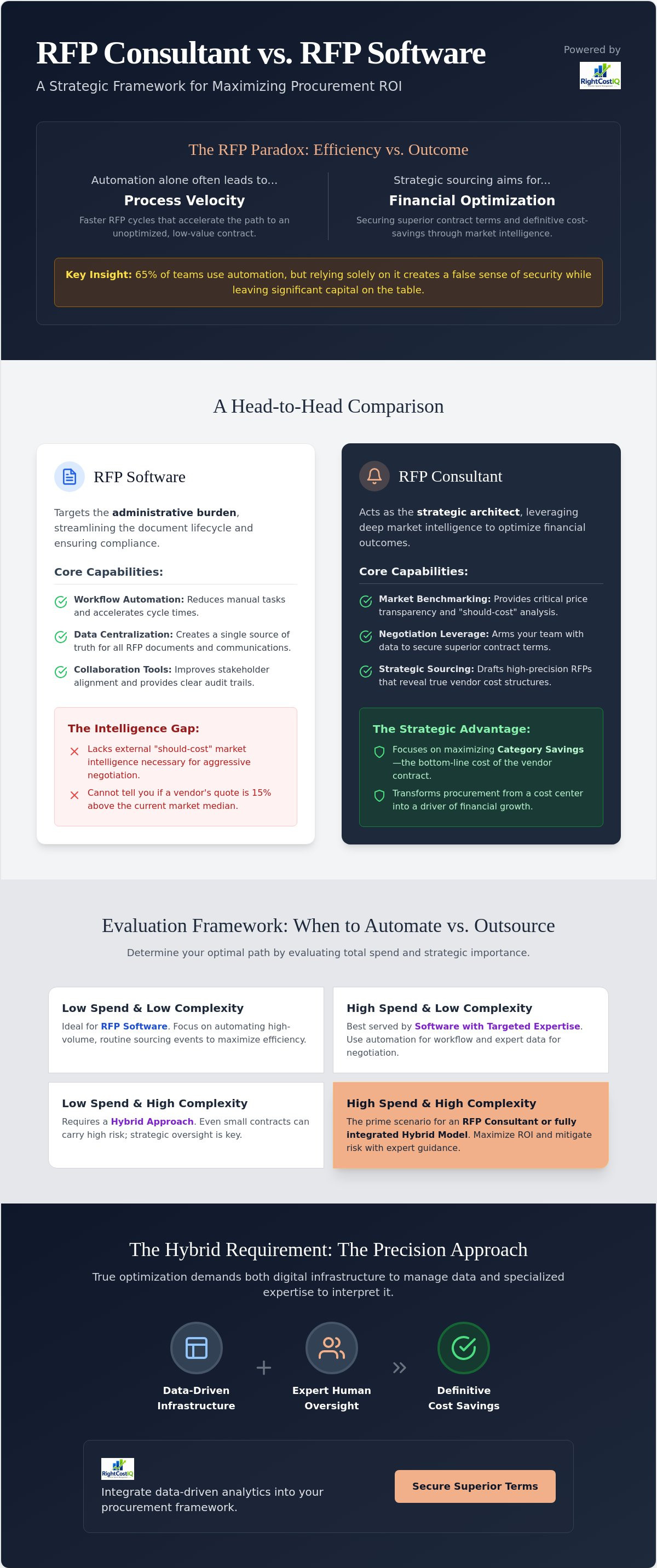
The decision to invest in an RFP consultant vs RFP software depends on a clinical analysis of your organization's spend profile. Procurement leaders must evaluate three primary metrics: technical depth, stakeholder count, and total spend volume. High-complexity sourcing events with significant financial exposure require the strategic architecting that only a consultant can provide. Meanwhile, routine procurement tasks with standardized requirements are prime candidates for software-led automation. This binary assessment prevents the common pitfall of over-investing in consultancy for simple tasks or under-investing in expertise for high-stakes contracts.
Aligning procurement strategy with business impact requires a Cost-Value Matrix. This framework categorizes sourcing events into two distinct groups. "Tail Spend" categories involve high-frequency transactions with low strategic impact. These are effectively managed through pure software automation which prioritizes process velocity. In contrast, "Strategic Spend" categories involve complex vendor ecosystems and high-value contracts. These demand consultant-led execution to ensure that market price transparency is maintained throughout the negotiation phase. Failing to apply this distinction often results in software shelfware or inefficient consultant utilization.
The Decision Matrix for Procurement Leaders
Effective resource allocation depends on identifying the ceiling of your internal team's capacity. Software is the logical choice for high-frequency, standardized requirements where process velocity is the primary goal. However, when dealing with volatile markets or high-spend categories, the technical expertise of a consultant becomes essential. You must analyze whether your internal team has the category-specific data to challenge vendor pricing models effectively. If the market intelligence is missing, automation will only accelerate a flawed selection process.
- Software Criteria: Standardized requirements, high frequency, low market volatility.
- Consultant Criteria: High contract value, complex technical specifications, volatile market pricing.
Hybrid Models: The Future of Sourcing
The most sophisticated procurement departments are adopting hybrid models. This approach utilizes software for the administrative RFP lifecycle while hiring consultants for the high-stakes negotiation phase. This technology-enabled consultancy ensures that you don't sacrifice strategic depth for operational speed. Leveraging specialized negotiation coach services allows internal teams to maintain control while benefiting from external market intelligence. This integration represents the pinnacle of modern procurement infrastructure, where high-level strategy and technical execution are perfectly aligned.
To accurately assess which model fits your current category needs, you should execute a procurement health diagnostic to identify specific areas for cost optimization. This clinical review ensures your investment in an RFP consultant vs RFP software delivers the maximum possible ROI and secures the superior vendor contract terms your organization requires.
RightCostIQ: The Precision Approach to RFP Management
RightCostIQ serves as the strategic architect for organizations navigating the complexities of modern procurement. We move beyond the binary choice of RFP consultant vs RFP software by providing a unified framework that combines expert-led negotiation with advanced digital analysis. This hybrid model ensures that your sourcing events aren't just faster, but financially superior. Our clinical approach to RFP management integrates real-time benchmarking and granular analytics into every stage of the procurement cycle. This prevents the "Efficiency Trap" where process speed comes at the expense of contract value.
Operational efficiency requires more than just document automation. We prioritize vendor performance tracking and strict compliance protocols to ensure that every contract delivers its promised value. By transforming procurement from a cost center into a strategic asset, we drive measurable financial growth. We provide the market transparency required to secure superior contract terms and definitive cost benchmarking that generic software platforms cannot replicate. This level of precision is essential for maintaining negotiation leverage in high-stakes enterprise sourcing.
Clinical Execution of Sourcing Cycles
Our framework for market price trending and risk management protects your organization from the financial volatility typical of complex categories. We achieve significant margin expansion through proprietary cost benchmarking protocols that challenge vendor pricing models at the line-item level. The RightCostIQ advantage lies in expertise that leverages technology for superior results. We don't just manage the data; we interpret it to identify the "should-cost" context necessary for aggressive negotiation. This ensures your final selection is based on objective market intelligence rather than vendor-supplied narratives.
Optimizing Your Procurement Infrastructure
Many organizations leave significant capital on the table within unmanaged or fragmented categories. We specifically address tail spend management to capture the hidden 20% of expenditure that often escapes strategic oversight. By partnering directly with the C-suite, we deliver measurable procurement ROI that aligns high-level financial goals with technical execution. This holistic approach ensures that your procurement infrastructure is robust, scalable, and relentlessly focused on the bottom line.
Securing a competitive advantage requires a move away from generic automation toward data-driven precision. When evaluating an RFP consultant vs RFP software, the answer lies in an integrated strategy that captures the benefits of both. Contact RightCostIQ for a strategic RFP audit to identify immediate opportunities for negotiation leverage and definitive cost reduction within your procurement portfolio.
Architecting a High-Leverage Procurement Framework
Strategic sourcing success requires a clinical distinction between administrative efficiency and financial optimization. While automation provides the infrastructure for data centralization, expert-led intervention ensures that this data translates into superior contract terms. The debate regarding an RFP consultant vs RFP software is resolved by a hybrid approach that utilizes technology for workflow management and specialized expertise for high-stakes negotiation. You must categorize your spend profile to ensure that strategic categories receive the market price transparency required for margin expansion.
RightCostIQ delivers this integrated precision. Specialized in healthcare financial analytics, we provide proprietary cost benchmarking and market trending models that transform procurement into a primary driver of financial growth. Our comprehensive negotiation assistance ensures that your organization captures maximum value from every high-value procurement event. It's time to eliminate the intelligence gap and secure the cost-savings your department deserves.
Optimize your sourcing strategy with RightCostIQ RFP Management and achieve definitive negotiation leverage today.
Frequently Asked Questions
Is RFP software better than hiring a procurement consultant for small businesses?
RFP software is generally superior for small businesses managing routine, low-complexity sourcing tasks where process velocity is the primary goal. However, if a small business manages a high-spend category, a consultant provides the market intelligence required to secure competitive pricing. The choice between an RFP consultant vs RFP software depends on whether the organization prioritizes administrative speed or bottom-line cost reduction.
Can RFP consultants help with software implementation and vendor selection?
RFP consultants frequently manage software implementation and vendor selection to ensure technical infrastructure aligns with strategic goals. They prevent the acquisition of shelfware by auditing platform capabilities against actual procurement requirements. This expert oversight ensures that the selected technology serves as a driver for financial growth rather than an administrative burden.
How do RFP consultants calculate their ROI compared to software costs?
Software ROI is primarily derived from operational efficiency and the reduction of administrative man-hours. In contrast, consultant ROI is calculated through category savings and definitive cost benchmarking achieved during the negotiation phase. Consultants focus on the total contract value, whereas software focuses on the cost of the process itself.
What are the risks of relying solely on RFP software for high-value contracts?
Relying solely on software for high-value contracts risks falling into the "Efficiency Trap." Automated systems lack the "should-cost" intelligence necessary to challenge vendor pricing models effectively. This often results in compliant contracts that lack market price transparency and fail to capture significant margin expansion.
Does RightCostIQ offer both RFP management software and consulting services?
RightCostIQ offers a comprehensive suite of RFP Management and Negotiation Assistance services integrated with advanced analytics. We don't sell standalone software but rather a precision-driven partnership focused on procurement optimization. Our services include vendor performance tracking and market price trending to ensure maximum negotiation leverage.
How does market price trending impact the effectiveness of RFP software?
Market price trending provides the strategic context that standard RFP software cannot generate. It allows procurement leaders to time sourcing events to coincide with favorable market conditions. Without this intelligence, software-managed cycles simply process current vendor quotes without questioning their alignment with broader market trends.
Can a consultant help manage tail spend more effectively than automated tools?
Specialized consultants manage tail spend more effectively by applying proprietary benchmarking to fragmented expenditure categories. While automated tools handle the workflow, consultants identify the hidden 20% of savings often lost in unmanaged spend. This clinical approach transforms tail spend into a strategic asset for the organization.
What is the typical duration of a consultant-led RFP cycle vs. a software-led cycle?
Software-led cycles prioritize process velocity, often reducing response times to an average of 25 hours. Consultant-led cycles focus on strategic depth and may take longer to execute due to rigorous market analysis and stakeholder alignment. The trade-off is a faster administrative process versus a financially superior contract outcome.


