

Most marketing RFPs are failed administrative exercises that prioritize creative chemistry over financial accountability. You've likely experienced the frustration of opaque agency fee structures and disparate service models that make apples-to-apples comparisons impossible. This lack of transparency often leads to budget volatility and underwhelming vendor performance once the contract is signed. Mastering how to write an RFP for marketing services transforms this process from a subjective beauty contest into a clinical execution of strategic procurement.
You need a framework that treats agency selection as a high-stakes financial investment rather than a simple talent search. This article delivers a standardized, repeatable framework designed to optimize vendor selection and engineer negotiation leverage from the outset. We'll examine the specific criteria required for benchmarking marketing costs and reducing financial volatility. By the end of this guide, you'll possess the tools to ensure long-term cost transparency and hold your partners to rigorous performance standards.
Key Takeaways
- Replace subjective agency searches with a clinical procurement framework to eliminate financial volatility and identify high-value operational synergies.
- Learn how to write an RFP for marketing services that prioritizes granular cost data extraction over broad estimates to ensure absolute price transparency.
- Engineer significant negotiation leverage by utilizing competitive tension and data-driven sourcing to optimize contract terms during the final selection phase.
- Apply procurement category cost benchmarking and historical spend analytics to set realistic budgets and mitigate long-term price risk.
- Establish clear KPIs and vendor performance tracking metrics within the RFP architecture to guarantee post-award accountability and results.
The Strategic Significance of a Precision Marketing RFP
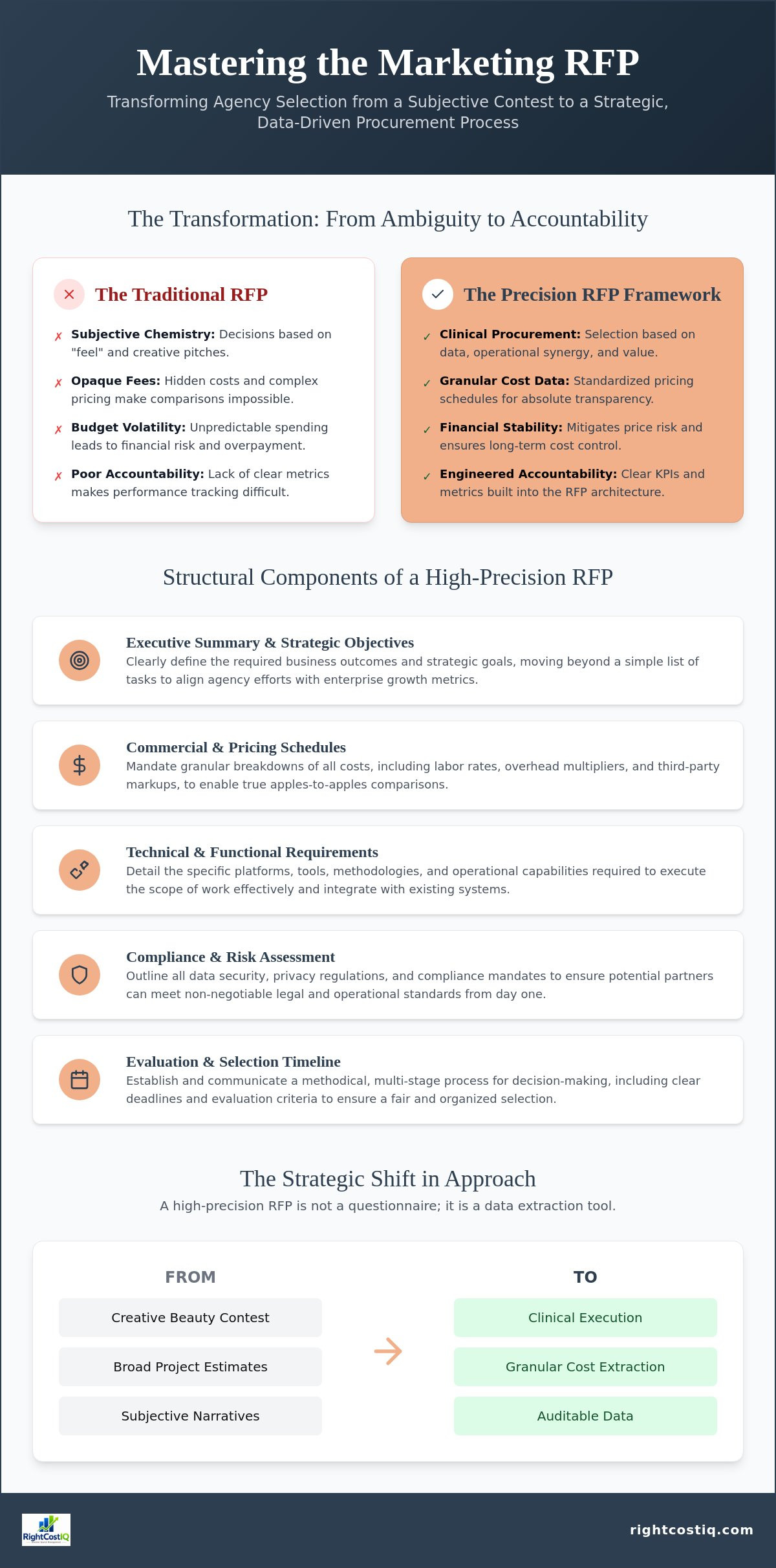
The marketing RFP is a clinical framework designed to identify operational synergies between an enterprise and its service providers. Traditional agency selection often relies on subjective "chemistry" or informal networking, which inevitably introduces financial volatility into the marketing budget. Organizations that fail to implement a data-driven sourcing process risk overpaying for services that don't align with their strategic growth metrics. Understanding how to write an RFP for marketing services is the first step in shifting from reactive spending to proactive procurement optimization. This document serves as the structural foundation for all subsequent contract negotiations and long-term performance tracking. Utilizing a specialized RFP management framework ensures that companies possess the objective benchmarks required to hold agencies accountable for their financial performance.
Beyond the Questionnaire: The RFP as a Sourcing Asset
A high-precision Request for Proposal (RFP) acts as a strategic sourcing asset that actively reduces tail spend within the marketing category. This unmanaged spend often accumulates through fragmented, small-scale agency engagements that bypass formal oversight. By utilizing procurement analytics during the pre-RFP phase, decision-makers can identify historical spend patterns and consolidate requirements into a single, high-leverage event. This process requires a cross-functional coalition of stakeholders, including the CMO, CFO, and procurement leads. These leaders must collaborate to ensure the sourcing strategy aligns with both creative needs and strict financial mandates. A well-structured RFP doesn't just ask questions; it forces vendors to disclose the operational efficiencies they bring to the table.
Mitigating Financial Volatility in Marketing Spend
Mastering how to write an RFP for marketing services allows organizations to insulate themselves against the impact of market price trending. In variable-cost categories like digital media and content production, prices fluctuate based on demand and technological shifts. A precision RFP extracts granular cost data that allows procurement teams to manage price risk across multi-year agency contracts. This technical approach transforms the marketing department from a cost center into a driver of enterprise-level operational efficiency. When the RFP process captures specific data points on labor rates and overhead multipliers, it creates the leverage necessary for aggressive cost optimization during the final selection phase. By establishing these data baselines early, you ensure the contract remains fiscally sustainable even as market conditions evolve.
Structural Components of a High-Precision Marketing RFP
A high-precision RFP functions as a technical blueprint that demands auditable data over subjective narratives. When determining how to write an RFP for marketing services, the architecture must force agencies into standardized response formats. This standardization is critical for clinical benchmarking; without it, procurement leads can't effectively compare disparate fee structures. The document should integrate risk management protocols and compliance requirements into its core to ensure the organization is protected from day one. A strategic approach to RFPs treats the selection process as a data-extraction exercise rather than a creative pitch. To achieve this level of precision, the document must include several non-negotiable sections:
- Executive Summary and Strategic Objectives: Defining the specific business outcomes required.
- Commercial and Pricing Schedules: Requiring granular breakdowns of labor rates and overhead.
- Technical and Functional Requirements: Detailing the specific tools and methodologies expected.
- Compliance and Risk Assessment: Outlining data security and regulatory requirements.
- Evaluation and Selection Timeline: Establishing a methodical process for decision-making.
Effective RFP management requires a shift away from broad project estimates toward granular cost extraction. This ensures that every line item is transparent and defensible. Utilizing a standardized RFP management platform allows your team to automate the collection of these data points, reducing the manual labor involved in vendor comparisons.
The Scope of Work: Defining Deliverables with Precision
Drafting technical requirements requires a level of detail that leaves no room for vendor ambiguity. You must clearly differentiate between one-time project costs, such as initial brand strategy, and ongoing management fees like monthly PPC optimization. The Scope of Work serves as the primary driver of contract compliance. Vague language leads to scope creep and unmanaged costs. By defining deliverables with clinical precision, you create a baseline for vendor performance tracking that persists throughout the contract lifecycle.
When drafting requirements for specialized projects like a new digital presence, you can learn more about Webexpand to understand how professional web design services align with these procurement standards.
Evaluation Frameworks and Scoring Rubrics
A weighted scoring system is essential for maintaining objectivity during the selection process. This rubric should prioritize strategic priorities, such as technical competence or cost-efficiency, over aesthetic preferences. Implementing data-driven benchmarks allows you to rank agency responses based on historical performance data rather than marketing fluff. This ensures the evaluation process is transparent and audit-ready. Reviewing your current sourcing efficiency with a clinical RFP diagnostic can reveal hidden margin opportunities and improve your negotiation position.
Engineering Negotiation Leverage through the RFP Process
The architecture of your sourcing document directly dictates the strength of your final negotiation position. While many firms view selection as a qualitative search, procurement architects understand that how to write an RFP for marketing services is actually about engineering competitive tension. By forcing agencies into a standardized data-extraction framework, you eliminate their ability to obscure profit margins within vague project bundles. This structural transparency allows you to identify "hidden" margins in agency fee structures that would otherwise remain undetected during a traditional pitch process. Clinical RFP analytics transform subjective proposals into auditable financial data, providing the objective leverage necessary to drive down costs without compromising service quality.
Competitive tension is not merely about having multiple bidders. It's about creating an environment where agencies know their pricing is being benchmarked against clinical standards. When you demand a breakdown of direct labor, indirect costs, and profit margins, you signal a high level of procurement maturity. This awareness alone often leads to more aggressive initial pricing from sophisticated vendors who recognize they're participating in a professional sourcing event rather than a standard beauty contest.
Identifying Leverage Points in Agency Proposals
Strategic procurement requires a granular analysis of resource allocation and hourly rate variance across all bidders. When agencies submit disparate pricing models, you must use a centralized RFP Management platform to identify outlier pricing and benchmark proposed technology fees against current market price trends. This analytical approach reveals where vendors have padded their estimates or inflated their overhead multipliers. Identifying these specific leverage points early in the process ensures that your negotiation team enters the final selection phase with a data-driven advantage. You don't just ask for a lower price; you challenge specific cost drivers based on comparative market intelligence.
The Role of Professional Negotiation Assistance
High-stakes marketing sourcing often requires specialized expertise to convert RFP data into tangible contract savings. Procurement experts use the extracted data to execute negotiations that move beyond simple price reduction. They focus on establishing performance-based incentives and ensuring all contract terms align with enterprise supply chain compliance. This is where Negotiation Coaching becomes a critical post-RFP step. Professional assistance ensures that the competitive tension generated during the RFP cycle is successfully captured in the final agreement. This methodical transition from data collection to active negotiation guarantees that the selected agency remains financially accountable throughout the entire partnership lifecycle.
Benchmarking and Analytics in Marketing Procurement
Benchmarking and analytics represent the clinical core of the marketing procurement cycle. While previous sections focused on structural engineering and negotiation leverage, this phase addresses the underlying financial intelligence required to validate agency proposals. Understanding how to write an RFP for marketing services is insufficient without the ability to benchmark category costs against objective market standards. High-level decision-makers must utilize Should-Cost modeling to establish a rigorous baseline for service valuations. This analytical technique calculates the theoretical cost of delivery based on labor rates, overhead multipliers, and reasonable profit margins. It ensures that agency bids remain within a defensible financial range before the first round of selection begins.
Historical spend analysis serves as the primary tool for setting realistic RFP budgets and preventing fiscal volatility. By examining previous engagement data, procurement leads identify patterns of overspending and service redundancies. This data-driven approach replaces guesswork with market intelligence, allowing the organization to forecast future agency costs with a high degree of precision. Integrating these insights into the RFP process ensures that every bid is evaluated against a pre-validated financial ceiling. Without this benchmarking, the organization remains vulnerable to the opaque pricing structures common in the agency world.
Implementing Spend Analytics for Marketing Categories
Consolidating disparate marketing spend data is essential for achieving a holistic view of the category. Enterprises often suffer from fragmented billing where multiple departments engage different agencies for similar services. Spend analytics identifies these opportunities for consolidation and volume-based discounts. By applying tail spend management, procurement teams capture hidden savings from unmanaged, low-value transactions that frequently bypass formal oversight. This systematic consolidation increases total leverage and simplifies vendor performance tracking across the entire marketing ecosystem. It transforms uncoordinated spending into a strategic asset.
Market Price Trending and Forecasting
External economic factors, such as labor market shifts and inflationary pressures, directly impact marketing labor costs and agency overhead. Market price trending allows organizations to anticipate these fluctuations and build protective clauses into long-term contracts. Forecasting price volatility in digital media and SaaS toolsets is equally critical, as these categories are prone to rapid shifts in demand and technology-driven pricing changes. Market price trending functions as a strategic safeguard that mitigates long-term financial risk by aligning contract pricing with real-world economic conditions.
To validate your current category costs against real-world benchmarks, access our clinical procurement diagnostic to identify immediate saving opportunities and optimize your next sourcing event.
Transitioning from Selection to Performance Tracking
The strategic procurement cycle doesn't terminate at the contract signature. To ensure the clinical execution of your marketing strategy, the RFP architecture must integrate post-award performance metrics from the outset. Establishing these metrics during the sourcing phase prevents the common phenomenon of vendor underperformance post-contract. When you master how to write an RFP for marketing services, you're essentially drafting the scorecard for the entire agency relationship. This document transforms from a selection tool into a clinical instrument for holding vendors accountable to the financial and operational promises made during the pitch.
KPIs established in the RFP should be granular and auditable. They must move beyond vague "brand awareness" metrics to focus on tangible business outcomes like qualified lead volume, customer acquisition cost (CAC) stability, and media spend efficiency. For agencies specializing in niche sectors, you can read more about how specific lead intelligence tools for the restoration and HVAC industries can ensure these targets are met. Integrating these data points into an automated vendor compliance system ensures that the agency's actual performance is constantly measured against the baseline established in their proposal. This data-driven approach eliminates the subjectivity of traditional agency reviews and provides a clear, objective path for contract renewal or termination.
Automated Vendor Performance Tracking Architectures
Modern procurement requires real-time visibility into agency deliverables. Setting up automated dashboards allows decision-makers to monitor performance without manual oversight. These architectures link performance tracking directly to operational efficiency and compliance, ensuring that every dollar spent aligns with the approved scope of work. Managing the transition from procurement selection to operational management involves migrating RFP data into live tracking tools. This transition ensures that the negotiation leverage engineered during the sourcing event is maintained throughout the contract lifecycle. It prevents the "service drift" that often occurs when procurement teams step away after the deal is closed.
Ensuring Long-Term ROI and Supply Chain Resilience
Maintaining long-term ROI requires a methodical cadence for quarterly business reviews (QBRs). These reviews should not be casual check-ins; they must be rigorous financial audits based on the original RFP goals. Organizations must adapt their marketing strategy based on ongoing vendor performance analytics to maintain a competitive advantage. Referencing a specialized Category Management framework allows for holistic optimization across the entire marketing supply chain. This process closes the loop by using current performance data to inform the requirements for the next sourcing cycle. By refining how to write an RFP for marketing services with real-world performance data, you ensure that each subsequent procurement event is more precise and effective than the last.
Operationalizing Your Marketing Procurement Strategy
Transitioning from fragmented, subjective agency searches to a clinical sourcing framework is essential for margin expansion. Structural precision in your document architecture directly dictates your final negotiation leverage. By mastering how to write an RFP for marketing services, you replace financial volatility with auditable cost data. This process ensures that every vendor engagement is grounded in clinical cost benchmarking and rigorous performance tracking from day one. You don't just select a partner; you engineer a high-performance supply chain that remains accountable to your enterprise growth metrics.
Achieving this level of operational efficiency requires advanced tools and expert oversight. RightCostIQ provides the technical infrastructure needed to automate vendor performance tracking and execute high-stakes negotiations for enterprise contracts. Our platform delivers the clinical precision in cost benchmarking required to eliminate opaque fee structures and secure long-term price risk management. Take the first step toward optimizing your marketing spend and securing superior vendor outcomes today.
Optimize your procurement outcomes with RightCostIQ RFP Management. Transforming your marketing category into a driver of financial growth is well within your reach.
Frequently Asked Questions
Is a marketing RFP necessary for small, one-time projects?
A full RFP is generally inefficient for small, one-time projects with low financial risk. However, you should still utilize a simplified sourcing document to establish cost benchmarks and basic deliverables. For projects exceeding $5,000, a structured approach is required to prevent unmanaged tail spend and ensure vendor accountability. This maintains fiscal discipline without the administrative overhead of a full-scale procurement event.
How long should the typical marketing RFP process take from issuance to award?
A well-structured marketing RFP process typically spans six to twelve weeks from distribution to final decision. This timeline accounts for document distribution, agency Q&A sessions, proposal evaluation, and final contract negotiation. Rushing this cycle often results in poor data extraction and weakened negotiation leverage. Providing a clear timeline with key milestones is essential for managing agency expectations and ensuring a professional selection process.
What is the difference between an RFI, RFQ, and RFP in marketing?
An RFI (Request for Information) identifies potential market players and their capabilities during the early discovery phase. An RFQ (Request for Quote) focuses strictly on price for commoditized tasks with fixed, non-negotiable requirements. An RFP (Request for Proposal) is a strategic document used to solicit comprehensive solutions for complex marketing challenges. It requires vendors to provide detailed operational strategies and granular cost breakdowns.
Can I use an RFP for creative services without stifling the agency’s creativity?
You can successfully use a clinical framework for creative services by defining desired business outcomes rather than specific executions. When determining how to write an RFP for marketing services that includes creative work, focus on strategic constraints and performance KPIs. This allows agencies to innovate within a clear financial and operational boundary. It ensures that creativity remains tethered to your core commercial objectives.
How many agencies should be invited to participate in a marketing RFP?
You should invite a shortlist of three to five qualified agencies to participate in the formal RFP stage. Inviting too many participants dilutes the quality of the proposals and increases the administrative burden on your procurement team. Pre-screening agencies through an RFI or initial chemistry meeting ensures that only high-fit vendors reach the final selection phase. This focused approach yields more detailed and competitive proposals.
What are the most common mistakes in writing a marketing RFP?
The most frequent errors include drafting vague scopes of work and failing to establish a weighted scoring rubric before issuance. Organizations also frequently ignore post-award performance tracking during the initial sourcing event. Mastering how to write an RFP for marketing services requires avoiding these pitfalls to ensure long-term cost transparency and vendor accountability. Without a rigorous evaluation framework, the selection process becomes subjective and financially risky.
How do I handle budget transparency in a marketing RFP?
Budget transparency is essential for receiving realistic and actionable proposals from high-quality agencies. You should provide a clear budget range to allow agencies to align their resource allocation with your financial constraints. This prevents time-wasting on proposals that are fiscally unviable and demonstrates that you are a serious, organized partner. Transparency early in the process facilitates more honest and productive negotiation during the final selection phase.
What is the role of procurement software in managing the RFP lifecycle?
Procurement software centralizes disparate vendor data and automates the comparison of complex fee structures. It provides the analytical infrastructure needed for should-cost modeling and historical spend analysis. Utilizing these tools ensures that the entire RFP lifecycle is auditable, data-driven, and optimized for maximum negotiation leverage. It transforms a manual administrative task into a strategic engine for margin expansion and vendor compliance tracking.


