
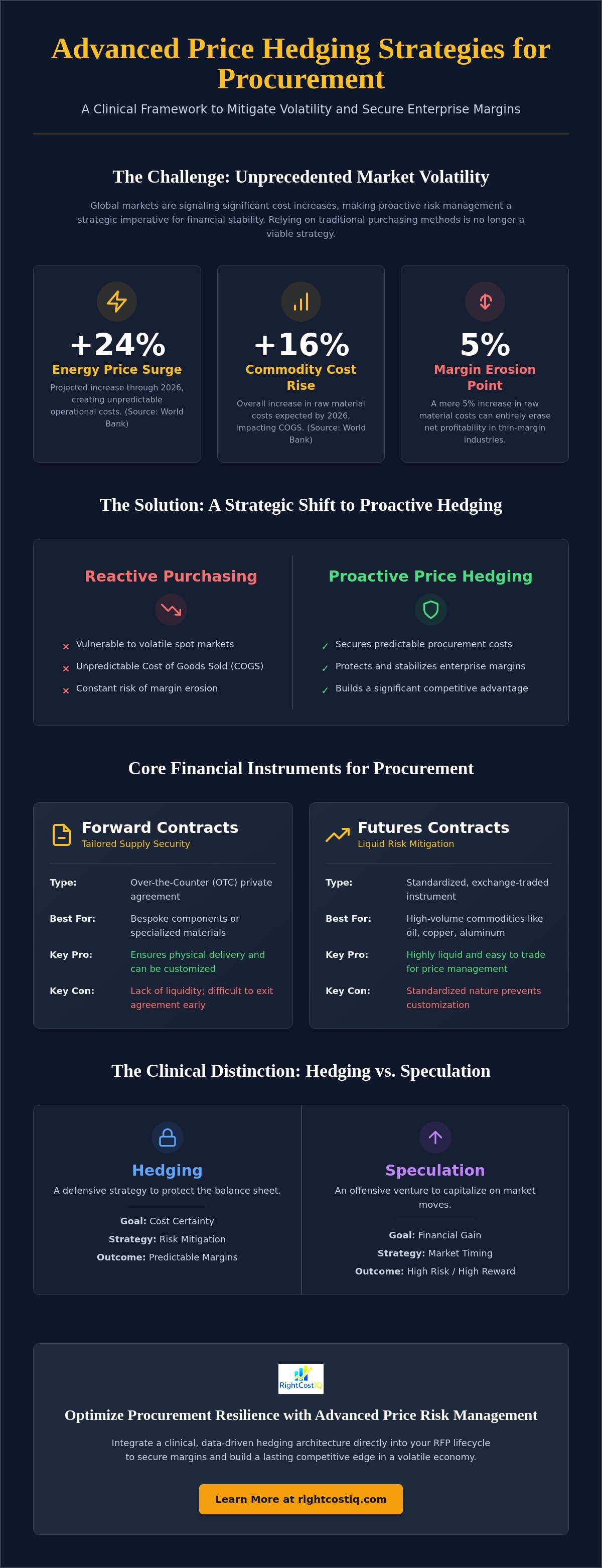
The World Bank projects a 24% surge in energy prices and a 16% rise in overall commodity costs throughout 2026, making procurement a critical strategic imperative for financial stability. You recognize that unpredictable margin erosion and volatile COGS forecasts are unacceptable risks when aluminum trades at $3,120 per ton and gold exceeds $4,000 per ounce. Traditional RFP cycles lack the technical depth to account for these rapid market price trends; this leaves your bottom line vulnerable to geopolitical instability and supply chain disruptions.
This article provides the sophisticated financial instruments and data-driven architectures required to execute advanced price hedging strategies for procurement. You'll learn to mitigate price volatility and secure enterprise margins through a repeatable, clinical approach to risk management. We'll analyze the integration of AI-enabled market intelligence with the latest FASB hedge accounting updates. This ensures your procurement operation functions as a primary driver of financial growth and competitive advantage in a volatile global economy.
Key Takeaways
- Transition from reactive purchasing to a clinical framework that offsets commodity fluctuations through proactive risk management.
- Master the technical deployment of forward and futures contracts to secure predictable procurement costs and protect enterprise margins.
- Implement sophisticated price hedging strategies for procurement by leveraging market price trending and category cost benchmarking.
- Build a repeatable architecture for price risk management by integrating categorical risk assessments directly into your RFP lifecycle.
- Gain a superior competitive advantage through the application of advanced forecasting services and real-time vendor performance tracking.
The Strategic Mandate for Price Hedging in 2026 Procurement
Price hedging is a clinical risk management strategy designed to neutralize the financial impact of commodity price fluctuations. In 2026, the traditional reliance on fixed-price contracts has become a strategic liability. Rapid geopolitical shifts and fragmented supply chains create price swings that static agreements cannot absorb. Modern procurement leaders must transition from reactive sourcing to a systematic application of price hedging strategies for procurement. This shift ensures long-term EBITDA stability by decoupling enterprise margins from the chaos of global spot markets. When the World Bank projects a 24% surge in energy prices, relying on hope is not a strategy.
To further stabilize these utility expenses, manufacturing CFOs often check out EnergoStrateg to optimize their media cost structures through advanced analytics.
The transition to clinical risk management requires a fundamental redefinition of the procurement function. It's no longer about finding the lowest price today; it's about securing the margin for tomorrow. Organizations that fail to adapt find their cost of goods sold (COGS) at the mercy of volatile indices. Conversely, those who integrate sophisticated hedging frameworks into their sourcing cycles gain a predictable cost structure that competitors cannot match. This predictability is the primary driver of enterprise value in an era defined by economic uncertainty.
Hedging vs. Speculation: A Clinical Distinction
Hedging is not a profit-seeking venture. While speculation attempts to capitalize on market timing for financial gain; procurement hedging prioritizes cost certainty above all else. The strategic architect within the procurement function defines specific risk tolerance levels to protect the balance sheet. By utilizing financial hedging instruments, organizations transform unpredictable raw material costs into fixed, manageable line items. This precision directly enhances financial forecasting accuracy and bolsters investor confidence by demonstrating operational control over external market forces. You aren't gambling on where the market goes; you're ensuring your business thrives regardless of its direction.
The Economic Impact of Price Volatility
In thin-margin industries, a 5% increase in raw material costs can entirely erase net profitability. The current market environment creates a "volatility trap" where procurement teams without a framework are forced into high-price spot markets during supply crunches. For instance, with aluminum trading at $3,120.70 per ton, even minor percentage fluctuations represent millions in potential margin erosion. Implementing a rigorous Price Risk Management protocol is a defensive necessity. This architecture prevents margin erosion and ensures that procurement remains a driver of financial growth rather than a victim of market instability. It's about moving from defensive purchasing to proactive margin protection.
Core Financial Instruments for Procurement Price Hedging
The execution of effective price hedging strategies for procurement necessitates a granular understanding of four primary financial instruments. Each tool offers distinct advantages depending on the underlying commodity's liquidity, the necessity for physical delivery, and the organization's specific risk tolerance. Forward contracts and swaps provide customized, often non-exchange-traded solutions; futures and options offer standardized, highly liquid avenues for risk mitigation. Selecting the wrong instrument can lead to unintended margin exposure or excessive transaction costs that undermine the entire risk management framework.
Forward Contracts: Tailored Supply Security
Forward contracts are over-the-counter (OTC) agreements between a buyer and a vendor to purchase a specific volume of a commodity at a set price on a future date. These are ideal for bespoke components or specialized materials where standardized exchange contracts don't exist. Because these are private agreements, they ensure physical delivery and can be customized to exact specifications. However, the primary risk factor is a lack of liquidity. Unlike exchange-traded tools, you can't easily exit a forward agreement if market conditions shift favorably. This makes them a high-conviction tool for strategic supply security rather than tactical price management.
Futures and Options: Liquid Risk Mitigation
Futures contracts are standardized, exchange-traded instruments designed for high-volume commodities like crude oil or copper. In July 2026, with copper trading at approximately $13,340.60 per ton, futures allow procurement teams to lock in prices and mitigate the impact of sudden industrial demand spikes. These require margin accounts and daily mark-to-market settlements, which can impact short-term cash flow. You must balance the benefit of price certainty against the operational requirement of maintaining these margin levels.
Options provide a more flexible alternative by offering the right, but not the obligation, to purchase at a specific price. While futures lock you into a price, options act as a safety net that allows you to participate in market downturns while protecting against spikes. This flexibility comes at the cost of an upfront premium. The strike price in options contracts serves as the critical pivot point for procurement ROI, representing the pre-determined valuation where the right to purchase is triggered.
Swaps further refine this architecture by allowing organizations to exchange floating price exposure for fixed rates over a defined period. This is particularly effective for managing energy costs or interest rate risks without the logistical burden of physical delivery. To determine which of these instruments aligns with your current category spend, you should utilize advanced price risk management tools to simulate various market scenarios and financial outcomes.
Data-Driven Entry: Leveraging Procurement Analytics for Hedging
Executing price hedging strategies for procurement without a robust data architecture is a financial gamble. Clinical precision in hedge timing depends on real-time Market Price Trending data to identify optimal entry points. You must move beyond historical averages to analyze granular price corridors. This ensures that financial instruments are deployed only when market intelligence signals a high probability of future volatility. Predictive analytics transform raw data into a strategic roadmap. This allows procurement to lock in costs before inflationary cycles erode enterprise margins. Without this data-driven entry, your hedging efforts remain reactive rather than strategic.
The integration of predictive analytics allows the strategic architect to forecast future price corridors with high confidence levels. By analyzing lead indicators and supply-demand imbalances, you can anticipate shifts in commodity markets like aluminum or crude oil before they manifest in spot prices. This foresight is critical for determining the duration and volume of your hedges. Data-driven procurement doesn't just react to the market; it anticipates it, providing a repeatable framework for margin protection that scales across all spend categories.
Clinical Benchmarking and Analytics
Utilizing advanced Procurement Analytics allows you to identify category-specific volatility before it impacts the P&L. Data granularity is the primary differentiator in high-stakes negotiations. It provides the empirical evidence needed to challenge supplier assumptions and defend your cost positions. Clinical benchmarking identifies when a commodity is over-indexed compared to its historical cost structure. This analytical rigor prevents the common error of over-hedging at market peaks. It ensures your risk management strategy remains cost-effective and aligned with actual market conditions. By benchmarking against global indices, you ensure your procurement costs remain competitive even in a fragmented market.
Should-Cost Modeling as a Hedging Lever
A rigorous Should-Cost framework provides the definitive "true" price of a component by breaking down material, labor, and overhead costs. This bottom-up analysis empowers procurement leaders to push back on supplier-driven price increases that aren't supported by underlying market shifts. There's a powerful synergy between this granular cost analysis and top-down market trending. While market data tells you where the price is going, should-cost modeling tells you what the price should be. This dual-lens approach validates every hedge decision. It ensures you aren't just protecting margins, but actively optimizing them. It's the ultimate tool for the strategic architect who demands total transparency and efficiency in the supply chain.
Implementation Architecture: Integrating Hedging into the RFP Lifecycle
Strategic procurement requires the seamless integration of financial risk management into the operational sourcing cycle. Treating hedging as a standalone finance function creates a disconnect between market intelligence and contractual execution. To achieve clinical margin protection, you must embed price hedging strategies for procurement directly into your implementation architecture. This process ensures that every dollar of spend is accounted for within a rigorous governance framework. It transforms procurement from a transactional department into a strategic architect of enterprise value.
- Step 1: Conduct a clinical risk assessment across all spend categories to identify exposure to volatile indices like Henry Hub natural gas ($3.28 per MMBtu) or LME copper ($13,340.60 per ton).
- Step 2: Establish a Price Risk Management policy with defined approval thresholds to maintain strict financial governance.
- Step 3: Integrate specific hedging clauses into the RFP Management process to ensure suppliers understand your risk mitigation requirements.
- Step 4: Execute the strategy through a Negotiation Coach to align supplier incentives with your internal margin targets.
- Step 5: Continuously monitor vendor performance and market movements to adjust hedge positions in real-time.
Designing RFP Frameworks for Volatility
Traditional fixed-price RFPs are no longer sufficient in a market where energy prices are projected to surge by 24% in 2026. You must incorporate price adjustment formulas (PAFs) that link directly to independent, transparent indices. This transparency forces suppliers to disclose how they manage their own upstream commodity risks, preventing them from hiding excessive margins behind market volatility claims. RFP precision reduces the risk premium suppliers often bake into fixed-price bids by shifting the focus from price-guessing to collaborative risk-sharing. This clinical approach ensures your cost structure remains lean regardless of external market shocks.
The Role of Negotiation Assistance
Securing flexible contract terms requires advanced Negotiation Strategies that move beyond simple price haggling. Suppliers often resist index-linked pricing because it removes their ability to profit from market timing. You must demonstrate that a clinical hedging framework provides mutual stability and long-term volume security. Third-party negotiation assistance is invaluable here; it provides the objective data and tactical expertise needed to navigate complex, high-value contracts. This ensures that your price risk management policy is actually enforceable at the vendor level. To evaluate your current implementation maturity, access our clinical procurement diagnostic today.
RightCostIQ: Optimizing Procurement Resilience via Advanced Price Risk Management
RightCostIQ provides the technical infrastructure required to execute complex price hedging strategies for procurement with absolute precision. Our Price Risk Management and Tracking Service acts as a clinical shield for your balance sheet, neutralizing the impact of commodity price surges. By integrating real-time market data with proprietary analytics, we enable procurement teams to move beyond basic cost-cutting. This service transforms procurement from a back-office function into a primary driver of EBITDA stability. You gain the ability to lock in margins while your competitors remain exposed to the volatility of global spot markets.
Our Market Price Trending and Forecasting Service delivers a distinct competitive edge by providing high-confidence predictive corridors. This isn't just data; it's a strategic roadmap for hedge timing. By identifying over-indexed commodities before they peak, RightCostIQ ensures your organization avoids the "volatility trap" discussed earlier in this framework. This foresight allows for the clinical application of forward and futures contracts at the most advantageous moments. The result is a predictable cost structure that facilitates aggressive financial growth and operational scaling.
Clinical Execution of Procurement Strategy
We focus relentlessly on financial growth metrics and operational efficiency. RightCostIQ empowers the persona of the strategic architect, providing the tools necessary to design a resilient supply chain. Our platform integrates RFP management with clinical cost benchmarking to ensure every negotiation is backed by empirical data. This level of transparency forces suppliers to align with your internal margin targets. We're committed to data-driven sourcing that doesn't just manage risk but actively expands margins through superior cost-benchmarking and negotiation assistance. It's about moving from defensive purchasing to proactive margin protection.
Securing the Future of Enterprise Sourcing
The procurement landscape of 2026 demands a methodical, analytical approach to hedging. A partnership with RightCostIQ transforms your procurement department into a sophisticated profit-center by institutionalizing price risk management. You don't have to guess where the market is going when you have a repeatable architecture for margin protection. We invite stakeholders to explore our Pricing and comprehensive platform capabilities to understand the full scope of our service offerings. It's time to replace reactive purchasing with high-level financial strategy and technical execution.
Optimize your procurement outcomes with RightCostIQ and secure your enterprise margins against the volatility of the global market.
Securing Long-Term Profitability in a Volatile Global Market
Transitioning from reactive purchasing to a clinical risk management framework is no longer optional. You've seen how integrating sophisticated financial instruments with real-time market intelligence protects enterprise margins from the volatility projected for 2026. By embedding price hedging strategies for procurement directly into your RFP lifecycle, you transform the procurement department into a strategic architect of financial growth. This methodical approach ensures that every sourcing decision is backed by empirical data rather than market speculation. It decouples your bottom line from the chaos of global spot markets.
RightCostIQ provides the technical execution required to institutionalize these frameworks across your entire spend portfolio. Our platform delivers clinical precision in cost benchmarking and specialized price risk management services that generic consulting firms cannot match. You gain access to data-driven market price trending and forecasting that secures your competitive advantage in fragmented markets. It's time to move beyond cost-cutting and start protecting your bottom line with absolute certainty. Master your margin protection with RightCostIQs Price Risk Management tools and ensure your organization thrives in any economic climate.
Frequently Asked Questions
What is the most effective price hedging strategy for mid-sized procurement teams?
A layered hedging approach is the most effective for mid-sized teams because it mitigates the risk of poor market timing. Instead of committing to a single price point, you execute smaller hedges over a defined period to achieve a favorable average cost. This strategy provides budget stability without the extreme cash flow requirements of high-volume futures. It's a clinical method for managing category spend while maintaining operational flexibility.
How does a forward contract differ from a futures contract in procurement?
Forward contracts are customized, over-the-counter agreements that focus on the physical delivery of specific components between two private parties. In contrast, futures contracts are standardized instruments traded on public exchanges, prioritizing liquidity over bespoke terms. While forwards eliminate the need for margin accounts, they carry higher counterparty risk and lack the exit flexibility found in exchange-traded futures. Choosing between them depends on your specific delivery requirements and risk tolerance.
Can price hedging actually increase total procurement costs?
Hedging can increase total procurement costs if market prices fall significantly below your locked-in rate or through the payment of upfront option premiums. You must view these costs as an insurance premium for margin stability rather than a failed investment. The primary objective is cost certainty, not profit generation. A clinical framework accepts these potential costs to eliminate the catastrophic risk of unmanaged price spikes in volatile markets.
What role does market price trending play in a hedging framework?
Market price trending acts as the primary validation layer for any hedging decision. It allows procurement leaders to identify when a commodity is trading outside its historical price corridor, signaling an optimal entry or exit point. By analyzing these trends, you avoid the common error of executing price hedging strategies for procurement during temporary market peaks. This data-driven approach ensures your risk management efforts are mathematically sound and strategically timed.
How do I integrate hedging strategies into my existing RFP process?
Integration begins by incorporating price adjustment formulas (PAFs) and index-linked clauses directly into your RFP templates. You must require suppliers to disclose their underlying commodity exposure and explain how they manage their own upstream risks. This transparency allows you to align your internal hedging instruments with the actual contractual terms negotiated at the vendor level. It transforms the RFP from a static bid into a dynamic risk management tool.
What are the risks of not hedging in a volatile commodity market?
The primary risk of failing to hedge is total exposure to margin erosion during sudden commodity surges. Without a protective framework, your cost of goods sold (COGS) becomes unpredictable, making accurate financial forecasting impossible. This exposure can force your organization into high-price spot markets during supply shortages, leading to a significant loss of competitive advantage. In a market where energy prices can surge 24%, unhedged procurement is a strategic liability.
Is an options contract better than a fixed-price agreement for long-term supply?
An options contract is superior for long-term supply because it provides a safety net against price spikes while allowing you to benefit from market downturns. A fixed-price agreement is static; it locks you in regardless of whether the market price drops. Options provide the clinical flexibility required to protect your ceiling without sacrificing the potential for cost savings. This versatility makes them a powerful tool for the strategic architect focused on long-term value.
How can procurement analytics help identify the best time to hedge?
Procurement analytics identify category-specific volatility and over-indexed commodities by comparing real-time data against historical benchmarks. These analytics provide the granular visibility needed to determine if a price increase is driven by actual market shifts or supplier opportunism. By utilizing predictive analytics, you can forecast future price corridors and establish automated triggers for hedge execution. This ensures that your price hedging strategies for procurement are always driven by empirical evidence rather than intuition.


