
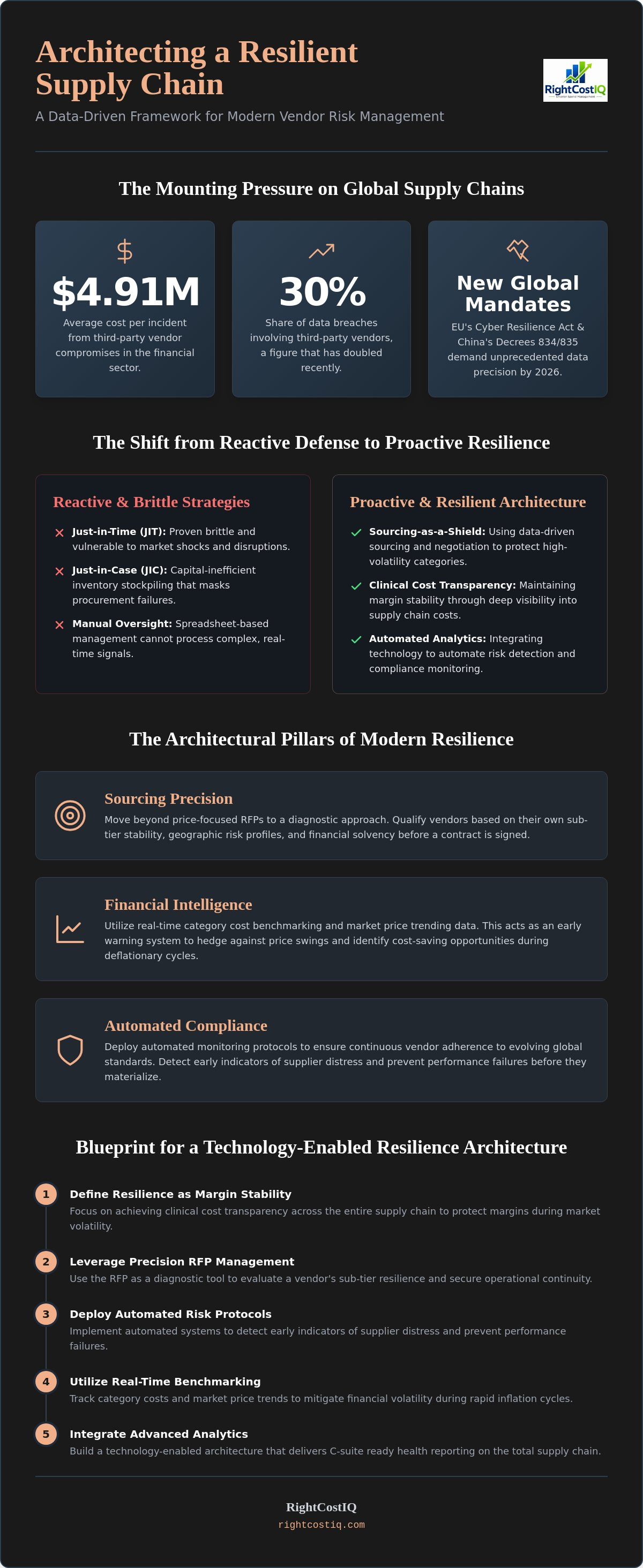
Third-party vendor compromises cost financial organizations an average of $4.91 million per incident, a reality that necessitates a transition from reactive recovery to clinical architectural precision. Effective vendor risk management in supply chain operations is no longer a secondary compliance function; it's a primary driver of financial stability and operational continuity. As global regulations like China's Decrees 834 and 835 and the EU's Cyber Resilience Act tighten their grip in 2026, the margin for procurement error has effectively vanished.
You've likely experienced the friction of unpredictable market price trending and RFP cycles that yield vendor misalignment rather than strategic partnership. These systemic inefficiencies, compounded by a lack of transparency in category cost benchmarking, often leave leadership teams blind to burgeoning financial risks. You deserve a methodology that converts these vulnerabilities into competitive advantages through rigorous data integration.
This article provides the blueprint to architect a procurement-led resilience strategy that mitigates volatility through data-driven sourcing precision. We'll analyze a framework for quantifiable price risk mitigation, streamlined performance tracking, and the development of C-suite ready reporting on total supply chain health. By the end of this guide, you'll have the tools to transition from a defensive posture to a position of strategic market dominance.
Key Takeaways
- Define resilience as the capacity to maintain margin stability through clinical cost transparency.
- Leverage precision RFP management as a diagnostic tool to evaluate vendor sub-tier resilience and secure operational continuity.
- Deploy automated vendor risk management in supply chain protocols to detect early indicators of supplier distress and prevent performance failures.
- Utilize real-time category cost benchmarking and market price trending to mitigate financial volatility during rapid inflation cycles.
- Integrate advanced analytics into the sourcing lifecycle to build a technology-enabled resilience architecture that delivers C-suite ready health reporting.
Architectural Foundations of a Resilient Supply Chain Strategy
Resilience is defined by the capacity to maintain margin stability and operational continuity through intense market volatility. The historical reliance on Just-in-Time (JIT) efficiency has proven brittle, yet the reactionary pivot toward Just-in-Case (JIC) inventory models is often a capital-inefficient trap. Without clinical cost transparency, stockpiling merely masks underlying procurement failures. A truly resilient architecture integrates vendor risk management in supply chain operations as a core financial discipline rather than a peripheral compliance task. This shift requires a move from manual, spreadsheet-based oversight to automated procurement analytics that can process 2026's complex regulatory and economic signals in real time. For instance, the introduction of China’s Decrees 834 and 835 alongside the EU’s Carbon Border Adjustment Mechanism (CBAM) demands a level of data precision that manual systems cannot provide.
The architectural pillars of modern resilience focus on three core areas:
- Sourcing Precision: Identifying and qualifying vendors based on their own sub-tier stability and geographic risk profiles.
- Financial Intelligence: Utilizing real-time data to hedge against price swings and identify cost-saving opportunities during deflationary cycles.
- Vendor Compliance: Ensuring continuous adherence to evolving global standards like the EU’s Cyber Resilience Act through automated monitoring.
The Economic Imperative for Supply Continuity
Disruption isn't just an operational delay; it's a direct hit to the balance sheet. With third-party involvement in data breaches doubling to 30% according to 2025 industry data, a proactive supply chain risk management framework delivers a measurable ROI by preventing these losses before they materialize. Market price trending acts as your early warning system. By tracking these fluctuations with high-frequency data, procurement teams can anticipate supply shocks and adjust sourcing strategies before margins erode. This level of category management is the bridge between procurement activities and enterprise-wide financial health. It transforms the procurement department from a cost center into a primary driver of financial growth.
Moving Beyond Defensive Logistics to Strategic Sourcing
Inventory stockpiling is a blunt instrument. It ties up working capital and ignores the root cause of supply fragility. Sophisticated leaders use "Sourcing-as-a-Shield" to protect high-volatility categories. This strategy involves using professional negotiation assistance to secure contract terms that prioritize flexibility and transparency. Securing robust contract terms through data-driven negotiation ensures that vendors are held accountable for their own resilience. Executing a resilient vendor risk management in supply chain program ensures that your competitive advantage won't come from how much you store, but from how precisely you source. Integrating these analytics into your sourcing lifecycle ensures that your architecture is built for performance, not just survival.
Precision RFP Management: Sourcing for Operational Continuity
Precision RFP management serves as the primary diagnostic tool for uncovering structural vulnerabilities within a supplier network. Most procurement teams treat the Request for Proposal as a mere pricing exercise. This narrow focus ignores the reality that building resilient global supply chains requires deep visibility into a vendor's own operational dependencies. Effective vendor risk management in supply chain begins by interrogating a supplier's sub-tier resilience, geographic concentration, and financial solvency before a contract is ever signed. Clinical execution in the sourcing cycle transforms the RFP from a document into a filter. By utilizing professional RFP Management, organizations can standardize data collection across diverse global categories. This standardization ensures that every vendor is measured against identical, high-stakes performance metrics, ultimately securing long-term reliability through data-driven selection.
Standardising the Sourcing Framework
The RightCostIQ methodology replaces qualitative bias with rigorous scoring architectures. We don't rely on subjective impressions about a vendor's capability. Instead, we deploy data-driven frameworks that quantify risk exposure across multiple dimensions, including financial stability and operational redundancy. RFP management functions as a strategic filter for supply chain risk, ensuring only the most robust partners enter your ecosystem. This methodical approach eliminates the noise of traditional sourcing, allowing for clear, results-oriented decision-making that prioritizes long-term stability over short-term savings.
Negotiation as a Risk Mitigation Lever
Negotiation isn't just about unit costs; it's about shifting the burden of risk. High-level Negotiation Assistance allows procurement leaders to embed specific Resilience Clauses into enterprise contracts. These clauses might include mandatory secondary sourcing disclosures or penalty-backed service level agreements (SLAs) tied to disruption response times. Leveraging market price forecasting during the final stages of the sourcing cycle provides the leverage needed to align vendor incentives with your long-term stability goals. Transitioning from transactional purchasing to strategic, value-aligned partnerships ensures that your supply chain isn't just surviving, but thriving under pressure. You can optimize your current strategy by reviewing our RFP management framework.
Analytics-Led Price Risk Management and Market Benchmarking
Resilience requires real-time visibility into category cost benchmarking and market price trending to maintain margin stability through 2026's economic cycles. Static pricing models, once the standard for long-term enterprise agreements, fail in an environment characterized by rapid inflation and deflation cycles. Effective vendor risk management in supply chain frameworks must account for the financial exposure inherent in volatile commodity markets. Without clinical visibility into market realities, procurement teams risk overpaying for critical inputs or being blindsided by sudden cost escalations. Utilizing Should-Cost Analysis allows organizations to validate supplier quotes against granular market data. This process ensures that every dollar spent is optimized, generating the savings necessary to fund broader resilience initiatives.
Sophisticated procurement analytics identify hidden cost drivers that traditional auditing misses. By integrating these insights into the sourcing lifecycle, businesses move from reactive cost-cutting to proactive financial architecture. This data-driven approach ensures that vendor selection is based on total value rather than just the lowest initial quote, protecting the organization from the long-term costs of supplier distress or market misalignment. For those specifically optimizing logistics spend, Warenous offers critical guidance on 3PL warehouse costs to ensure your sourcing decisions are backed by the latest market benchmarking.
Forecasting Financial Volatility
Implementing market price trending models allows procurement leaders to predict cost escalations before they impact the bottom line. This predictive capability is essential for protecting margins in fixed-price contract environments where traditional hedging may be insufficient. To achieve this, organizations must master five key strategic pillars:
- Price Risk Management: Mitigating exposure to commodity price swings.
- Market Price Trending: Identifying long-term cost trajectories.
- Cost Benchmarking: Validating internal spend against industry standards.
- Financial Volatility: Quantifying the impact of economic instability on procurement.
- Procurement Analytics: Transforming raw data into actionable sourcing intelligence.
Category Cost Benchmarking Standards
Establishing a clinical baseline for market pricing is the only way to prevent overpayment during periods of high disruption. This baseline serves as a reference point for all negotiations, ensuring that vendors remain competitive even when supply is tight. Integrating Tail Spend Management into the broader resilience strategy ensures that smaller, unmanaged categories don't become sources of significant financial leakage. For a deeper dive into these methodologies, see our guide on Category Management in Procurement: A Clinical Framework for Margin Expansion (2026). This holistic approach ensures that every category, regardless of size, contributes to the overall stability of the enterprise.
Vendor Performance Tracking: Ensuring Compliance and Reliability
Resilience is only as strong as the weakest link in the vendor performance chain. In a 2026 market defined by rapid disruption, manual oversight of supplier health is a liability. Sophisticated vendor risk management in supply chain requires the automation of performance tracking to identify early indicators of supplier distress before they escalate into operational failures. By shifting from periodic reviews to continuous monitoring, procurement departments can maintain margin stability even when external conditions fluctuate. This clinical approach ensures that every partner in the ecosystem meets rigorous standards for reliability and financial health. Since third-party involvement in data breaches reached 30% in 2025, the ability to track vendor cybersecurity posture in real time has become a non-negotiable requirement for operational continuity.
Implementing a rigorous performance scoring system drives continuous supplier improvement and ensures that contract terms are actually met. These scores shouldn't just reflect past performance but should act as predictive tools for future reliability. By integrating these metrics into the broader sourcing lifecycle, procurement leaders can make informed decisions about which vendors to grow and which to phase out. This methodical approach to performance management creates a feedback loop that strengthens the entire supply architecture over time.
Architecting a Performance Tracking System
Effective tracking systems utilize key performance indicators (KPIs) that correlate directly with supply chain resilience, such as lead-time variance, quality defect rates, and financial stability scores. For health-focused enterprises like Nutrahara, these metrics provide the clinical oversight necessary for maintaining the rigorous standards required for women's health supplements. Automated dashboards provide real-time compliance monitoring, allowing decision-makers to visualize risk across the entire category landscape. Vendor transparency acts as the primary catalyst for effective risk mitigation within the procurement lifecycle. These technical frameworks eliminate the ambiguity of traditional supplier management, replacing subjective opinions with quantifiable performance data that is C-suite ready.
Vendor Compliance as a Strategic Asset
Compliance shouldn't be viewed as a bureaucratic hurdle, but as a strategic asset that secures sub-tier visibility. Mandatory compliance reporting within a centralized procurement platform ensures that vendors provide data on their own supply dependencies, mitigating the risk of hidden failures. With the EU’s Cyber Resilience Act reporting obligations beginning on September 11, 2026, automated compliance tracking is essential for legal and operational safety. Supplier diversity programs further strengthen this architecture by building a multi-node, resilient supply network that isn't dependent on a single geographic or corporate entity. When performance gaps emerge, the solution isn't reactive vendor swapping, but data-backed negotiation to enforce contract terms. You can evaluate your current supplier health by utilizing our procurement risk diagnostic tool.
Executing the Resilient Strategy with RightCostIQ Frameworks
Executing a resilient strategy requires a fundamental shift from defensive logistics to a technology-enabled resilience architecture. Traditional procurement models often suffer from data fragmentation, leaving organizations vulnerable to the sudden shifts of the 2026 economic environment. By integrating vendor risk management in supply chain protocols directly into the sourcing lifecycle, businesses can achieve the clinical precision necessary for C-suite oversight. This integration ensures that every procurement decision is backed by real-time analytics rather than historical assumptions. The result is a supply chain that doesn't just survive market shocks but thrives by capitalizing on cost-optimized sourcing opportunities.
Integrating advanced analytics into the sourcing lifecycle provides a distinct competitive advantage. It allows procurement teams to identify hidden savings that can be reinvested into resilience initiatives, such as diversifying supply nodes or upgrading cybersecurity monitoring. This strategic reallocation of capital ensures that the procurement department acts as a primary driver for financial growth. RightCostIQ frameworks provide the structural rigor needed to transform these theoretical strategies into quantifiable business outcomes. Since third-party vendor compromises cost financial organizations millions per incident, the ROI of an analytics-led framework is immediate and measurable.
Integrating Technology and Strategy
The RightCostIQ Platform serves as the central nervous system for your procurement operations. It centralizes risk data and sourcing workflows, eliminating the inefficiencies of manual spreadsheet management. This centralization is critical for maintaining compliance with global regulations like the EU’s Deforestation Regulation (EUDR), which requires proof of material origins by December 30, 2026. Professional RFP management acts as a high-yield insurance policy for your global supply chain. It forces a level of vendor transparency that traditional sourcing cannot achieve, ensuring that your partners are as resilient as your own organization. To understand how to leverage these tools effectively, consult our guide on RFP Management: Strategic Frameworks for AI-Led Procurement Optimization.
The Path to Procurement Optimization
Optimization is achieved by reducing operational friction through automated vendor and price risk tracking. These systems provide the early warning signals necessary to adjust sourcing strategies before market volatility erodes margins. Actionable next steps for the current fiscal year include initiating a clinical audit of your current supply chain resilience framework. This audit identifies specific vulnerabilities in your category cost benchmarking and vendor performance tracking. RightCostIQ provides the expertise to conduct this deep-dive analysis, ensuring your architecture is ready for future disruptions. Optimize your procurement outcomes with RightCostIQ to secure your competitive position in an increasingly unpredictable market.
Architecting a Competitive Advantage Through Procurement Precision
Building a resilient supply chain strategy is a clinical necessity for 2026. Success requires a transition from manual oversight to a sophisticated architecture that integrates vendor risk management in supply chain operations as a primary financial driver. You've seen how precision RFP management and real-time category cost benchmarking protect margins from the volatility of rapid inflation cycles. By replacing qualitative bias with automated performance tracking, you ensure global compliance and operational continuity across every category.
RightCostIQ provides the high-level tools needed to execute this transition with unwavering focus. Our specialized price risk management and market price trending services deliver the foresight required to hedge against market shocks. Through expert RFP management and negotiation assistance, we help you secure robust contract terms that shift the burden of risk. We also offer comprehensive vendor performance tracking to ensure your suppliers remain reliable partners in a complex regulatory environment.
The path to strategic dominance begins with a clinical audit of your current sourcing framework. Secure your supply chain with RightCostIQ’s precision RFP and analytics frameworks. You have the opportunity to transform your procurement department into a powerful engine for financial growth and stability. We look forward to helping you architect a more resilient future.
Frequently Asked Questions
What are the four pillars of a resilient supply chain strategy?
The four pillars are Sourcing Precision, Financial Intelligence, Vendor Compliance, and Operational Redundancy. These foundational elements transform procurement from a cost center into a strategic shield for the enterprise. Integrating these pillars ensures that your organization can maintain margin stability despite rapid market shifts or geopolitical disruptions.
How does RFP management contribute to supply chain resilience?
RFP management serves as the primary diagnostic tool for identifying hidden risks within a supplier network. It standardizes data collection across global categories, allowing procurement leaders to evaluate a vendor's sub-tier resilience and financial solvency before a contract is signed. This methodical filtering process ensures that only the most reliable partners enter your ecosystem.
What is the difference between supply chain robustness and resilience?
Robustness is the ability of a system to resist shock without changing its state, whereas resilience is the capacity to absorb disturbances and adapt to new market realities. While robustness focuses on maintaining a defensive posture, resilience prioritizes agility and the ability to maintain operational continuity through recovery. Both are necessary for a complete risk mitigation framework.
How can procurement analytics help mitigate price risk?
Procurement analytics mitigate price risk by providing real-time visibility into category cost benchmarking and Should-Cost data. These insights allow teams to validate supplier quotes against objective market realities and identify hidden cost-saving opportunities. This data-driven approach protects the organization from overpaying during periods of high market volatility.
Why is vendor performance tracking essential for risk management?
Tracking performance is essential because it identifies early indicators of supplier distress, such as lead-time variance or quality defect rates. Effective vendor risk management in supply chain operations relies on these automated metrics to prevent minor disruptions from escalating into systemic failures. Continuous monitoring ensures that every link in the chain remains compliant and operationally reliable.
What role does market price trending play in sourcing strategy?
Market price trending acts as an early warning system for impending supply shocks and cost escalations. It provides the foresight necessary to adjust sourcing strategies and hedge against commodity volatility before it impacts the bottom line. This predictive capability aligns procurement activities with broader macroeconomic trajectories to protect enterprise margins.
How do I calculate the ROI of a supply chain resilience program?
Calculate ROI by quantifying the total cost of disruptions prevented and the measurable savings achieved through cost benchmarking against the program's implementation costs. Organizations should track specific metrics like reduced downtime and margin preservation during inflationary cycles. This data provides the C-suite with a clear financial justification for resilience investments.
Can tail spend management improve overall supply chain stability?
Tail spend management improves stability by eliminating financial leakage in smaller, unmanaged categories that often harbor hidden risks. Bringing these categories under clinical oversight ensures that secondary supply nodes are as robust as primary ones. This holistic visibility prevents minor vendor failures from cascading into significant operational bottlenecks across the wider network.


