
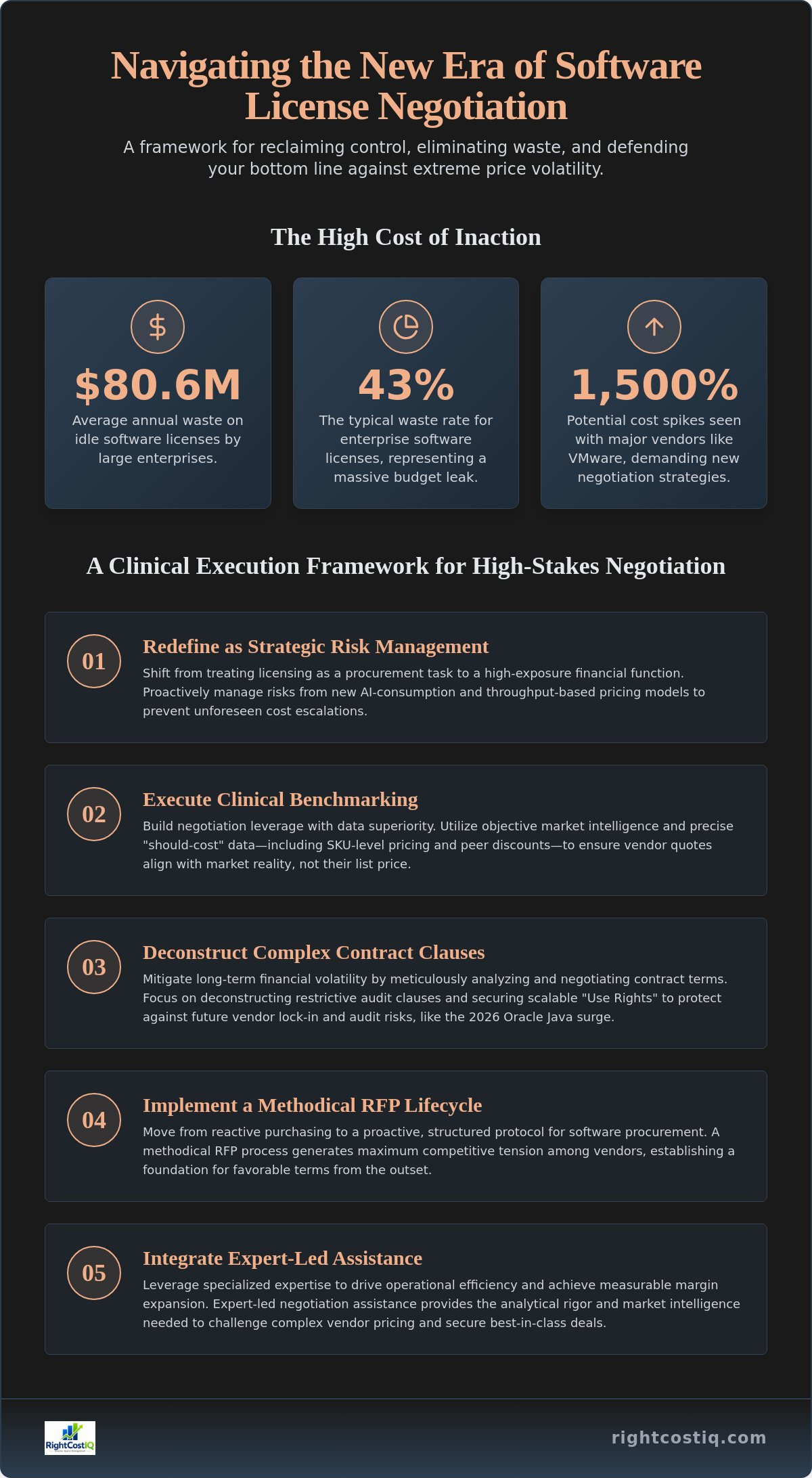
Large enterprises are currently hemorrhaging an average of $80.6 million annually on software licenses that sit entirely idle. This 43% waste rate isn't just a budget leak; it's a failure of strategic oversight in an era where VMware costs have spiked by up to 1,500% and Microsoft has eliminated volume-based discounts. You likely recognize that negotiating software license agreements has shifted from a routine procurement task to a high-stakes financial defense. The opacity of AI-integrated pricing and the aggressive shift toward subscription-only bundles have left most organizations vulnerable to extreme price volatility.
This article provides a clinical execution framework to reclaim control over your vendor ecosystem. You'll learn to neutralize vendor lock-in, eliminate redundant license waste, and optimize total cost of ownership through data-driven benchmarking. We will examine the specific mechanics of securing favorable renewal rights and mitigating the 2026 surge in Oracle Java audits to ensure your software stack serves your bottom line rather than draining it.
Key Takeaways
- Redefine software licensing as a strategic risk management function to successfully navigate the transition toward AI-consumption and throughput-based pricing models.
- Execute clinical benchmarking for negotiating software license agreements to align vendor pricing with objective market intelligence and precise "should-cost" data.
- Mitigate long-term financial volatility by deconstructing restrictive audit clauses and securing scalable "Use Rights" within complex enterprise contracts.
- Implement a methodical RFP lifecycle to generate maximum competitive tension and establish a structured protocol for high-stakes software procurement.
- Integrate expert-led negotiation assistance to drive operational efficiency and achieve measurable margin expansion across the entire vendor ecosystem.
The 2026 Software Licensing Landscape: Strategic Risks and Financial Volatility
Effective corporate governance now requires treating a Software license as a high-exposure financial instrument rather than a static administrative asset. The 2026 market has transitioned into a period of extreme structural volatility. Vendors have moved beyond simple volume discounts to aggressive, consumption-based monetization strategies. Traditional procurement tactics, which rely on historical price anchoring, consistently fail because they don't account for these new variable cost drivers. Mastering the process of negotiating software license agreements in this environment requires a shift toward clinical risk management.
Strategic risks are no longer limited to over-provisioning. They now include unmanaged throughput escalations and opaque AI integration costs. Organizations must recognize that vendor profitability is increasingly tied to "sticky" consumption metrics that are difficult to forecast without advanced analytics. This shift demands a methodical protocol that prioritizes data-backed leverage over conversational negotiation. If your team treats a renewal as a simple line-item update, you're likely absorbing hidden 20% price increases recently implemented by major providers like Microsoft.
The Rise of AI-Integrated Licensing Models
Enterprise software providers are aggressively implementing "AI-uplift" fees to monetize generative capabilities. These models typically bifurcate into fixed-fee "digital labor" agreements or variable-consumption token systems. Fixed-cost licenses offer predictability but often include high minimum commitments that lead to significant waste. Conversely, variable models introduce massive financial exposure if usage isn't strictly governed. Generative AI tokens represent a hidden cost layer; they often lack transparent audit trails, making it nearly impossible for procurement teams to verify invoice accuracy without specialized tracking tools. Negotiating software license agreements now requires explicit contract language to cap these consumption-based escalations.
SaaS Sprawl and the Erosion of Procurement Control
Decentralized purchasing remains a primary driver of margin erosion. Large enterprises currently waste an average of $80.6 million annually on unused licenses, according to recent industry benchmarks. This sprawl is exacerbated by shadow IT, where departmental heads bypass central procurement to acquire niche AI tools. This fragmentation destroys negotiation leverage. Establishing a clinical baseline for spend under management is the first step toward recovery. By centralizing visibility, organizations can consolidate their footprint and utilize a structured should-cost analysis to identify where redundant applications are cannibalizing the budget. Regaining control requires moving from reactive purchasing to a proactive, centralized governance model.
Clinical Benchmarking: The Foundation of Negotiation Leverage
Negotiation leverage isn't a product of charisma; it's a byproduct of data superiority. Clinical benchmarking transforms vague market sentiment into actionable intelligence by applying granular market data to specific vendor proposals. This process eliminates the "black box" of enterprise pricing, allowing procurement teams to identify exactly where a quote deviates from peer-group norms. When negotiating software license agreements, relying on list price is a strategic failure. You must instead employ a "should-cost" methodology that deconstructs the vendor’s cost structure, including their research and development overhead, support margins, and historical discount triggers.
Effective category cost benchmarking requires specific data points: SKU-level pricing, regional price variances, and peer-weighted discount tiers. By aggregating this intelligence, organizations move from a defensive posture to offensive execution. This analytical rigor ensures that every dollar committed is validated against the current market reality. Without this foundation, your team is simply guessing at what constitutes a fair deal.
Identifying Category Savings through Analytics
Advanced analytics are essential to strip away the deliberate complexity of bundled pricing. Modern vendors often hide margin by grouping high-value services with low-utility features. Utilizing Procurement Category Cost Benchmarking allows your team to isolate core license costs and eliminate paying for "shelfware." Price benchmarking is the clinical comparison of vendor quotes against verified market data. By revealing these hidden margins, you can force vendors to justify every line item in the contract. You might find that performing a diagnostic analysis of your contract portfolio reveals immediate opportunities for cost avoidance before your next renewal cycle begins.
Market Price Trending as a Negotiation Lever
Forecasting the 2026 to 2028 cycle is critical for long-term budget stability. With Microsoft 365 suite prices scheduled to rise on July 1, 2026, and 41% of SaaS companies now employing usage-based or hybrid pricing models, historical spend isn't a reliable predictor of future costs. Market price trending allows you to time your negotiations to coincide with vendor fiscal year-ends and broader market volatility. This data provides the necessary ammunition to challenge "standard" 5% to 10% annual price escalators that vendors often bake into long-term agreements. When you possess a data-backed forecast of market direction, you can demand price protection clauses that reflect actual market indices rather than arbitrary vendor targets. Negotiating software license agreements without this forward-looking intelligence leaves your organization exposed to the escalating renewal rates that characterize the current software economy.
Deconstructing Complex Contract Clauses: Beyond Legal Jargon
Contractual architecture dictates long-term financial performance. When negotiating software license agreements, legal boilerplate often masks significant financial exposure. Strategic procurement leaders must view every clause as a variable that either protects or erodes the bottom line. Beyond the price per seat, the structural integrity of your agreement rests on Negotiated Renewal Rights and precise "Use Rights." These elements determine your ability to scale operations without triggering unforeseen costs or vendor lock-in. A clinical approach to contract deconstruction identifies "poison pills" in termination and assignment clauses that can paralyze a business during a merger, acquisition, or simple technology pivot.
Standard liability caps also require modern scrutiny. In 2026, enterprise legal teams are increasingly rejecting default caps that lack specific carve-outs for data breaches and intellectual property indemnification. Data processing addenda now require vendors to disclose LLM subprocessors. Failing to secure these disclosures creates a compliance vacuum that can lead to regulatory penalties. High-stakes negotiation requires moving beyond "standard" terms to secure a contract that functions as a flexible financial asset. You don't want to discover a liability gap during a critical security event.
Audit Defense and Financial Risk Mitigation
Audit clauses represent a massive unmanaged liability. These "soft" clauses often grant vendors broad access to internal usage data, which is then used to manufacture compliance gaps. You must negotiate to limit audit frequency and define the specific telemetry tools the vendor can utilize. It's critical to establish a "cure period" that allows for self-correction before financial penalties apply. For a deeper analysis of vendor behavior during these cycles, consult our framework on Negotiation Strategies for High-Value Procurement to understand how vendors weaponize compliance data to force unfavorable renewals.
Aligning Usage with Subscription Tiers
The financial danger of "shelfware" remains a primary driver of wasted spend. Downward flexibility is a non-negotiable requirement for any modern enterprise agreement. Negotiating software license agreements should prioritize license portability. This allows you to reassign seats across subsidiaries or departments without additional fees. Additionally, agreements must account for fluctuating AI-consumption needs. By structuring contracts with "step-down" rights, you can reduce license counts at renewal without penalty, ensuring your subscription tiers remain aligned with actual throughput rather than theoretical capacity.
The RFP Framework for Software Procurement: A Methodical Protocol
The Request for Proposal (RFP) is not merely an administrative hurdle; it's a strategic instrument designed to manufacture competitive tension in a consolidated market. When negotiating software license agreements, the RFP serves as the primary mechanism for forcing price transparency and neutralizing vendor-skewed narratives. A methodical RFP Management protocol ensures that the organization dictates the terms of engagement rather than reacting to vendor-imposed timelines. This lifecycle moves from clinical requirement gathering to rigorous performance benchmarking, creating a structured environment where vendors must compete on both cost and operational efficacy.
Establishing strict communication protocols is essential to maintain this tension. All vendor interactions must be centralized and documented to prevent the "divide and conquer" tactics often used by sales teams targeting individual department heads. By standardizing the response format, procurement teams can execute objective cost comparisons that strip away the marketing fluff and reveal the true total cost of ownership. This disciplined approach ensures that the final selection is based on data-driven performance metrics rather than the strength of a vendor's sales relationship.
Phase 1: Precision Requirement Gathering
Requirement gathering must be a surgical exercise. It's critical to differentiate core functional specifications from vendor-inflated "bloatware" that is often bundled to artificially inflate contract value. Technical requirements should be drafted to prioritize interoperability and prevent future vendor lock-in. By utilizing standardized response templates, you enable a clinical analysis that aligns with the benchmarking strategies discussed in previous sections. This phase is about defining the floor of your actual needs to ensure you don't pay for theoretical capacity or features that offer zero ROI.
Phase 2: Competitive Sourcing and Evaluation
The evaluation phase shifts the focus to active market pressure. Executing a competitive sourcing event forces vendors to reveal their true bottom-line pricing and incentive structures. This is also the optimal time to implement tail-spend management strategies to consolidate niche software vendors into a more manageable, cost-efficient portfolio. Your evaluation scorecards must integrate specific performance tracking metrics, such as uptime guarantees and support response times, into the final selection criteria.
Clinical precision in the evaluation of these metrics prevents subjective bias from influencing the final decision. If your current RFP process lacks this level of analytical depth, you can perform a diagnostic evaluation of your procurement protocols to identify immediate structural improvements. Integrating these performance trackers into the contract itself ensures that the vendor remains accountable throughout the entire lifecycle of the agreement.
Executing the Negotiation: RightCostIQ’s Precision Assistance
Strategic margin expansion depends on the clinical synchronization of market intelligence and tactical execution. While previous sections established the importance of benchmarking and contractual deconstruction, the final stage of negotiating software license agreements requires the assertive application of that data at the point of impact. Professional negotiation assistance acts as a force multiplier for procurement teams. It transforms a defensive renewal process into a proactive financial exercise. By leveraging real-time price risk management and tracking, organizations can neutralize vendor leverage and secure terms that reflect actual market value rather than aspirational revenue targets.
Transitioning from reactive procurement to proactive price risk management is essential for long-term budget stability. Professional RFP management provides a documented ROI by creating a repeatable protocol for competitive tension. This methodical approach ensures that vendors remain accountable to performance metrics and market-aligned pricing throughout the contract lifecycle. Organizations that integrate expert-led assistance consistently outperform their peers in reducing total cost of ownership and eliminating the 14.2% year-over-year increase in SaaS waste currently seen across the enterprise landscape.
The Role of the Negotiation Coach
Vendors employ specialized sales teams trained to maximize contract value through complexity and urgency. Utilizing Negotiation Assistance allows your procurement team to counter these aggressive tactics with clinical objectivity. A negotiation coach provides the external market intelligence necessary to challenge vendor claims during high-stakes renewals. This partnership ensures that your team maintains a data-driven demeanor, even when faced with significant price escalations or audit threats. The negotiation coach is a strategic partner who applies market analytics to vendor interactions. This expertise allows for the surgical removal of unnecessary "AI-uplift" fees and the securing of favorable downward flexibility rights.
Securing Long-Term Procurement Efficiency
Efficiency in software procurement is not a one-time achievement but a continuous operational requirement. Implementing a robust Vendor Performance Tracking Service ensures that the value negotiated during the RFP phase is actually delivered during the contract term. This tracking identifies where vendors fail to meet service level agreements, providing additional leverage for future negotiations. Establishing a repeatable framework for software category management allows the organization to scale its procurement successes across all business units. For a comprehensive look at enterprise-wide strategy, refer to our clinical framework for Category Management in Procurement. By treating software as a strategic category rather than a series of isolated transactions, you ensure sustained margin expansion and operational resilience.
Securing Strategic Advantage in the 2026 Renewal Cycle
The 2026 software market demands a transition from traditional procurement to clinical risk management. Organizations must move beyond the "black box" of vendor pricing by implementing a methodical RFP framework and deconstructing opaque contract clauses. Negotiating software license agreements isn't just a legal formality; it's a primary driver of margin expansion. By leveraging data superiority and "should-cost" analytics, your team can neutralize aggressive vendor tactics and reclaim control over escalating renewal rates.
RightCostIQ provides the sophisticated tools necessary to execute this strategy with precision. Our platform offers cost benchmarking analytics across 500+ procurement categories and a professional RFP management framework to ensure competitive tension. With expert negotiation assistance for high-value contracts, you'll eliminate financial volatility and optimize vendor performance. Optimize your next software negotiation with RightCostIQs clinical benchmarking tools and establish a repeatable protocol for long-term procurement efficiency. You're now equipped to turn software spend into a strategic financial asset.
Frequently Asked Questions
What are the most important clauses to negotiate in a software license agreement?
The most critical clauses include Use Rights, audit limitations, and Negotiated Renewal Rights. Use Rights define your long-term scalability, while audit limitations protect against the 20% of Java users Gartner predicts will face Oracle audits by 2026. You must also secure price protection caps and termination for convenience to maintain operational flexibility. These clauses prevent vendor lock-in and ensure your contract functions as a manageable financial asset rather than a liability.
How does consumption-based pricing affect software negotiation strategy?
Consumption-based models shift financial risk directly to the licensee by introducing variable cost volatility. With 41% of SaaS companies now using usage-based pricing, negotiating software license agreements requires a shift toward throughput monitoring and contractually mandated usage caps. You must prioritize "step-down" rights to ensure you aren't paying for theoretical capacity. Clinical oversight of these metrics is essential to prevent unmanaged budget escalations driven by variable AI tokens and throughput spikes.
Can I negotiate a software renewal if we are already locked into the vendor ecosystem?
You can negotiate renewals effectively even within a locked-in ecosystem by manufacturing competitive tension through a managed RFP process. While switching costs are high, vendors still prioritize market share retention and predictable revenue growth. Utilizing clinical benchmarking allows you to challenge vendor quotes with objective market data. Positioning a potential migration as a viable financial exercise, even if complex, forces vendors to offer more favorable renewal terms to avoid churn.
What is the difference between a software license audit and a compliance review?
A software license audit is a formal, contractually mandated investigation, whereas a compliance review is often a vendor-led exercise designed to identify upsell opportunities. Audits carry high financial risk and legal exposure, often weaponized by vendors to force new subscription commitments. Compliance reviews are softer but frequently serve as the precursor to a formal audit. You should treat both with clinical caution and involve a negotiation coach to limit unauthorized data disclosure.
How far in advance should I start negotiating a major software renewal?
Negotiations for major enterprise software renewals should ideally commence 9 to 18 months before the contract expiration date. Starting early allows your team to execute a methodical RFP and gather the clinical benchmarking data required for leverage. If you wait until the renewal notice arrives, you lose the ability to credibly threaten migration. Early engagement is the only way to neutralize the aggressive timelines and "take it or leave it" tactics used by major vendors.
Is it possible to negotiate price caps on future software renewals?
Securing price protection caps on future renewals is a standard requirement for mitigating long-term financial volatility. You should negotiate caps tied to the Consumer Price Index (CPI) or a fixed percentage, typically between 3% and 5%. Without these protections, you are vulnerable to the extreme price hikes recently seen in the VMware and Microsoft ecosystems. negotiating software license agreements with these caps ensures your total cost of ownership remains predictable across multiple fiscal cycles.
How do AI features change the way software licenses are priced in 2026?
AI features have introduced "AI-uplift" fees and variable consumption models that complicate the traditional per-user seat license. Vendors are increasingly packaging AI as "digital labor" or throughput-based tokens, which can lead to rapid cost escalations. In 2026, contracts must include specific disclosures regarding AI subprocessors and explicit caps on token-based spending. This clinical approach prevents vendors from using opaque AI metrics to erode your procurement margins and inflate software budgets beyond sustainable levels.
What data do I need to benchmark my software costs effectively?
Effective benchmarking requires SKU-level pricing, historical discount tiers, and peer-weighted market data. You must also analyze regional price variances and vendor-specific fiscal year-end incentives to identify optimal negotiation windows. This data allows you to perform a "should-cost" analysis that strips away bundled margins. Without granular intelligence on what similar organizations are paying for identical throughput, your procurement team lacks the leverage necessary to secure a clinical advantage during high-stakes renewals.


