
What if the most significant value your team generates remains invisible to the traditional profit and loss statement? Procurement leaders often face a persistent credibility gap when reporting to the CFO, primarily due to inconsistent benchmarking data and the inherent difficulty of quantifying prevented expenditures. Mastering the distinction of cost avoidance vs cost savings in procurement is the only way to bridge this divide in an era where 80% of companies have digitized their sourcing processes. Relying on outdated reporting metrics creates friction with finance departments and obscures the strategic impact of your negotiations.
You'll gain a definitive reporting framework designed to transform ambiguous data into high-impact negotiation outcomes and surgical C-suite reporting. This clinical analysis details the engineering of future financial resilience through price risk management while ensuring hard savings hit the bottom line. We will analyze the 2026 regulatory shifts, including the federal preference for fixed-price contracts, to provide a roadmap for sophisticated financial optimization. This guide ensures your procurement outcomes align perfectly with corporate growth metrics and operational efficiency goals.
Key Takeaways
- Establish a definitive distinction between cost avoidance vs cost savings in procurement to eliminate reporting ambiguity and strengthen C-suite credibility.
- Deploy clinical calculation methodologies, including Price Variance analysis, to accurately isolate procurement’s impact on P&L performance.
- Leverage category-specific benchmarking and market price trending to identify value leakage and establish data-driven baselines for 2026.
- Utilize RFP management as a primary vehicle for realized savings while applying negotiation assistance to engineer strategic cost avoidance.
- Integrate vendor performance tracking and price risk management to transform procurement from a transactional function into a strategic financial architect.
Defining the Financial Dichotomy: Hard Savings vs. Strategic Avoidance
Procurement value is bifurcated into two distinct financial realities: what is captured today and what is prevented tomorrow. This distinction between cost avoidance vs cost savings in procurement determines whether a sourcing team is viewed as a back-office cost center or a strategic architect of the balance sheet. CFOs demand hard data. While they instinctively prioritize realized savings because they translate directly into P&L performance, a clinical procurement framework requires both metrics to ensure long-term fiscal health. Ignoring the prospective nature of avoidance leads to budget erosion and unmanaged risk.
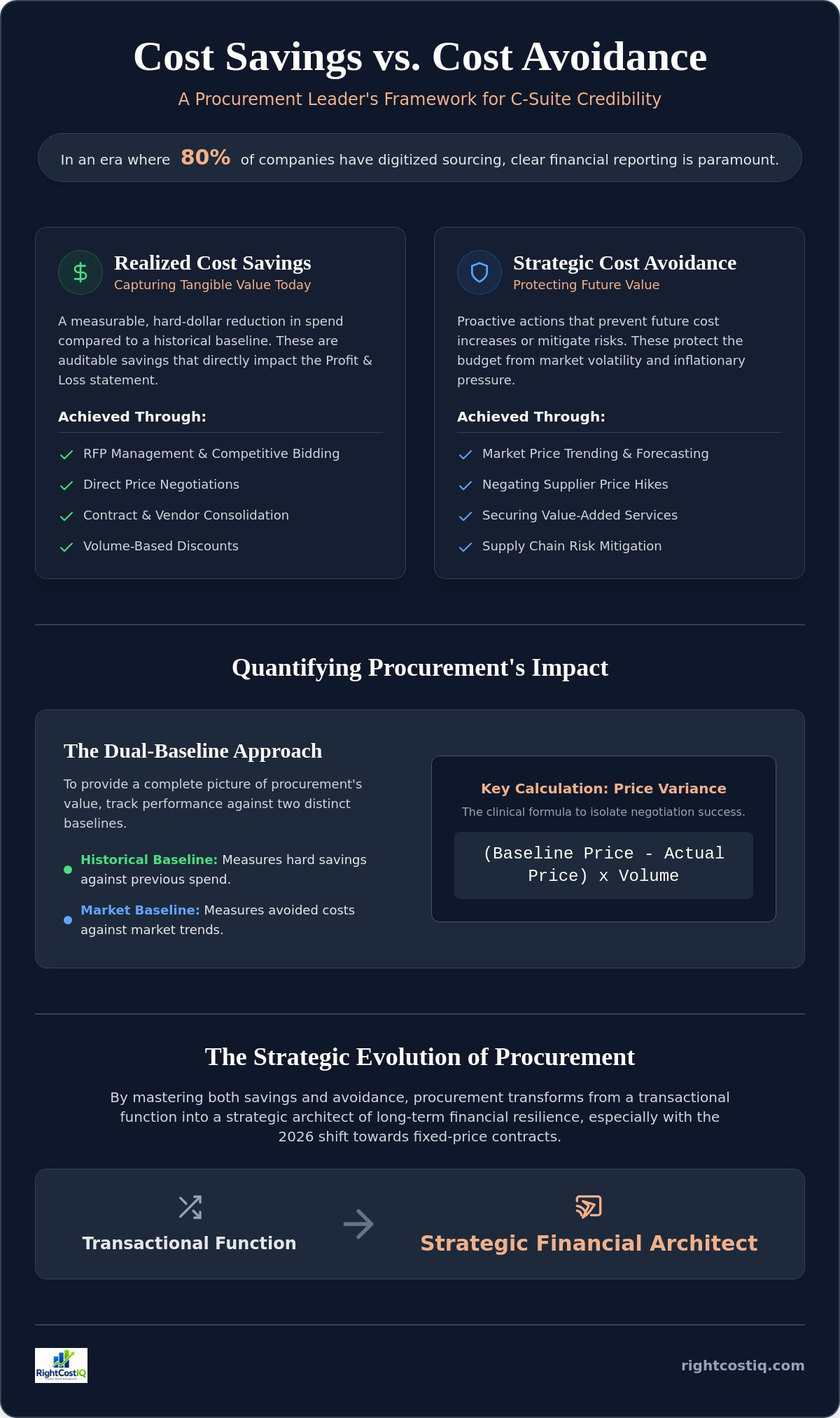
Realized savings, often termed "hard savings," represent a measurable decrease in spend compared to the previous fiscal period or a documented historical baseline. These are the figures that finance teams can audit and verify with precision. Conversely, cost avoidance involves proactive measures that prevent future price escalations or mitigate operational risks. While these don't always lower the current year's budget, they protect the organization from market volatility and inflationary pressures. Integrating both into a holistic performance dashboard is essential for any enterprise pursuing comprehensive cost reduction strategies.
The Mechanics of Realized Cost Savings
Realized savings are achieved through aggressive, data-driven interventions in the supply chain. This process often begins by utilizing RFP management to drive down unit costs through competitive transparency. Procurement teams capture hard savings by executing direct price negotiations that result in lower invoice totals for the same volume of goods. They also focus on activating contract consolidations and volume-based discount triggers to maximize purchasing power. These actions produce tangible results that appear immediately on financial statements, providing the clear ROI that executive leadership expects.
The Architecture of Strategic Cost Avoidance
Cost avoidance is about engineering future resilience. It relies heavily on market price trending and forecasting to identify and neutralize potential price hikes before they manifest. A clinical understanding of cost avoidance vs cost savings in procurement allows teams to defend budgets against inflationary spikes. Using a negotiation coach approach, teams can negate supplier price increases by leveraging benchmarking data to prove market stability. They also secure value-added services at no additional cost and implement risk mitigation strategies that prevent the catastrophic expenses associated with supply chain disruptions. In the 2026 landscape, where federal mandates favor fixed-price contracts, the ability to avoid future cost increases is as critical as cutting current spend.
Quantifying Impact: Calculation Methodologies and P&L Integration
Precision in measurement separates procurement architects from administrative clerks. To bridge the persistent credibility gap between procurement activities and P&L results, organizations must adopt a dual-baseline approach. The Historical Baseline tracks absolute reductions against the previous year's spend, providing the hard savings data finance teams require for auditing. Simultaneously, the Market Baseline accounts for external economic shifts and inflationary pressures. This dual-track methodology is the only way to validate the ROI of cost avoidance vs cost savings in procurement to a skeptical CFO. Integrating these metrics into long-term financial forecasting models ensures that procurement is viewed as a driver of financial growth rather than a source of budget variance.
Formulaic precision is required to isolate procurement’s specific influence on the bottom line. Calculating the Price Variance—where the baseline price minus the actual price is multiplied by volume—provides a clinical view of negotiation success. Using should-cost analysis provides the necessary data to validate these savings claims by identifying the theoretical minimum cost of a product or service based on its raw components and manufacturing overhead. This clinical approach prevents suppliers from obfuscating margins and ensures that negotiation targets are grounded in technical reality. You can analyze your current cost structures to determine where hidden value remains untapped.
Modeling Savings with Benchmarking Analytics
Category cost benchmarking sets the standard for realistic target prices by comparing internal spend against broader industry data sets. Procurement teams must track realized savings against Annual Operating Plan (AOP) targets to maintain strict alignment with corporate financial goals. Spend under management serves as the primary linguistic anchor for calculating the total ROI of a procurement department. Successful Collaborative Procurement initiatives demonstrate that benchmarking is not just a tool for reduction, but a mechanism for strategic alignment across complex supply chains. By anchoring savings to external benchmarks, procurement leaders move beyond anecdotal wins to documented financial outcomes.
Documenting Avoidance through Market Intelligence
Proving price increase negation requires robust market price trending data to demonstrate that a proposed supplier hike was successfully neutralized or minimized. Quantifying the cost of doing nothing provides a stark contrast to the value generated through strategic intervention, illustrating the potential budget erosion that would have occurred without procurement's involvement. To ensure C-suite credibility, all cost avoidance claims must be supported by audit-ready documentation that links market intelligence to specific negotiation outcomes. This documentation acts as a financial shield, protecting the procurement department’s reputation during high-stakes budget reviews. Moving from transactional sourcing to this clinical architectural approach ensures every dollar of avoidance is recognized as a strategic win.
Benchmarking and Analytics: The Data Foundation of Procurement ROI
Generic market data acts as a blunt instrument in a surgical environment. For high-level decision-makers, relying on broad averages obscures the granular opportunities required to master cost avoidance vs cost savings in procurement. A clinical approach demands category-specific benchmarking that accounts for specific SKU variations, regional logistics costs, and volume-based pricing tiers. Without this precision, procurement teams can't distinguish between a market-driven price shift and a supplier-specific margin grab. Effective data architectures transform raw spend into actionable intelligence, allowing for the identification of outliers that signal immediate realized savings potential.
Identifying value leakage is particularly critical in unmanaged categories. Sophisticated analytics reveal that significant capital is lost through fragmented purchasing patterns. Optimizing tail spend management through automated analytics prevents the "invisible" erosion of budgets caused by non-contracted spend and rogue buying. By centralizing this data, organizations establish a baseline that converts reactive cost-cutting into a structured strategic architecture. This transition is fueled by the spend analytics market’s projected 17.9% CAGR through 2030, reflecting a global shift toward data-driven sourcing precision.
Clinical Category Cost Benchmarking
True leverage comes from comparing internal pricing against rigorous regional and global standards. Identifying outlier pricing, where a specific facility or department pays significantly above the established market mean, uncovers instant hard savings opportunities. This benchmarking doesn't just reveal past failures; it provides the empirical evidence needed to dominate future negotiations. When procurement leaders enter a negotiation armed with clinical category data, the conversation shifts from subjective requests to objective financial corrections. This data-driven demeanor forces suppliers to justify deviations from market norms, directly driving higher-impact outcomes.
Vendor Performance and Risk Tracking
Vendor performance tracking serves as a dual-action driver for both realized savings and strategic avoidance. Calculating the specific cost impact of vendor non-compliance, such as late deliveries or quality defects, allows procurement to reclaim lost value through service level agreement (SLA) credits. Beyond immediate recovery, clinical tracking prevents hidden costs by identifying high-risk suppliers before disruptions occur. Using this performance data to negotiate better renewal terms ensures that future contracts are anchored in proven reliability rather than supplier promises. This methodical oversight bridges the gap between traditional business functions and modern financial optimization, engineering long-term resilience across the entire supply chain.
Strategic Execution: Using RFPs and Negotiations as Financial Levers
Strategic execution is the crucible where theoretical models transform into realized financial outcomes. While previous sections established the metrics of cost avoidance vs cost savings in procurement, this phase focuses on the actual mechanisms of value capture. Professional RFP management acts as the primary lever for securing immediate hard savings by forcing suppliers into a state of competitive price transparency. It eliminates the information asymmetry that vendors typically exploit during the sourcing cycle. By contrast, strategic avoidance requires a nuanced tactical approach, utilizing sophisticated negotiation frameworks to engineer long-term price stability.
Implementing price risk management clauses within multi-year contracts is a non-negotiable requirement for 2026. These clauses act as a financial buffer against market volatility. This strategic focus on fixed-price stability aligns with the April 30, 2026, Executive Order establishing a federal preference for fixed-price contracts, a trend now permeating the private sector. Organizations must move beyond transactional interactions to a model where every contract serves as a strategic asset. Advanced negotiation assistance mitigates financial volatility by establishing structured guardrails against unpredictable market shifts.
RFP Frameworks for Maximum Competition
Structuring a bid request requires more than a list of technical specifications; it requires a strategic architecture that highlights cost avoidance opportunities. Procurement leaders must integrate market price trending data as a clinical anchor throughout the RFP process to prevent suppliers from inflating baseline costs. Evaluating the Total Cost of Ownership (TCO) ensures that supplier selection is based on long-term fiscal impact rather than short-term price optics. This clinical evaluation identifies:
- Hidden maintenance and lifecycle expenditures often omitted from initial quotes.
- Potential escalation triggers in vendor pricing models that threaten future budgets.
- Operational risks that could lead to unbudgeted expenses if left unaddressed.
Advanced Negotiation Tactics for Cost Avoidance
The negotiation coach approach shifts the focus from simple price reductions to the creation of total value. This involves negotiating aggressive price caps and "most favored nation" clauses that protect the organization from future market spikes. Securing long-term price stability is particularly critical in volatile cycles where supply chain disruptions can lead to exponential cost increases. These tactics don't always appear as a reduction in current spend, but they're essential for protecting the integrity of future budgets. By integrating price risk management directly into the negotiation phase, procurement architects build a defensive perimeter around the company's capital. To see how your current strategies measure up against 2026 standards, access our clinical procurement diagnostic.
RightCostIQ: Engineering Long-Term Financial Resilience
RightCostIQ transforms procurement from a reactive cost center into a strategic engine of financial growth. Traditional sourcing often fails because it treats cost avoidance vs cost savings in procurement as separate, disconnected activities. Our clinical framework integrates these functions into a single, cohesive strategic architecture. By combining high-velocity RFP management with advanced negotiation assistance, we ensure that immediate realized savings are captured while future price risks are systematically neutralized. This shift toward automated cost transparency allows high-level decision-makers to view their supply chain through a lens of real-time benchmarking and predictive analytics.
The 2026 procurement landscape demands a move away from manual spreadsheets toward integrated digital platforms. RightCostIQ provides the technical foundation for this evolution, offering specialized expertise in market price trending and forecasting. This data-driven approach ensures that every procurement outcome is linked directly to enterprise financial growth metrics. By treating procurement as a sophisticated financial function, organizations can achieve a level of operational efficiency that was previously unattainable. We prioritize results and efficiency over conversational warmth, positioning our platform as a powerful tool for high-stakes corporate management.
Integrated Performance and Price Risk Management
Effective financial leadership requires real-time tracking of both hard savings and strategic avoidance metrics. RightCostIQ’s clinical approach to vendor performance tracking allows for the immediate identification of value leakage; this ensures that negotiated terms are strictly enforced across the entire contract lifecycle. Forecasting future price trends enables teams to stay ahead of market shifts, moving from a defensive posture to a proactive strategic one. This integration ensures that procurement outcomes are not just anecdotal wins but are instead documented drivers of P&L performance and C-suite credibility. By linking these outcomes to enterprise growth, we provide a definitive reporting framework for the modern CFO.
The Future of Data-Driven Sourcing
The transition to a high-level consultancy model is powered by proprietary analytics that provide a definitive competitive advantage. As procurement workloads are projected to increase by 8.0% in 2026 despite contracting budgets, the only path forward is the integration of advanced technology into traditional business functions. RightCostIQ bridges this gap, providing the clinical precision required to manage complex global supply chains with minimal staffing. This architectural approach redefines the strategic importance of the procurement department, positioning it as a primary driver for financial growth. Optimize your procurement outcomes with RightCostIQ and secure your organization’s long-term financial resilience.
Mastering the Strategic Architecture of Procurement Value
Transitioning from transactional sourcing to strategic financial architecture requires clinical mastery of cost avoidance vs cost savings in procurement. You've established that while realized savings drive immediate P&L performance, strategic avoidance engineers the long-term resilience required to navigate 2026's volatile market. Deploying category-specific benchmarking and should-cost analysis provides the empirical evidence needed to dominate high-stakes negotiations. By integrating price risk management directly into your contract lifecycle, you protect corporate capital from unmanaged inflationary spikes and operational leakage.
RightCostIQ has delivered global procurement optimization since 2023, specializing in professional RFP management and negotiation assistance. Our platform provides expert market price trending and forecasting to ensure your team moves beyond reactive cost-cutting into proactive value architecture. It's time to transform your department into a strategic architect for enterprise growth. Scale your procurement efficiency with RightCostIQ's clinical analytics platform. Your path to definitive C-suite credibility and optimized financial outcomes starts with data-driven precision.
Frequently Asked Questions
Is cost avoidance considered a 'real' saving by CFOs?
CFOs typically classify cost avoidance as a strategic value-add rather than a direct P&L impact. While realized savings reduce current budgets, avoidance prevents future erosion. Proving its reality requires audit-ready documentation that links market intelligence to specific negotiation outcomes to ensure procurement isn't just claiming credit for market-driven shifts.
What is the most accurate way to calculate cost savings in 2026?
The Price Variance formula remains the gold standard for accuracy. Multiply the delta between the historical baseline price and the actual invoice price by the total volume. In 2026, this calculation must be adjusted for market price trending to isolate procurement’s specific influence from broader economic shifts or regulatory changes like the April 2026 federal fixed-price mandates.
How can I prove cost avoidance during a supplier price increase?
Proving avoidance requires a delta analysis between a supplier’s documented price hike and the final negotiated rate. Use market price trending data to demonstrate that the proposed increase exceeded industry norms or was successfully neutralized. This clinical approach transforms a defensive negotiation into a documented financial win that finance teams can validate.
Why is benchmarking critical for differentiating savings from avoidance?
Benchmarking establishes the objective Market Baseline necessary to distinguish cost avoidance vs cost savings in procurement. It identifies whether a price reduction is a hard saving against historical spend or a strategic avoidance of an above-market quote. Without category-specific data, reporting remains ambiguous and lacks the precision required for C-suite credibility.
Can RFP management software help track both metrics simultaneously?
Advanced RFP management platforms track both metrics by capturing the initial bid baseline and the final contract value. These systems document the value gap created through competitive transparency and negotiation assistance. This dual-track tracking ensures that every dollar of prevented expenditure is visible and auditable for finance leadership during year-end reviews.
How does price risk management influence cost avoidance strategies?
Price risk management provides the technical guardrails for avoidance strategies. By implementing price caps and leveraging the 2026 preference for fixed-price contracts, procurement architects prevent future budget volatility. This methodical approach converts theoretical risk into a structured financial architecture that protects the organization’s bottom line from unpredictable market cycles.
What are the common mistakes when reporting procurement ROI to the board?
The most frequent error is conflating realized savings with prevented costs in a single line item. Boards require a clear separation between hard P&L impact and strategic risk mitigation. Failing to provide clinical benchmarking data to support these claims often results in a loss of departmental credibility and a failure to secure future technology investments.
How do I calculate the 'Total Cost of Ownership' in a cost avoidance model?
Total Cost of Ownership (TCO) in an avoidance model includes the unit price plus lifecycle expenditures and risk-adjusted disruption costs. Calculate the delta between the TCO of a standard market offering and your strategically negotiated contract. This reveals the total value generated through clinical risk management and vendor performance tracking beyond the initial purchase price.


