
With the average cost of a data breach reaching $4.9 million, procurement leaders can no longer afford the financial volatility of subjective vendor vetting. You've likely experienced the friction of unpredictable price hikes or the frustration of presenting risk reports to the C-suite that lack objective data. Building a vendor risk assessment matrix is the primary mechanism to transform these vulnerabilities into quantifiable strategic assets that drive superior negotiation outcomes.
This article provides a data-driven framework to architect a scalable matrix that mitigates supply chain volatility and optimizes high-stakes procurement. We'll examine how to integrate market intelligence and cost benchmarking into your risk axes, moving beyond basic compliance to achieve true operational resilience. You'll learn to leverage risk data to gain negotiation power and streamline RFP cycles for maximum financial efficiency. Since 85% of clients now consider SOC 2 compliance a critical factor, your framework must align technical security with financial performance metrics to ensure long-term stability and competitive advantage.
Key Takeaways
- Transition from static vendor lists to a quantitative framework that measures risk probability and impact to safeguard enterprise margins in volatile markets.
- Deploy a two-axis model utilizing weighted risk scoring to differentiate between critical procurement categories and routine suppliers effectively.
- Integrate price risk management and market price trending into your matrix to forecast future vendor-related costs with clinical precision.
- Execute a systematic process for building a vendor risk assessment matrix that categorizes the procurement ecosystem based on organizational priorities.
- Transform risk scores into negotiation leverage, using objective data to dictate RFP invitation lists and optimize high-stakes contract terms.
The Strategic Necessity of a Vendor Risk Assessment Matrix
A vendor risk assessment matrix functions as a clinical instrument for quantifying the probability of supplier failure and the severity of its impact on enterprise operations. While many organizations treat risk management as a compliance-driven checkbox, sophisticated procurement leaders recognize it as a prerequisite for protecting margins. Building a vendor risk assessment matrix allows firms to move beyond high-level qualitative assumptions and adopt a data-driven framework that measures risk in financial terms. This shift transforms procurement from a reactive crisis-management function into a proactive strategic driver of supply chain resilience.
The reliance on legacy vetting processes often leaves companies vulnerable to sudden market shifts and supplier instability. A quantitative matrix provides the objective data required for C-suite reporting, replacing vague concerns with actionable risk scores. By standardizing the evaluation process, procurement teams can ensure consistency across diverse categories, from high-spend raw materials to critical IT infrastructure. This structured approach is essential for maintaining operational continuity and optimizing the total cost of ownership across the entire vendor ecosystem.
Beyond Cybersecurity: The Total Cost of Vendor Failure
The financial impact of vendor failure extends into every corner of the balance sheet. While a 2024 IBM report identifies the average data breach cost at $4.9 million, the operational erosion from supplier instability often exceeds this figure through cumulative efficiency losses. Procurement teams must account for the hidden costs of non-compliance and service interruptions that directly degrade EBITDA. In 2026, 57% of organizations terminated a vendor relationship due to security concerns, a trend that underscores the necessity of a rigorous Third-Party Risk Management strategy that looks beyond basic compliance. Integrating these factors into a comprehensive risk framework allows for precise procurement category cost benchmarking, ensuring that vendor selection is based on reliability rather than surface-level price points.
Why Static Spreadsheets Undermine Strategic Procurement
Manual data entry creates a dangerous information asymmetry in an era defined by rapid market shifts. Building a vendor risk assessment matrix on a foundation of static data is a strategic liability, as spreadsheets cannot capture real-time performance fluctuations. Stale information undermines high-stakes RFP management, often masking a vendor's deteriorating financial health or escalating price volatility. A dynamic matrix must incorporate real-time market price trending to provide an accurate forecast of supplier performance. This approach transforms the risk matrix into a live clinical tool, enabling procurement teams to pivot before market disruptions impact the bottom line. Relying on outdated records in a high-stakes negotiation is a recipe for margin compression and operational failure.
Core Components of a High-Performance Risk Matrix
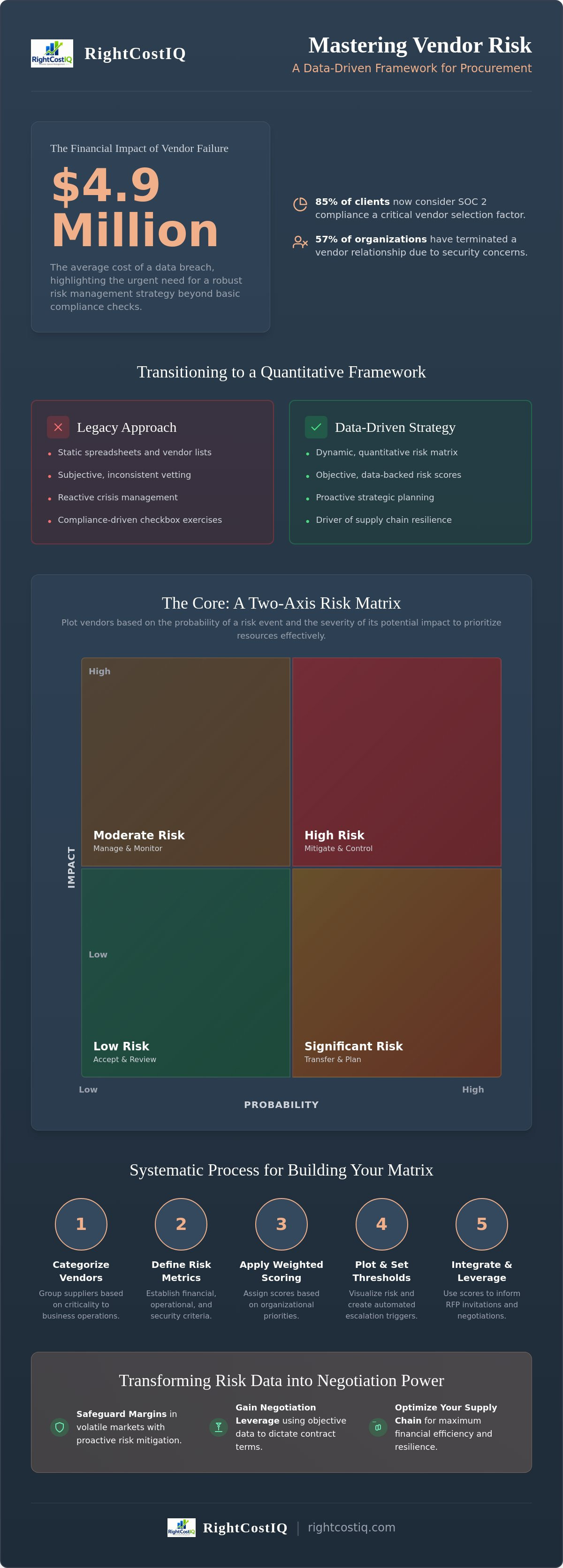
Building a vendor risk assessment matrix requires a structural framework that moves beyond binary security checks. High-performance models utilize a two-axis grid to intersect the probability of a risk event with the severity of its potential impact. This architecture ensures that procurement resources are allocated based on actual exposure rather than administrative convenience. By implementing weighted risk scoring, organizations can adjust the significance of specific metrics based on the procurement category's criticality. For instance, a vendor providing primary raw materials requires a higher weighting for operational reliability than a secondary office supplies provider. This clinical approach allows for the precise allocation of vetting resources where they deliver the highest return on risk mitigation.
Defining clear thresholds within this matrix is essential for automated escalation protocols. When a supplier's risk score exceeds a predetermined limit, the system should trigger immediate intervention from senior procurement analysts. This methodology eliminates the subjectivity often found in manual vetting processes. Integrating qualitative insights with quantitative metrics, such as liquidity ratios or lead time variability, provides a holistic view of supplier health. Utilizing a standardized Vendor Risk Assessment Matrix allows teams to categorize vendors into distinct tiers, facilitating more efficient oversight and resource distribution across the entire supply chain ecosystem.
Defining the Axes: Impact vs. Probability in Supply Chains
The "Impact" axis measures the potential damage to enterprise EBITDA and operational continuity. This dimension must account for spend under management and the difficulty of supplier replacement. The "Probability" axis evaluates the likelihood of failure based on historical vendor performance tracking and current market volatility. A standard 5x5 grid provides the necessary granularity for enterprise-level categorization, ranging from negligible to catastrophic impact. This structure allows decision-makers to visualize risk concentrations and prioritize mitigation efforts with mathematical certainty. Precise categorization at this stage is a prerequisite for effective resource deployment in the subsequent RFP management phases.
Risk Categorization: Financial, Operational, and Compliance Dimensions
Financial health metrics serve as the primary indicator of long-term viability. Procurement leaders should analyze liquidity ratios, debt-to-equity levels, and cash flow stability to predict potential insolvency before it disrupts the supply chain. Operational KPIs, including lead time variability and quality defect rates, offer immediate insights into daily reliability. Finally, the compliance dimension must integrate modern standards. As of 2026, adherence to ISO/IEC 27001:2022 and SOC 2 Trust Services Criteria is a mandatory requirement for 85% of clients. Incorporating these regulatory benchmarks ensures that building a vendor risk assessment matrix reflects the full spectrum of modern enterprise risk, from data security to environmental sustainability mandates. For suppliers managing physical logistics, ensuring asset protection is equally critical; you can explore Ghost 2 Immobiliser – Autowatch as a proactive measure for securing vehicle fleets against theft.
Quantifying Risk: Financial and Operational Metrics
Quantifying risk requires a shift from qualitative descriptions to measurable financial and operational indicators. Building a vendor risk assessment matrix that ignores price volatility leaves the enterprise exposed to significant margin erosion. While traditional models focus heavily on cybersecurity, a strategic procurement framework must prioritize the financial stability of the supply chain. Price risk management serves as a critical dimension here, allowing procurement leaders to assess the likelihood of sudden cost escalations. By integrating these metrics, organizations can move beyond surface-level vetting and adopt a clinical approach to supplier selection that protects the bottom line.
Effective quantification relies on a robust methodology for benchmarking vendor pricing against market standards. This process identifies outliers where a supplier's cost structure diverges from the industry average, signaling potential operational inefficiency or predatory pricing strategies. Market price trending provides the predictive data required to forecast future vendor-related costs with precision. This forward-looking analysis is a prerequisite for maintaining budget stability in volatile commodity markets. Validating these risk assumptions through continuous vendor performance tracking ensures that the matrix remains an accurate reflection of real-world supplier reliability.
Price Risk Management: Forecasting Financial Volatility
Market price forecasting acts as the primary defense against surprise budget variances. When building a vendor risk assessment matrix, procurement architects must analyze how commodity price shifts impact specific vendor contract stability. This analysis identifies suppliers whose pricing models are most vulnerable to external market shocks. Linking this data to Procurement Category Cost Benchmarking allows teams to identify overpayment risks and establish clinical negotiation levers. Proactive forecasting transforms price volatility from an unmanaged threat into a quantifiable variable within the procurement strategy, enabling more resilient financial planning.
Performance Tracking: Quantifying Vendor Reliability
Continuous monitoring is the only way to validate the "Probability" axis of your risk matrix. A structured framework for performance tracking measures KPIs such as lead time variability and quality defect rates in real time. This performance data feeds directly back into the risk probability score, ensuring that the matrix evolves as vendor reliability fluctuates. Utilizing a professional Vendor Performance Tracking Service provides the granular data necessary for these real-time risk adjustments. This feedback loop eliminates the danger of relying on stale annual reviews, allowing procurement departments to execute rapid course corrections before supplier failures impact enterprise EBITDA.
Step-by-Step: Building Your Vendor Risk Assessment Matrix
Constructing a resilient procurement framework requires a methodical sequence of data integration and strategic weighting. Building a vendor risk assessment matrix is not a one-time administrative task but a continuous architectural process. To ensure the matrix delivers actionable insights, procurement teams must follow a structured five-stage execution plan:
- Identify and Categorize: Map every entity within the procurement ecosystem to distinguish between strategic partners and transactional vendors.
- Define and Weight Criteria: Establish risk factors based on organizational priorities, such as financial liquidity or operational criticality.
- Data Collection: Aggregate granular information through structured RFPs, historical performance logs, and real-time market intelligence.
- Scoring and Mapping: Assign numerical values to populate a visual heatmap for immediate diagnostic analysis.
- Mitigation Protocols: Develop specific action plans for high-risk quadrants to ensure enterprise resilience and operational continuity.
This systematic approach ensures that data, not intuition, drives procurement decisions. By standardizing these steps, organizations can maintain a clinical overview of supplier health even as market conditions fluctuate. This clarity is a prerequisite for effective resource deployment and margin protection across the entire supply chain.
Establishing Scoring Criteria and Weighting Factors
Assigning numerical values to qualitative factors like "reputational risk" removes the subjectivity that often plagues manual vetting processes. Strategic architects must recognize that "Critical" vendors require a different weighting framework than those managed under Tail Spend Management. For a primary manufacturer, operational reliability and financial liquidity might carry a 40% weight. Conversely, for a software provider, SOC 2 compliance and ISO 27001:2022 status take precedence. Balancing these dimensions correctly prevents over-investment in low-impact areas while securing the core supply chain against catastrophic failure.
Developing the Visual Heatmap and Response Protocols
A high-utility heatmap provides an instantaneous visualization of risk concentration across the vendor landscape. Suppliers occupying the "Red" zone represent significant threats to enterprise EBITDA and require immediate clinical intervention. Response protocols for these high-risk entities should include mandatory secondary sourcing, increased audit frequencies, or immediate contract termination. By mapping out these vulnerabilities, procurement leaders can allocate their oversight resources with mathematical precision. Execute a clinical audit of your current supplier risk profile by accessing our procurement risk diagnostic tool to identify immediate vulnerabilities in your supply chain.
Integrating Risk Matrices into RFP Management and Negotiation
The final stage of procurement optimization involves weaponizing risk data within the sourcing lifecycle. Building a vendor risk assessment matrix creates a clinical filter that dictates which suppliers earn an invitation to the RFP process. Instead of broad, unvetted invitations, procurement architects use risk scores to exclude vendors whose financial or operational profiles exceed enterprise risk appetites. This targeted approach accelerates the sourcing cycle and ensures that negotiation efforts are spent only on viable, high-performance candidates. It’s a strategic shift that moves procurement from a general administrative function to a high-stakes financial gatekeeper.
Strategic procurement requires that risk mitigation is baked into the contract's DNA. Risk scores should directly influence Service Level Agreement (SLA) structures, mandating more rigorous reporting or higher penalty clauses for vendors in elevated risk categories. This data-driven framework ensures that the burden of risk is shared equitably between the enterprise and the supplier, protecting the balance sheet from predictable failures. When risk is quantified, it becomes a tradable commodity within the contract, allowing for more precise control over total cost of ownership.
Leveraging Matrices for RFP Optimization and Sourcing
Filtering potential suppliers based on pre-calculated risk thresholds is the most efficient way to reduce supply chain volatility. By integrating matrix scores into RFP Management: Strategic Frameworks, procurement teams can automate the exclusion of non-compliant or financially unstable entities. Utilizing "Should-Cost" models alongside the risk matrix allows for a dual-layered assessment of financial viability. If a vendor's bid is significantly lower than the market benchmark while their risk score is high, it signals a potential sustainability failure that could disrupt operations. This clinical analysis prevents the selection of vendors that carry hidden, catastrophic financial liabilities under the guise of competitive pricing.
Negotiation Coaching: Using Risk Data as a Lever
Identifying a vendor's operational or financial risk provides an assertive lever during contract discussions. When building a vendor risk assessment matrix, you uncover specific vulnerabilities, such as lead time variability or debt-to-equity concerns, that can be used to negotiate lower price points or better payment terms. Risk-based pricing adjustments ensure the enterprise is compensated for the additional oversight required to manage a higher-risk supplier. Sophisticated leaders use a Negotiation Coach to execute these strategies, transforming raw risk data into clinical negotiation scripts. This approach ensures that every contractual term is mathematically justified by the supplier's risk profile, maximizing value and mitigating supply chain volatility simultaneously.
Architecting a Resilient Procurement Future
Transitioning from subjective vetting to a quantitative framework is a prerequisite for protecting enterprise margins. Building a vendor risk assessment matrix allows procurement leaders to neutralize financial volatility through clinical data integration. By aligning weighted risk scoring with real-time market price trending, organizations transform vulnerability into a strategic negotiation lever. This methodology ensures that every RFP invitation and contractual SLA is backed by mathematical certainty rather than administrative intuition.
RightCostIQ provides the technical architecture necessary to execute this transition with precision. Our platform integrates specialized price risk management analytics and global procurement benchmarking data to deliver actionable supplier insights. Combined with expert negotiation assistance, these tools empower you to secure superior terms while eliminating supply chain instability. It's time to replace reactive crisis management with proactive, data-driven sourcing that prioritizes the bottom line.
Optimize Your Procurement Strategy with RightCostIQ's RFP Management
Your journey toward a data-driven, resilient supply chain starts with a clinical assessment of your current risk profile. We look forward to helping you architect a more profitable procurement ecosystem.
Frequently Asked Questions
What is the difference between a risk assessment and a risk matrix?
A risk assessment is the clinical process of identifying and analyzing potential threats within your supply chain. The risk matrix is the quantitative visualization tool that maps these threats based on probability and impact. While the assessment provides the raw data, the matrix facilitates strategic decision making by categorizing vendors into actionable quadrants for immediate diagnostic review.
How often should a vendor risk assessment matrix be updated?
Modern procurement standards favor continuous monitoring over point in time annual reviews. For critical suppliers, your matrix should integrate real time performance data to reflect current market volatility. Less critical vendors may only require quarterly or bi annual updates. Maintaining a dynamic framework ensures your risk mitigation strategies remain relevant as supplier financial health fluctuates throughout the fiscal year.
What are the most common mistakes when building a risk matrix?
The most frequent error when building a vendor risk assessment matrix is relying on static, manual data entry. This creates a strategic blind spot where stale information masks escalating supplier instability. Other common failures include using unweighted scoring systems that treat secondary office suppliers with the same clinical criticality as primary raw material manufacturers or high spend service providers.
How do I weight financial risk against security risk?
Weighting factors must align with the vendor's specific operational role. For IT services, security criteria like SOC 2 compliance often carry a 50% weighting. In contrast, manufacturing vendors require a heavier emphasis on financial liquidity and lead time reliability to protect the supply chain. This clinical balance ensures resource allocation matches the actual potential for enterprise EBITDA erosion.
Can a vendor risk matrix help reduce procurement costs?
Yes, a risk matrix generates clinical leverage for price negotiations. By identifying a supplier's operational vulnerabilities, procurement teams can justify risk based pricing adjustments or improved SLA terms. Quantifying risk transforms it from a vague concern into a tradable commodity, allowing organizations to avoid the hidden costs of supplier failure and unmanaged budget variances that compromise margins.
What software is best for managing vendor risk matrices?
Specialized Vendor Risk Management software, such as Vanta, provides automated modules for tracking compliance. Enterprise level solutions should integrate with market intelligence tools to capture price risk and performance metrics. The best software choice facilitates the seamless flow of quantitative data into your visual matrix, eliminating the administrative inefficiencies associated with legacy, spreadsheet based risk management.
How do I present a vendor risk matrix to the C-suite?
Focus on financial outcomes and operational resilience when presenting to executive leadership. Use the heatmap visualization to highlight high risk concentrations that threaten enterprise EBITDA. Quantify the potential cost of inaction, such as the $4.9 million average breach cost found in 2024 reports, to justify the strategic necessity of a data driven risk management framework.
Should I include tail spend vendors in my risk matrix?
Tail spend vendors should be included but managed with a streamlined weighting framework. While individual tail spend suppliers carry lower financial impact, their cumulative volume can introduce significant compliance or operational risk. Applying a simplified matrix to this category ensures comprehensive visibility without exhausting the resources required for your most critical, high spend strategic partners.


