
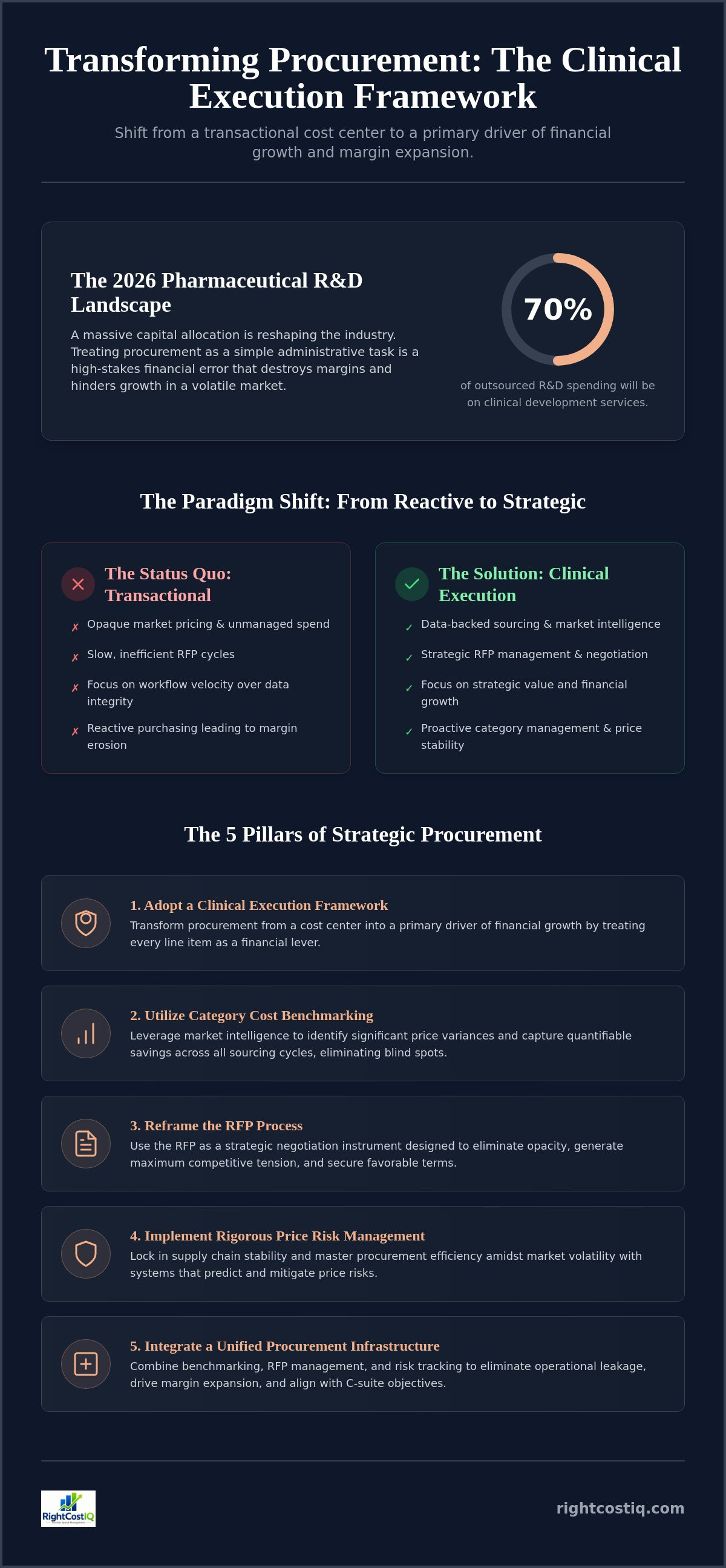
By 2026, clinical development services are projected to account for up to 70% of outsourced pharmaceutical R&D spending. This massive capital allocation proves that treating procurement as a back-office administrative task is a high-stakes financial error. You likely recognize the drain caused by opaque market pricing and RFP cycles that fail to keep pace with rapid industry shifts. Determining how to improve procurement efficiency is no longer about incremental gains; it's about survival in a volatile market where unmanaged price risk destroys margins. We agree that the status quo of reactive bidding is insufficient for modern clinical demands.
This guide delivers the data-driven methodologies and rigorous negotiation frameworks required to transform procurement into a primary driver of financial growth. You'll learn to secure quantifiable cost savings through clinical benchmarking and drastically reduce procurement cycle times. We'll preview a strategic framework for execution that ensures predictable pricing even during periods of intense market volatility. By integrating advanced cost analytics with professional negotiation assistance, you'll move from a functional buyer to a strategic architect of your organization's bottom line.
Key Takeaways
- Shift from transactional speed to a "Clinical Execution" framework to transform procurement from a cost center into a primary driver of financial growth.
- Utilize category cost benchmarking and market intelligence to identify pricing variances and capture quantifiable savings across all sourcing cycles.
- Reframe the RFP process as a strategic negotiation instrument designed to eliminate opacity and generate maximum competitive tension among vendors.
- Implement rigorous price risk management systems to lock in supply chain stability and master how to improve procurement efficiency amidst market volatility.
- Integrate benchmarking, RFP management, and risk tracking into a unified procurement infrastructure to eliminate operational leakage and drive margin expansion.
The Architecture of Procurement Efficiency: Defining Clinical Execution
Transactional speed is no longer a competitive advantage for enterprise supply chains. In the 2026 fiscal landscape, true efficiency demands a pivot toward strategic value creation. Organizations often struggle with how to improve procurement efficiency because they prioritize workflow velocity over data integrity. Clinical execution provides a rigorous framework for the systematic elimination of waste through data-backed sourcing models. This methodology treats every line item as a financial lever rather than a mere administrative requirement. It forces a transition from reactive purchasing to proactive category management.
Opaque sourcing cycles and unmanaged maverick spend frequently result in substantial margin erosion. When procurement operates without granular visibility, it remains trapped in a state of constant fire-fighting. A deep dive into The Architecture of Procurement shows that standardized processes are merely the entry point. For elite teams, these standards serve as the baseline for performance, not the final objective. The goal is to leverage these structures to support advanced cost modeling and predictive analytics. Clinical execution requires several core pillars:
- Data-Backed Sourcing: Replacing anecdotal vendor selection with rigorous category cost benchmarking.
- Waste Elimination: Systematically identifying and removing redundant approval layers and manual data entry.
- Financial Integration: Linking procurement outputs directly to balance sheet improvements.
- Precision Timing: Utilizing market intelligence to execute RFPs during optimal pricing windows.
Identifying Hidden Efficiency Leaks
Efficiency leaks often hide within the complexities of the P2P and RFP lifecycle. A comprehensive audit of these bottlenecks is the first step toward clinical optimization. Stalled vendor onboarding and prolonged approval cycles create "invisible" costs that directly impact project timelines and capital allocation. By quantifying the financial weight of these delays, teams can justify the transition to automated, rigorous systems. Optimizing the RFP Lifecycle for Enterprise Efficiency offers a blueprint for identifying these specific friction points and implementing scalable solutions that prevent capital leakage.
Aligning Procurement with C-Suite Financial Growth
Procurement must evolve to align with C-suite financial objectives. This transition requires translating traditional procurement metrics into tangible EBITDA improvements and margin expansion. By positioning the department as a "Strategic Architect," leaders can demonstrate how to improve procurement efficiency through professional infrastructure rather than fragmented manual tracking. This approach builds a compelling business case for investment in advanced analytics. It shifts the perception of procurement from a back-office cost center to a primary engine of corporate growth and financial stability.
Data-Driven Optimization: Leveraging Benchmarking and Market Intelligence
Internal spend analysis provides a useful historical view, but it often fails to account for external market shifts that dictate true value. To understand how to improve procurement efficiency, strategic architects must look beyond their own ledgers. Relying solely on past performance data creates a significant blind spot where organizations overpay simply because they lack market-wide price transparency. A modern procurement strategy integrates real-time market intelligence into every sourcing decision. This shift enables teams to pre-emptively solve sourcing challenges before an RFP ever hits the market. By aligning internal needs with external availability and pricing trends, procurement transforms from a reactive function into a predictive powerhouse.
Precision Category Cost Benchmarking
Category-specific benchmarking identifies significant price variances that internal audits frequently miss. Organizations often accept vendor quotes as "market rate" without the benefit of verified external validation. Implementing Procurement Category Cost Benchmarking allows for the construction of "should-cost" models. These models calculate what a service or commodity ought to cost based on raw material inputs, labor, and logistics rather than what a vendor claims it costs. This data provides objective leverage during high-stakes negotiations. It moves the conversation from subjective bargaining to clinical, data-driven cost justification. Identifying these variances early ensures that:
- Vendors are held to objective market standards rather than arbitrary list prices.
- Procurement teams identify "leakage" where current contracts exceed market benchmarks.
- Negotiation frameworks are built on verifiable data, increasing the likelihood of successful cost reduction.
This process eliminates the "opaque pricing" pain point that plagues most enterprise sourcing cycles. It ensures that every dollar spent is optimized against the most current market realities.
Predictive Market Price Trending
Predictive market price trending mitigates the risk of financial volatility by forecasting future cost trajectories months in advance. Timing high-value procurement cycles to coincide with market troughs can lead to substantial margin expansion and EBITDA growth. Instead of sourcing based on immediate operational need, efficient teams source based on market opportunity. Market price trending is the systematic analysis of historical and projected price data to identify optimal sourcing windows and mitigate supply chain volatility. This foresight prevents the budget erosion typically caused by sudden inflationary spikes or supply chain disruptions. Integrating these forecasts into the sourcing timeline ensures that procurement remains a driver of financial growth rather than a victim of market volatility. To evaluate your current category costs against real-time market averages, you can access our benchmarking analytics platform.
Clinical RFP Management and Negotiation Frameworks
Many organizations view the Request for Proposal as a tedious administrative hurdle. This perspective is a primary barrier to understanding how to improve procurement efficiency. A clinically executed RFP functions as a strategic instrument designed to generate maximum competitive tension and transparency. By moving beyond simple vendor consolidation, teams can implement strategic procurement practices that prioritize value-based purchasing. This approach ensures that every bid is evaluated against rigorous performance metrics rather than just the lowest price point.
Structuring High-Performance RFPs
Operational efficiency is often lost in the friction of vendor communication and manual data entry. Designing RFP Management cycles that minimize response friction is essential for attracting high-tier suppliers. Automation plays a critical role in this stage. By utilizing systems that automatically extract and normalize data from vendor proposals, procurement teams can perform clinical comparisons without the risk of manual error. This structural rigor ensures compliance through exhaustive documentation and real-time tracking. It eliminates the ambiguity that often leads to overpayment or contract disputes later in the lifecycle.
Advanced Negotiation Strategies
Professional negotiation is the final lever for margin expansion. Relying on generic automated bids often leaves significant capital on the table. Implementing specialized Negotiation Coach methodologies allows teams to secure favorable terms by leveraging the benchmarking data identified in previous stages. This process isn't about aggressive bargaining; it's about objective, data-backed justification for price concessions. When you understand how to improve procurement efficiency, you treat negotiation as a technical discipline rather than a soft skill.
A high-performing negotiation framework follows a methodical 5-step process:
- Preparation: Aligning internal requirements with market "should-cost" models.
- Opening: Establishing transparency as the baseline for the partnership.
- Exploration: Identifying non-monetary value drivers that reduce total cost of ownership.
- Bargaining: Using validated market intelligence to challenge vendor pricing variances.
- Closing: Formalizing performance-based terms that tie payments to measurable outcomes.
The ROI of expert-led negotiation coaching is particularly evident in high-value contract renewals. By reframing vendor relationships from transactional exchanges into performance-based partnerships, organizations can ensure long-term supply chain stability. This level of precision is the hallmark of a strategic architect who understands that negotiation is a technical skill. Professional assistance ensures that the final contract reflects the true market value uncovered during the benchmarking phase.
Mitigating Price Risk and Performance Volatility
Efficiency is frequently compromised when external market volatility triggers unpredicted cost increases. Traditional procurement departments often operate under the assumption of stable pricing, leaving them vulnerable to sudden inflationary spikes or supply chain disruptions. Understanding how to improve procurement efficiency requires a shift from passive monitoring to active risk mitigation. Implementing rigorous price risk management systems allows organizations to lock in supply chain stability and protect their bottom line from erratic market movements. This clinical approach ensures that financial growth remains predictable regardless of external economic shifts.
Operational efficiency is also lost through unmanaged vendor performance. When suppliers fail to meet delivery KPIs or compliance standards, the resulting delays create a ripple effect of inefficiency throughout the entire enterprise. Clinical execution involves the continuous tracking of these metrics to ensure that every partner contributes to, rather than detracts from, organizational goals. Addressing these risks isn't a seasonal activity but a constant strategic priority. It requires a relentless focus on data integrity to prevent the operational leakage that occurs when vendor standards slip.
Strategic Price Risk Management
Strategic price risk management serves as the clinical defense against margin erosion. By utilizing sophisticated market price trending models, procurement architects can forecast financial risk and identify potential cost escalations before they manifest. This foresight enables the development of advanced hedging strategies or performance-based contract structures designed to neutralize market spikes. Instead of reacting to price increases after they occur, efficient teams leverage data to secure long-term price certainty. This proactive posture transforms procurement from a department that manages costs into one that actively safeguards EBITDA.
Vendor Performance and Compliance Tracking
Securing operational efficiency requires automated tracking for supply chain compliance and delivery KPIs. Manual tracking is often fragmented and prone to error, leading to missed opportunities for contract renegotiation. A primary driver of hidden risk is unmanaged Tail Spend Management. By addressing this fragmented vendor base, organizations can consolidate spend and eliminate the operational leakage associated with low-value, high-volume transactions. Linking vendor performance data directly to contract renewal and negotiation levers ensures that suppliers remain accountable for their results. This level of oversight is essential for any leader seeking to master how to improve procurement efficiency through disciplined vendor management.
To identify specific risk vulnerabilities within your current supply chain, you can access our clinical procurement diagnostic tool.
Implementing a Strategic Procurement Infrastructure for 2026
Transitioning from fragmented spreadsheets to a unified Procurement Analytics platform is the definitive step in the clinical execution framework. Legacy systems and disconnected data silos are the primary drivers of operational leakage. To master how to improve procurement efficiency, organizations must integrate benchmarking, RFP management, and risk tracking into a single, cohesive workflow. This unification ensures that every sourcing event is informed by real-time market intelligence and rigorous risk forecasts. Scaling this infrastructure across global enterprises requires a methodical roadmap that replaces manual data entry with automated technical descriptors and financial modeling.
Measuring the success of these efficiency initiatives requires a focus on Spend Under Management (SUM). This metric serves as a clinical indicator of the department's reach and influence over total corporate expenditure. High-performing procurement teams aim to maximize SUM by capturing previously unmanaged "tail spend" and subjecting it to standardized sourcing protocols. When spend is managed through a unified infrastructure, the resulting data integrity allows for precise EBITDA tracking and margin expansion. This level of oversight transforms procurement from a functional department into a powerful tool for corporate management.
Building the Digital Procurement Core
The digital procurement core must prioritize cost transparency over simple expense management. It isn't enough to record historical spend; the system must provide a window into "should-cost" variances and market fluctuations. Ensuring data interoperability between sourcing and finance departments is essential for real-time financial reporting. This alignment allows for a seamless transition between tactical execution and high-level strategy. Referencing a validated framework for Category Management in Procurement ensures that your digital infrastructure supports long-term financial growth goals rather than just short-term administrative speed.
The ROI of Professional Sourcing Support
Professional sourcing support provides a quantifiable return on investment that exceeds the capabilities of generic automated software. By utilizing professional RFP management, organizations can save hundreds of hours of internal labor while ensuring maximum competitive tension. The margin expansion resulting from professional negotiation assistance often represents a significant percentage of the total contract value. Strategic architects recognize that expert-led intervention is a technical necessity for high-stakes renewals. This disciplined approach ensures that every contract is optimized for both price and performance. To finalize your transition into a high-efficiency procurement powerhouse, optimize your procurement outcome with RightCostIQ.
Mastering the Strategic Architecture of Clinical Sourcing
The transition from transactional purchasing to clinical execution is the definitive solution for organizations determining how to improve procurement efficiency. Success in the 2026 fiscal landscape requires a relentless focus on data integrity. This is achieved through proprietary category cost benchmarking analytics that validate every vendor quote against objective market standards. By replacing administrative RFP cycles with professional RFP and negotiation assistance, you secure favorable terms that generic software bids cannot match. Protecting your organization's EBITDA also demands specialized price risk management services to neutralize market volatility before it impacts your bottom line.
Transforming procurement into a primary driver of financial growth is no longer a theoretical goal; it's a technical requirement for modern enterprise management. You now possess the architectural framework to eliminate operational leakage and drive margin expansion across your entire supply chain. Moving forward, the integration of advanced analytics and professional sourcing support will define the high-performing teams that thrive despite market uncertainty. It's time to transition from a functional buyer to a strategic architect of your department's financial future.
Execute your procurement strategy with clinical precision—get started with RightCostIQ
Frequently Asked Questions
What is the fastest way to improve procurement efficiency?
The immediate catalyst for optimization is the elimination of manual, spreadsheet-based workflows. Transitioning to an automated digital platform removes administrative friction and allows your team to pivot from data entry to strategic sourcing. This shift ensures that high-level decision-makers focus on margin expansion rather than reconciling fragmented vendor data.
How does cost benchmarking impact procurement ROI?
Cost benchmarking provides the "should-cost" baseline required to identify pricing variances and negotiate effectively. By validating vendor quotes against real-world market averages, you secure quantifiable cost savings that directly improve your bottom line. This data-driven approach ensures that every contract is optimized for true market value rather than arbitrary list prices.
Can RFP management software actually reduce cycle times?
Professional software reduces cycle times by normalizing vendor responses and automating data extraction for clinical comparison. This technical rigor eliminates the weeks typically spent on manual analysis, allowing for faster decision-making and project commencement. Streamlining these cycles prevents the operational delays that often lead to increased project costs.
What is the difference between expense management and procurement efficiency?
Expense management is a reactive function that tracks historical spend after capital has been committed. Conversely, learning how to improve procurement efficiency involves optimizing the sourcing process itself to ensure maximum value and risk mitigation before a contract is signed. It's the difference between auditing costs and architecting financial growth.
How do I manage price risk in a volatile market?
Managing price risk requires the integration of market price trending and forecasting models into your sourcing timeline. These tools allow you to identify optimal procurement windows and implement hedging or contract strategies that neutralize market spikes. This proactive posture ensures supply chain stability even during periods of intense economic fluctuation.
Why is vendor performance tracking essential for efficiency?
Vendor performance tracking prevents operational leakage by ensuring every supplier meets delivery KPIs and compliance standards. When performance is continuously monitored, you can link results directly to contract renewals and negotiation levers. This accountability reduces the supply chain friction that often leads to unpredicted cost increases.
How can I improve procurement efficiency in a decentralized organization?
Efficiency in decentralized environments is achieved through a unified procurement analytics platform that standardizes sourcing protocols across all departments. This consolidation allows you to manage "tail spend" effectively and ensures that every category follows the same data-backed methodology. It transforms fragmented purchasing into a cohesive corporate strategy.
What are the key KPIs for measuring procurement process improvement?
The most critical metrics include Spend Under Management (SUM), procurement cycle time, and cost savings per RFP. These KPIs quantify the financial impact of your efficiency initiatives and the effectiveness of your negotiation frameworks. Tracking these indicators allows you to demonstrate how to improve procurement efficiency through measurable EBITDA improvements.


