
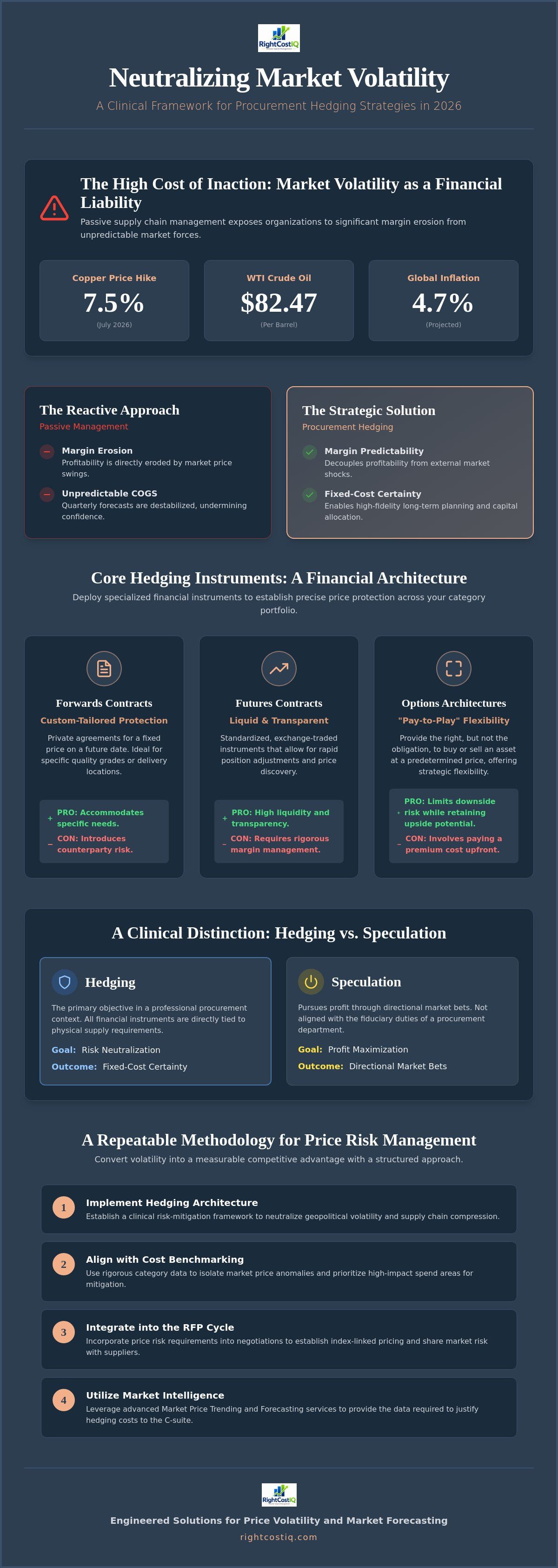
Copper suppliers enforced 7.5% price hikes in July 2026 while WTI crude oil reached $82.47 per barrel, proving that passive supply chain management is a high-risk financial liability. Most organizations suffer margin erosion because they categorize market volatility as an unavoidable external pressure instead of a manageable operational variable. To secure the bottom line, leaders must deploy sophisticated procurement hedging strategies that integrate speculative financial instruments with physical supply chain execution.
You understand that unpredictable COGS and rigid contract clauses are currently destabilizing quarterly forecasts and undermining C-suite confidence. It's challenging to justify risk mitigation costs without the rigorous data required to prove long-term ROI during this period of 4.7% global inflation. This article provides a clinical framework to neutralize market fluctuations through advanced financial architectures and Market Price Trending services. We'll preview a repeatable methodology for price risk management that converts volatility into a measurable competitive advantage. This approach ensures margin predictability and operational efficiency regardless of shifting commodity cycles.
Key Takeaways
- Implement procurement hedging strategies as a clinical risk-mitigation architecture to neutralize 2026 geopolitical volatility and supply chain compression.
- Deploy specialized financial instruments, including custom-tailored Forwards and standardized Futures, to establish precise price protection across your category portfolio.
- Align hedging initiatives with rigorous category cost benchmarking to isolate market price anomalies and prioritize high-impact spend areas for mitigation.
- Integrate price risk requirements into the RFP management cycle to negotiate index-linked pricing and ensure suppliers share the burden of market fluctuations.
- Utilize advanced Market Price Trending and Forecasting services to provide the data-driven intelligence required to justify hedging costs to the C-suite.
The Strategic Imperative of Price Risk Management in 2026
Market volatility in 2026 has transitioned from a periodic disruption to a permanent operational constant. With global inflation projected at 4.7% and critical commodities like copper experiencing sudden 7.5% price surges, traditional procurement models are failing to preserve corporate margins. Effective procurement hedging strategies serve as a clinical risk-mitigation architecture designed to decouple enterprise profitability from external market shocks. This framework moves beyond simple cost-avoidance, positioning price risk management as a core driver of enterprise valuation. Predictable cost structures allow for aggressive capital allocation and higher price-to-earnings multiples, as investors prioritize bottom-line stability over speculative growth.
The 2026 landscape is defined by geopolitical shifts and extreme supply chain compression. For instance, the European Union's decision to limit tariff-free steel imports to 18.3 million metric tons has created artificial scarcity, forcing procurement leaders to choose between defensive and offensive hedging stances. Defensive hedging focuses on protection, establishing a price ceiling to prevent catastrophic margin erosion during supply spikes. Conversely, offensive hedging utilizes market intelligence to lock in advantageous rates during temporary troughs, creating a cost-basis advantage that competitors cannot replicate. This strategic duality transforms the procurement department from a cost center into a sophisticated engine for competitive differentiation.
Hedging vs. Speculation: A Clinical Distinction
Clarity in objective is the primary requirement for any risk management framework. Hedging in finance seeks risk neutralization, whereas speculation pursues profit maximization through directional market bets. In a professional procurement context, the goal is always fixed-cost certainty. By neutralizing price variance, organizations can execute long-term planning with high-fidelity data. Legal and ethical boundaries within the enterprise demand that procurement teams avoid unhedged exposure, ensuring that all financial instruments are directly tied to physical supply requirements rather than speculative gains.
The Financial Impact of Unmitigated Volatility
Unhedged procurement categories are currently subject to a "volatility tax" that erodes quarterly earnings and complicates capital expenditure forecasts. CFOs are increasingly prioritizing procurement hedging strategies because unmitigated price swings directly impact the cost of goods sold (COGS) and operational cash flow. Board-level visibility into these risks is no longer optional; it's a fiduciary requirement in a high-interest environment where the bank prime loan rate sits at 6.75%. Based on 2026 market projections, a successful hedge transforms a projected 4.7% inflationary cost increase into a 0% margin variance through precise contract execution and data-driven market timing.
Core Hedging Instruments: Forwards, Futures, and Options Architectures
Deploying effective procurement hedging strategies requires a granular understanding of both financial and physical architectures. Forward contracts serve as the primary bilateral mechanism for custom-tailored protection. These are private agreements between a buyer and supplier to exchange a commodity at a fixed price on a specific future date. Because they are non-standardized, they accommodate specific quality grades or delivery locations that exchange-traded instruments cannot match. While they eliminate price risk, they introduce counterparty risk; the hedge is only as reliable as the supplier's ability to perform.
Futures contracts provide a more liquid, exchange-traded alternative. Traded on standardized platforms like the LME or CME, these instruments offer immediate price discovery and high transparency. In the current 2026 market, where WTI Crude has fluctuated near $82.47 per barrel, the liquidity of futures allows for rapid position adjustments. Many organizations adopt strategic hedging for price volatility to ensure these financial positions offset physical cost increases in real-time. However, futures require rigorous margin management, as price swings can trigger immediate cash requirements to maintain positions.
Options architectures offer "pay-to-play" flexibility. By paying an upfront premium, procurement teams gain the right, but not the obligation, to purchase at a strike price. This is particularly effective during high-uncertainty periods, such as the 7.5% copper price surge observed in July 2026. If prices drop, the organization simply lets the option expire and buys at the lower spot rate. Swaps and index-linked pricing further extend this by managing long-term price parity through periodic cash-flow exchanges based on floating market indices, effectively smoothing out volatility over multi-year cycles.
Contractual vs. Financial Hedging
Physical hedging involves embedding price adjustment clauses directly into supplier contracts. This approach ensures the hedge is perfectly aligned with the physical supply chain but requires high supplier cooperation. Financial or "paper" hedging utilizes derivatives on commodity exchanges to neutralize risk independently of the supplier. The choice depends on market liquidity; if a commodity lacks a robust exchange, physical contractual locks are the only viable path. Most sophisticated firms use a hybrid model to balance physical supply security with financial flexibility.
Selecting the Optimal Instrument for the Category
Instrument selection is a function of liquidity, volume, and internal treasury maturity. Complex options require sophisticated monitoring and reporting capabilities that may exceed standard procurement functions. To determine the most effective entry point, leaders utilize should-cost modeling to establish the hedge strike price. This data-driven approach ensures the hedge is executed at a level that guarantees margin targets. To evaluate your organization's current exposure and refine your instrument selection, you can access our strategic performance resources for clinical alignment.
Data-Driven Decisioning: Aligning Hedging with Category Benchmarking
Precision in procurement hedging strategies requires a rigorous analytical foundation. Organizations must utilize procurement analytics to differentiate between cyclical price fluctuations and structural market shifts. This clinical filtering process identifies "hedge-worthy" spend by correlating category volume with historical volatility indices. For instance, with copper prices surging 7.5% in July 2026, an unbenchmarked category lead might panic-buy, whereas a data-driven architect recognizes the anomaly relative to the five-year mean and executes a targeted hedge only when specific risk thresholds are breached.
Automated "Trigger Points" represent the operationalization of this data. By setting clinical alerts based on real-time market movements, procurement teams can execute hedging instruments without the delay of manual approval cycles. This speed is critical when the 30-day average SOFR is 3.62139%, as financing costs for hedges directly impact the net ROI of the risk mitigation effort. These triggers ensure that the organization captures price floors and avoids ceilings with mathematical consistency, removing the emotional bias that often leads to poor market timing.
The intersection of tail spend management and risk exposure is a frequently ignored vulnerability. While high-volume commodities receive the most attention, the cumulative impact of unhedged tail spend can destabilize a budget during periods of high inflation. By consolidating these fragmented spends into a singular risk profile, procurement leaders can apply hedging principles to broader spend buckets. This strategic aggregation transforms a series of minor exposures into a manageable, hedgeable asset class that contributes to overall bottom-line predictability.
Market Price Trending as a Predictive Engine
Forecasting models reduce the "timing risk" inherent in any financial derivative. By integrating macroeconomic indicators like the 4.7% projected global inflation rate into category profiles, firms can anticipate upward pressure before it manifests in supplier quotes. Integrating these trends into a unified risk profile allows for the proactive adjustment of hedge ratios based on the probability of market movement. Market price trending validates the cost of a hedge by quantifying the "expected loss" of remaining unhedged against the known premium of the instrument.
Benchmarking Against the Market
Benchmarking identifies if current supplier pricing is "at market" or "above market," which is essential for determining the baseline of a hedge. Organizations often overlook risk in fragmented categories, but using tail spend analytics allows for the consolidation of disparate volumes into a single, hedgeable block. This consolidation increases leverage and ensures that even low-visibility spend is protected from the 3% to 10% price increases currently observed in steel and fittings. Establishing a baseline for "acceptable volatility" per category prevents over-hedging, which can be as financially damaging as under-hedging in a high-interest environment.
Operationalizing Hedging within the RFP and Negotiation Cycle
Operationalizing procurement hedging strategies requires moving beyond financial desks and embedding risk mitigation directly into the sourcing lifecycle. The clinical execution of these strategies occurs during the RFP Management cycle, where price risk requirements are established as non-negotiable baseline parameters. Organizations must demand transparency regarding supplier cost structures to identify the specific origins of market volatility. This allows for the implementation of index-linked pricing models that distribute risk proportionally between the buyer and the vendor, ensuring that neither party is decimated by sudden market spikes like the 7.5% copper price increase recorded in July 2026.
Securing these contractual protections requires a high degree of tactical precision. Utilizing a Negotiation Coach allows procurement teams to bridge the gap between strategic intent and binding contract language. This specialized assistance ensures that price adjustment clauses are grounded in verifiable market indices rather than arbitrary supplier projections. The final stage is the continuous monitoring of hedge performance. Procurement architects must audit realized costs against forecasted benchmarks to ensure the financial protection is actually delivering the promised bottom-line predictability.
Negotiation Levers for Risk Sharing
Effective negotiation frames hedging as a stabilization tool for both parties. Suppliers often attempt to bake "risk premiums" into their base pricing during high-volatility periods to protect their own margins. Procurement leads must challenge these premiums by presenting objective data, such as the 3.64% SOFR rate or current NYMEX natural gas futures at $2.858. By offering a clinical price escalation clause that triggers only at specific, data-validated thresholds, the buyer removes the supplier's need for defensive overpricing. This creates a transparent cost basis that remains resilient even as global inflation is projected to reach 4.7% in 2026.
Integrating Risk into Vendor Performance
Risk mitigation must be institutionalized through rigorous vendor performance tracking. Organizations should audit supplier pass-through costs in commodity-heavy contracts to prevent "margin creep" during market corrections. Adherence to agreed-upon price indices becomes a primary metric for contract renewal. These outcomes must be linked to broader sourcing and procurement KPIs to ensure the department's value is measured by financial stability rather than just initial savings. To refine your current approach and identify execution gaps, you can access our strategic risk diagnostic for a comprehensive assessment.
RightCostIQ: Engineered Solutions for Price Volatility and Market Forecasting
RightCostIQ provides the technical infrastructure required to execute complex procurement hedging strategies with clinical precision. Our Price Risk Management and Tracking Service eliminates the ambiguity of market fluctuations by integrating proprietary Market Price Trending and Forecasting data directly into the sourcing workflow. While competitors offer static dashboards, RightCostIQ delivers a holistic methodology that bridges the gap between high-level financial strategy and granular contract execution. By utilizing our category cost benchmarking and analytics, organizations can identify hidden margin leakage in volatile categories before it impacts the quarterly forecast.
Our methodology transforms data-driven insights into clinical negotiation results. We don't just report on the 7.5% copper price hike; we provide the data engine required to neutralize its impact on your COGS. This process begins with a rigorous analysis of category spend, followed by the deployment of tailored financial and contractual architectures. This systematic approach ensures that price risk management is not an isolated financial exercise but a core component of the procurement function. It aligns treasury goals with supply chain realities to produce a singular, resilient financial outcome.
Precision RFP Management
Precision RFP Management involves more than just price solicitation. It requires the structural integration of risk parameters from the outset. RightCostIQ designs sophisticated RFP architectures that embed hedging requirements into the initial bid phase. This reduces the administrative friction of tracking disparate price indices manually. Our Negotiation Coach service acts as a strategic lever, providing the expert-led support necessary to secure favorable adjustment clauses in high-stakes commodity categories. This combination of automated intelligence and professional assistance ensures that every contract is engineered for maximum bottom-line predictability.
The Future of Predictive Sourcing
The Future of Predictive Sourcing relies on the convergence of AI-driven forecasting and real-time market benchmarking. In a landscape where global inflation is projected at 4.7% and commodity swings are increasingly erratic, reactive buying is no longer a viable strategy. RightCostIQ enables a transition to proactive price architecture, where hedge timing is optimized through 2026-specific predictive models. This approach transforms procurement from a reactive function into a primary driver of financial growth. Organizations can now leverage these tools to secure cash flows against the 3.8% to 4.1% projected rise in federal funds rates. Secure your margins by contacting RightCostIQ for a clinical procurement audit.
Securing Financial Predictability in Volatile Markets
Transitioning from reactive cost-management to clinical procurement hedging strategies is no longer a strategic option; it's a financial necessity for 2026. This framework requires the seamless integration of standardized financial instruments with physical supply chain contracts to neutralize market fluctuations. By utilizing data-driven market price trending, organizations can identify cost anomalies and execute hedges with mathematical certainty. Success depends on operationalizing these risk-mitigation architectures within the RFP cycle to ensure supplier accountability and margin stability.
RightCostIQ provides the engineered solutions necessary to stabilize your bottom line. Our specialized price risk management service and clinical RFP management frameworks allow you to replace uncertainty with data-driven predictability. By leveraging our proprietary market intelligence, you can justify risk-mitigation costs to the C-suite and secure a measurable competitive advantage through cost stability. It's time to transform your procurement function into a high-performance financial architect.
Optimize your price risk strategy with RightCostIQ today and take control of your category margins.
Frequently Asked Questions
What is the primary goal of procurement hedging strategies?
The primary goal of procurement hedging strategies is to neutralize financial volatility and secure bottom-line predictability by decoupling corporate margins from market price swings. Rather than seeking profit from market speculation, these architectures focus on establishing a fixed-cost basis for critical commodities. This clinical approach allows for precise capital allocation and protects enterprise valuation against the 4.7% global inflation projected for 2026.
How do forward contracts differ from futures in a procurement context?
Forward contracts are custom-tailored bilateral agreements between a buyer and supplier, while futures are standardized instruments traded on public exchanges. Forwards allow for specific delivery locations and quality grades but carry counterparty risk. Futures offer high liquidity and transparency but require rigorous margin management to handle daily price fluctuations in markets like WTI crude oil, which reached $82.47 per barrel in July 2026.
When should a company choose options over a fixed-price contract?
A company should choose options when market volatility remains high but there is a significant possibility of price declines. Options provide the right, but not the obligation, to purchase at a strike price, offering a ceiling while allowing the firm to capture lower spot rates if the market softens. This is effective for commodities like copper, which saw a 7.5% surge in July 2026 but remains subject to geopolitical cooling.
Can small to mid-market firms implement effective hedging without a treasury department?
Small to mid-market firms can implement effective procurement hedging strategies by utilizing physical contractual hedging instead of complex financial derivatives. By embedding index-linked price adjustment clauses directly into supplier agreements, these firms achieve risk mitigation without the overhead of a dedicated treasury department. Professional price risk management services provide the necessary data-driven benchmarking to execute these agreements with clinical precision.
How does category benchmarking improve the effectiveness of a hedge?
Category benchmarking identifies market price anomalies and establishes the "should-cost" baseline required to determine an effective hedge strike price. Without this data, a procurement team cannot distinguish between a fair market rate and an inflated supplier quote. Benchmarking provides the objective intelligence needed to validate hedge costs against the 3.64% SOFR rate and other macroeconomic indicators, ensuring the protection doesn't exceed the risk.
What are the risks of over-hedging in a declining market?
Over-hedging in a declining market locks an organization into fixed prices that are significantly higher than the prevailing spot rate, creating a substantial opportunity cost. This "hedge drag" can lead to a competitive disadvantage if rivals are able to source materials at lower market prices. Clinical risk management requires balancing the hedge ratio to protect against spikes while maintaining enough flexibility to benefit from market corrections.
How often should a procurement team review their price risk management strategy?
Procurement teams should conduct a formal review of their price risk management strategy at least once per quarter, or immediately following significant regulatory shifts. For example, the SEC and CFTC memorandum of understanding signed on March 11, 2026, required firms to reassess their derivatives reporting. Continuous monitoring through automated trigger points ensures that the strategy remains aligned with live market data and 2026 inflationary trends.
What role does AI play in 2026 market price forecasting?
AI serves as the predictive engine for 2026 market price forecasting by analyzing vast datasets to identify upward pressure before it manifests in quotes. With 85% of procurement teams now using cloud-based platforms, AI-powered automation is used for spend classification and should-cost modeling. These digital architectures reduce "timing risk" by correlating macroeconomic indicators with specific category volatility to optimize hedge entry and exit points.


