

By 2026, over 80% of organizations will integrate predictive analytics into their sourcing; however, most procurement teams still struggle with the fallout of subjective vendor selection. You've likely experienced the difficulty of justifying a high-stakes contract to the C-suite when the scoring feels arbitrary and hidden costs emerge after the ink is dry. Establishing rigorous RFP evaluation criteria is the only way to transform procurement from a support function into a primary driver of financial growth. In an era where global public procurement exceeds $12 trillion annually, precision in vendor assessment is a non-negotiable requirement for operational efficiency.
This guide delivers a strategic framework to master the architecture of objective selection and maximize procurement ROI. You'll move beyond static checklists to implement dynamic financial models that prioritize Total Cost of Ownership (TCO) and price risk mitigation. We'll examine how to build a standardized, repeatable evaluation matrix that leverages should-cost data and performance tracking. By the end of this analysis, you'll possess the tools to eliminate subjectivity, reduce financial risk, and deliver clear, data-driven results from every RFP cycle.
Key Takeaways
- Replace subjective "gut-feeling" selections with a quantitative architecture to prevent margin erosion and operational friction.
- Deconstruct vendor proposals using a three-pillar scoring model that evaluates technical efficiency, financial transparency, and risk mitigation.
- Integrate should-cost analysis into your RFP evaluation criteria to establish a data-driven anchor for financial benchmarking.
- Utilize pass/fail deal-breakers to prune the vendor pool early and ensure all finalists align with strategic stakeholder requirements.
- Leverage the final evaluation scorecard as a clinical negotiation tool to maximize procurement ROI during the contract execution phase.
The Strategic Importance of Precision RFP Evaluation Criteria
Precision in procurement is a financial necessity, not a luxury. The RFP evaluation criteria serve as the quantitative architecture for vendor selection, providing a structured methodology to analyze complex proposals with clinical objectivity. Relying on subjective "gut-feeling" selections frequently results in operational friction and significant margin erosion. When decision-makers prioritize qualitative impressions over data-driven scoring, they invite hidden costs and post-contract service failures that compromise the bottom line. A standardized Request for Proposal (RFP) framework ensures that every vendor interaction is measured against tangible business outcomes.
The 2026 procurement landscape demands a fundamental shift beyond simple price-comparison models. With 80% of organizations expected to integrate predictive analytics and AI into their sourcing processes by the end of this year, static spreadsheets no longer suffice. Modern criteria must account for extreme market volatility and a global public procurement market exceeding $12 trillion. Robust evaluation frameworks ensure regulatory compliance and supply chain resilience, particularly as major overhauls like the Federal Acquisition Regulation (FAR) updates of June 2026 require stricter adherence to streamlined, transparent sourcing protocols.
Eliminating Subjectivity in High-Stakes Sourcing
Bias-neutral frameworks protect organizations from vendor favoritism and ensure that selection remains strictly objective. The cost of vendor misalignment is substantial, often manifesting as a sharp increase in total cost of ownership due to operational inefficiency and integration delays. Standardizing your approach eliminates the "noise" of sales presentations and focuses exclusively on performance metrics. RFP evaluation criteria function as a strategic financial instrument designed to extract maximum value from the vendor ecosystem.
Alignment with Organizational Growth Targets
Successful procurement teams map their outcomes directly to C-suite financial objectives. By utilizing advanced RFP management, departments transition from traditional cost-centers to dynamic value-generators. This shift relies on precision scoring that prioritizes enterprise efficiency and long-term ROI. When procurement functions as a primary driver for financial growth, the selection process becomes a catalyst for competitive advantage rather than a reactive administrative hurdle.
Core Components of a Modern RFP Scoring Model
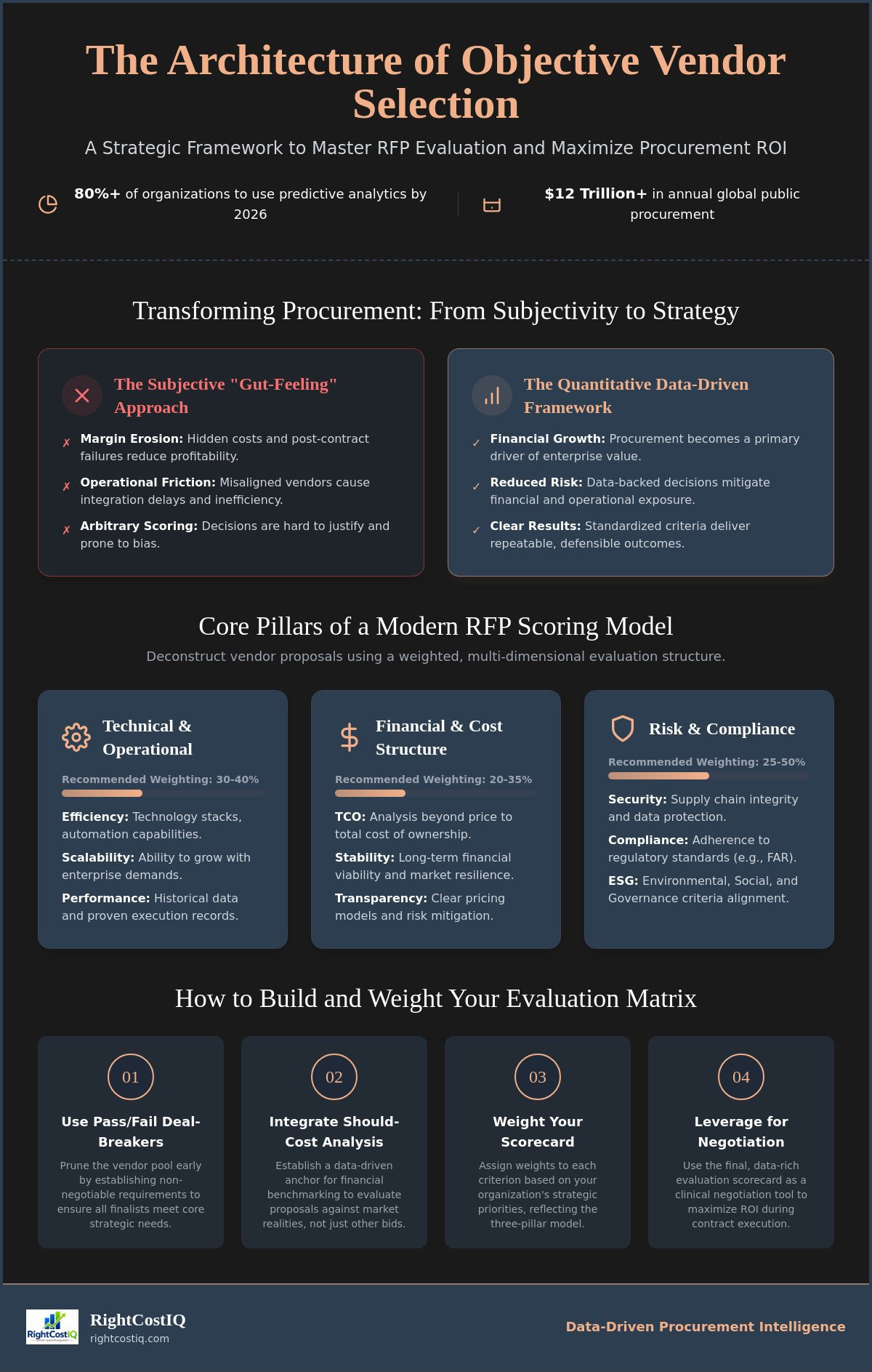
Modern procurement requires a multi-dimensional approach to vendor scoring that transcends basic price comparison. A sophisticated scoring model deconstructs vendor proposals into three core pillars: Technical, Financial, and Risk-Based criteria. While traditional models often stall at administrative checklists, a high-performance framework utilizes a comprehensive list of evaluation criteria to ensure holistic alignment with enterprise goals. 2026 industry data indicates that technical capability typically accounts for 30 to 40 percent of the total score, while pricing and cost structure represent 20 to 35 percent. This weighting reflects a strategic shift toward long-term value over immediate savings.
Technical competence must shift from a binary "can they do it" check to a granular analysis of operational efficiency. Financial viability assessment focuses on long-term partnership stability and the vendor's ability to withstand market shocks. Risk and compliance factors now integrate ESG standards and supply chain security directly into the scorecard to mitigate reputational and operational exposure. These components ensure that the final selection is grounded in data rather than optimistic projections.
Technical and Operational Excellence Criteria
Evaluating technology stacks and automation capabilities is critical for ensuring future-proof operations. Scalability metrics determine whether a vendor can maintain performance as enterprise requirements expand. Integrating historical data through vendor performance tracking provides a factual baseline that prevents reliance on curated case studies. This objective data serves as a historical benchmark for future reliability, ensuring that RFP evaluation criteria prioritize vendors with proven execution records. High-performing teams focus on how efficiently a vendor delivers results, rather than just the breadth of their service catalog.
Financial Integrity and Price Risk Management
Financial integrity requires analyzing price stability against market volatility. Most evaluation models fail because they ignore the impact of fluctuating commodity costs and inflationary pressures. Incorporating price risk management as a weighted scoring factor allows procurement teams to identify vendors with sustainable pricing models. Market price trending should dictate the financial weight of a proposal, ensuring that RFP evaluation criteria account for external economic pressures. This data-driven approach identifies outlier bids that might signal low-quality service or hidden future price hikes. Decision-makers looking to refine their financial scoring can explore advanced procurement analytics to automate these complex risk calculations.
Benchmarking and Should-Cost Analysis in Evaluation
Objective financial assessment requires a clinical anchor to prevent the common error of treating the lowest bid as the best value. Should-cost analysis serves as this anchor, providing a data-driven baseline for RFP evaluation criteria that identifies exactly what a service or category should cost in the current market. By establishing a "should-cost" model before reviewing proposals, procurement teams transition from reactive price comparison to proactive financial validation. This methodology exposes unsustainable pricing structures and protects the organization from the operational risks associated with "low-ball" bids that often signal hidden service gaps or future price escalations.
Utilizing procurement category cost benchmarking allows for the immediate detection of outlier bids that deviate from industry norms. In a global procurement market exceeding $12 trillion, relying on vendor-provided data alone is a strategic failure. Data-driven analytics validate vendor cost assumptions by cross-referencing them against market intelligence and historical performance data. This level of scrutiny ensures that the financial pillar of your scoring model remains resilient against market volatility and vendor margin-padding.
Integrating Cost Benchmarking into Scoring
Strategic scoring models use should-cost data to define the "perfect" financial score, penalizing bids that fall significantly above or below this benchmark. Granular category analysis identifies hidden margins by deconstructing the vendor’s cost components, from labor and materials to overhead and profit. This level of transparency transforms benchmarking into a powerful tool for objective price justification during C-suite reviews. When every point in the financial section is backed by market-verified data, the RFP evaluation criteria become an unassailable defense of the final selection.
Total Cost of Ownership (TCO) vs. Initial Bid
The initial bid is merely the visible portion of a complex financial commitment. Precision procurement requires calculating lifecycle costs, including maintenance, implementation friction, and eventual exit barriers. In 2026, Total Cost of Ownership (TCO) is the only metric that accurately reflects the impact of a vendor on enterprise margins. TCO analysis exposes the financial volatility of low-bid vendors by quantifying the cumulative impact of implementation delays, post-contract price escalations, and technical debt. Shifting the focus to TCO ensures that the evaluation process prioritizes long-term financial stability over short-term budget optics.
How to Build and Weight an RFP Evaluation Matrix
Constructing a bulletproof scoring matrix requires a methodical five-step process that translates abstract requirements into measurable data points. This architecture ensures that RFP evaluation criteria remain objective throughout the entire selection lifecycle. Precision begins with stakeholder requirement gathering to prioritize strategic goals, followed by the implementation of "pass/fail" deal-breakers. These deal-breakers prune the vendor pool early, eliminating non-compliant entities before they consume valuable analytical bandwidth. The third step involves assigning percentage weights to core categories, typically balancing technical superiority against financial stability. Fourth, teams must develop a granular 1-10 scoring scale with objective definitions for each rank to remove interpretative bias. Finally, the matrix is finalized for cross-departmental evaluation, ensuring a unified front during the final selection phase.
A structured matrix acts as a clinical shield against internal favoritism. By quantifying every vendor attribute, procurement leaders can present an unassailable case to the C-suite. To ensure your current framework meets these rigorous standards, you can access a procurement performance diagnostic to identify gaps in your existing scoring logic.
The Science of Weighted Scoring
Determining the ideal ratio between technical capability and cost is a strategic exercise in risk management. High-complexity categories often demand a 40% weighting for technical superiority to ensure operational continuity. However, procurement teams must adjust these weights based on the sourcing type. For example, tail spend management typically prioritizes cost efficiency and speed, whereas strategic sourcing for core infrastructure requires a heavier emphasis on technical resilience. Avoiding the "averaging" trap in multi-stakeholder scoring is essential; weighted scores must reflect the specific priorities of the primary business unit rather than a diluted consensus.
Transparency and Vendor Debriefing
Disclosing RFP evaluation criteria within the solicitation document is a legal and ethical necessity that drives high-quality responses. When vendors understand the scoring logic, they submit more targeted proposals that align with organizational needs. This transparency also facilitates professional debriefs for unsuccessful bidders, using the matrix as a factual basis for feedback. Providing data-driven debriefs improves the quality of future vendor responses and reinforces the organization's reputation as a sophisticated, fair-market participant. Clinical transparency in the evaluation phase reduces the likelihood of protests and ensures a smoother transition to the contract execution stage.
Optimizing Selection Through Negotiation Coaching
The final scoring output is not a finish line but a strategic baseline for aggressive value extraction. High-performing procurement teams use the RFP evaluation criteria as the primary lever during contract negotiations to address specific vendor weaknesses identified during the scoring phase. This clinical approach bridges the critical gap between vendor selection and operational execution. By integrating RightCostIQ's negotiation coach, decision-makers transform raw scoring data into tangible financial leverage. Even the most competitive proposals contain negotiable gaps, often found in technical implementation timelines, service level agreement (SLA) penalties, or rigid pricing escalations. Identifying these outliers ensures that the final contract reflects the maximum achievable ROI rather than just a "best-fit" compromise.
Refining the Finalist Pool
Shortlisting strategies must rely on scoring clusters to identify the top tier of potential partners. Once the pool is pruned, conducting deep-dive interviews is essential to validate "paper" scores against actual operational capabilities. This validation phase ensures that vendor claims aren't merely optimized for the evaluation matrix but are grounded in reality. Linking these selection criteria to a comprehensive category management strategy ensures that the procurement department remains a driver of margin expansion. Sophisticated organizations use this stage to pressure-test vendor scalability and cultural alignment before making a multi-year commitment.
The Clinical Conclusion: Data-Driven Selection
Finalizing the vendor decision requires a rigorous synthesis of data, risk profiles, and strategic fit. The selected partner must demonstrate alignment with 2026 market price trending forecasts to protect the organization from future volatility and inflationary shocks. A data-driven selection process provides the necessary evidence to justify procurement decisions to the C-suite with absolute confidence. Precision in the final selection stage defines the financial success of the entire contract lifecycle. To achieve this level of procurement precision and eliminate subjectivity, it's time to optimize your RFP management with RightCostIQ. Our framework ensures that every selection is backed by clinical analysis, should-cost benchmarking, and expert negotiation assistance.
Architecting Future-Proof Procurement ROI
Mastering RFP evaluation criteria allows procurement leaders to move beyond administrative checklists toward high-level financial strategy. By integrating should-cost analysis and weighted scoring models, organizations eliminate the risk of subjective bias and hidden post-contract costs. This strategic framework ensures that every vendor selection is a data-driven decision aligned with C-suite growth targets. Transitioning from a cost-center to a value-generator requires clinical execution at every stage of the sourcing lifecycle.
Leveraging a proprietary cost benchmarking database and advanced price risk forecasting tools provides the competitive edge necessary in volatile markets. Expert negotiation coaching for high-value contracts further ensures that selected vendors deliver maximum operational efficiency and financial returns. You possess the blueprint for objective selection; now it's time to implement these precision standards across your enterprise. Execute RFP cycles with clinical precision—explore RightCostIQ. Secure your procurement future with confidence.
Frequently Asked Questions
What are the most important RFP evaluation criteria for 2026?
Technical capability and solution alignment are paramount, typically accounting for 30 to 40 percent of the total score. For 2026, organizations must prioritize data security, AI integration, and price risk management within their RFP evaluation criteria. These factors ensure that vendors can maintain operational resilience during periods of market volatility. High-performing teams also weigh organizational experience and past performance at 15 to 30 percent to verify execution reliability.
How do you calculate a weighted score for an RFP response?
Calculating a weighted score involves multiplying the raw score for each individual criterion by its assigned percentage weight. For example, if a vendor earns an 8 out of 10 on a technical section weighted at 40 percent, their weighted score for that section is 3.2. Summing these weighted values across all categories provides a final, standardized score. This mathematical approach ensures that strategic priorities remain the primary driver of the final vendor ranking.
Should pricing be the most heavily weighted criterion in an RFP?
Pricing should rarely be the sole dominant factor in a strategic sourcing event. While it typically carries a weight of 20 to 35 percent, prioritizing the lowest bid often leads to higher Total Cost of Ownership (TCO) through hidden implementation and maintenance expenses. Modern RFP evaluation criteria focus on value-based selection. This approach ensures that technical superiority and risk mitigation receive appropriate weighting to support long-term financial growth and operational stability.
What is the difference between selection criteria and evaluation criteria?
Selection criteria act as binary filters to qualify vendors, whereas evaluation criteria are used to rank them. Selection criteria often include non-negotiable "pass/fail" requirements such as minimum insurance levels or specific certifications. Evaluation criteria are more granular, utilizing a scoring matrix to assess the quality and efficiency of a vendor's proposed solution. Distinguishing between these two stages prevents procurement teams from wasting time scoring vendors that don't meet baseline organizational standards.
How can I ensure my RFP evaluation process is compliant and fair?
Transparency is the foundation of a compliant and fair evaluation process. You must disclose your high-level scoring categories and weightings within the initial RFP document to guide vendor responses. Utilizing a standardized scoring matrix with objective rank definitions prevents individual bias from skewing the results. Independent evaluations should be conducted by multiple stakeholders before aggregating scores to ensure a holistic and defensible selection that stands up to C-suite scrutiny.
How do deal-breakers or 'knock-out' criteria work in an RFP?
Knock-out criteria serve as immediate disqualifiers for vendors that fail to meet critical organizational needs. These are typically mandatory requirements, such as data residency in a specific region or compliance with the 2026 FAR overhaul regulations. If a vendor receives a "fail" on any knock-out item, their proposal is removed from the pool without further analysis. This pruning mechanism protects analytical resources and ensures only viable finalists reach the deep-dive scoring phase.
What role does AI play in modern RFP evaluation and scoring?
AI is transitioning from simple text generation to agentic workflow execution in modern procurement. By late 2026, approximately 75 percent of large enterprises will utilize AI-driven procurement for compliance checks and document analysis. These tools identify outliers in financial proposals and automate the scoring of technical requirements against pre-defined benchmarks. This automation increases evaluation speed while maintaining the clinical precision required for high-stakes vendor selection and price risk management.
How do I handle scoring discrepancies between different internal stakeholders?
Discrepancies are managed through a moderated consensus meeting where stakeholders justify their scores based on objective evidence. If significant outliers persist, the scores from the primary business unit responsible for the project should carry more weight. Using a granular scoring scale with clear definitions for each rank helps minimize these variances from the start. This structured approach ensures that the final selection reflects a strategic synthesis of diverse departmental priorities.


