

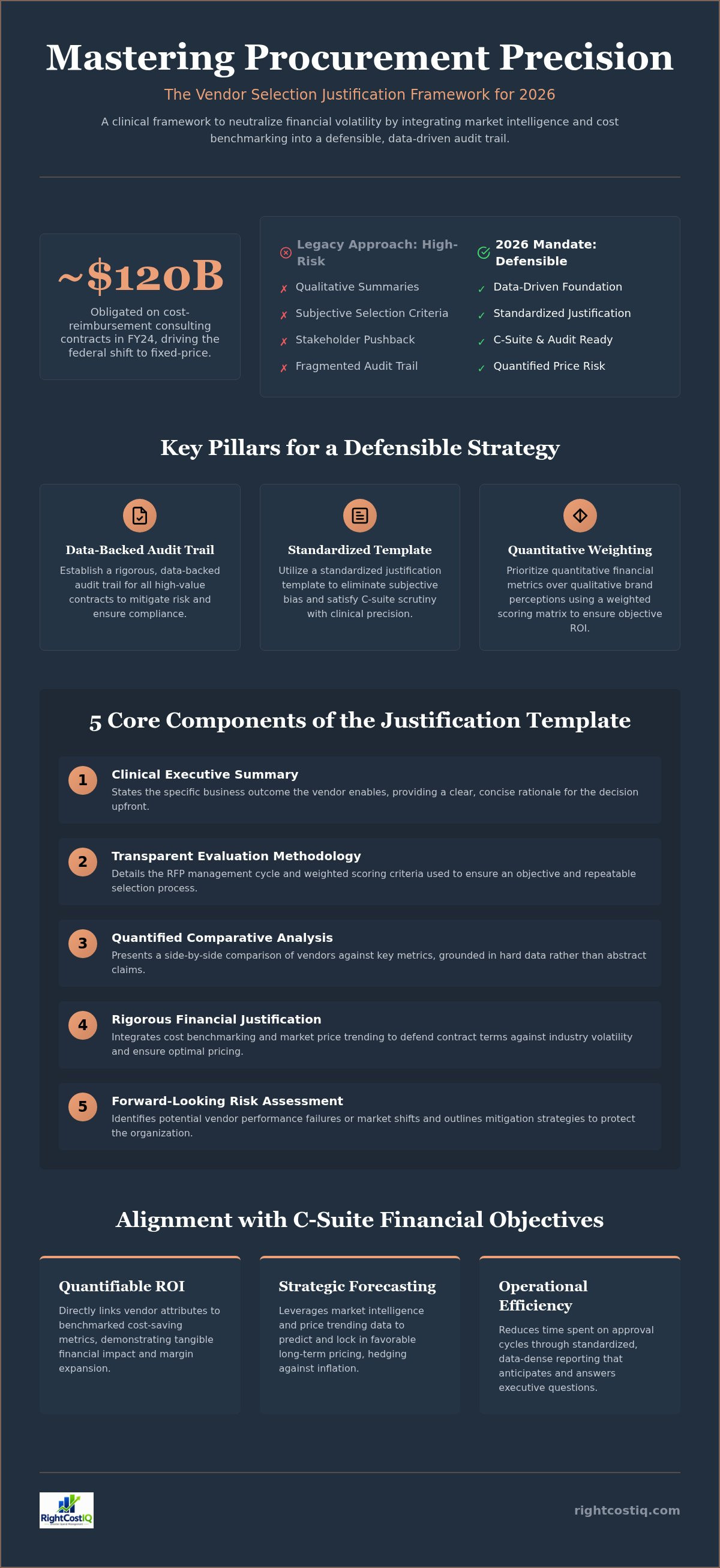
With approximately $120 billion obligated on cost-reimbursement consulting contracts in FY24, the federal shift toward mandatory fixed-price contracting isn't just a trend; it's a strategic mandate. As of the April 2026 Executive Order, procurement departments must move beyond qualitative summaries to survive intense C-suite scrutiny. You recognize that subjective selection criteria often lead to stakeholder pushback and a fragmented audit trail. Quantifying price risk and market trending remains a significant hurdle when your reporting lacks a standardized, data-driven foundation.
This article provides the clinical framework necessary to master procurement precision through a high-performance vendor selection justification template. You'll learn to neutralize financial volatility by integrating market intelligence and cost benchmarking into your internal reports. We'll preview a streamlined approval process for high-value contracts that satisfies both regulatory requirements and bottom-line growth. By the end of this guide, your procurement decisions will be backed by a defensible methodology that eliminates guesswork and optimizes every contract outcome for 2026 and beyond.
Key Takeaways
- Establish procurement as a strategic risk-mitigation function by implementing a rigorous, data-backed audit trail for all high-value contracts.
- Utilize a standardized vendor selection justification template to eliminate subjective bias and satisfy C-suite scrutiny with clinical precision.
- Prioritize quantitative financial metrics over qualitative brand perceptions using a weighted scoring matrix to ensure objective ROI.
- Streamline the RFP lifecycle by consolidating cost benchmarking and market price trending data into a singular, defensible decision narrative.
- Leverage advanced analytics and professional negotiation assistance to automate justification workflows and mitigate long-term price risk in 2026.
The Strategic Necessity of a Formal Vendor Selection Justification
A formal vendor selection justification serves as the definitive audit trail for high-stakes corporate decision-making. In the 2026 regulatory environment, specifically following the April Executive Order mandating fixed-price defaults for federal procurements, procurement teams can't rely on qualitative narratives. A standardized vendor selection justification template transforms subjective preferences into clinical, defensible data. This transition is essential to mitigate financial volatility and price risk, especially as organizations face increased scrutiny over non-fixed-price contracts. Precision in selection directly correlates to enterprise-level margin expansion by eliminating the fiscal leakage inherent in gut-feeling sourcing.
Justification as a Risk Management Asset
Establishing a clinical framework for compliance is the primary defense against supply chain disruptions. By formalizing the supplier evaluation process, organizations create a repeatable methodology for resilience. This reporting prevents surprise costs and vendor performance failures by requiring rigorous documentation of price risk management before a contract is signed. When Procurement Category Cost benchmarking is integrated into the justification, it provides a benchmarked reality check against market averages. This ensures the selected vendor isn't just a safe choice, but a financially optimal one that stands up to internal audits and external regulatory reviews.
Aligning Procurement with C-Suite Financial Objectives
Sourcing decisions must translate into tangible ROI to satisfy modern financial scrutiny. Procurement operates as a strategic architect of financial growth when it leverages Market Price Trending and Forecasting to justify long-term commitments. Using a data-driven vendor selection justification template allows teams to show exactly how a vendor choice protects the bottom line against inflationary pressures. This alignment turns procurement into a value center. It provides high-level decision-makers with the confidence that every contract is optimized for maximum efficiency. Key objectives for this alignment include:
- Quantifiable ROI: Linking specific vendor attributes to cost-saving benchmarks.
- Strategic Forecasting: Using market intelligence to predict and lock in favorable pricing.
- Operational Efficiency: Reducing the time spent on approval cycles through standardized reporting.
Ultimately, the justification process bridges the gap between traditional business functions and cutting-edge financial optimization. It ensures that every high-value contract is a calculated step toward broader corporate stability. By removing ambiguity, procurement professionals position themselves as essential partners in the pursuit of sustainable financial growth.
Core Components of a High-Performance Justification Template
A high-performance vendor selection justification template is more than a summary; it's a data-dense document designed to survive C-suite interrogation. It requires five core pillars to ensure clinical execution: a clinical executive summary, a transparent evaluation methodology, a quantified comparative analysis, a rigorous financial justification, and a forward-looking risk assessment. The executive summary must state the specific business outcome the vendor enables, supported by an evaluation methodology that details the RFP management cycle used to ensure objectivity. This structured approach aligns with the Department of Energy's Source Selection Guide, which emphasizes documented rationale and trade-off processes to achieve maximum value.
The Evidentiary Basis: Cost Benchmarking and Analytics
Market intelligence shouldn't be a secondary consideration. Integrating real-time market price trending into the price justification section allows procurement to defend contract terms against industry volatility. You must use price risk management data to demonstrate how the selected vendor protects the organization from future cost spikes. Cost benchmarking serves as the clinical baseline for all vendor justifications in 2026. This data-heavy approach ensures pricing is competitive not just against current bids, but against historical and forecasted market standards. By anchoring your report in these analytics, you neutralize stakeholder pushback during the final approval phase.
Operational and Technical Evaluation Criteria
High-performance templates require a rigorous scoring system for vendor performance tracking capabilities and supply chain compliance. Evaluating these through a clinical lens removes the ambiguity often found in traditional reviews. You should assess finalists based on their ability to integrate with your existing analytics stack and their adherence to 2026 regulatory standards. You can explore our RFP Management Framework to see how these criteria are structured for maximum precision. Assessing supply chain resilience ensures the selection isn't just about the lowest price, but about long-term operational stability.
Quantifying the variance between top-tier candidates requires a weighted scoring matrix. This matrix ensures that financial metrics and risk assessments outweigh qualitative perceptions. By presenting a side-by-side comparison of benchmarking results, you prove that the selection is the result of a methodical process rather than a subjective choice. To begin optimizing your own reporting logic, you might review our procurement intelligence dashboard to see how data-driven insights strengthen the justification narrative.
Quantitative vs. Qualitative Weighting: The Logic of Selection
Eliminating subjectivity starts with a clinical weighting logic that favors objective ROI. Qualitative factors like legacy brand longevity or general industry reputation are often used to mask a lack of competitive pricing. In a high-stakes 2026 procurement environment, these soft traits don't protect margins or satisfy federal auditors looking for fixed-price accountability. A vendor selection justification template must force a comparison where financial metrics, specifically cost benchmarking and price risk management, carry the highest weight. This ensures the final selection isn't just a familiar name but a strategic asset that aligns with the organization's financial growth targets.
Constructing the Scoring Matrix
Effective matrix construction involves assigning high percentage weights to critical procurement categories. You should typically weight price competitiveness at 40%, technical compliance at 30%, and risk mitigation at 20%. The remaining 10% can cover innovation or Supplier Relationship Management (SRM), but only if these are tied to measurable outcomes like documented R&D investment or verified lead-time reductions. Advanced analytics help identify outliers in vendor pricing models, highlighting bids that suspiciously deviate from established should-cost models. This level of detail ensures the vendor selection justification template remains an objective tool rather than a vehicle for pre-existing biases.
Defending the Final Decision with Data
The final decision narrative must pivot from best fit to clinically optimal. This means the chosen vendor has passed a rigorous filter of performance tracking and market price trending. Balancing immediate cost savings with vendor performance sustainability is a critical calculation. A vendor offering the lowest initial price may carry a higher risk of service failure or price creep in later years. You should utilize market price forecasting to project costs over the full contract lifecycle, preventing short-term wins from becoming long-term financial liabilities.
When an RFP response contains outliers, professional negotiation assistance helps normalize the data before the final scoring is locked. This process ensures the justification narrative is built on verified performance metrics rather than vendor promises. Defending a selection to the C-suite requires moving beyond a simple summary to demonstrate a methodical analysis of cost benchmarking. For a deeper look at how this fits into broader strategy, read more on Category Management in Procurement to understand how clinical frameworks drive margin expansion.
Step-by-Step: Writing Your Vendor Selection Justification Report
Executing a high-stakes report requires a methodical progression from raw data to strategic narrative. You begin by consolidating RFP responses alongside category-specific cost benchmarking results. This ensures your baseline is grounded in current market realities rather than vendor-supplied estimates. Next, apply the weighted scoring logic discussed previously to all finalists. This step filters out candidates who fail to meet technical or financial thresholds. A standardized vendor selection justification template provides the necessary structure to ensure these steps are repeatable across all high-value procurement categories.
Drafting the Financial Narrative
Market intelligence is the primary driver of a persuasive financial narrative. You must use data-driven insights to explain price variances between finalists, specifically highlighting how the selected vendor's pricing aligns with broader market trending for 2026. A critical component is the "Should-Cost" analysis, which proves negotiation success by demonstrating that the final contract price is aligned with actual production and delivery costs. You can utilize our Should-Cost Analysis Tools to generate the evidentiary support required for this section. This narrative transforms raw numbers into a clinical case for ROI that satisfies both the CFO and internal auditors.
Step 4 involves a rigorous price risk management review to identify potential volatility over the contract lifecycle. In the current economic landscape, this means accounting for inflationary shifts and supply chain disruptions documented in your market price forecasting reports. Finally, you draft the executive summary for C-suite approval. This summary shouldn't just recap the process; it must articulate the outcome: how this selection drives margin expansion and mitigates enterprise-level risk.
The Final Review: Audit-Proofing the Document
Precision at the final stage prevents stakeholder pushback and regulatory non-compliance. Every claim in your report must be backed by procurement analytics and verified vendor performance tracking data to ensure the document serves as a durable audit trail for future reviews. A justification without a benchmarking audit is merely an opinion. By cross-referencing your selection against proprietary cost benchmarks, you eliminate the possibility of subjective bias undermining the contract's legitimacy. This clinical approach ensures that the vendor selection justification template remains a tool for financial growth rather than a mere administrative formality.
To ensure your current reporting meets these clinical standards, access our procurement performance diagnostic to identify gaps in your justification logic and optimize your selection narrative.
Automating Justification with RightCostIQ Precision
Transitioning from a static vendor selection justification template to a dynamic, automated workflow is the final step in procurement modernization. Manual data entry is prone to error and often fails to capture the rapid shifts in market price trending that define 2026. By integrating RightCostIQ analytics directly into your existing RFP lifecycle, you ensure that every justification report is populated with real-time cost benchmarking data. This automation doesn't just save time; it provides a level of clinical precision that manual processes can't match. It transforms the justification from a bureaucratic requirement into a strategic asset that continuously validates your sourcing decisions.
The RightCostIQ Advantage in RFP Management
RightCostIQ provides proprietary benchmarking that competitors can't replicate, offering a granular view of category-specific costs. This intelligence allows you to defend contract terms with authoritative data on price risk management and forecasting. When you consult with our Negotiation Coaches, you add a layer of professional expertise to your justification narrative. This assistance ensures that outliers are addressed and neutralized before the report reaches the C-suite. The result is a defensible, audit-proof document that reflects a sophisticated understanding of market dynamics.
Continuous justification is achieved through automated vendor performance tracking. Unlike one-time reports, RightCostIQ monitors vendor delivery against the original justification criteria throughout the contract term. If a vendor's performance drifts or market prices shift, the system alerts you, providing the data needed to renegotiate or pivot. This proactive approach to price risk management ensures that the initial ROI promised in your vendor selection justification template is actually realized over the long term. This systematic tracking eliminates the visibility gaps that often lead to financial leakage.
Empowering the Strategic Architect
This technology transforms procurement managers from administrative gatekeepers into strategic architects of financial growth. By offloading the technical burden of data consolidation to RightCostIQ, you can focus on high-level consulting and margin expansion strategies. You'll move beyond simply selecting vendors to architecting complex supply chain solutions that provide a competitive advantage. For deeper insights into these advanced workflows, see our guide on RFP Management: Strategic Frameworks for AI-Led Procurement.
The shift to clinical execution begins with replacing legacy spreadsheets with integrated procurement intelligence. You can optimize your next RFP with RightCostIQ to experience the difference that data-driven precision makes in your selection process. By leveraging automation, you secure a future where every procurement decision is backed by an unbreakable audit trail and optimized for maximum bottom-line impact.
Securing Strategic Precision in 2026 Procurement
Mastering the clinical execution of procurement requires moving beyond antiquated, subjective narratives. You've seen how a data-driven vendor selection justification template acts as a strategic audit trail, protecting your organization from financial volatility and regulatory pushback. By prioritizing quantitative weighting over qualitative brand perceptions, you ensure that every contract is optimized for maximum ROI. Integrating advanced cost benchmarking analytics and market price trending into your report structure transforms procurement from a back-office function into a primary driver of enterprise-level margin expansion.
The transition to clinical execution is seamless when backed by global procurement expertise and rigorous RFP management frameworks. RightCostIQ provides the sophisticated tools necessary to automate these workflows, ensuring your justifications remain audit-proof and defensible under C-suite scrutiny. Don't leave your high-value contracts to chance or gut feelings. You can optimize your procurement outcomes with RightCostIQ precision today. Take command of your supply chain strategy and lead your organization toward a more resilient, data-backed future.
Frequently Asked Questions
What is a vendor selection justification template?
A vendor selection justification template is a clinical framework used to document the data-driven rationale behind choosing a specific supplier over its competitors. It serves as a standardized audit trail that captures RFP results, cost benchmarking, and risk assessments. By utilizing this template, procurement teams eliminate subjective bias and provide high-level decision-makers with a transparent, defensible record of how a selection aligns with enterprise financial growth and operational efficiency targets.
Why is a formal justification report required in 2026 procurement?
Formal justification reports are mandatory in 2026 due to increased regulatory scrutiny and a federal shift toward fixed-price contract defaults. Following the April 2026 Executive Order, organizations must provide a clear evidence-based narrative for every high-value procurement decision. These reports mitigate financial volatility by proving that selections are based on objective cost benchmarking rather than qualitative gut feelings. This level of documentation is essential for maintaining compliance and satisfying internal financial audits.
How do I calculate the weighted score for a vendor selection?
You'll calculate a weighted score by assigning percentage-based importance to critical procurement categories, such as price competitiveness, technical compliance, and risk mitigation. For example, you might assign price a 40% weight and technical compliance 30%. Multiply the raw score of each vendor in these categories by their respective weights. Summing these totals provides a clinical, objective final score that allows for an apples-to-apples comparison between finalists, neutralizing subjective brand perceptions.
What financial metrics are essential for a C-suite justification report?
Essential financial metrics include Total Cost of Ownership (TCO), projected ROI, and procurement category cost benchmarking data. You must also include price risk management analysis to demonstrate how a contract protects the organization against market volatility. Presenting these metrics allows the C-suite to see the direct link between a sourcing decision and bottom-line margin expansion. Reports should also feature should-cost modeling results to prove that the final negotiated price aligns with market realities.
How does market price trending influence vendor selection?
Market price trending influences selection by providing a forward-looking view of cost volatility and inflationary pressures. By analyzing historical data and future forecasts, procurement teams can identify which vendors offer the most sustainable pricing over a long-term contract lifecycle. This intelligence prevents the selection of vendors who offer low initial bids but carry high risk for future price creep. It ensures that every contract is architected to withstand shifting economic conditions throughout 2026.
Can I use a vendor selection template for tail spend management?
Applying a vendor selection justification template to tail spend management brings clinical precision to often-unmanaged expenditure. While tail spend involves lower-value contracts, the cumulative financial impact is significant. Standardizing the justification process for these vendors prevents fragmented purchasing and ensures that even small-scale selections adhere to corporate cost benchmarking standards. This approach reduces financial leakage and consolidates the supply chain, turning minor transactions into opportunities for broader procurement optimization and risk mitigation.
What happens if a vendor justification report is audited?
If a vendor justification report is audited, it serves as the primary evidentiary document proving that the selection process was objective and compliant. Auditors examine the report for clinical data points, such as weighted scoring matrices and cost benchmarking analysis. A robust report demonstrates that the organization followed a methodical RFP cycle and mitigated price risk effectively. Without this documented audit trail, procurement decisions are vulnerable to claims of favoritism, bias, or fiscal negligence during regulatory reviews.
How does RightCostIQ automate the justification process?
RightCostIQ automates the process by integrating real-time cost benchmarking and market price trending directly into your reporting workflow. Our platform replaces manual spreadsheets with clinical analytics that automatically populate your justification narrative with defensible data. We provide automated vendor performance tracking to ensure continuous justification throughout the contract lifecycle. This technology transforms procurement managers into strategic architects by offloading data consolidation and providing the precise insights needed to satisfy intense C-suite scrutiny.


