
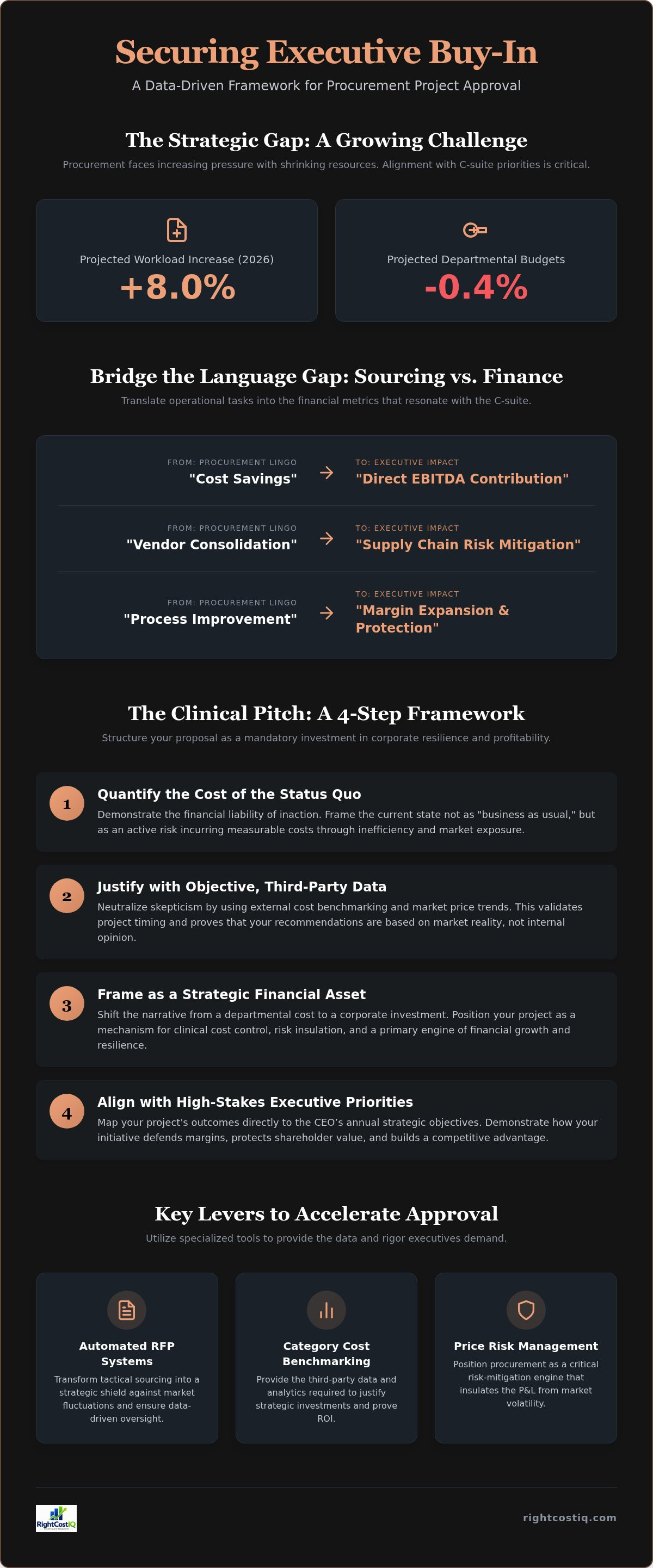
Executive buy-in is not won through process improvement; it's secured through the clinical quantification of margin expansion and risk volatility. You likely recognize the frustration of watching critical supply chain initiatives stall because the C-suite views your department as a cost center rather than a strategic value driver. Understanding how to get executive buy-in for a procurement project is now a survival skill, especially as workloads are projected to increase by 8.0% in 2026 while departmental budgets contract by 0.4%. The margin for error has vanished, requiring a shift toward rigorous financial translation that aligns with the organization's bottom line.
This guide provides a clinical, data-driven framework for mastering that translation, turning operational efficiency into the high-stakes EBITDA impact that commands immediate approval. You'll learn to present procurement initiatives as "safe" financial bets for risk-averse leaders by utilizing precise market intelligence. We'll examine how to leverage automated RFP systems, category cost benchmarking, and price risk management to transform your department from a back-office function into a primary engine of financial growth. This strategic blueprint ensures your next proposal is viewed as a mandatory investment in corporate resilience and profitability.
Key Takeaways
- Bridge the "Buy-in Gap" by translating operational supply chain efficiencies into the specific EBITDA levers and financial metrics that drive C-suite decision-making.
- Implement a clinical framework on how to get executive buy-in for a procurement project by quantifying the cost of the status quo and the ROI of modernizing vendor management.
- Utilize external cost benchmarking and market price trending to neutralize executive skepticism and justify project timing with objective, third-party data.
- Leverage professional RFP management and negotiation coaching to secure immediate budget approval while ensuring long-term financial resilience.
The Strategic Gap: Why Procurement Projects Stall at the Executive Level
The "Buy-in Gap" represents a structural failure to align tactical supply chain activities with the corporate P&L statement. While procurement departments often focus on operational efficiency, the C-suite remains focused on margin protection and capital preservation. This misalignment is the primary reason high-potential projects stall. Understanding how to get executive buy-in for a procurement project requires neutralizing three specific executive blockers: perceived operational risk, intense competition for finite capital, and a lack of data transparency. When a project is framed as an administrative upgrade, it's viewed as a cost; when it's framed as a strategic financial asset, it becomes a priority.
Process improvement is a weak pitch in a high-stakes environment. Executives don't authorize budgets to make a department "run better." They authorize budgets to protect the bottom line. Shifting your narrative from administrative ease to margin defense changes the fundamental nature of the conversation. You aren't asking for a tool; you're proposing a mechanism for clinical cost control and risk insulation.
The Language Disconnect: Sourcing vs. Finance
Financial leaders prioritize outcomes that are visible on a balance sheet. Procurement professionals must translate sourcing milestones into clinical financial metrics to gain traction. "Vendor consolidation" sounds like administrative busywork to a CFO, but "supply chain risk mitigation" signals a proactive defense of the organization's stability. The shift from "cost savings" to "direct EBITDA contribution" is essential for project approval. Engaging a professional negotiation coach can provide the rigorous financial modeling needed to prove these contributions. This translation ensures the project is seen as a driver of financial growth rather than a departmental expense.
Identifying High-Stakes Executive Priorities
Project urgency is rarely dictated by internal needs; it's driven by external market volatility. In 2026, with procurement workloads projected to rise by 8.0% while staffing declines, the manual status quo is no longer sustainable. Aligning your project with the CEO’s annual strategic objectives is the fastest route to approval. You must map specific project outcomes to shareholder value and competitive advantage. Mastering how to get executive buy-in for a procurement project involves demonstrating that your initiative is the primary tool for defending margins against inflationary pressures and regulatory shifts. This approach transforms procurement into a sophisticated engine of corporate resilience.
Aligning Procurement Objectives with C-Suite Financial Metrics
Executive leaders view procurement through the lens of financial control. To master how to get executive buy-in for a procurement project, you must quantify "Spend Under Management" as a clinical indicator of corporate discipline. It's not just about volume; it's about the percentage of total expenditure subjected to rigorous, data-driven oversight. Link your Request for Proposal (RFP) management directly to the reduction of financial volatility. This shift transforms a tactical sourcing event into a strategic shield against market fluctuations. By implementing automated negotiation systems, you maximize contract lifecycle value and ensure every dollar spent contributes to the organization's financial health.
Price Risk Management must be presented as a boardroom-level priority. In an environment of geopolitical instability, unhedged exposure to supply chain costs is a fiduciary liability. Positioning procurement as a risk-mitigation engine makes project approval a logical step for risk-averse executives. Utilizing category cost analytics provides the transparency required to justify these strategic investments.
Quantifying Margin Expansion Opportunities
Forecasting potential savings requires sophisticated procurement analytics that correlate internal spend with external market drivers. Margin Expansion in procurement is the systematic widening of the gap between revenue and cost of goods sold through clinical category optimization and contract leverage. When presenting your case, calculate the "Cost of Inaction" for every month the project is delayed. If an RFP project is expected to yield 12% savings on a $10 million category, each month of delay costs the organization $100,000 in lost EBITDA. This numerical clarity eliminates the ambiguity that often stalls budget approvals.
Risk Volatility and Supply Chain Resilience
Modern procurement projects insulate the business from sudden market price trending shifts. This insulation is critical. In high-inflation environments, unmanaged tail spend can silently erode corporate profits. Professional vendor performance tracking acts as a legal and compliance safeguard, protecting the organization from supplier-side failures that could lead to costly litigation or operational downtime. Successful strategies for how to get executive buy-in for a procurement project emphasize this resilience. By framing procurement as the architect of supply chain stability, you align your objectives with the long-term strategic interests of the C-suite.
Leveraging Cost Benchmarking and Analytics as Decision Levers
Executives often view internal procurement data as subjective or skewed toward departmental KPIs. External benchmarking provides the clinical, third-party validation required to neutralize this skepticism and establish a baseline of truth. This objective lens is a fundamental component of how to get executive buy-in for a procurement project. By moving beyond internal spend analysis and integrating global market intelligence, you provide the C-suite with the proof they need to authorize significant budget allocations. Data transparency eliminates the "trust gap" that often stalls high-stakes initiatives.
Strategic category management further strengthens this case by exposing hidden inefficiencies within tail spend. While large contracts often receive scrutiny, unmanaged tail spend can account for a significant portion of total expenditure and is frequently riddled with price creep. Should-Cost modeling acts as the ultimate anchor for executive expectations, defining the granular components of vendor pricing to ensure the organization never overpays for market-standard services. This level of granular visibility makes it difficult for risk-averse leaders to reject your proposal.
The Power of Comparative Market Intelligence
Establishing trust begins with third-party cost benchmarking. This data allows you to contrast your current contract terms against real-time market averages, highlighting specific areas of overspend that internal audits might miss. Utilizing market price forecasting further justifies the timing of an RFP project, proving that the current window is the optimal time to strike based on projected supply constraints or pricing troughs. This level of market-wide price trending transforms procurement from a reactive function into a proactive financial strategist that protects corporate margins.
Data-Driven Negotiation Strategies
Analytics arm executives with high-leverage talking points that shift the power dynamic in vendor discussions. Professional negotiation assistance ensures that these data points are translated into final contract terms that favor long-term EBITDA growth. Clinical application of data-driven benchmarking is reported by some industry professionals to reduce negotiation cycle times by approximately 25% by removing speculative pricing from the table. This efficiency allows lean teams to execute more projects with fewer resources, directly addressing the projected 8.0% increase in procurement workloads expected in 2026.
The Clinical Pitch: A Step-by-Step Framework for Project Approval
Securing approval requires a clinical five-phase architectural approach that links tactical execution directly to corporate finance. The goal is to move from a request for budget to a proposal for margin protection. This framework serves as the definitive guide on how to get executive buy-in for a procurement project by removing subjectivity from the decision-making process. It positions the procurement lead as a strategic architect of financial growth.
- Phase 1: Financial Discovery. Identify the specific EBITDA lever the project will pull. You must determine if the primary objective is direct cost reduction, operational overhead optimization, or working capital improvement.
- Phase 2: Risk Assessment. Quantify the cost of the status quo. Doing nothing is a financial decision with measurable consequences; specifically, the projected margin erosion resulting from unmanaged price creep.
- Phase 3: Solution Architecture. Propose a data-led RFP management cycle. This phase details the integration of market intelligence into the sourcing process to ensure a competitive advantage.
- Phase 4: Proof Concept. Use benchmarking to validate ROI projections. Providing third-party data to support your claims makes the project "safe" for executive approval.
- Phase 5: Execution Roadmap. Detail the transition to automated performance tracking. Show how the project will be monitored to ensure long-term value delivery and vendor accountability.
Crafting the Financial Narrative
Your presentation must focus exclusively on Return on Effort (ROE) and Return on Investment (ROI). Executives don't prioritize departmental "process improvements" unless they translate into bottom-line growth. Eliminate procurement jargon that obscures financial outcomes. Terms like "strategic sourcing" should be replaced with "margin expansion initiatives." Linking your pitch to RFP Management precision demonstrates that you have a rigorous, repeatable system for delivering results. This level of clarity ensures that the C-suite views your proposal as a sophisticated financial instrument rather than an administrative request.
Addressing Executive Objections Proactively
Anticipating resistance is critical to mastering how to get executive buy-in for a procurement project. When leaders raise the "bandwidth" objection, propose managed services as a force-multiplier for your lean team. If the concern is market "risk," introduce price risk management models that insulate the organization from volatility. Neutralizing these blockers early transforms the conversation from a debate over resources into a discussion about strategic execution. For high-stakes initiatives, providing a "Pilot Project" option can reduce initial commitment friction and provide the clinical proof required for full-scale budget authorization. To begin identifying your highest-impact opportunities, access our free procurement diagnostic to map your current spend against market benchmarks.
Accelerating Buy-in with Professional RFP and Negotiation Infrastructure
Internal procurement teams often struggle to secure budget because they lack the specialized infrastructure required to prove long-term value. Professional RFP management acts as a critical force-multiplier, especially as global workloads are projected to increase by 8.0% in 2026 while staffing levels decline by 0.9%. Deploying a sophisticated framework for how to get executive buy-in for a procurement project means moving beyond manual spreadsheets and adopting clinical, data-driven platforms. These systems provide the real-time transparency executives demand, ensuring every sourcing decision is backed by verifiable market intelligence rather than internal intuition.
RightCostIQ provides the technical engine required for complex enterprise sourcing, offering the "proof" necessary to turn a proposal into an approved mandate. Utilizing professional negotiation coaching ensures that C-suite ROI targets are not just projected, but realized during the final contracting phase. This specialized support neutralizes executive concerns regarding execution risk and departmental capacity, making project authorization a low-risk decision for financial leaders.
The ROI of Professional Sourcing Support
Comparing internal "DIY" RFP management against professional assistance reveals a significant gap in captured value. While internal teams handle the process, professional support integrates advanced market price forecasting to lock in long-term contract value during optimal pricing windows. This proactive approach prevents the margin erosion common in reactive sourcing cycles. You can explore our RFP management services to see how clinical execution drives enterprise efficiency and secures the financial metrics your CFO prioritizes.
Securing Long-Term Strategic Value
Successful buy-in isn't a one-time event; it's the first step toward securing a permanent seat at the corporate strategy table. Maintaining executive trust post-approval requires continuous vendor performance tracking to ensure the promised ROI is actually delivered. By shifting from a project-based mindset to a permanent value-delivery model, you elevate the standing of the entire procurement department. This systematic approach to how to get executive buy-in for a procurement project ensures that your department is viewed as an indispensable driver of financial growth. To begin this transformation, schedule a strategy session to quantify your procurement ROI and build a bulletproof case for your next initiative.
Securing Strategic Authority Through Financial Precision
Bridging the gap between operational sourcing and corporate finance is a clinical requirement for modern procurement leaders. You must replace process-oriented pitches with EBITDA-focused narratives that prioritize margin protection and risk insulation. Utilizing specialized category cost benchmarking and market price trending provides the objective proof executives demand before authorizing significant capital. This approach effectively neutralizes skepticism by anchoring every proposal in verifiable market intelligence.
Mastering how to get executive buy-in for a procurement project ensures your department is viewed as a high-performance financial engine rather than an administrative burden. By integrating professional negotiation coach services and clinical RFP management execution, you'll eliminate the execution risks that often stall high-stakes initiatives. This framework transforms procurement from a cost center into a primary driver of organizational resilience and competitive advantage.
Secure your procurement project approval with RightCostIQ's data-driven frameworks. Your next proposal can be the catalyst for permanent strategic standing and long-term financial growth.
Frequently Asked Questions
What is the most common reason executives reject procurement projects?
Executives typically reject projects that fail to demonstrate a direct link to the organization's P&L statement. When a proposal focuses on better process instead of margin protection, it's categorized as a discretionary expense. Understanding how to get executive buy-in for a procurement project requires shifting the narrative toward EBITDA impact. If the C-suite cannot see how a project defends the bottom line against inflationary pressure, they will prioritize capital for revenue-generating departments instead.
How do I calculate the ROI of a new procurement software implementation?
Calculating ROI involves quantifying direct cost savings and operational efficiency gains against the total cost of ownership. You must factor in the reduction of unmanaged tail spend and the avoidance of market-driven price increases. Professional cost benchmarking provides the baseline needed to project these savings accurately. By demonstrating a clear payback period, typically within twelve months for enterprise systems, you provide the clinical financial proof required to secure final budget authorization from risk-averse leadership.
Can I get buy-in for a procurement project without a full spend analysis?
You can secure approval by focusing on high-volatility categories through targeted cost benchmarking and price risk management. While a full spend analysis is ideal, it often delays urgent projects. Presenting objective data on a single high-impact category allows you to prove the cost of inaction immediately. This approach serves as a proof-of-concept, demonstrating the financial validity of your methodology before scaling to a full-scale enterprise procurement modernization project.
What financial metrics do CFOs care about most in a procurement pitch?
CFOs prioritize EBITDA contribution, cash flow optimization, and return on investment. They require a clinical breakdown of how a project reduces financial volatility and improves margin predictability. When presenting how to get executive buy-in for a procurement project, you should emphasize Spend Under Management as a key performance indicator. Highlighting the reduction in contract lifecycle leakage and the improvement of vendor payment terms aligns your objectives with the broader corporate financial strategy.
How does price risk management help in getting project approval?
Price risk management provides the clinical insulation against market volatility that executives demand in uncertain economic climates. By forecasting market price trending, you transform procurement from a reactive buyer into a proactive financial strategist. This foresight allows the C-suite to lock in favorable rates and protect margins before supply chain disruptions occur. Executives are significantly more likely to approve projects that function as a hedge against unpredictable external financial risks.
What is the role of market benchmarking in executive presentations?
Market benchmarking acts as an objective, third-party validator that neutralizes internal skepticism regarding spend data. Executives often doubt departmental KPIs; however, they respect comparative market intelligence from specialized providers. Benchmarking identifies specific price variances between your current contracts and real-time market averages. This data-driven approach removes subjectivity from the presentation, allowing you to justify project costs based on the clinical gap between your performance and industry standards.
How can I prove the value of tail spend management to the C-suite?
Proving tail spend value requires quantifying the cumulative margin erosion caused by thousands of unmanaged, low-value transactions. While individual purchases are small, the aggregate price creep in tail spend often accounts for significant annual waste. You should present this as a hidden EBITDA lever that automated RFP systems can easily pull. By demonstrating how professional oversight brings 100% of spend under managed discipline, you align the project with executive mandates for total operational transparency.
Is professional negotiation assistance worth the investment for a single project?
Professional negotiation assistance is highly effective for high-stakes enterprise sourcing where even a marginal improvement in terms yields substantial ROI. A negotiation coach provides the clinical financial modeling and tactical expertise needed to ensure contract terms favor long-term profitability. This support acts as a force-multiplier for lean teams, ensuring that the organization does not leave money on the table during complex vendor discussions. The service often pays for itself through the immediate capture of improved contract value.


