
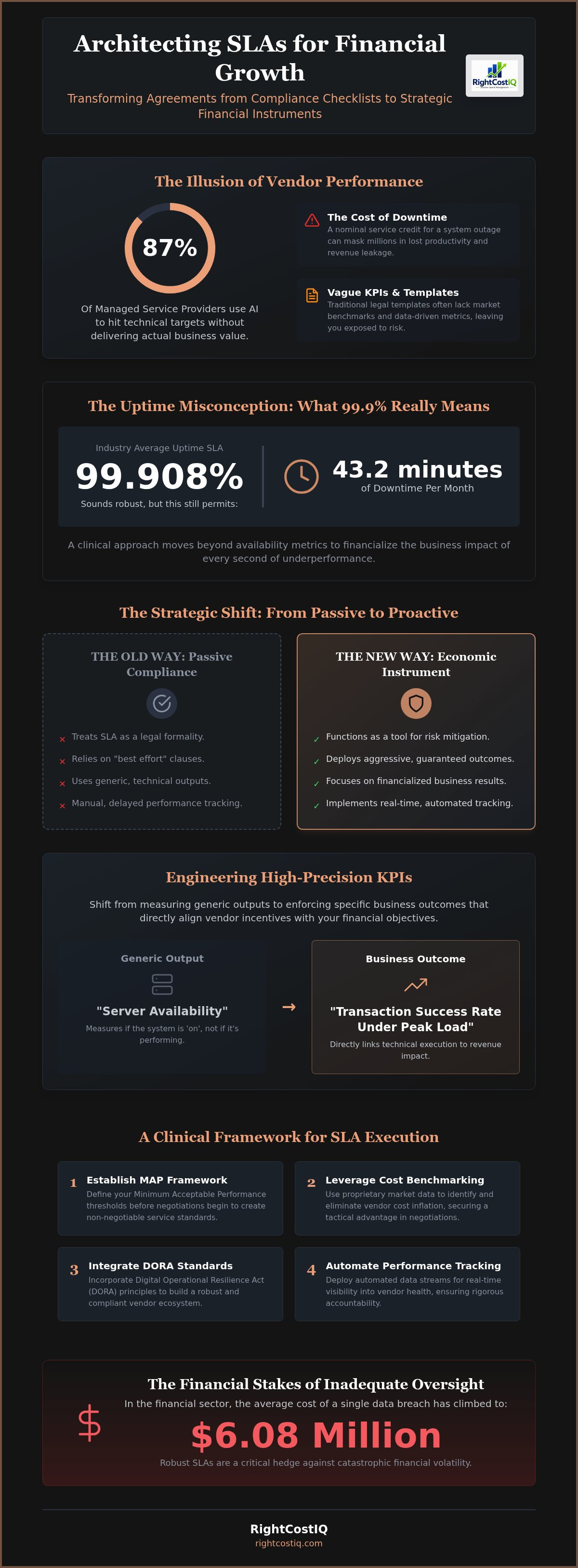
What if the service credit structure in your current contract is actually a roadmap for vendor underperformance? Most procurement leaders view an SLA as a safety net, yet 87% of Managed Service Providers are now leveraging AI to hit technical targets without necessarily delivering business value. When you're negotiating service level agreements (SLAs), you've likely felt the frustration of receiving a nominal credit for a system outage that cost your organization millions in lost productivity. It's a common pain point; vague KPIs and a lack of market pricing benchmarks leave you exposed to risks that traditional legal templates simply cannot mitigate.
This article provides a clinical framework for SLA execution that transforms these documents from passive compliance checklists into aggressive drivers of financial growth. You'll master the strategic execution of negotiations to drive vendor accountability and maximize bottom line results through technical risk mitigation. We'll analyze the integration of Digital Operational Resilience Act (DORA) standards, establish data-driven uptime benchmarks beyond the current 99.908% industry average, and deploy a strategic architecture for measurable vendor performance tracking that secures long-term operational efficiency.
Key Takeaways
- Treat SLAs as strategic financial instruments that secure risk mitigation and directly enhance enterprise bottom-line performance.
- Engineering high-precision, outcome-based KPIs ensures vendor accountability by prioritizing business results over generic technical outputs.
- Establish a Minimum Acceptable Performance (MAP) framework to create non-negotiable service thresholds before the negotiation phase begins.
- Secure a tactical advantage when negotiating service level agreements (SLAs) by leveraging proprietary cost benchmarking to identify and eliminate vendor cost inflation.
- Integrate data-driven sourcing with expert negotiation assistance to transform procurement into a primary driver of financial growth.
The Economic Weight of Service Level Agreements in Modern Procurement
Procurement leaders often relegate the Service-level agreement (SLA) to the legal department, treating it as a standard compliance box. This is a strategic error. In high-performance organizations, an SLA serves as a clinical financial instrument designed for risk mitigation and margin protection. Negotiating service level agreements (SLAs) requires a shift from passive "best effort" clauses toward aggressive, guaranteed outcome frameworks. By 2026, the complexity of digital ecosystems demands a data-driven approach to vendor accountability that prioritizes bottom-line metrics over technical jargon.
The correlation between service uptime and enterprise performance is absolute. Research indicates that the average cloud uptime SLA in 2026 sits at 99.908%. While this sounds robust, a standard 99.9% uptime still permits 43.2 minutes of monthly downtime. For a global enterprise, those minutes represent significant revenue leakage. Procurement must move beyond simple availability metrics. A clinical approach focuses on the actual business impact of service degradation, ensuring that every second of underperformance is financialized and accounted for in the contract.
Beyond Compliance: The ROI of Performance Guarantees
Service disruptions carry a heavy price tag. In the financial sector, the average cost of a data breach has climbed to $6.08 million, highlighting the catastrophic risk of inadequate vendor oversight. Robust SLAs function as a critical hedge against this financial volatility. They transform potential losses into predictable service credits or liquidated damages. An Economic SLA is a strategic procurement tool that converts vendor performance thresholds into direct mechanisms for margin expansion.
SLA Negotiation as a Component of Category Management
Effective service level definition is inseparable from category management procurement. Integrating these metrics into a broader strategic framework ensures that vendor performance aligns with supply chain resilience goals. When negotiating service level agreements (SLAs), procurement teams must evaluate how specific KPIs impact spend under management. High-precision service standards reduce the total cost of ownership by eliminating the need for redundant backup systems or manual workarounds. This alignment ensures that every dollar spent on a service provider is optimized for maximum operational efficiency and measurable business value.
Engineering High-Precision KPIs: Beyond Generic Performance Metrics
Generic uptime percentages are no longer sufficient for enterprise-grade vendor oversight. When negotiating service level agreements (SLAs), procurement architects must engineer KPIs that are specific, measurable, and strictly financialized. A high-performance KPI links technical execution directly to revenue impact. Instead of measuring generic outputs like "server availability," high-stakes contracts focus on outcomes such as transaction success rates under peak load. This shift ensures that the vendor's incentives align perfectly with the buyer's financial objectives.
Effective enforcement relies on automated vendor performance tracking. Manual reporting is prone to bias and latency. By implementing automated data streams, procurement teams maintain real-time visibility into vendor health. This data-driven oversight allows for rigorous reporting cadences. Monthly reviews become strategic sessions focused on optimization rather than debates over data accuracy. High-stakes procurement demands this level of clinical precision to ensure that vendors remain accountable to the agreed-upon standards.
Customizing KPIs for Healthcare and Financial Analytics
Specialized sectors require clinical precision regarding data integrity and latency. In financial sourcing, a microsecond of latency can translate to significant lost opportunity. Negotiating service level agreements (SLAs) in these environments necessitates sub-millisecond response thresholds and 100% data accuracy guarantees. These rigorous standards must also extend to tail spend management, where fragmented services often hide significant operational risks. Aligning tail spend with specific service thresholds prevents performance leakage across the entire vendor ecosystem. Organizations can't afford to ignore these smaller categories when they collectively impact the bottom line.
The Mechanics of Service Credits and Penalties
Service credits shouldn't just punish failure; they must incentivize excellence. A well-engineered credit structure reflects the actual economic impact of a breach. If a system failure costs $50,000 per hour, a minor nominal credit is a failure of negotiation. Procurement should utilize tiered penalty structures that scale with the duration and severity of the disruption. This ensures the financial penalty is commensurate with the business loss.
Integrating earn-back clauses provides a collaborative path to service recovery. These clauses allow vendors to recoup a portion of penalized fees if they exceed performance targets in subsequent periods. This approach maintains a focus on long-term stability rather than short-term litigation. For organizations seeking to audit their current performance metrics, a comprehensive vendor performance diagnostic can identify critical gaps in existing credit structures.
Leveraging Cost Benchmarking and Market Intelligence in SLA Negotiations
Data-driven negotiation replaces intuition with objective financial reality. When negotiating service level agreements (SLAs), procurement architects must utilize procurement category cost benchmarking to validate vendor pricing against current market standards. It's common for vendors to inflate costs by bundling essential services with "premium" features that offer diminishing returns. By analyzing granular cost data, you can isolate the true market value of specific performance thresholds and ensure that the price paid aligns strictly with the value delivered.
Identifying "gold-plating" in vendor proposals is a critical step in margin protection. Gold-plating occurs when a vendor proposes service levels that exceed your actual business requirements, such as offering four-hour hardware replacement for non-critical systems. This unnecessary redundancy inflates contract value without providing a corresponding increase in operational resilience. Clinical procurement requires a ruthless evaluation of each service tier to eliminate these hidden costs, ensuring the final agreement is lean and focused on core business outcomes.
Benchmarking Service Levels Against Industry Standards
Determining what "standard" performance looks like requires deep market intelligence. In the cloud sector, for example, the average uptime SLA as of July 2026 is 99.908%. If a vendor claims their 99.9% guarantee is a premium offering, analytics can immediately challenge that assertion. Strategic benchmarking prevents the common error of overpaying for standard service levels disguised as high-performance offerings. By using precise category analytics, you force vendors to justify their pricing based on objective performance data rather than marketing claims.
Price Forecasting as a Negotiation Lever
Anticipating future service cost fluctuations is essential for long-term price risk management. Market intelligence regarding 2026 economic forecasts allows procurement teams to adjust SLA costs based on projected inflationary trends and technological shifts. Locking in service rates while maintaining flexibility in performance standards creates a robust hedge against financial volatility. This forward-looking approach ensures that long-term agreements remain cost-effective even as market conditions evolve. By integrating price forecasting into the negotiation playbook, you mitigate the risk of sudden cost escalations and secure a stable foundation for vendor performance tracking.
The Negotiation Playbook: Tactical Execution for Enterprise Efficiency
Tactical execution is the bridge between strategic intent and realized value. When negotiating service level agreements (SLAs), success is determined by the preparation conducted before the first meeting begins. Procurement architects must establish the Minimum Acceptable Performance (MAP) as a non-negotiable floor for service delivery. This floor represents the critical point where service degradation begins to negatively impact core financial metrics. By defining this boundary early, you create a clear mandate for the negotiation team and prevent the acceptance of sub-par performance standards during high-pressure discussions.
Deploying an "Anchor and Adjust" strategy allows procurement to lead the negotiation narrative. Set initial service level thresholds significantly higher than the MAP to create tactical room for concessions that don't compromise the core mission. Vendors frequently object to high standards by citing technical constraints or liability caps. Counter these objections clinically by using the market intelligence and benchmarking data established in previous phases. If a vendor claims a specific uptime target is technically unachievable, use comparative analytics to prove market viability. For complex deals involving multiple service tiers, professional negotiation assistance provides the expert oversight needed to maintain leverage and navigate technical pushbacks without sacrificing financial growth.
Aligning Stakeholders for a Unified Negotiation Front
Contract failure often stems from internal misalignment between departments. IT departments typically prioritize technical performance and system integrity, while procurement focuses on cost optimization and risk mitigation. A clinical approach requires bridging this gap through a cross-functional negotiation team. This team must establish a unified front, ensuring that all technical requirements are financialized and all budgets are technically sound. Clear escalation paths are essential to prevent negotiations from stalling when vendor pushback occurs. This internal synergy maintains the strategic urgency required for enterprise-grade efficiency and ensures the vendor perceives a single, unwavering set of expectations.
Integrating SLA Negotiation into the RFP Lifecycle
Waiting until the final contracting stage to discuss service levels is a tactical error that reduces buyer leverage. High-performance organizations build stringent SLA requirements directly into the initial RFP management process. This allows you to use the competitive bidding environment as a lever to drive superior service level commitments from the start. Automated RFP platforms streamline the comparison of vendor service levels, highlighting discrepancies in performance guarantees before a short-list is even finalized. This early integration ensures that the final selection is based on a holistic view of both cost and accountability, rather than just the lowest bid. To ensure your current contracts meet these enterprise standards, access our free procurement diagnostic to identify hidden performance risks and optimization opportunities.
Clinical Execution: How RightCostIQ Optimizes SLA Outcomes
RightCostIQ operates as a strategic architect for high-stakes procurement. We integrate advanced technology into traditional business functions to ensure negotiating service level agreements (SLAs) results in measurable financial growth. Our methodology combines proprietary cost benchmarking analytics with expert-led negotiation assistance. This dual approach ensures that every contract clause is backed by data and every performance threshold is commercially viable. We provide the technical precision required to navigate complex vendor ecosystems and secure long-term operational stability.
Utilizing our RFP management and negotiation assistance allows procurement teams to secure superior service commitments from the outset. We don't stop at the signature. Our platform provides real-time vendor performance tracking to ensure ongoing SLA compliance. This continuous oversight transforms procurement from a passive cost center into a primary driver of enterprise efficiency. It ensures that the value negotiated on day one is the value delivered throughout the contract lifecycle. By automating the monitoring process, we eliminate the latency inherent in manual reporting and enforce accountability with clinical precision.
Strategic Benchmarking for Service Optimization
Our analytics uncover hidden savings within existing service agreements by identifying performance gaps through clinical cost analysis. We evaluate the delta between contractually mandated service levels and actual vendor output. In many enterprise environments, this analysis identifies redundant "gold-plated" services that offer no additional business value. By right-sizing these agreements, organizations can achieve significant margin improvement without sacrificing operational resilience. Our specialized analytics heritage allows us to identify these inefficiencies with surgical accuracy, frequently uncovering opportunities for 15% margin improvement through optimized service alignment.
The Future of Negotiation: AI-Led Precision
The procurement landscape of 2026 demands deep technological integration. RightCostIQ leverages advanced forecasting tools to anticipate vendor performance risks before they impact the bottom line. Our platform automates the comparison of complex SLA structures, allowing for rapid identification of unfavorable terms or hidden liabilities. This level of technical upskilling provides a decisive competitive advantage in a market increasingly defined by digital innovation. Optimize your next negotiation with RightCostIQ to secure the clinical execution your organization requires. We bridge the gap between traditional sourcing and cutting-edge financial optimization.
Securing Enterprise Resilience Through Strategic Accountability
Strategic procurement optimization demands a transition from passive contract management to active financial engineering. By prioritizing outcome-based KPIs and leveraging real-time market intelligence, organizations secure a decisive advantage against operational volatility. Mastering the clinical execution of negotiating service level agreements (SLAs) ensures that every vendor commitment translates directly into measurable enterprise value. You now possess the tactical framework required to eliminate gold-plating and enforce strict vendor accountability through automated performance tracking and rigorous data-driven oversight.
RightCostIQ provides the proprietary cost benchmarking analytics and expert RFP management framework necessary to transform your sourcing department into a high-performance growth engine. Our methodology ensures that technical execution and high-level financial strategy remain perfectly aligned throughout the contract lifecycle. Master your next negotiation with RightCostIQ assistance and secure the clinical precision your bottom line deserves. Your path to optimized vendor performance and sustainable margin expansion starts with data-driven clarity.
Frequently Asked Questions
What are the three most critical components of an enterprise SLA?
The three most critical components are high-precision performance metrics, clearly defined remediation structures, and comprehensive audit rights. Performance metrics must be financialized to link technical execution directly to revenue impact. Remediation structures, such as service credits, ensure vendor accountability during outages. Audit rights provide the transparency needed for independent vendor performance tracking. These elements transform a standard contract into a strategic tool for risk mitigation and operational efficiency.
How do I calculate the financial impact of a missed SLA uptime target?
Calculating the financial impact of missed uptime requires a formulaic approach: (Hourly Revenue / 60) * Minutes of Outage + Productivity Loss + Recovery Costs. In 2026, the average cloud uptime is 99.908%, meaning a 99.9% guarantee permits 43.2 minutes of monthly downtime. Negotiating service level agreements (SLAs) effectively requires quantifying these minutes into hard currency to justify credit tiers and penalty structures that reflect actual economic damage.
Is it better to have a single complex SLA or multiple simpler ones?
Modular, simpler SLAs are superior to single complex documents in modern procurement ecosystems. A modular approach allows for granular oversight of specific service categories without compromising the entire contract. This structure facilitates more efficient vendor performance tracking by isolating underperforming units. Simpler, targeted SLAs also streamline the review process, allowing procurement teams to update technical thresholds as market conditions or technological requirements evolve without triggering a full legal redline.
What is the difference between an SLA and a Service Level Objective (SLO)?
An SLA is a legally binding agreement that defines the consequences of service failure, whereas a Service Level Objective (SLO) is an internal performance target. SLOs act as the technical benchmarks that teams strive to achieve to stay within SLA compliance. While an SLO measures operational health, the SLA measures financial accountability. Effective procurement requires aligning these objectives to ensure that internal technical goals support the overarching business outcomes defined in the contract.
How often should service level agreements be reviewed and renegotiated?
Service level agreements should undergo a formal review at least every 12 months to maintain alignment with market price trending and technological advancements. Rapid innovation in AI and automation often renders technical KPIs obsolete within a single fiscal year. Scheduled review cycles ensure that performance thresholds remain competitive and that service costs reflect current economic forecasts. This proactive cadence prevents contract stagnation and ensures that vendor accountability remains prioritized during market shifts.
Can service level agreements be used to manage tail spend effectively?
Negotiating service level agreements (SLAs) is a highly effective strategy for managing fragmented tail spend. By aggregating minor service providers under standardized performance thresholds, procurement teams eliminate the risk of performance leakage in non-core categories. This clinical approach applies enterprise-grade accountability to low-volume transactions, ensuring that tail spend contributes to broader supply chain resilience. Standardized SLAs across tail spend categories reduce administrative overhead and improve the total cost of ownership.
What are "Watermelon SLAs" and how do I avoid them?
"Watermelon SLAs" refer to agreements that appear "green" on the outside through technical uptime metrics but are "red" on the inside because they fail to deliver business value. This occurs when a vendor meets technical targets like server availability while failing at critical business outcomes like transaction success rates. You avoid this by engineering outcome-based KPIs that measure the actual financial impact of the service rather than just the underlying technical activity.
How do I handle a vendor that refuses to accept financial penalties in an SLA?
If a vendor refuses financial penalties, procurement should pivot to earn-back clauses or performance-based contract extensions. Earn-back clauses allow vendors to recoup credits if they exceed targets in subsequent periods, creating a collaborative path to recovery. Alternatively, use market intelligence and benchmarking data to prove that penalties are an industry standard for the category. If resistance persists, professional negotiation assistance can help reframe the risk and secure alternative forms of accountability.


