
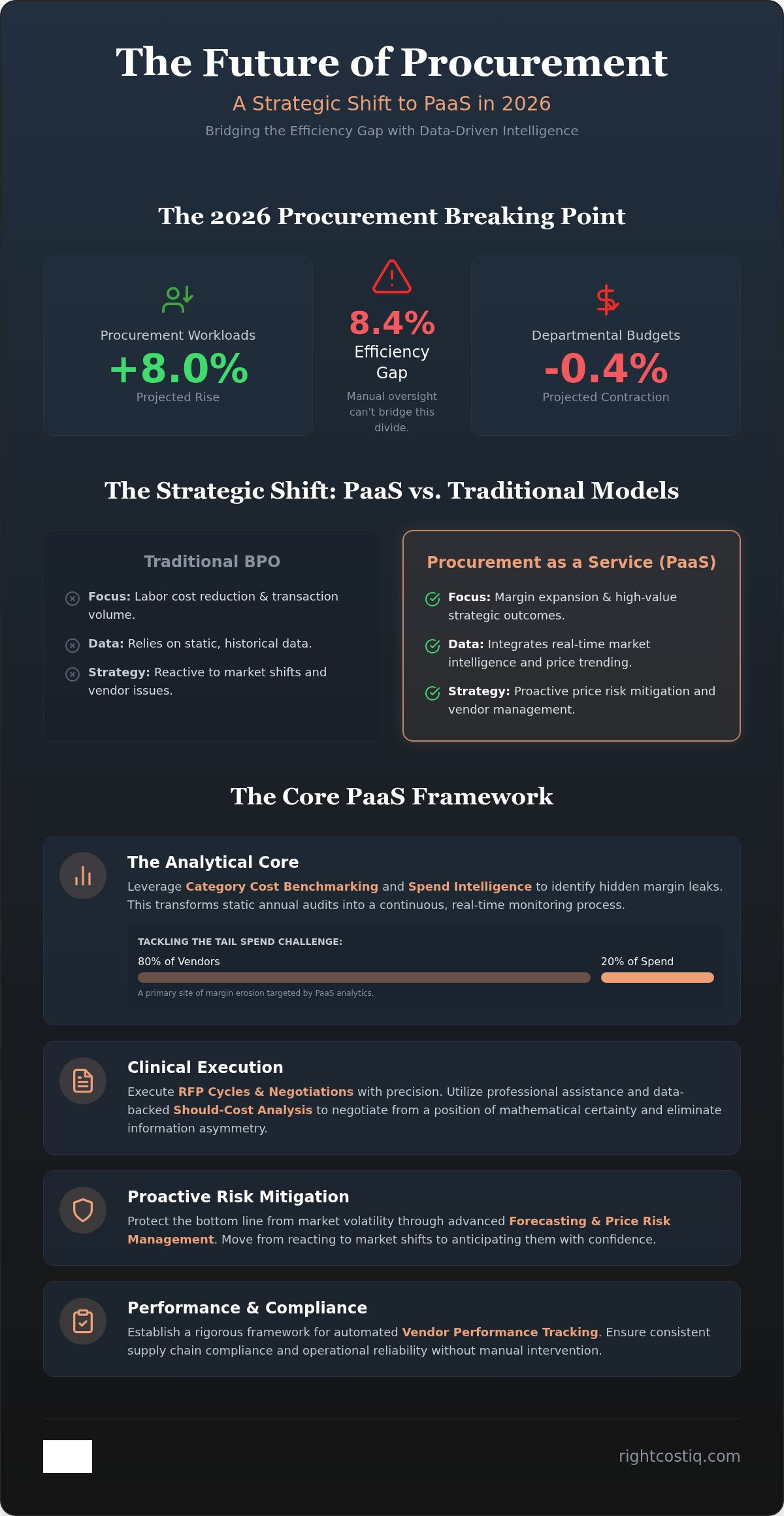
With procurement workloads projected to rise by 8.0% in 2026 while departmental budgets simultaneously contract by 0.4%, the traditional sourcing model has reached a terminal breaking point. High-level decision-makers now face an 8.4% efficiency gap that manual oversight simply can't bridge. Inconsistent vendor tracking and a lack of real-time market data are no longer just operational hurdles; they're direct threats to your fiscal integrity. By integrating advanced procurement optimization services, your organization can pivot from reactive cost-cutting to a clinical, data-driven strategy that protects the bottom line.
This article demonstrates how Procurement as a Service (PaaS) utilizes advanced analytics, RFP management, and price risk mitigation to deliver precision in supply chain execution. You'll discover how to achieve quantifiable cost savings through benchmarking and reduced financial volatility via strategic market intelligence. We'll examine the specific framework required to transform procurement from a cost center into a primary driver of margin expansion for 2026.
Key Takeaways
- Shift from reactive sourcing to a strategic architecture designed for margin expansion through technology-led procurement models.
- Identify hidden cost-saving opportunities by leveraging professional category cost benchmarking and actionable spend intelligence.
- Execute RFP cycles with clinical precision to eliminate margin erosion and utilize professional negotiation assistance as a strategic lever.
- Protect your bottom line from market volatility with advanced price risk management and procurement optimization services.
- Establish a rigorous framework for vendor performance tracking to ensure consistent supply chain compliance and operational reliability.
Defining Procurement as a Service (PaaS): The Strategic Shift in 2026
Procurement as a Service (PaaS) represents an agile, technology-led architecture designed to optimize every phase of the procurement process. By 2026, the transition from tactical outsourcing to strategic margin expansion is a financial necessity. Organizations no longer require simple labor arbitrage; they require clinical intelligence. This model integrates advanced analytics, specialized RFP management, and rigorous vendor performance tracking into a unified strategic framework. It empowers the Clinical Procurement Executive to prioritize data-backed decisions over historical precedent. These procurement optimization services bridge the gap between traditional sourcing and modern financial requirements.
The Evolution of Sourcing and Procurement
Traditional sourcing models often fail because they're built for static market conditions. In 2026, procurement workloads are projected to rise by 8.0%, yet budgets are contracting. This creates an 8.4% efficiency gap that manual oversight cannot bridge. Automated platforms within the PaaS ecosystem ingest real-time data to identify price risk before it erodes margins. Clinical execution ensures every procurement cycle follows a rigorous, repeatable framework. This isn't about simple task completion. It's about engineering a supply chain that responds to geopolitical shifts and market volatility with mathematical certainty. Efficiency isn't a goal; it's the baseline for survival.
PaaS vs. Traditional BPO: A Critical Distinction
The distinction between PaaS and traditional Business Process Outsourcing (BPO) lies in the focus on high-value strategic outcomes rather than transaction volume. Traditional BPO providers prioritize labor cost reduction. PaaS providers prioritize margin expansion through specialized intelligence. This model utilizes proprietary data and benchmarking tools to provide a quantifiable competitive edge. High-level decision-makers utilize these procurement optimization services to implement strategic sourcing and procurement frameworks that are both scalable and precise. Key differentiators include:
- Integration of real-time market price trending data.
- Clinical precision in RFP lifecycle execution.
- Proactive price risk mitigation strategies.
- Automated vendor compliance and performance tracking.
By focusing on these strategic levers, PaaS transforms procurement from a back-office function into a primary engine for corporate financial growth.
The Analytical Core: Category Cost Benchmarking and Spend Intelligence
In 2026, raw data is a liability unless it's distilled into actionable intelligence. Sophisticated procurement optimization services rely on a continuous pipeline of category cost benchmarking to identify margin leaks that traditional audits miss. Most organizations lose significant value because their benchmarking remains a static, annual event. PaaS transforms this into a rhythmic monitoring process. By utilizing real-time market intelligence, decision-makers can understand pricing variance across complex categories with clinical precision. This shift ensures that procurement departments don't just react to market shifts but anticipate them with data-backed confidence.
Advanced Benchmarking Standards
Static spreadsheets can't keep pace with a market where North American procurement spend accounts for nearly 45% of global revenue. Strategic sourcing requires a deep understanding of what drives cost. Implementing a rigorous should-cost analysis allows your team to negotiate from a position of mathematical certainty. This granular reporting identifies category-specific savings by comparing internal spend against validated market price trending data. It's the difference between guessing at a discount and engineering a specific financial outcome. Clinical execution requires that every benchmarking report translates directly into a negotiation lever or a risk mitigation strategy. When you understand the underlying cost drivers, you eliminate the information asymmetry that vendors typically exploit.
Spend Analysis as a Driver for Financial Growth
C-suite reporting now demands more than just a list of expenditures. It requires a quantified impact of spend under management on the organization's bottom line. The tail spend challenge, often representing 20% of spend but 80% of vendors, is a primary site of margin erosion. Automated, data-driven frameworks within specialized procurement optimization services bring these unmanaged transactions into a clinical oversight structure. This ensures that every dollar spent aligns with the broader Category Management in Procurement: A Clinical Framework (2026).
Continuous data monitoring acts as the rhythmic heartbeat of a modern procurement department. It closes the 8.9% productivity gap by automating the identification of savings opportunities. To see where your current data gaps exist, you can perform a preliminary spend diagnostic to uncover immediate optimization targets. This analytical rigor transforms procurement from a back-office necessity into a sophisticated engine for financial growth.
RFP Management and Negotiation: Executing Sourcing with Clinical Precision
RFP management is frequently dismissed as administrative overhead. In a high-stakes fiscal environment, it's actually the primary architecture for value capture. Professionalized procurement optimization services transform the Request for Proposal from a simple bid collection tool into a clinical instrument for vendor alignment. This transition ensures that every sourcing cycle delivers maximum ROI while mitigating long-term operational risk. When the RFP process is treated as a strategic framework rather than a clerical task, it becomes a powerful lever for margin protection.
The Clinical Execution of RFP Cycles
A structured RFP lifecycle eliminates the subjectivity that typically leads to margin erosion. Clinical execution requires a three-step approach to ensure that the final contract aligns with organizational financial goals:
- Step 1: Data-driven requirement definition. Aligning internal needs with verified market capabilities prevents scope creep and ensures that the sourcing event targets actual business requirements.
- Step 2: Sophisticated vendor shortlisting. Utilize historical vendor performance tracking data to filter for reliability, compliance, and fiscal stability before the bidding begins.
- Step 3: Strategic negotiation coaching. Maximize total contract value by aligning vendor incentives with your organization's specific growth targets and operational KPIs.
Negotiation Strategies for High-Value Procurement
Negotiation is the final stage of the value capture process. It requires more than interpersonal skills; it requires a distinct information advantage. By integrating market price trending data into the discussion, procurement teams can challenge vendor quotes with objective reality. This bridges the gap between high-level procurement strategy and tactical execution, ensuring that negotiated savings actually materialize in the final contract. For teams looking to sharpen these specific skills, utilizing a specialized negotiation coach provides the clinical edge needed to secure superior terms in complex categories.
Professionalized management of complex sourcing cycles yields a measurable return. Strategic sourcing components represented 31.5% of the PaaS market share in 2025, highlighting the shift toward high-precision execution. These procurement optimization services ensure that negotiation isn't just a discussion about unit price, but a strategic alignment of the entire supply chain architecture. By professionalizing the RFP lifecycle, organizations can eliminate the 8.4% efficiency gap that often plagues manual sourcing departments.
Forecasting and Price Risk Management: Mitigating Financial Volatility
Financial volatility is the primary antagonist of margin expansion. In an environment where procurement technology spend is rising by 6.1% to close efficiency gaps, the ability to predict cost fluctuations is a baseline requirement for fiscal survival. Sophisticated procurement optimization services integrate market price trending to replace speculation with clinical foresight. By implementing a dedicated price risk management service, organizations can insulate their bottom line from the sudden inflationary spikes or geopolitical shifts that characterize the 2026 landscape. This isn't just about tracking prices; it's about engineering a defensive perimeter around your corporate margins.
Market Price Trending and Forecasting Models
Effective forecasting requires a deep dive into historical data to identify the underlying trajectories of core categories. Analytics platforms now ingest millions of data points to pinpoint market inflection points before they impact the P&L. This data-driven approach allows decision-makers to move from reactive purchasing to proactive strategic sourcing. Price risk management acts as a critical driver of fiscal stability by insulating corporate margins from unpredictable market fluctuations. Clinical precision in this area ensures that your financial planning remains grounded in mathematical reality rather than historical guesswork.
Mitigating Volatility in Contract Negotiations
Integrating risk forecasting into the initial sourcing definition is the most effective way to secure long-term value. When you understand the probable future cost of a category, you can structure contracts that include protective indexing or price-adjustment triggers. This ensures continuous supply chain compliance and protects against the 8.4% efficiency gap that often results from unmanaged price creep. These frameworks are explored in depth within our guide on RFP Management: Strategic Frameworks for AI-Led Procurement Optimization.
Automated market intelligence platforms provide the rhythmic monitoring necessary to maintain this information advantage. They track vendor performance against real-time market movements, ensuring that your organization never pays a premium during market downturns. To identify which of your high-spend categories are currently exposed to unmitigated price risk, you can access a clinical price risk diagnostic to evaluate your current exposure levels. This level of oversight transforms procurement from a transactional function into a powerful engine for financial growth and risk mitigation.
Integrating PaaS into Enterprise Infrastructure: Performance and Compliance
Strategic integration of Procurement as a Service into existing enterprise infrastructure is the final step in securing long-term margin expansion. This process requires a clinical framework that aligns high-level financial strategy with granular technical execution. In 2026, where 70% of organizations target significant digital transformation, the infrastructure must support automated oversight. Advanced procurement optimization services act as the connective tissue between disparate data sets and actionable sourcing outcomes. By embedding these services into the core operational workflow, decision-makers ensure that efficiency gains are permanent rather than temporary.
Vendor Performance and Compliance Architectures
Establishing a clinical framework for vendor performance tracking is essential to mitigate operational risk. Systems must be configured with specific KPIs that measure reliability, cost adherence, and compliance with contractual terms. Automated oversight eliminates the manual errors that frequently lead to an 8.4% efficiency gap in unmanaged supply chains. To maintain total visibility across all expenditure, organizations should utilize tail spend management modules to bring low-value, high-volume transactions into the compliance fold. This architectural approach ensures that every vendor relationship is evaluated against objective data rather than subjective sentiment. Operational efficiency increases as compliance becomes a self-correcting mechanism within the platform.
The Future of Procurement Infrastructure
The next generation of procurement infrastructure prioritizes the seamless integration of analytics into the primary platform. Scaling sourcing capabilities no longer requires increasing headcount; it requires deploying automated PaaS modules that handle the heavy lifting of data processing. When choosing a partner for these procurement optimization services, the primary criteria must be clinical precision and a proven ROI framework. The partner should function as a strategic architect, providing the tools necessary to bridge the gap between financial growth targets and supply chain realities. This holistic alignment ensures that the procurement department remains a powerful engine for corporate stability.
To evaluate how your current infrastructure handles performance tracking and compliance, you can access our free diagnostic tool for a comprehensive audit of your procurement maturity. This analysis provides the baseline data needed to begin a strategic shift toward a more resilient, technology-led sourcing model.
Architecting Financial Resilience for the 2026 Procurement Landscape
The transition to a technology-led sourcing model is no longer optional for organizations targeting sustained margin expansion. By implementing a clinical framework for procurement optimization services, decision-makers can transform procurement from a reactive cost center into a sophisticated engine for growth. We've detailed the necessity of integrating advanced analytics, professionalized RFP execution, and rigorous price risk mitigation into your core enterprise infrastructure.
RightCostIQ operates as a global strategic sourcing authority, providing the specialized tools required to eliminate information asymmetry in vendor negotiations. Our expert-led RFP management and negotiation assistance, combined with proprietary price risk management and tracking, ensure that your financial outcomes are engineered with mathematical certainty. Don't allow market volatility to erode your fiscal integrity. Take the first step toward clinical precision and optimize your procurement outcomes with RightCostIQ clinical analytics. Your organization possesses the potential to turn every supply chain challenge into a quantifiable competitive advantage.
Frequently Asked Questions
What exactly is Procurement as a Service (PaaS)?
Procurement as a Service is an agile, technology-led model that integrates advanced analytics and expert sourcing oversight into a unified strategic framework. Unlike traditional models, PaaS focuses on clinical precision in supply chain execution to drive margin expansion. It allows organizations to scale their procurement capabilities without increasing headcount. By deploying specialized procurement optimization services, businesses can automate complex cost analysis and market monitoring to achieve permanent efficiency gains.
How does PaaS differ from traditional procurement outsourcing?
Traditional outsourcing focuses on labor arbitrage and administrative task completion. PaaS is a strategic architecture that prioritizes financial growth metrics and operational efficiency through proprietary data. While traditional BPO providers manage transaction volume, PaaS partners provide high-level consultancy and sophisticated analytics. This model bridges the gap between back-office functions and C-suite financial strategy by leveraging real-time market intelligence. It's an expert-led approach to engineering a resilient supply chain.
What are the primary financial benefits of implementing a PaaS model?
The primary benefit is quantifiable cost savings achieved through rigorous benchmarking and clinical negotiation frameworks. Organizations can close the 8.4% efficiency gap by automating vendor oversight and price risk tracking. PaaS protects corporate margins by identifying hidden savings in complex categories and reducing financial volatility. These procurement optimization services transform procurement into a primary driver of the organization's bottom line by aligning technical execution with high-level financial goals.
Can PaaS help manage tail spend effectively?
PaaS utilizes automated data-driven frameworks to bring unmanaged tail spend under clinical oversight. This category often represents 80% of vendors but only 20% of spend, leading to significant margin erosion when left unmonitored. By implementing specialized modules, organizations can apply the same analytical rigor to low-value transactions as they do to strategic categories. This ensures total supply chain compliance and captures previously lost value through continuous monitoring and automated process integration.
What role does market price trending play in PaaS?
Market price trending serves as a vital component of clinical procurement, allowing teams to challenge vendor quotes with objective reality. It replaces speculation with data-backed forecasting to identify market inflection points before they impact the P&L. By tracking historical trajectories and real-time shifts, PaaS providers engineer a defensive perimeter around your margins. This information advantage is critical for securing superior terms during contract negotiations and mitigating the impact of global price volatility.
How do I ensure vendor compliance within a PaaS framework?
Compliance is maintained through a clinical framework of automated oversight and vendor performance tracking. Systems are configured with specific KPIs that measure reliability and cost adherence in real time. This architecture moves beyond subjective sentiment, evaluating every vendor relationship against hard data. When performance drops below established standards, the platform triggers corrective actions to protect operational efficiency and mitigate supply chain risk. It ensures that every partner aligns with your organization's fiscal requirements.
Is PaaS suitable for highly regulated industries like healthcare?
PaaS is particularly effective in highly regulated environments where cost variance and compliance are critical. RightCostIQ specializes in sophisticated financial analytics, providing the clinical precision required to manage complex procurement categories. The model ensures that all sourcing activities align with strict regulatory requirements while simultaneously optimizing for financial growth. It provides a sophisticated tool for decision-makers navigating politicized trade relationships, shifting tariff structures, and the pragmatic realities of corporate management.
What is the expected ROI for professional RFP management services?
Professional RFP management delivers ROI by eliminating the subjectivity that typically leads to margin erosion in sourcing cycles. By aligning requirements with verified market capabilities, organizations avoid scope creep and secure maximum contract value. Strategic sourcing components represent a growing share of the market because they provide a measurable return through precision negotiation. These services ensure that every RFP lifecycle is a clinical exercise in value capture and long-term financial stability for the enterprise.


