

Your current RFP scoring criteria are likely leaking capital through the gaps of stakeholder subjectivity and unquantified qualitative data. When procurement decisions rest on intuitive preference rather than clinical precision, the resulting vendor misalignment creates operational friction and financial erosion. You likely recognize that a simple weighted average is insufficient for high-stakes sourcing, yet the difficulty of quantifying vendor strengths often leads back to defenseless selection processes.
This article provides the mathematical and strategic architecture required to build objective RFP scoring models that eliminate bias and secure maximum ROI. By implementing a clinical approach to evaluation, you can transform vendor responses into measurable business assets. We'll preview a repeatable, defensible framework that balances technical expertise with cost-value metrics. You'll learn to move beyond basic checklists toward a sophisticated system that ensures your final selection is both operationally stable and financially optimized for the 2026 market.
Key Takeaways
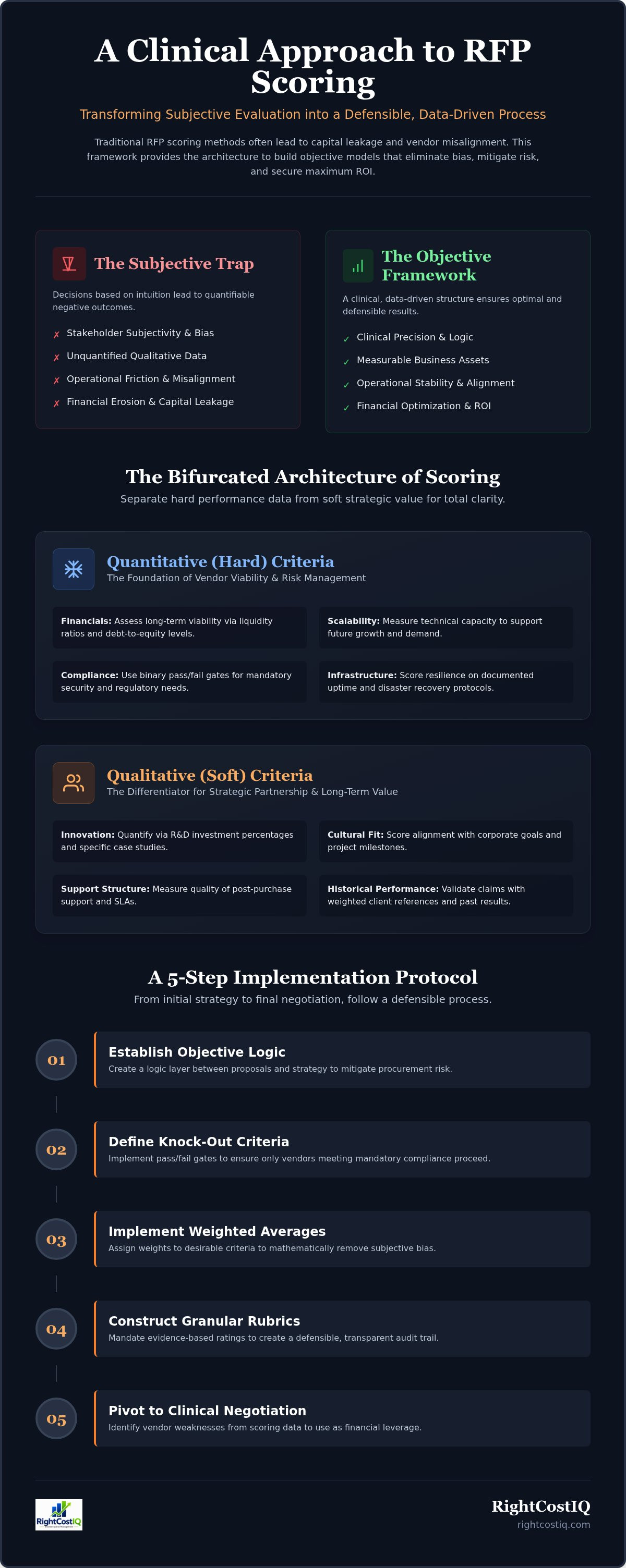
- Establish an objective logic layer between vendor proposals and corporate strategy to mitigate high-stakes procurement risk.
- Categorize RFP scoring criteria into quantitative and qualitative clusters to distinguish between mandatory compliance and strategic desirability.
- Implement weighted average models and knock-out criteria to remove subjective bias and ensure only top-tier vendors proceed.
- Construct granular rubrics that mandate evidence-based ratings, creating a defensible audit trail for every selection decision.
- Pivot from scoring to clinical negotiation by identifying vendor weaknesses that function as financial leverage during the final selection phase.
The Strategic Role of RFP Scoring Criteria in Sourcing Optimization
In high-stakes procurement, the RFP scoring criteria function as the objective logic layer between raw vendor proposals and corporate strategy. This framework isn't merely a checklist; it's a risk management tool designed to protect the organization from the volatility of subjective stakeholder bias. By formalizing evaluation parameters within the Request for Proposal (RFP) process, procurement leaders create a defensible barrier against misaligned partnerships and operational failures.
Modern sourcing has shifted decisively from legacy "price-only" selection models toward Total Cost of Ownership (TCO) architectures. A clinical scoring framework accounts for long-term maintenance, integration overhead, and potential downtime. This ensures that the lowest bid doesn't result in the highest lifetime expense. This pre-defined structure is essential for auditability and regulatory compliance, providing a transparent record that justifies selection decisions to internal boards and external auditors alike.
Converting Qualitative Promises into Quantitative Data
Strategic procurement requires the conversion of subjective vendor attributes into measurable data points. By assigning numerical values to qualitative factors like innovation or service culture, organizations can effectively compare disparate offerings. This methodology forces cross-departmental stakeholders to align on specific performance thresholds before reviewing bids. Standardized scoring eliminates the "halo effect" often granted to incumbent vendors. It ensures that long-term vendor performance tracking begins with a baseline of objective data gathered during the initial selection phase.
The Economic Imperative of Scoring Integrity
The cost of selection error in enterprise sourcing is catastrophic. A failed implementation doesn't just lose the initial contract value; it consumes internal resources and creates opportunity costs that ripple through the balance sheet. Rigorous RFP scoring criteria prevent scope creep by anchoring the evaluation to the original business requirements. When vendors know they're being measured against a clinical rubric, they're less likely to submit inflated promises that lead to post-contract disputes. RFP scoring is a clinical mechanism for margin expansion through the systematic elimination of vendor-induced operational waste.
Structural Components: Quantitative vs. Qualitative Scoring Paradigms
Effective RFP scoring criteria require a bifurcated architecture that separates hard performance data from soft strategic value. This structural clarity prevents high-performing but financially unstable vendors from entering the supply chain. It also ensures that technical specialists don't overvalue features that lack a tangible business outcome. Utilizing a comprehensive guide to RFP evaluation criteria helps establish these clusters during the initial vetting phase. The hierarchy begins with "Mandatory" requirements; these are binary pass/fail gates. If a vendor fails a mandatory compliance check, their qualitative strengths are irrelevant. "Desirable" criteria are then weighted to differentiate top-tier performers from the baseline.
Hard Criteria: Financials, Scalability, and Compliance
Quantitative scoring focuses on the vendor's fiscal resilience and technical capacity. Procurement teams must use specific metrics for liquidity ratios and debt-to-equity levels to assess long-term viability. Incorporating clinical RFP management principles into this cluster allows for the integration of market price trending data. This ensures the vendor can maintain service levels during market volatility without seeking emergency price increases. Infrastructure resilience is scored based on documented uptime and disaster recovery protocols, providing a mathematical floor for operational stability.
Soft Criteria: Innovation, Cultural Fit, and Support
Qualitative scoring is where subjective bias typically compromises the process. To maintain clinical precision, organizations should score "innovation" based on specific case studies or R&D investment percentages. Historical performance and client references carry a weight that validates the vendor's ability to execute on technical promises. Implementation timelines are scored against internal project milestones to ensure alignment with corporate growth targets. High-quality post-purchase support structures are quantified by Service Level Agreement (SLA) response times and dedicated account management ratios rather than general testimonials.
Balancing technical excellence with aggressive cost-savings is the primary friction point in modern procurement. The solution lies in a price-to-quality ratio that penalizes both under-spec and over-spec bids. This ensures the organization pays only for the utility required to drive margin growth. If you're struggling to align these variables, you can audit your current scoring framework to identify where subjectivity is inflating your vendor costs.
Weighting Methodologies: Mitigating Subjective Bias in Vendor Selection
The 'Weighted Average' model serves as the primary engine for clinical procurement selection. Unlike a flat point system, this model recognizes that not all RFP scoring criteria carry equal strategic weight. By assigning specific percentage allocations, procurement architects ensure that mission-critical requirements carry significantly more influence than secondary features. To protect the integrity of this model, a 'Knock-out' strategy must be deployed. This immediately disqualifies any vendor failing to meet non-negotiable compliance thresholds. It prevents the selection of high-performing but high-risk partners who cannot meet fundamental security or financial standards.
'Blind Scoring' is a vital technique for eliminating brand-name bias. By removing vendor identifiers during the technical evaluation phase, stakeholders focus strictly on solution architecture and performance data. This prevents the 'halo effect' where a market leader's reputation obscures technical deficiencies. Finally, the 'Normalization' of scores is required to adjust for 'hawkish' or 'dovish' graders. This statistical adjustment uses mean-adjustment formulas to ensure that a strict grader's low marks don't unfairly penalize a vendor compared to a lenient grader's high marks. Without normalization, the final selection is often a product of committee composition rather than vendor merit.
The Mathematical Architecture of Weighting
Allocating percentage weights requires a direct link to business outcomes. A standard 'Price-to-Quality' ratio prevents the common pitfall of selecting a low-cost vendor that fails to deliver long-term value. In high-differentiation requirements, 'Exponential Scoring' can be used to reward exceptional performance more aggressively than 'Linear Scoring'. For example, squaring the raw score of a top-tier innovator creates a wider mathematical gap between them and an average provider. This makes the final choice defensible and obvious to executive leadership.
Bias Mitigation and Stakeholder Calibration
The 'Delphi Method' provides a structured communication technique for reaching consensus on criteria weighting. It involves iterative rounds of independent feedback followed by group discussion to align stakeholder priorities. This process identifies 'outlier' scores that may indicate personal bias or a misunderstanding of the requirements. Correcting these outliers is essential for maintaining selection defensibility. This calibration phase must align with broader category management procurement strategies. This ensures the RFP outcome supports the long-term cost-reduction and risk-mitigation goals of the specific spend category while maximizing operational efficiency.
Designing the Scorecard: A Step-by-Step Implementation Protocol
The transition from theoretical weighting to tactical execution occurs during the scorecard design phase. A well-constructed scorecard converts your RFP scoring criteria into a functional evaluation engine. This protocol ensures that every stakeholder evaluates vendors against the same clinical benchmarks, removing the ambiguity that often leads to selection error. Follow these four steps to build a defensible scoring instrument.
- Step 1: Align every metric with the business objectives established in your RFP management cycle. If a criterion doesn't drive a specific financial or operational outcome, it shouldn't exist in the scorecard.
- Step 2: Construct rubrics on a 0-10 scale. This provides enough granularity to distinguish top performers without introducing excessive complexity.
- Step 3: Lock the scorecard before opening bids. Distributing the criteria to stakeholders early prevents "reverse-engineering" where weights are adjusted to favor a specific vendor's known strengths.
- Step 4: Perform a sensitivity analysis. This involves shifting weights by 5-10% to see if the vendor ranking remains stable. If a minor shift flips the winner, your model may lack the necessary breadth.
Defining the Scoring Rubric with Precision
Interpretative variance is the primary enemy of objective scoring. You must minimize the gap between how different graders perceive a "good" response. A score of 10 isn't a feeling. It's a verification. For example, a maximum score for "Technical Resilience" might require three documented enterprise-scale implementations with 99.99% uptime. The comments section is mandatory for any score that deviates from the group mean by more than two points. This forces stakeholders to justify outlier ratings with specific evidence from the proposal, creating a robust audit trail.
Scorecard Validation and Final Calibration
The procurement lead must validate the consistency of the final scores before the results are presented to executive leadership. In tie-breaker scenarios, the committee should look at secondary criteria clusters or "desirable" features that were not part of the primary weighted score. This clinical approach applies to all contract values. Even for tail spend management, a simplified version of this scorecard prevents financial leakage in lower-value RFPs. If you want to identify gaps in your current evaluation process, you can access our free procurement diagnostic to stress-test your existing models.
Leveraging RightCostIQ for Automated RFP Management and Negotiation
Clinical scoring isn't the conclusion of the procurement cycle; it's the tactical foundation for the final contract phase. The data gathered through your RFP scoring criteria informs the professional negotiation assistance required to secure optimal terms. RightCostIQ analytics identify specific gaps between vendor proposals and the ideal "should-cost" benchmark, allowing procurement leads to enter negotiations with a data-driven advantage. This transition converts the scorecard from a selection tool into a strategic roadmap for margin expansion.
Integrating cost benchmarking directly into your financial scoring cluster ensures that vendor pricing is evaluated against real-world market intelligence. When a vendor's pricing score is low, it's often a signal of hidden risk or inflated margins. RightCostIQ’s platform highlights these anomalies, providing the evidence needed to challenge vendor assumptions. This process ensures that the final selection isn't just the "best" among a pool of bidders, but a partner whose financial structure aligns with your organization's long-term cost-reduction targets.
From Scoring to Strategic Negotiation
Identifying a vendor's weak scores provides specific levers for the negotiation phase. If a top-tier vendor scores poorly on implementation timelines or post-purchase support, these deficiencies become non-negotiable points for price concessions or enhanced SLA guarantees. Utilizing cost transparency tools validates whether a vendor's pricing reflects the current market shift or if it's based on legacy models. A unified framework that links RFP scoring criteria to negotiation coaching eliminates the efficiency loss typically found when moving between different procurement stages. It ensures that every insight gained during the evaluation is utilized to drive down the total cost of ownership.
Optimizing the Procurement Lifecycle
The ROI of clinical scoring is realized through the systematic elimination of selection error and the optimization of vendor performance. By acting as a strategic architect, you move the procurement department from a cost center to a primary driver of financial growth. This methodology ensures that high-value enterprise contracts are secured with mathematical precision and defended against stakeholder bias. Once the contract is signed, the scoring baseline serves as the foundation for ongoing vendor performance tracking and price risk management. To transform your sourcing process into a clinical engine for efficiency, contact our team for a consultation on RFP management and professional price risk tracking.
Securing Future Margins Through Clinical Evaluation
Transitioning from subjective selection to a data-driven logic layer is the most significant lever for procurement optimization in 2026. By implementing standardized RFP scoring criteria, organizations move beyond simple vendor checklists toward a mathematical architecture that quantifies strategic value and mitigates financial risk. This clinical approach ensures that every selection decision is defensible, auditable, and directly aligned with corporate cost-savings targets. You've learned how to structure rubrics that eliminate the halo effect while providing the necessary data for aggressive, evidence-based negotiation.
Effective sourcing requires more than just a scorecard; it demands the integration of expert-led negotiation assistance and data-driven cost benchmarking. Comprehensive vendor performance tracking ensures that the promises made during the RFP stage convert into tangible operational assets. To identify the specific gaps in your current selection process and stress-test your evaluation models, access your professional procurement diagnostic today. You can transform your department into a strategic engine for margin expansion and long-term supply chain stability.
Frequently Asked Questions
What are the most common RFP scoring criteria for enterprise software?
Common RFP scoring criteria for enterprise software include functional alignment, cybersecurity compliance, integration scalability, and vendor financial viability. Organizations prioritize technical architecture and data security protocols to mitigate operational risk. Implementation timelines and post-purchase support structures are also quantified. This clinical approach ensures that the selected software doesn't just meet current needs but supports long-term margin growth through technical stability and cost-value alignment.
How do you calculate a weighted score in an RFP evaluation?
Calculating a weighted score requires multiplying a vendor's raw score in a specific category by that category's pre-assigned percentage weight. For example, if technical capability is weighted at 40% and a vendor scores an 8, the weighted value is 3.2. Summing these values across all categories produces the final score. This weighted average model provides a clinical, mathematical basis for selection, ensuring that mission-critical requirements carry the most influence.
Should price be the most heavily weighted criterion in an RFP?
Price should rarely be the most heavily weighted factor. Over-weighting the initial bid price ignores the Total Cost of Ownership (TCO) and potential operational waste. A clinical framework balances cost against technical excellence and risk mitigation. Strategic procurement architects focus on "should-cost" benchmarks and value-based outcomes. This prevents the selection of low-cost, low-value vendors that create financial leakage through poor performance or high maintenance requirements in the future.
How do you handle subjective bias among different internal stakeholders during scoring?
Mitigating stakeholder bias requires the implementation of blind scoring and score normalization. Removing vendor names from technical proposals prevents brand-name favoritism. Normalization formulas adjust for lenient or strict graders, ensuring statistical validity across the committee. Establishing granular rubrics with specific evidence requirements forces stakeholders to justify their ratings. This methodical approach anchors the evaluation in data rather than personal preference, protecting the integrity of the final selection.
What is the difference between a technical score and a commercial score in an RFP?
Technical scores evaluate a vendor's solution architecture, functional capabilities, and security protocols. Commercial scores analyze the financial proposal, including contract terms, pricing structures, and risk management. Maintaining a separation between these scores prevents technical strengths from obscuring financial risks. This bifurcated evaluation allows procurement leads to identify specific negotiation levers. It ensures that the final partnership is both technically viable and financially optimized for long-term margin expansion.
Can you change the RFP scoring criteria after the proposals have been received?
Changing RFP scoring criteria after receiving proposals is a violation of procurement integrity. This practice invites legal risk and suggests a desire to reverse-engineer results to favor a specific vendor. Criteria must be locked and distributed to stakeholders before bid opening to ensure auditability. If the requirements change significantly after proposal review, the organization should consider a re-bid or a formal amendment to maintain a defensible and transparent selection process.
How do 'knock-out' criteria improve the efficiency of the RFP process?
Knock-out criteria act as binary pass/fail gates for non-negotiable requirements like security certifications or financial liquidity ratios. They improve efficiency by immediately disqualifying vendors who don't meet fundamental compliance thresholds. This prevents evaluation committees from wasting resources on deep-dive reviews of unqualified proposals. By filtering out high-risk vendors early, procurement teams can focus their clinical analysis on top-tier candidates who possess the baseline capacity to deliver results.
What is a sensitivity analysis in the context of RFP scoring?
Sensitivity analysis involves intentionally shifting the weights of primary criteria to determine if the vendor ranking remains stable. If a 5% change in a single weight flips the winner, the scoring model may be too fragile or biased. This validation step ensures that the final selection is robust and not overly dependent on a single subjective variable. It provides a mathematical stress test that confirms the selection is defensible under different strategic scenarios.


