

Most procurement teams treat the selection process as a beauty contest of polished sales decks rather than a rigorous financial stress test. This superficial approach masks operational risks and complicates the task of learning how to evaluate RFP responses with clinical precision. You've likely faced the challenge of normalizing 'apples to oranges' technical responses while navigating the subjective biases of internal stakeholders. It's difficult to provide a clear justification for vendor selection to the board when hidden costs and pricing volatility remain buried in complex proposals.
Mastering a data-driven methodology is the only way to mitigate financial risk and ensure optimal procurement outcomes. This article provides a repeatable scoring framework designed to replace qualitative intuition with objective analysis. You'll learn to implement cost benchmarking and price risk management strategies that transform vendor data into strategic assets. We'll examine a structured analysis process that eliminates scoring bias, reduces price risk, and delivers the technical precision required for high-stakes corporate decision-making.
Key Takeaways
- Shift from subjective stakeholder scoring to a clinical audit to eliminate bias and prevent post-contract scope creep.
- Learn how to evaluate RFP responses using a multi-dimensional architecture that weights technical, commercial, and risk factors objectively.
- Utilize procurement analytics and cost benchmarking to verify market price trending and uncover the true cost of vendor partnerships.
- Detect operational risks early by identifying non-committal language and unjustified deviations from industry pricing standards.
- Transform evaluation data into a strategic lever for negotiation to ensure long-term vendor performance and financial optimization.
The Strategic Stakes of Professional RFP Evaluation
Professional procurement relies on a clinical audit of potential partners. A Request for Proposal (RFP) evaluation is the systematic process of validating vendor claims against objective business requirements. It's the primary mechanism for converting sales promises into binding operational performance. Many organizations struggle with how to evaluate RFP responses because they rely on subjective stakeholder intuition rather than data-driven scoring architectures. This qualitative bias inevitably leads to scope creep post-contract, as vendors exploit vague requirements to increase billable hours. High-level decision-makers must treat this process as a financial risk mitigation exercise, not a clerical task.
By 2026 procurement standards, the industry focus has shifted from securing the lowest price to identifying the optimal cost. This evolution requires a rigorous analysis of total cost of ownership and inherent price risk. Clinical evaluation protects the bottom line by identifying hidden volatility before a contract is signed. It ensures supply chain compliance by forcing vendors to provide verifiable evidence of their operational capabilities. When procurement teams ignore these strategic stakes, they leave their organizations vulnerable to vendor underperformance and unforeseen financial liabilities.
The Cost of Inefficient Evaluation Cycles
Poor vendor selection carries a heavy financial penalty. When evaluation cycles lack technical precision, the result is often operational friction and wasted administrative overhead. Inadequate analysis creates significant price risk, leading to budget volatility that disrupts quarterly financial planning. Procurement category cost benchmarking serves as a critical baseline here. Without benchmarking, teams lack the market intelligence needed to set realistic expectations. It's impossible to identify when a vendor's bid is dangerously underpriced or artificially inflated without these data points. Precision in the evaluation phase prevents the cascading costs of a failed implementation.
Moving Toward Data-Driven Sourcing
Modern enterprises are transitioning from manual spreadsheets to automated evaluation architectures. This shift is essential for optimizing sourcing and procurement workflows. Managing high-stakes vendor selection requires a structured framework that eliminates human error. Success depends on establishing evaluation criteria before the RFP is released. This proactive approach ensures that the scoring process remains objective and focused on pre-defined business goals. Learning how to evaluate RFP responses through an automated lens allows procurement leaders to present a clear, data-backed justification for vendor selection to the board. It's a move from guesswork to strategic certainty.
Establishing a Multi-Dimensional Scoring Architecture
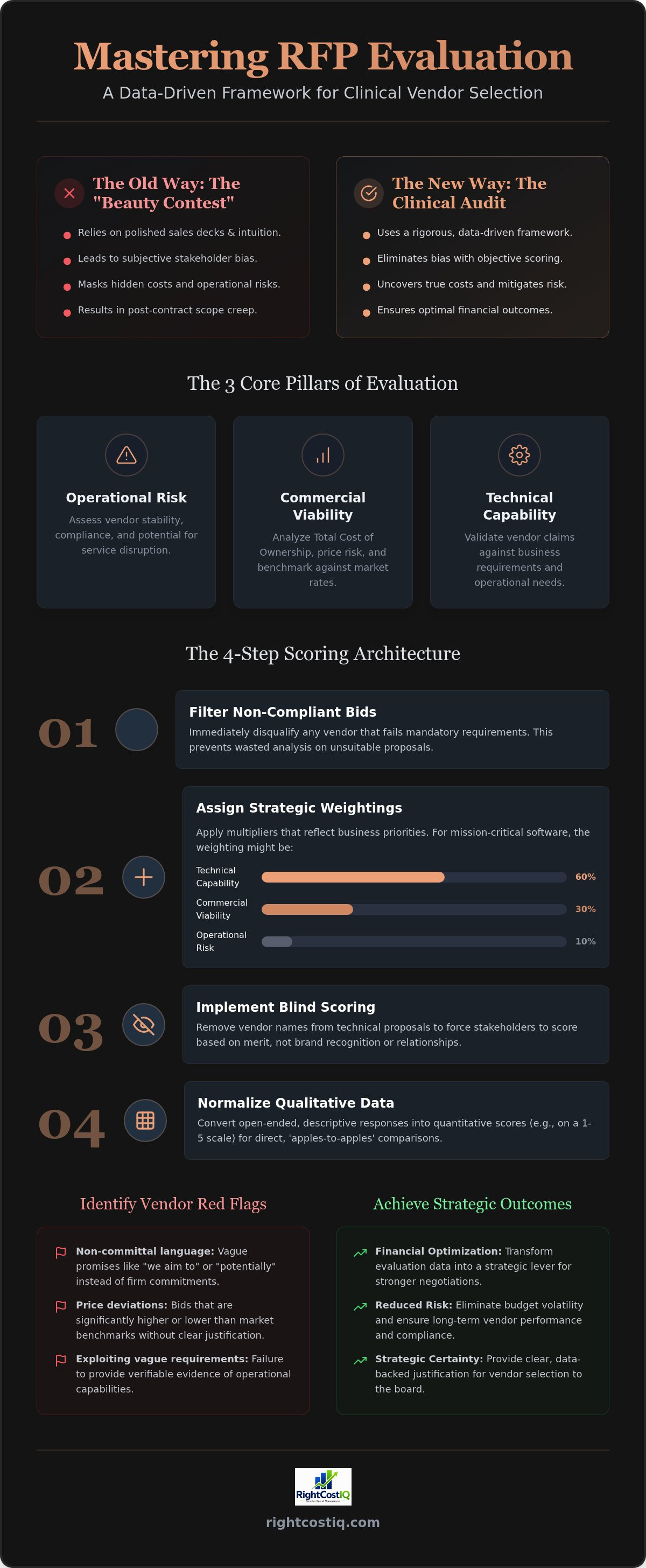
Effective procurement requires a rigid framework to strip away marketing hyperbole. A clinical approach to how to evaluate RFP responses demands a multi-dimensional scoring architecture that prioritizes three core pillars: Technical capability, Commercial viability, and Operational risk. Without this structured weighting, stakeholders often fall back on subjective impressions. This leads to selecting vendors who excel at sales presentations but fail at execution. You can eliminate this ambiguity by following a four-step normalization process.
- Step 1: Filter non-compliant bids. Define mandatory requirements versus desirable features. If a vendor fails a mandatory check, it's an immediate disqualification to prevent wasted analysis time.
- Step 2: Assign strategic weightings. Multipliers must reflect the category's importance. A mission-critical software implementation requires higher technical weighting than a commodity supply contract.
- Step 3: Implement blind scoring. Remove vendor names from the technical evaluation phase. This forces stakeholders to score based on data and architecture rather than brand recognition or existing relationships.
- Step 4: Normalize qualitative data. Convert open-ended technical responses into quantitative values. This allows for direct 'apples-to-apples' comparisons across diverse vendor proposals.
Organizations that don't utilize a standardized architecture often find themselves trapped in 'analysis paralysis'. Implementing professional Request For Proposal (RFP) management ensures that every data point is weighted according to its actual impact on the bottom line.
Technical vs. Operational Alignment
Evaluating vendor capability requires more than checking boxes. You must validate technical architecture against internal IT and security standards to prevent integration failures. Clinical evaluation involves assessing a vendor's ability to execute within your specific supply chain constraints. Use performance tracking metrics from previous engagements or industry case studies to verify claims. If a vendor's technical roadmap doesn't align with your internal milestones, the operational risk is likely too high to justify the partnership.
The Role of Compliance in Scoring
Risk mitigation is the foundation of procurement excellence. Integrating supplier risk management directly into your scorecard ensures that baseline ESG and regulatory requirements are non-negotiable. This prevents non-compliant vendors from skewing the commercial average. Compliance weighting serves as a clinical safeguard against future legal volatility and regulatory shifts. By quantifying these risks during the evaluation phase, you protect the organization from unforeseen litigation or supply chain disruptions that could erode margins later.
Commercial Analysis: Benchmarking Costs and Price Risk
Commercial evaluation is often the most mismanaged phase of procurement. Evaluators frequently focus on the headline figure, ignoring the systemic risks embedded in the proposal's fine print. Mastering how to evaluate RFP responses requires looking beyond the sticker price to calculate the total cost of ownership (TCO). A vendor's proposed fee is merely a starting point. The true financial impact includes implementation overhead, long-term maintenance, and potential tail spend risks that emerge after the initial deployment. Precision here prevents budget overruns that typically surface 12 to 18 months into a contract.
Strategic procurement teams utilize procurement analytics to validate vendor claims against real-world market data. This clinical audit identifies whether a vendor is offering a sustainable price or a loss-leader bid designed to secure the contract before introducing aggressive change orders. Analyzing price risk management strategies proposed by the vendor is essential. You must determine if the vendor is absorbing market volatility or passing that risk directly to your organization's balance sheet. If a proposal lacks a clear risk-sharing mechanism, the commercial score must be adjusted downward to reflect the potential for future cost spikes.
Executing a Should-Cost Analysis
A should-cost model provides an independent baseline for comparing RFP responses. By leveraging cost benchmarking data, you can isolate outliers that deviate from the industry mean. A bid that's significantly lower than the benchmark often signals a lack of technical understanding or a high risk of service failure. Conversely, bids that are too high indicate a lack of competitive alignment. Integrating market price trending allows you to forecast the long-term contract value, ensuring the deal remains viable as market conditions fluctuate. Applying this data is how to evaluate RFP responses with financial rigor.
Mitigating Financial Volatility
Financial stability is a non-negotiable metric in commercial scoring. Scrutinize price adjustment clauses and inflation-linked escalators to prevent uncontrolled cost growth during the contract term. You must assess the vendor's financial health to ensure they possess the liquidity required for long-term service continuity. A vendor facing insolvency presents a massive operational risk that no discount can offset. The final commercial score must integrate these risk factors, ensuring that the selection process prioritizes financial resilience over short-term savings. This objective approach provides the clear justification needed for board-level approval.
Identifying Vendor Red Flags and Operational Risks
Identifying operational risk requires a clinical eye for inconsistencies. Understanding how to evaluate RFP responses involves more than just scoring positive attributes; it requires detecting subtle signals of future failure. These red flags often manifest as data gaps or linguistic evasions that signal a vendor's inability to deliver on contractual promises. Procurement leaders must treat these discrepancies as non-negotiable warnings rather than minor oversight.
- Red Flag 1: Non-committal language. Watch for phrases like "we aim to," "it's our intention," or "subject to further review." These qualifiers allow vendors to retreat from technical requirements during implementation, shifting the risk back to your organization.
- Red Flag 2: Significant deviation from industry cost benchmarks. If a bid falls 25% below the "should-cost" baseline without a documented technological advantage, it's likely a loss-leader strategy. This approach inevitably leads to aggressive change orders and service degradation.
- Red Flag 3: Poor historical performance tracking. Vendors who cannot provide verifiable performance metrics or specific, relevant case studies often lack the operational maturity required for high-stakes partnerships.
- Red Flag 4: Resistance to transparency. Any hesitation regarding audit rights or detailed cost breakdowns suggests hidden margins or a fragmented sub-tier supply chain that the vendor cannot control.
When a bid falls significantly below the market mean, it creates a sustainability gap that threatens service continuity. You must demand a granular breakdown of their labor and material costs to identify where they've cut corners. If they refuse, the risk of post-contract scope creep is high. Mastering how to evaluate RFP responses means prioritizing long-term stability over short-term savings.
The Danger of Generic Responses
Recycled sales content is a primary indicator of a low-effort bid. You must differentiate between tailored solutions and "canned" answers by probing specific operational workflows during the interview phase. Ask vendors to explain exactly how their architecture handles your unique edge cases rather than accepting a generic platform overview. Specificity is the primary indicator of vendor commitment because it demonstrates a granular understanding of your organization's unique operational constraints. If a response remains high-level, the vendor hasn't invested the time to understand your business requirements.
Assessing Supplier Diversity and Resilience
Resilience evaluation extends beyond the primary vendor to their own supply chain. A vendor's internal instability can disrupt your operations regardless of their technical score. Modern procurement standards integrate supplier diversity programs to build a more robust and innovative vendor ecosystem. You must balance the agility of innovative niche players with the financial stability of established market leaders. A clinical audit of their sub-tier suppliers ensures your organization remains protected from external shocks. To verify if your current process catches these risks, use a procurement health diagnostic to audit your evaluation framework.
Optimizing Outcomes through Professional RFP Management
Evaluation is a diagnostic tool, not a final decision. The transition from analysis to execution requires converting scoring data into a negotiation lever. When you master how to evaluate RFP responses, you generate the objective evidence needed to extract maximum value from the preferred vendor. This process identifies specific areas where a vendor’s proposal falls short of the "should-cost" baseline or technical requirements. These gaps become the primary focus of the final negotiation phase, ensuring that the organization doesn't overpay for sales hyperbole.
Engaging a negotiation coach provides a high ROI by bridging the gap between raw data and contractual commitment. Professional guidance ensures that procurement teams maintain their clinical leverage throughout the high-stakes finalization period. Learning how to evaluate RFP responses through this lens significantly reduces the cycle time from initial release to signed contract. By eliminating subjective back-and-forth and focusing on pre-validated data points, organizations achieve faster deployment and more predictable financial outcomes. This methodical approach ensures that procurement departments function as strategic architects of margin expansion.
The Clinical Execution of Negotiations
Clinical negotiation relies on the scoring architecture established during the evaluation phase. You must use the identified scoring gap to negotiate better terms with the preferred vendor. If a vendor scored high on technical ability but poorly on price risk, use benchmarking data to challenge unreasonable pricing structures. This data-driven pressure forces vendors to align their commercial terms with market realities. It's essential that the final contract reflects the exact specifications and performance promises made in the winning RFP response. Any deviation here creates a "bait-and-switch" risk that erodes the integrity of the entire procurement process.
Integrating Analytics into the Procurement Lifecycle
RFP evaluation is just the beginning of comprehensive RFP management. The data gathered during this phase shouldn't be archived; it must be used to establish KPIs for future vendor performance tracking. By embedding these metrics into the contract, you ensure that the clinical standards used to select the vendor are the same standards used to measure their success. This continuous improvement loop transforms procurement from a transactional function into a strategic driver of financial growth. To optimize your results, request a consultation with RightCostIQ to audit your current process and implement a data-driven evaluation architecture.
Driving Financial Growth through Clinical Procurement
Transitioning from a subjective selection process to a data-driven audit is essential for modern procurement excellence. By mastering how to evaluate RFP responses through a clinical framework, you replace guesswork with technical precision. This methodology enables the identification of hidden costs and operational risks before they impact your balance sheet. Utilizing data-driven cost benchmarking and clinical procurement analytics ensures that every vendor claim is validated against market realities. These insights don't just help you choose a partner; they provide the leverage required for expert negotiation coaching to secure optimal terms.
Establishing a repeatable scoring architecture protects your organization from the financial volatility of poorly vetted contracts. It's time to move beyond polished sales decks and focus on the granular metrics that drive long-term growth. Optimize your next procurement cycle with RightCostIQ's professional RFP management services to ensure your vendor selection process is as efficient as it is objective. You possess the strategic tools to transform procurement into a powerful engine for margin expansion.
Frequently Asked Questions
How do you ensure stakeholder buy-in during the RFP evaluation process?
Define objective scoring criteria and weightings before the RFP is released. This eliminates post-submission debates by aligning all parties on what constitutes success. When stakeholders participate in the weighting phase, they're more likely to accept the clinical output of the scorecard. Using a blind scoring system further ensures that decisions are based on technical merit rather than personal vendor preferences or historical biases.
What is the ideal number of vendors to shortlist for final evaluation?
Shortlist three to five vendors to maintain competitive tension while ensuring a manageable audit workload. Evaluating more than five responses often leads to "analysis paralysis" and dilutes the depth of the technical review. A smaller, high-quality group allows procurement teams to execute a more rigorous "should-cost" analysis. This focused approach ensures each candidate is thoroughly vetted against the organization's specific operational constraints and supply chain compliance standards.
Can AI tools be used to evaluate RFP responses objectively?
AI tools excel at extracting data and identifying non-compliant language, but they cannot replace clinical human judgment for strategic risk assessment. These technologies streamline the initial filtering of mandatory requirements, allowing evaluators to focus on complex qualitative analysis. You must audit AI-generated summaries to ensure they haven't missed subtle nuances in vendor commitment. Integrating automation into how to evaluate RFP responses improves efficiency while maintaining the necessary oversight for high-stakes financial decisions.
How much weight should be given to price versus technical capability?
Weighting depends entirely on the strategic importance of the procurement category. Mission-critical implementations typically require a 60/40 or 70/30 split in favor of technical capability to mitigate operational risk. For commodity purchases, price might carry a 60% weighting. You must establish these ratios based on the potential cost of failure. A clinical evaluation ensures that the "lowest price" doesn't lead to higher total cost of ownership through implementation delays or service gaps.
What happens if the top-scoring vendor is significantly over budget?
Use procurement category cost benchmarking to determine if the vendor's price reflects market reality or excessive margin. If the bid is justified by superior technical architecture, re-evaluate the project's internal ROI. You can also engage in negotiation coaching to target specific cost drivers within their proposal. When a preferred vendor is over budget, data-driven leverage is the only way to align their pricing with your financial constraints without sacrificing essential functionality.
How do you evaluate a vendor's financial risk during an RFP?
Audit the vendor's financial statements to assess liquidity, debt-to-equity ratios, and overall service continuity potential. A clinical risk assessment involves looking beyond their current balance sheet to evaluate their own sub-tier supply chain stability. You must identify if the vendor has the financial resilience to withstand market volatility over the contract term. Integrating these metrics into the final commercial score protects your organization from the catastrophic operational impact of a vendor's insolvency.
What are the most common mistakes in RFP scoring models?
The most frequent errors include using subjective "gut feelings" instead of weighted criteria and failing to normalize diverse technical responses. Many organizations also ignore hidden implementation costs, which masks the true price risk of a proposal. Learning how to evaluate RFP responses correctly requires a rigid architecture that treats every vendor claim as a data point for validation. Skipping the "should-cost" analysis phase is another critical mistake that leaves procurement teams without an objective baseline for comparison.
How does market price trending impact the evaluation of multi-year contracts?
Market price trending provides the forecasting data required to structure fair price adjustment clauses and inflation-linked escalators. For multi-year contracts, you must evaluate whether a vendor's fixed pricing is sustainable or if it introduces long-term supply risk. Clinical analytics help you identify if a vendor's proposed increases align with projected industry benchmarks. This data-driven foresight allows you to lock in competitive rates while ensuring the vendor remains incentivized to maintain high service levels throughout the engagement.


