
Healthcare cost transparency isn't a regulatory burden; it's the most powerful negotiation lever in modern procurement history. As of April 1, 2026, the enforcement of CMS Hospital Price Transparency updates has shifted the landscape from theoretical data access to mandatory, standardized dollar-based precision. For leaders focused on healthcare supply chain cost reduction, this shift marks the end of information asymmetry between providers and vendors. You've likely spent years wrestling with massive machine-readable files (MRFs) that offer little immediate utility, yet the new version 3.0.0 templates now demand a level of accuracy and attestation that transforms these files into clinical-grade market intelligence.
Managing extreme procedure price variance is impossible when the raw data remains a chaotic digital landfill. Processing millions of rows of payer-specific negotiated charges requires a specialized strategic architecture rather than standard administrative tools. This article provides a definitive roadmap to master the transition from mere regulatory compliance to aggressive margin expansion. We'll outline a clinical framework for procurement optimization, demonstrate how to integrate transparency data into your RFPs, and provide the methodology needed to manage price risk through market benchmarking precision.
Key Takeaways
- Transform regulatory transparency disclosures into a strategic negotiation asset to secure superior vendor contract terms and pricing leverage.
- Navigate the technical architecture of version 3.0.0 machine-readable files (MRFs) to eliminate data normalization gaps across disparate healthcare systems.
- Implement a clinical benchmarking framework for healthcare supply chain cost reduction by identifying and rectifying extreme procedure price variance.
- Optimize the RFP management lifecycle through automated market intelligence feeds that proactively disqualify high-cost vendor submissions in the early sourcing stages.
- Leverage engineered price risk management and market trending analytics to stabilize financial volatility and drive sustainable margin expansion.
Beyond Compliance: Leveraging Transparency as a Strategic Negotiation Asset
High-level decision-makers often view transparency as a regulatory hurdle. This perspective is a strategic failure. In 2026, the shift from defensive compliance to offensive data exploitation is the primary driver of healthcare supply chain cost reduction. Informational symmetry is no longer a distant goal; it's a baseline requirement for procurement teams. Procurement inefficiency thrives in the shadows of information asymmetry. When vendors possess more market data than providers, contract negotiations inevitably favor the seller. Transparency data eliminates this imbalance, providing a mathematical foundation for every vendor interaction.
Price variance is the chief architect of procurement waste. Identical procedures and supply categories often fluctuate by massive margins across a single region, yet these discrepancies remain hidden without structured benchmarking. Strategic execution requires a shift in mindset: transparency files aren't just reports for CMS; they're the most potent intelligence tools in your arsenal. Organizations that master this data transition from reactive price-takers to proactive market-shapers.
The Evolution of Transparency Regulations
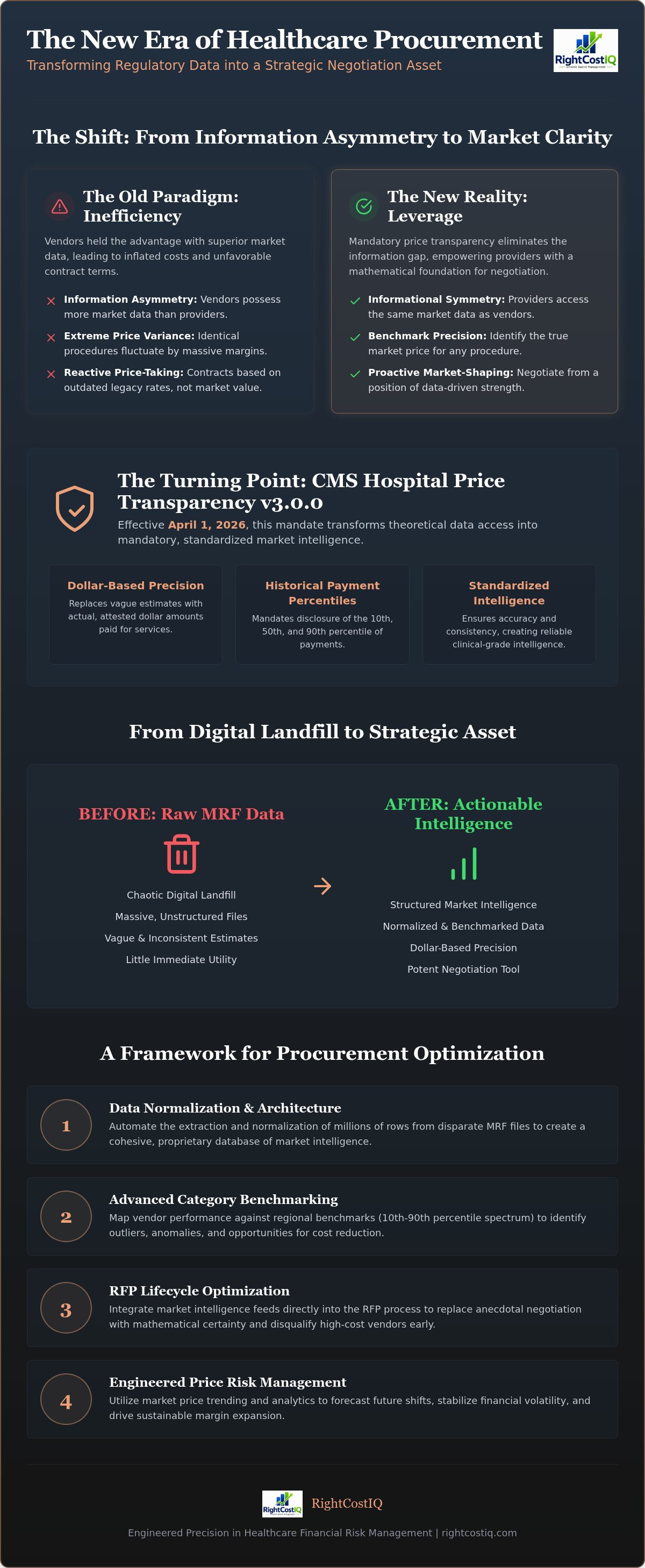
The regulatory landscape has matured significantly. The No Surprises Act and CMS Hospital Price Transparency rules have transitioned from simple disclosure mandates to rigorous data integrity standards. As of April 1, 2026, CMS enforces the version 3.0.0 machine-readable file (MRF) template. This update replaces estimated allowed amounts with actual dollar-based data, including the 10th, 50th, and 90th percentiles of historical payments. These standards optimize medical logistics by providing a transparent window into regional market realities. Procurement leads must stop treating these files as administrative burdens and start using them as technical blueprints for aggressive sourcing.
Strategic Intelligence vs. Administrative Data
Raw data is useless without a clinical execution framework. Administrative data confirms what you paid; strategic intelligence reveals what you should've paid. The "negotiation gap", which is the delta between your proprietary contract rates and the regional benchmarks found in MRFs, represents untapped margin. Effective cost management requires market price trending to forecast future shifts and disqualify high-cost vendors early in the cycle. By integrating these benchmarks into your RFP process, you replace anecdotal negotiation with mathematical certainty. This transition ensures that every contract aligns with actual market performance rather than outdated internal legacy rates.
Deciphering Machine-Readable Files (MRFs): The Foundation of Cost Analytics
Machine-readable files represent the raw material of modern procurement. In 2026, these files utilize the version 3.0.0 standard, requiring hospitals to encode Type-2 NPIs and actual dollar-based data rather than vague estimates. For procurement leads, this isn't just a technical update. It's a shift toward a structured repository of market intelligence. However, the sheer volume of JSON and CSV files creates a significant barrier. Data normalization is the only way to transform these disparate files into a cohesive sourcing strategy. Without it, you're looking at millions of rows of disconnected data that provide no actionable path to healthcare supply chain cost reduction.
Automating the extraction of negotiated rates is the only viable method for category benchmarking. Manual analysis fails when faced with the scale of modern transparency disclosures. You need a system that maps vendor performance across regional benchmarks to identify outliers and anomalies. This architecture allows your team to build a proprietary database of market intelligence. It's the difference between guessing at a vendor's "best" price and knowing exactly where their offer sits in the regional 10th to 90th percentile spectrum.
Data Normalization and Procurement Analytics
Converting complex JSON files into actionable procurement analytics requires a clinical execution framework. Disparate healthcare systems often use inconsistent naming conventions for the same categories, which obscures true price variance. Utilizing spend analytics allows teams to prioritize negotiation efforts based on high-variance categories where the "negotiation gap" is widest. This process identifies which contracts are significantly above market averages, ensuring your sourcing resources are deployed where they'll yield the highest ROI.
Mapping Market Price Trends
Strategic supply chain management in healthcare identifies standardization and price trending as primary cost levers. Tracking historical price fluctuations through 2025 and 2026 allows you to predict 2027 procurement risks with mathematical precision. This intersection of transparency data and price risk management quantifies the financial impact of market volatility before it hits your bottom line. It's about moving from reactive purchasing to proactive financial forecasting. Conducting a preliminary data audit helps identify which MRF categories hold the most immediate savings potential for your specific contract portfolio.
Identifying Procedure Price Variance through Advanced Category Benchmarking
Clinical execution of category management requires a departure from anecdotal sourcing. With supply costs per calendar day rising 9% year over year, traditional procurement methods are insufficient for modern healthcare supply chain cost reduction. Hospital supply expenses now represent approximately 10.5% of the average hospital budget, making price precision a financial necessity rather than a clerical goal. You must identify outliers and anomalies by cross-referencing internal contract rates with the percentile data now mandated in 2026 MRFs. This precision allows you to quantify potential savings by targeting categories where your current rates exceed the regional 50th percentile.
Precision cost analytics reveal the "negotiation gap" that exists within every major category. Many organizations struggle with data integrity, yet the 2026 CMS standards require a 12 to 15 month lookback period for all dollar-based data. This historical depth provides a stable foundation for benchmarking. By analyzing the delta between your internal spend and public market rates, you can prioritize categories that offer the highest immediate ROI. This approach also exposes hidden costs within tail spend, where unmanaged variance often erodes the margins gained in high-volume categories.
Strategic Category Benchmarking Framework
Margin expansion depends on a structured approach to high-volume procurement. Implementing category management procurement protocols ensures that every sourcing event is informed by regional market benchmarks. This framework integrates should-cost modeling to determine the fair market value of supplies before you enter formal negotiations. Since 60% of health system supply chain leaders cite rising costs as their top operational challenge, utilizing a data-driven framework is the only way to maintain a competitive advantage. It transforms procurement from a reactive support function into a primary driver of financial growth.
Mitigating Financial Volatility
Transparency data acts as a strategic hedge against rising operational expenses. By establishing a should-cost baseline for every major RFP, you set firm price ceilings that protect against vendor-driven inflation. Price variance is the delta between public MRF rates and internal spend. Eliminating this delta requires a relentless focus on market intelligence to stabilize procurement outcomes. Using transparency data to set long-term contract ceilings ensures that your organization isn't vulnerable to the sudden price spikes that have characterized the market since 2024. This methodical approach replaces negotiation guesswork with mathematical certainty.
Integrating Transparency Data into the RFP Management Lifecycle
The RFP process is the primary battleground for healthcare supply chain cost reduction. Traditional sourcing cycles often rely on outdated vendor quotes and anecdotal market knowledge. In 2026, the integration of automated transparency data feeds into the RFP lifecycle eliminates this guesswork. By utilizing real-time benchmarks from version 3.0.0 MRFs, procurement teams can disqualify high-cost vendors before they enter the final selection rounds. This proactive filtering ensures that only vendors whose pricing aligns with regional 10th to 50th percentile benchmarks progress through the cycle.
Supply chain compliance also depends on transparent vendor reporting. When vendors know their rates are being cross-referenced against public dollar-based data, the quality of their submissions improves. This transparency-led sourcing model creates a "should-cost" baseline that protects the organization from arbitrary price hikes. Professional negotiation assistance becomes essential here to navigate the complexities of multi-year contracts and volume-based discounts. It's about shifting the burden of proof from the provider to the vendor.
Precision Frameworks for Sourcing
Executing a data-driven sourcing event requires a methodical three-step approach. First, extract and normalize dollar-based data from regional MRFs to establish a baseline. Second, perform a competitive benchmarking analysis of your current vendor performance against these public rates. Third, draft the RFP using transparency-informed price targets. This framework ensures that your pricing expectations are grounded in actual market performance rather than vendor-supplied narratives. It eliminates the information asymmetry that historically favored vendors during the bid process.
Negotiation as a Strategic Lever
Negotiation isn't a soft skill; it's a data-driven discipline. Leveraging transparency data during the negotiation coach phase provides your team with the evidence needed to counter vendor pushback. When a vendor claims their rates are "market-leading," you can present the specific percentile data from their own public disclosures to refute the claim. Utilizing advanced RFP Management frameworks allows you to drive operational efficiency by shortening the negotiation cycle and securing superior contract terms. Organizations that fail to weaponize this data will continue to overpay for essential supplies. To see how your current contracts measure up against 2026 benchmarks, access our procurement diagnostic tool.
RightCostIQ: Engineered Precision in Healthcare Financial Risk Management
RightCostIQ serves as the strategic architect for high-level decision-makers focused on healthcare supply chain cost reduction. Our platform replaces administrative guesswork with engineered precision by integrating advanced analytics into traditional procurement functions. We don't offer generic advice; we provide a technical blueprint for margin expansion. While internal teams often struggle with the technical weight of version 3.0.0 machine-readable files, our system executes market price trending and forecasting with clinical accuracy. This ensures that every sourcing event is backed by the full weight of regional market benchmarks.
Advanced Analytics for Decision-Makers
Strategic decision-making requires a departure from internal data silos. Our proprietary frameworks for procurement category cost benchmarking provide a panoramic view of regional and national pricing landscapes. We manage financial risk through dedicated price risk management services, allowing organizations to set firm price ceilings in a volatile market. It's not just about finding the lowest price; it's about establishing a stable financial baseline. Review our pricing for enterprise-level analytics to understand how our technical stack supports large-scale sourcing operations.
The Clinical Execution of Cost Optimization
Optimization is only effective if it's consistently enforced. Our vendor performance tracking service ensures that transparency-led contract terms are accurately reflected in every invoice. We eliminate the financial leakage that occurs when vendor systems fail to align with the latest negotiated tiers. Automated intelligence also resolves the unmanaged variance found in tail spend, which often erodes the savings achieved in high-volume categories. The ROI of our professional RFP management and negotiation assistance is measured in superior procurement outcomes and the permanent reduction of information asymmetry. Access your free diagnostic to evaluate your current procurement cycle against 2026 performance standards.
The Future of Strategic Margin Expansion
The transition from 2025 regulatory adherence to 2026 strategic data exploitation is mandatory for organizations seeking sustainable financial growth. Mastering version 3.0.0 machine-readable files isn't just about avoiding CMS penalties; it's about weaponizing dollar-based intelligence to eliminate procedure price variance. By integrating these benchmarks into every RFP lifecycle, procurement leaders transform opaque vendor relationships into transparent, performance-based partnerships. This shift is the definitive driver for healthcare supply chain cost reduction in an era of unprecedented financial volatility.
RightCostIQ operates as a strategic architect for C-suite decision-makers, providing clinical precision in vendor performance tracking and deep expertise in healthcare price risk management. We don't just process data; we engineer superior procurement outcomes through sophisticated market intelligence. Our role as strategic mentors ensures your team possesses the technical upskilling required to maintain a competitive advantage. Optimize your healthcare procurement with RightCostIQ’s precision RFP management tools. Your organization's path to financial resilience starts with data-driven sourcing.
Frequently Asked Questions
What is healthcare cost transparency and why does it matter for procurement?
Healthcare cost transparency refers to the mandatory public disclosure of negotiated rates between providers and payers, governed by federal CMS regulations. For procurement teams, this data eliminates information asymmetry by revealing regional price benchmarks. It shifts the focus from anecdotal pricing to dollar-based market intelligence. This transparency is a foundational element for healthcare supply chain cost reduction, as it allows decision-makers to identify where current contract rates exceed regional market averages.
How can transparency data improve my RFP management process?
Transparency data improves the RFP management process by providing a "should-cost" baseline before a bid cycle begins. Procurement leads use this intelligence to set realistic price targets and disqualify high-cost vendors during early selection phases. Integrating automated data feeds into the sourcing lifecycle ensures that every proposal is evaluated against actual regional performance. This methodical approach reduces negotiation cycles and ensures that final contracts align with documented market percentiles rather than vendor-supplied narratives.
What are machine-readable files (MRFs) in the context of hospital pricing?
Machine-readable files (MRFs) are standardized digital documents, typically in JSON or CSV format, containing a hospital's negotiated charges and payer-specific rates. As of April 1, 2026, CMS enforces the version 3.0.0 template, which requires hospitals to use actual dollar-based data and include Type-2 NPIs. These files are engineered for automated processing, allowing sophisticated procurement platforms to extract large-scale pricing intelligence for comprehensive category benchmarking, market price trending, and long-term financial forecasting.
Can transparency data help in negotiating lower rates with healthcare vendors?
Yes, transparency data provides the objective evidence required to counter vendor claims of "best-in-market" pricing. By presenting regional 10th or 50th percentile benchmarks during negotiations, procurement teams shift the burden of proof to the vendor. This data-driven strategy forces vendors to justify price discrepancies between their public disclosures and proprietary quotes. It transforms the negotiation from a personality-driven exchange into a clinical comparison of mathematical market realities and documented regional averages.
What is price risk management in healthcare procurement?
Price risk management involves using market intelligence to identify and mitigate financial volatility within the supply chain. RightCostIQ executes this by tracking historical price trending and forecasting future cost shifts based on transparency data. This service allows organizations to set contract price ceilings and hedge against inflation or sudden vendor-driven price hikes. It's a proactive financial strategy that stabilizes procurement outcomes and protects margins from market instability through engineered precision and data-driven foresight.
How do I benchmark my healthcare procurement costs against market trends?
Benchmarking requires extracting and normalizing dollar-based data from regional MRFs to compare against your internal contract rates. You must identify the delta between your spend and the regional 10th to 90th percentile spectrum for specific categories. High-level decision-makers utilize RightCostIQ’s analytics to automate this process, ensuring that benchmarking is based on a 12 to 15 month lookback period. This precision highlights high-variance categories where immediate savings are achievable through strategic sourcing and renegotiation.
Is transparency data accurate enough for high-stakes negotiations?
Transparency data is highly accurate due to 2026 CMS enforcement standards that require hospital CEOs to attest that MRF information is true and complete. The shift from estimated allowed amounts to actual dollar-based data provides the clinical precision necessary for high-stakes sourcing. While raw files often contain formatting inconsistencies, normalized data sets offer a reliable foundation for benchmarking. Organizations that process these files correctly gain a definitive advantage during complex contract renewals and vendor selection.
What is the role of a negotiation coach in healthcare procurement?
A negotiation coach acts as a strategic mentor, providing data-backed evidence and tactical guidance during complex RFP cycles. At RightCostIQ, this role involves helping procurement teams weaponize transparency benchmarks to secure superior contract terms. The coach assists in navigating vendor pushback and ensures that negotiation strategies align with long-term financial growth metrics. This expert-led support bridges the gap between raw data analysis and the successful execution of high-value vendor agreements through technical upskilling.


