
Traditional hospital procurement strategies are no longer sufficient to offset the aggressive price volatility forecasted for 2026. If your current RFP process feels more like an administrative burden than a strategic lever, you're facing a systemic risk to your bottom line. Opaque market pricing and a lack of granular spend visibility often lead to underperforming vendor partnerships that compromise both financial health and clinical efficiency. We agree that the status quo of reactive sourcing is unsustainable in a high-stakes healthcare environment. This article outlines a rigorous, clinical framework for operational excellence designed for high-level decision-makers. You'll learn to deploy data-driven negotiation architectures and cost-benchmarking analytics that secure sustainable margin expansion. We'll examine the specific methodologies required to build high-performing vendor ecosystems and establish predictable cost structures through predictive market intelligence. By the end of this analysis, you'll possess the technical blueprint to transform procurement from a back-office function into a primary driver of institutional growth and strategic advantage.
Key Takeaways
- Transition from transactional purchasing to a Total Cost of Ownership (TCO) model to drive sustainable margin expansion.
- Modernize hospital procurement strategies by deploying precision-engineered RFP documentation and quantitative vendor scoring matrices.
- Combat economic volatility through predictive market intelligence and proactive price risk management frameworks.
- Utilize objective cost benchmarking data as a strategic anchor to gain leverage during high-complexity contract negotiations.
- Ensure operational stability by integrating real-time vendor performance tracking into a continuous procurement feedback loop.
The Evolution of Hospital Procurement: From Transactional Buying to Strategic Resilience
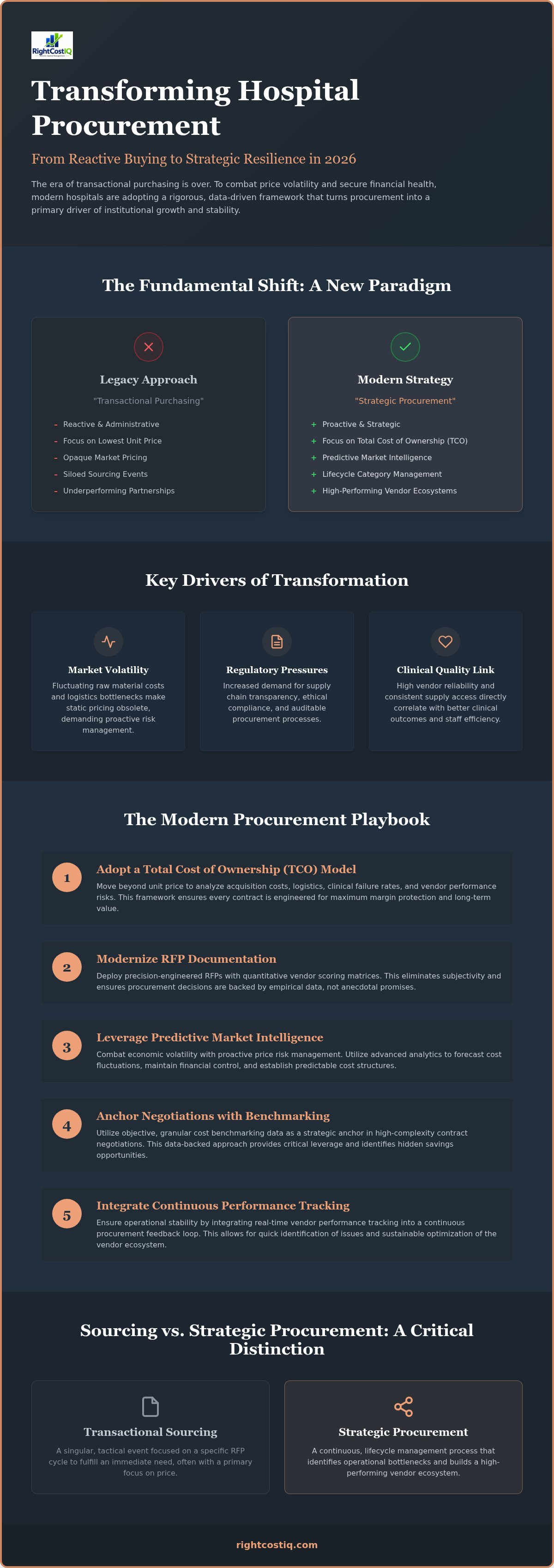
Hospital procurement strategies in 2026 have transitioned from reactive, transactional buying to a model defined by strategic resilience. Historically, procurement functioned as a back-office administrative task focused on securing the lowest unit price. This legacy approach often relied exclusively on Group Purchasing Organizations (GPOs) to aggregate volume and negotiate discounts. While these entities provide essential scale, they often lack the granular agility required to combat localized market volatility and specific institutional inefficiencies. Modern healthcare leaders now view procurement as a primary driver of financial growth and operational stability.
The defining shift in 2026 is the move from "lowest price" to "total cost of ownership" (TCO). This framework accounts for acquisition costs, logistics, clinical failure rates, and vendor performance risks. A low upfront price is irrelevant if the product results in higher clinical waste or frequent supply chain disruptions. By adopting a "Clinical Execution" model, supply chain managers apply the same analytical rigor to procurement that clinicians apply to medical procedures. This ensures that every contract is engineered for maximum margin protection and long-term sustainability.
Drivers of Procurement Transformation in 2026
Market volatility serves as the primary catalyst for this transformation. Fluctuating raw material costs and logistics bottlenecks have made static pricing models obsolete. Procurement teams must now utilize advanced cost benchmarking and analytics to maintain financial control. Regulatory pressures also demand increased supply chain transparency and ethical compliance. Beyond the balance sheet, procurement supports clinical quality. High vendor reliability directly correlates with clinical outcomes, as consistent access to supplies prevents care delays and ensures staff efficiency.
Sourcing vs. Strategic Procurement: A Critical Distinction
It's vital to distinguish between transactional sourcing and strategic procurement. Sourcing is a singular event focused on a specific RFP cycle. In contrast, strategic procurement involves lifecycle category management. It identifies operational bottlenecks before they manifest on the hospital floor. By linking procurement outcomes to bottom-line performance, hospitals achieve predictable cost structures. This level of oversight requires sophisticated RFP management to ensure every vendor agreement is a strategic asset rather than an administrative burden. Strategic procurement doesn't just buy products; it builds a high-performing vendor ecosystem that scales with the institution's needs.
A Clinical Framework for RFP Lifecycle Management
Effective hospital procurement strategies require a transition from administrative paperwork to precision-engineered RFP documentation. An RFP shouldn't be a passive inquiry; it's a strategic instrument designed to extract maximum value from the market. By standardizing vendor evaluation through quantitative scoring matrices, hospitals eliminate the subjectivity that often leads to underperforming contracts. This framework ensures that every procurement decision is backed by empirical data rather than anecdotal vendor promises. Reducing administrative friction through automated RFP management architectures allows supply chain teams to focus on high-level strategy instead of manual data entry. Integrating compliance benchmarks directly into the sourcing cycle further protects the institution from regulatory volatility and operational gaps.
Phase 1: Diagnostic Needs Assessment and Benchmarking
Success begins with a rigorous diagnostic phase. Utilizing advanced procurement category cost benchmarking is essential to set realistic, data-backed price targets before engaging the market. A comparative study of procurement models suggests that institutions prioritizing granular data analytics identify significantly more category savings than those relying on historical spend alone. Internal stakeholder alignment is critical here. Clinical and operational requirements must be defined with clinical precision to ensure the final sourcing outcome supports frontline care delivery. This phase transforms raw spend data into a targeted negotiation roadmap that identifies hidden category savings through deep-tier analytics.
Phase 2: RFP Execution and Vendor Selection
The execution phase must maximize competitive tension to secure sustainable margin expansion. Structuring your RFP management process to include rigorous vendor vetting protocols prevents the selection of low-cost, high-risk partners. Evaluating a vendor's performance history as a primary selection criterion ensures that clinical execution remains uncompromised by supply chain instability. You must treat vendor selection as a clinical trial where performance data is the only acceptable evidence of future success. This methodical approach ensures that the chosen vendor ecosystem is both high-performing and fiscally disciplined. To begin optimizing your current vendor evaluation protocols, you can explore our comprehensive procurement analytics platform for a deeper look at your category health. By establishing these protocols, you convert the RFP from a hurdle into a high-leverage business asset.
Leveraging Market Intelligence and Price Risk Management
Sophisticated hospital procurement strategies require a transition from reactive buying to proactive price risk management. In the 2026 economic environment, relying on lagging indicators or historical spend alone creates unacceptable financial exposure. Market intelligence must function as a primary lever in contract renegotiations, allowing procurement leaders to challenge vendor-driven price escalations with objective, forward-looking data. By utilizing predictive analytics, institutions can neutralize the impact of market volatility on category costs before it impacts the bottom line. This methodical approach transforms procurement from a department that reacts to invoices into one that actively dictates financial outcomes.
Market Price Trending and Forecasting Models
Analyzing historical data to predict 2026 pricing trajectories is essential for maintaining strategic leverage. Global supply chain shifts continue to exert pressure on hospital category costs, making static pricing a liability. Procurement teams must deploy models that account for raw material fluctuations and logistics indices to maintain accurate "should-cost" targets. Price risk management serves as a strategic hedge against inflation by utilizing predictive data to lock in favorable contract terms before market shifts occur. This ensures that the institution remains insulated from sudden cost escalations that would otherwise erode operating margins.
Managing Tail Spend and Category Optimization
Institutional margin protection often fails not at the high-value contract level, but within the fragmented "hidden 20%" of unmanaged spend. Addressing this through specialized tail spend management is critical for total category optimization. Fragmented spend across multiple vendors dilutes buying power and increases administrative friction. Consolidating these purchases into a unified framework allows for increased volume-based leverage and standardized vendor performance tracking. For a deeper technical analysis of these methodologies, refer to our guide on Category Management in Procurement. Implementing these margin expansion strategies ensures that every dollar of hospital spend is accounted for and optimized for institutional growth.
Effective price risk management also requires a shift in negotiation architecture. Instead of defensive posturing, procurement leaders use forecasted market intelligence to anchor discussions in objective reality. This data-driven approach forces vendors to justify price points against verifiable market trends. When procurement teams possess superior market intelligence, they effectively shift the burden of proof to the vendor, resulting in more favorable contract structures and predictable cost foundations.
Strategic Negotiation Tactics for High-Complexity Contracts
High-stakes healthcare negotiations require a structural architecture that prioritizes institutional stability and margin protection. Traditional adversarial bargaining is inefficient; it often leads to hidden cost escalations that surface months after the ink is dry. Modern hospital procurement strategies utilize benchmarking data as an objective anchor to ground discussions in fiscal reality. This data-driven approach shifts the power dynamic from subjective vendor claims to verifiable market indices. By establishing a "should-cost" baseline before the first meeting, procurement leaders maintain control over the negotiation narrative and prevent price creep.
The Role of the Professional Negotiation Coach
Professional negotiation assistance is a technical requirement for high-complexity sourcing. Vendors deploy sophisticated sales teams trained to protect their margins through psychological anchoring and complex pricing structures. Hospitals must counter with equal technical expertise to level the playing field. A specialized coach identifies hidden levers in vendor contract terms that internal teams might overlook. These include unfavorable payment terms, rigid volume commitments, or vague service level agreements. By countering these tactics with granular market intelligence, procurement leaders ensure that operational compliance is fundamentally baked into the final agreement.
Frameworks for Contractual Resilience
Contractual resilience is achieved through dynamic frameworks rather than static, multi-year agreements. Implementing price adjustment clauses based on market trending allows hospitals to capture savings when raw material costs drop. This mechanism prevents vendors from passing on arbitrary price hikes under the guise of general inflation. Structuring performance-based incentives for critical suppliers further ensures that vendor accountability is directly linked to clinical outcomes. For a comprehensive look at how these negotiations integrate into the broader sourcing cycle, visit our RFP Management Pillar.
Moving toward value-based partnership structures requires a fundamental shift in market engagement. It's about building a vendor ecosystem that shares the risk of operational inefficiency. This collaborative yet disciplined approach ensures that both parties are incentivized to drive down the total cost of ownership. To evaluate the resilience of your current high-value contracts and identify immediate negotiation leverage, you can access our free procurement diagnostic tool today.
Integrating Performance Tracking for Sustainable Optimization
Sustainable hospital procurement strategies depend on the rigorous execution of post-contract management. High-level decision-makers often fall into the trap of a "set and forget" mentality once a contract is signed. This oversight leads to price leakage and underperforming service levels that erode negotiated margins. Establishing a continuous feedback loop between procurement and clinical operations ensures that the strategic intent of the sourcing cycle is maintained throughout the contract lifecycle. Real-time vendor performance tracking is a technical necessity for operational excellence. Bridging the gap between "negotiated savings" and "realized savings" requires granular visibility into daily spend and vendor compliance. Scaling efficiency is only possible when integrated procurement analytics provide a single source of truth for all stakeholders.
Automating Vendor Performance and Compliance
Monitoring KPIs is essential to ensure clinical execution and adherence to agreed service levels. Automated alerts for price deviations and contract non-compliance prevent "invoice creep" before it impacts the monthly budget. If a vendor deviates from the contracted price, the system must trigger an immediate corrective action. This prevents small discrepancies from compounding into significant financial losses. Performance tracking ensures the integrity of the RFP cycle by verifying that vendors deliver on the specific promises made during the competitive bidding phase. By automating these oversight functions, supply chain teams can maintain a lean, high-performing vendor ecosystem with minimal administrative overhead.
Driving Long-term Margin Expansion
The cumulative impact of sustained category benchmarking creates a compounding financial advantage for the institution. Instead of starting from zero every three years, procurement leaders use historical performance data to inform the next RFP cycle before it even begins. This creates a cycle of continuous improvement where each negotiation is more informed and aggressive than the last. Using data to identify vendor strengths and weaknesses allows hospitals to consolidate spend with high-performers while phasing out laggards. This data-driven approach turns the vendor ecosystem into a strategic asset that evolves with the hospital's financial needs. To ensure your institution captures every dollar of negotiated value, you can optimize your procurement outcomes with RightCostIQ analytics. Integrating these insights into your long-term strategy ensures that operational excellence is not a one-time event but a permanent institutional standard.
Architecting Strategic Resilience for 2026
Operational excellence in the modern healthcare landscape requires a fundamental shift from reactive sourcing to predictive, data-driven hospital procurement strategies. By prioritizing total cost of ownership and precision-engineered RFP cycles, institutions can effectively neutralize market volatility and secure sustainable margin expansion. The integration of advanced category cost benchmarking and market-leading price risk management transforms procurement into a primary driver of financial growth. It's no longer enough to negotiate a favorable contract; you must ensure realized savings through automated performance tracking and expert negotiation coaching. This clinical framework provides the technical blueprint to build a high-performing vendor ecosystem that scales with your institution's needs. You possess the tools to move beyond administrative friction and toward a model of strategic resilience. To begin this transformation, secure your facility's bottom line with RightCostIQ's RFP Management and Negotiation assistance. We look forward to helping you master your supply chain and achieve unprecedented operational efficiency.
Frequently Asked Questions
What are the most effective hospital procurement strategies for 2026?
The most effective strategies prioritize data-driven frameworks that focus on total cost of ownership (TCO) and predictive market intelligence. Procurement teams must move beyond transactional buying toward strategic resilience by deploying price risk management to neutralize inflation. Hospitals that integrate clinical execution into their supply chain achieve more predictable cost structures. This methodical approach identifies deep-tier category savings and secures sustainable margin expansion for the institution.
How does RFP management improve hospital supply chain efficiency?
Precision-engineered RFP management transforms a passive administrative task into a high-leverage strategic asset. By standardizing vendor evaluation through quantitative scoring matrices, hospitals eliminate subjectivity and reduce administrative friction. This process ensures that only high-performing vendors enter the ecosystem. Automated RFP architectures accelerate the sourcing cycle, allowing procurement teams to focus on complex negotiation architectures rather than manual data entry or document handling.
Why is market price trending important for healthcare procurement?
Market price trending provides the predictive foresight required to mitigate financial volatility in a shifting economic environment. It allows procurement leaders to forecast future cost escalations and adjust contract terms proactively. By analyzing historical data and global supply chain shifts, hospitals can identify the optimal time to lock in pricing. This data-driven approach shifts the burden of proof to vendors during renegotiations, effectively securing institutional bottom lines.
What is the difference between GPO benchmarking and independent cost benchmarking?
GPO benchmarking relies on aggregated volume data from a broad member base, which often overlooks localized market nuances. Independent cost benchmarking, such as that provided by RightCostIQ, offers granular, category-specific analytics tailored to an institution's unique spend profile. This specialized analysis identifies "should-cost" targets that GPOs might miss. It provides objective, third-party leverage for high-stakes negotiations where GPO-only strategies are insufficient for maximum margin protection.
How can hospitals manage tail spend in medical procurement?
Managing tail spend requires a dedicated analytical framework to address the fragmented 20% of unmanaged institutional spend. Hospitals must consolidate these low-value, high-frequency purchases into a unified category management system. Utilizing specialized tail spend analytics identifies hidden price variance across disparate vendors. This consolidation increases volume-based leverage and reduces the administrative burden of managing thousands of unoptimized transactions, directly contributing to institutional bottom-line performance.
What role does negotiation assistance play in high-value medical contracts?
Professional negotiation assistance provides the technical expertise needed to counter sophisticated vendor pricing tactics. Specialized coaches identify hidden levers in contract terms, such as rigid volume commitments or unfavorable payment schedules. This service ensures that institutional requirements are fundamentally baked into the final agreement. By using data-driven market intelligence as an objective anchor, negotiation assistance secures more favorable contract structures and ensures long-term operational compliance.
How do you measure vendor performance in a clinical environment?
Measuring vendor performance involves tracking specific KPIs related to delivery reliability, price compliance, and service level agreements. Real-time tracking systems provide automated alerts for price deviations or service failures. This data-based oversight creates a continuous feedback loop between procurement and clinical operations. Measuring these metrics ensures that negotiated savings are actually realized and that operational quality remains uncompromised by supply chain disruptions or vendor underperformance.
Can professional procurement analytics replace traditional sourcing methods?
Professional procurement analytics don't replace sourcing but rather modernize it into a more precise, data-backed discipline. Traditional methods often rely on anecdotal evidence or outdated spend reports. Modern analytics platforms integrate market price trending, cost benchmarking, and vendor performance tracking into a single source of truth. This technological intersection allows for more agile hospital procurement strategies that respond to market shifts with clinical precision and strategic urgency.


