
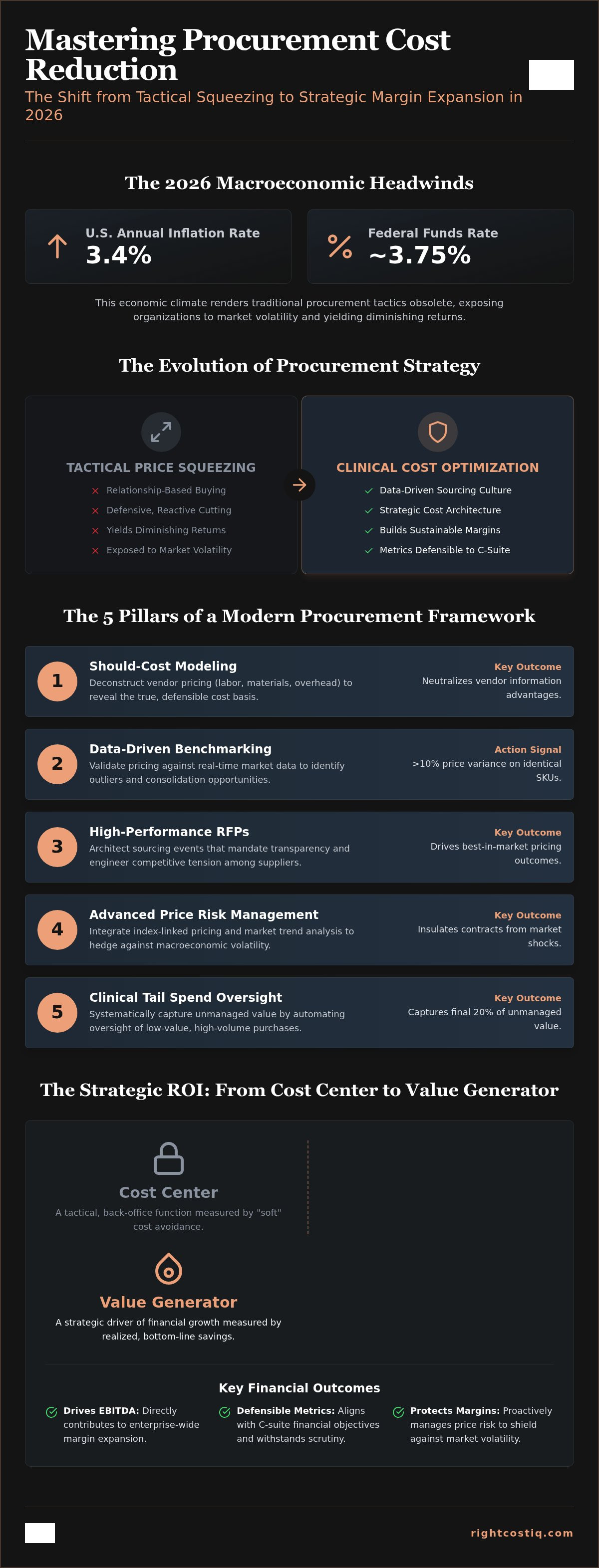
The era of aggressive supplier posturing as a primary lever for margin expansion has officially ended. With the U.S. annual inflation rate holding at 3.4% as of August 2026 and federal funds rates stabilized near 3.75%, the margin for error in supply chain forecasting has vanished. You've likely realized that traditional tactics now yield diminishing returns, leaving your organization exposed to market price volatility and a lack of granular benchmarking data. It's a technical reality where yesterday's negotiation playbooks fail to counter modern macroeconomic pressures.
This article provides the advanced methodology required to master procurement cost reduction strategies for the 2026 fiscal environment. We'll move beyond simple cost-cutting to establish a clinical framework rooted in data-driven sourcing and sophisticated price risk management. Our analysis covers the transition from tactical buying to strategic orchestration, ensuring your cost reduction metrics are defensible to the C-suite and resilient against market fluctuations. We'll examine how precision analytics and vendor performance tracking transform procurement into a high-level driver of financial growth.
Key Takeaways
- Understand the evolution of procurement cost reduction strategies from tactical price squeezing to clinical architectures designed for sustainable margin expansion.
- Apply Should-Cost modeling and category benchmarking to neutralize vendor information advantages and identify precise market outliers.
- Develop high-performance RFP architectures that mandate transparency and engineer competitive tension within every sourcing event.
- Integrate market price trending and index-linked pricing models to insulate contracts from 2026 macroeconomic volatility.
- Systematically capture unmanaged value through clinical tail spend oversight and automated vendor performance tracking systems.
Beyond Defensive Cutting: The Strategic Shift to Clinical Cost Optimization
Tactical price "squeezing" is a relic of low-inflation environments. In 2026, where the annual U.S. inflation rate sits at 3.4%, simple renegotiation is a failing tactic. Modern procurement cost reduction strategies require a strategic cost architecture rather than defensive cutting. This shift moves the department from a back-office function to a primary driver of enterprise-wide EBITDA. Organizations must replace relationship-based buying with a clinical, data-driven sourcing culture. This approach prioritizes market intelligence over historical loyalty. It's about building a defensible methodology that withstands C-suite scrutiny.
Traditional models fail because they lack the precision to handle 2026 market volatility. High interest rates, currently holding at 3.5% to 3.75%, mean that capital efficiency is paramount. By adopting foundational cost reduction strategies, firms can move toward structural margin expansion. This isn't about asking for a 5% discount; it's about re-engineering the cost basis of every category. You don't just buy better; you architect better.
The ROI of Strategic Procurement Optimization
Professional procurement isn't measured by cost avoidance; it's measured by realized savings that hit the bottom line. C-suite leaders demand metrics that align with financial growth, not just "soft" savings. Clinical optimization ensures that every dollar saved is a dollar added to the margin. This requires transitioning to proactive price risk management. By anticipating market shifts, you protect the organization from price spikes that erode quarterly performance. Strategic procurement transforms from a cost center into a value generator by aligning sourcing cycles with corporate financial objectives.
Identifying Inefficiencies in the Current Sourcing Lifecycle
Maverick spend and non-compliant vendor behavior are silent margin killers. When departments bypass established protocols, they create "shadow" costs that are difficult to track but easy to feel. Fragmented data prevents a clear view of the sourcing lifecycle, leading to overpayment and missed opportunities. Utilizing should-cost modeling allows you to identify where vendor margins are excessive. Market price trending acts as a diagnostic tool, highlighting outliers in your spend data. Managing tail spend effectively captures the final 20% of unmanaged value that often leaks through fragmented systems. Identifying these leaks is the first step toward clinical cost recovery.
Leveraging Benchmarking and Should-Cost Analysis for Precision Pricing
Precision pricing is the antidote to vendor-dictated margins. Modern procurement cost reduction strategies rely on shifting the conversation from "what they charge" to "what it should cost." Efficiency is the mandate. This transition requires a clinical breakdown of vendor cost structures, including labor, raw materials, and overhead components. By utilizing procurement analytics, organizations can identify market outliers and neutralize information asymmetry during sourcing events. This methodology ensures that every contract is anchored in objective reality rather than supplier-led narratives.
Effective cost reduction isn't a one-time event; it's a continuous process of long-term value capture. Category cost benchmarking provides the necessary market intelligence to validate vendor pricing across similar procurement categories. When benchmarking reveals a price variance exceeding 10% for identical SKUs, it signals an immediate opportunity for renegotiation or supplier consolidation. This data-driven approach allows procurement teams to act as strategic architects of the company’s financial health. It turns market volatility into a competitive lever for margin expansion.
Data-Driven Category Benchmarking
Accessing real-time market intelligence is critical to validating vendor quotes in a 3.4% inflation environment. Organizations must analyze price variance across all categories to detect inefficiencies. Data reveals the truth. Implementing Should-Cost analysis as a mandatory pre-negotiation requirement forces transparency. It allows your team to dismantle a vendor's proposal and challenge specific cost components based on verified industrial standards. This level of technical upskilling ensures your negotiators operate with a competitive advantage, grounded in the pragmatic realities of business finance.
Visualizing Spend Under Management
Establishing a single source of truth for enterprise spend is non-negotiable for 2026. Fragmented data leads to "savings leakage" where negotiated discounts fail to manifest in actual spend due to non-compliant purchasing patterns. Real-time analytics provide the visibility needed to identify non-compliant vendor behavior and eliminate maverick spend at the source. Implementing these procurement cost reduction strategies ensures that every department adheres to the financial guardrails established by the C-suite. Should-Cost analysis serves as the clinical baseline for 2026 negotiation by establishing the theoretical minimum price point based on objective market inputs. You can begin optimizing your category performance by exploring how expert negotiation assistance can validate your current cost structures.
RFP Architectural Excellence: Driving Competitive Tension in Sourcing
The Request for Proposal (RFP) is a strategic instrument, not a clerical formality. Most organizations remain trapped in a "Three Bids and a Buy" cycle, which fails to generate structural competitive tension. In the 2026 market, effective procurement cost reduction strategies require RFP architectural excellence to force margin disclosure. By designing sourcing events that mandate transparency, you shift the burden of proof to the supplier. This architectural approach ensures that bidders compete on granular cost components rather than surface-level discounts. Precision is the objective.
Advanced RFP management reduces sourcing cycle times by automating standard evaluation criteria. This efficiency allows procurement teams to execute more frequent bidding cycles, maintaining constant pressure on vendor margins. Clinical RFP design moves beyond simple vendor selection to become a primary lever for long-term financial optimization. It's about engineering the market to work in your favor.
The Anatomy of a High-Performance RFP
High-performance RFPs mandate a full cost-breakdown from every participant. You shouldn't accept a "lump sum" quote. Bidders must disclose labor rates, material markups, and logistics fees. This granularity enables direct comparison against your internal benchmarks and Should-Cost models. Aligning service level agreements (SLAs) with specific cost reduction targets ensures that vendors remain accountable for operational efficiency. Utilizing structured RFP management frameworks guarantees compliance across all business units. As noted in IBM's guide to procurement strategies, implementing technology-driven sourcing processes is essential for eliminating maverick spend and capturing realized savings.
Managing Vendor Performance from the Start
Vendor performance tracking begins during the RFP phase, not after contract signature. You must integrate performance-based KPIs into the initial contract architecture. These metrics should link vendor-led cost improvements to contract renewal options. Automating the evaluation of complex sourcing events removes subjective bias and accelerates decision-making. By setting clear financial guardrails during the bidding process, you establish a culture of accountability. This ensures that the procurement cost reduction strategies negotiated on day one remain effective throughout the contract lifecycle. Proactive performance tracking prevents the value leak that typically occurs when vendors shift from acquisition to maintenance mode.
Advanced Negotiation and Price Risk Management as Cost Levers
Intuition-based negotiation is a high-risk liability in a "higher for longer" interest rate environment. For 2026, the most effective procurement cost reduction strategies integrate market price trending directly into the contract lifecycle. This clinical approach allows organizations to time negotiations based on objective market cycles rather than arbitrary renewal dates. By implementing index-linked pricing, procurement teams protect the enterprise against commodity spikes and unexpected supply chain volatility. You must transition from defensive bargaining to proactive price risk management to secure sustainable margin expansion. This shift ensures that every contract is a calculated financial instrument rather than a simple purchase agreement.
Forecasting Market Price Trends
Predicting future costs requires a synthesis of historical data and real-time market intelligence. With U.S. inflation holding at 3.4% as of August 2026, understanding the trajectory of specific categories is essential for long-term financial stability. Forecasting acts as a strategic lever. It enables your team to identify the "Optimal Negotiation Window," allowing you to lock in longer-term fixed pricing before anticipated market upticks. This foresight transforms procurement from a reactive purchaser into a strategic architect of the company’s cost basis. It ensures that your organization isn't just following the market but anticipating its movements to maintain a competitive advantage. Using these models, you can mitigate financial volatility by aligning contract durations with favorable price trending forecasts, effectively neutralizing the impact of market fluctuations on your bottom line.
Clinical Negotiation Assistance
High-value enterprise contracts demand a higher level of technical precision than traditional sourcing can provide. Employing negotiation assistance ensures that every discussion is anchored in hard market data rather than supplier narratives. This data-driven coaching allows your team to counter vendor price increases by presenting verified benchmarking and proprietary should-cost figures. It neutralizes the information advantage typically held by suppliers during complex sourcing events. Price risk management is the primary defense against 2026 inflation. By integrating these analytical tools, you ensure that every negotiation outcome is defensible to the C-suite and perfectly aligned with enterprise-wide EBITDA goals. This methodology eliminates the "guesswork" from the bargaining table, replacing it with a relentless focus on efficiency and realized savings. To validate your current negotiation posture and uncover hidden inefficiencies, access our free diagnostic tool to identify immediate cost-recovery opportunities.
Ensuring Long-Term Value Capture: Performance Tracking and Tail Spend
Negotiated savings remain purely theoretical until they are realized through rigorous post-award oversight. Many organizations fail to capture the full value of their procurement cost reduction strategies due to a lack of clinical performance tracking. Savings leakage is a technical reality. It occurs when vendor behavior deviates from contractually agreed pricing or when internal departments engage in maverick spend. Establishing automated vendor performance tracking systems is the only way to ensure that enterprise-wide EBITDA goals are actually met. This process transforms procurement from a tactical buyer into a sophisticated profit center focused on relentless efficiency.
Optimizing Tail Spend for Resilience
The "Hidden 20%" of unmanaged enterprise spend represents a significant opportunity for cost recovery. This tail spend management methodology focuses on consolidating low-value, high-volume transactions into managed categories. Non-strategic purchases often bypass the scrutiny applied to high-value contracts, leading to fragmented data and lost margins. Implementing automated sourcing for these categories ensures that even minor transactions adhere to established financial guardrails. It's about eliminating the inefficiency of manual oversight for non-critical buys. By capturing these lost margins, organizations build a more resilient supply chain capable of withstanding the market price volatility seen in 2026.
Vendor Compliance and Performance Audits
Continuous improvement cycles rely on the clinical comparison of realized savings against contractually agreed pricing. You can't manage what you don't measure. Performance audits must be data-driven, utilizing real-time analytics to identify billing discrepancies and service level failures. This data doesn't just protect current margins; it informs the architecture of future RFP cycles. When you approach a renewal with a comprehensive record of a vendor's compliance history, you maintain the competitive advantage. It forces transparency and ensures that vendors remain accountable for the efficiencies they promised during the sourcing event.
Proactive audit cycles prevent the value erosion that typically occurs in the second and third years of a long-term contract. By tracking KPIs related to vendor-led cost improvement, you ensure that the organization continues to extract value long after the initial negotiation. This systematic approach to compliance is the final pillar of a modern procurement framework. It bridges the gap between high-level financial strategy and technical execution. To see how these frameworks can be integrated into your organization, discover how RightCostIQ can optimize your procurement architecture and drive sustainable margin expansion.
Architecting Future-Proof Procurement Margins
Transitioning to a clinical cost architecture is a non-negotiable financial necessity. You've seen how precision RFP design and Should-Cost modeling neutralize vendor information advantages. These procurement cost reduction strategies establish a technical baseline for 2026, ensuring that every sourcing event contributes directly to enterprise EBITDA. It isn't just about the initial contract; it's about the relentless tracking of realized savings and the aggressive management of tail spend to prevent value erosion. Success in high-volatility markets depends on your ability to replace relationship-based buying with data-driven orchestration.
Sustainable margin expansion requires more than intuition. It demands the integration of advanced market intelligence and technical negotiation frameworks. RightCostIQ provides the expert RFP management and negotiation assistance needed to dominate complex supply chains. By leveraging our data-driven category cost benchmarking and proprietary price risk management models, your organization can turn market volatility into a strategic lever. Optimize your procurement outcomes with RightCostIQ and secure your competitive advantage today. You're now equipped to lead your department from a back-office function to a high-performance profit driver.
Frequently Asked Questions
What is the difference between cost reduction and cost avoidance in 2026?
Cost reduction refers to realized decreases in expenditure relative to historical baselines, while cost avoidance focuses on preventing price escalations. In 2026, with inflation holding at 3.4%, avoidance is necessary to maintain margins, but only realized reduction directly impacts enterprise EBITDA. Effective procurement cost reduction strategies prioritize structural savings that manifest in financial statements rather than theoretical prevention. C-suite leaders increasingly demand defensible metrics that prove actual cash flow improvement.
How does Should-Cost modeling differ from traditional market benchmarking?
Traditional market benchmarking compares your pricing to peer data, whereas Should-Cost modeling clinically deconstructs a vendor's margin by analyzing labor, materials, and overhead. Benchmarking tells you if you're overpaying; Should-Cost modeling tells you exactly why. This methodology establishes a theoretical minimum price point based on objective market inputs. It's the primary defense against arbitrary vendor price increases, providing negotiators with the technical data required to challenge opaque supplier cost structures.
Why is RFP management considered a primary cost reduction strategy?
RFP management acts as a strategic instrument to engineer competitive tension and mandate vendor transparency. By utilizing structured bidding cycles, organizations force suppliers to disclose granular cost components rather than providing lump-sum quotes. This architectural approach reduces sourcing cycle times and ensures that bidders compete on efficiency rather than relationship history. Clinical RFP design is essential for identifying market outliers and securing the long-term margin expansion required in high-volatility environments.
Can tail spend management significantly impact the bottom line?
Tail spend management captures the "Hidden 20%" of unmanaged enterprise spend that typically leaks through fragmented systems. While individual transactions are small, their cumulative volume often masks significant margin erosion. Consolidating these low-value purchases into managed categories and implementing automated sourcing eliminates maverick spend. Capturing these lost margins significantly impacts the bottom line by ensuring that even non-strategic purchases adhere to the organization's established financial guardrails.
How does market price trending help in vendor negotiations?
Market price trending allows procurement teams to time contract negotiations based on objective market cycles rather than arbitrary renewal dates. By analyzing historical data and forecasting future costs, organizations can identify the "Optimal Negotiation Window" to lock in favorable rates. This data-driven approach counters vendor-led narratives about price increases with hard market intelligence. It transforms negotiation from a reactive bargaining session into a proactive exercise in price risk management.
What are the most effective procurement cost reduction strategies for indirect spend?
The most effective procurement cost reduction strategies for indirect spend focus on category consolidation and automated performance tracking. Indirect categories often suffer from high maverick spend and non-compliant vendor behavior. Establishing a single source of truth for all enterprise spend allows for real-time analytics to identify savings leakage. Organizations should implement index-linked pricing and clinical tail spend oversight to protect these categories from the inflationary pressures expected throughout 2026.
How do we measure the success of a procurement optimization program?
Success is measured by realized savings that hit the bottom line, vendor compliance rates, and the percentage of spend under management. You must track the delta between negotiated pricing and actual invoice data to ensure value capture. High-performance programs also monitor vendor-led cost improvement and service level agreement adherence. These clinical metrics provide the C-suite with a defensible overview of how procurement optimization contributes to the company's overall financial growth.
What role does technology play in capturing realized procurement savings?
Technology provides the architectural framework for automated performance tracking and the identification of non-compliant purchasing patterns. It ensures that negotiated discounts are actually realized by flagging maverick spend in real time. Advanced platforms integrate market price trending and Should-Cost models directly into the sourcing lifecycle. This integration allows procurement professionals to move from tactical buying to strategic orchestration, utilizing data to maintain a persistent competitive advantage over suppliers.


