
In 2026, healthcare negotiation is no longer a soft skill; it's the clinical execution of market intelligence and price risk management. With medical costs projected to grow by up to 9.0% this year, the margin for error in procurement has evaporated. Most hospital executives recognize that relying on opaque vendor pricing models and stagnant GPO benchmarks is an invitation for financial instability. You've likely seen how rising volatility in medical supply chains can disrupt even the most disciplined budgets. This guide delivers the precision benchmarking and market-led healthcare contract negotiation strategies required to protect your institution's bottom line. By mastering these data-driven frameworks, you'll secure the ability to transform procurement from a reactive cost center into a primary driver of measurable margin expansion. We'll examine how to implement a repeatable, data-backed RFP process and utilize market forecasting to mitigate price risk across high-value categories. This is the roadmap for turning technical cost analysis into a definitive competitive advantage.
Key Takeaways
- Transition from subjective, relationship-led sourcing to a clinical execution model that prioritizes data-driven efficiency and margin protection.
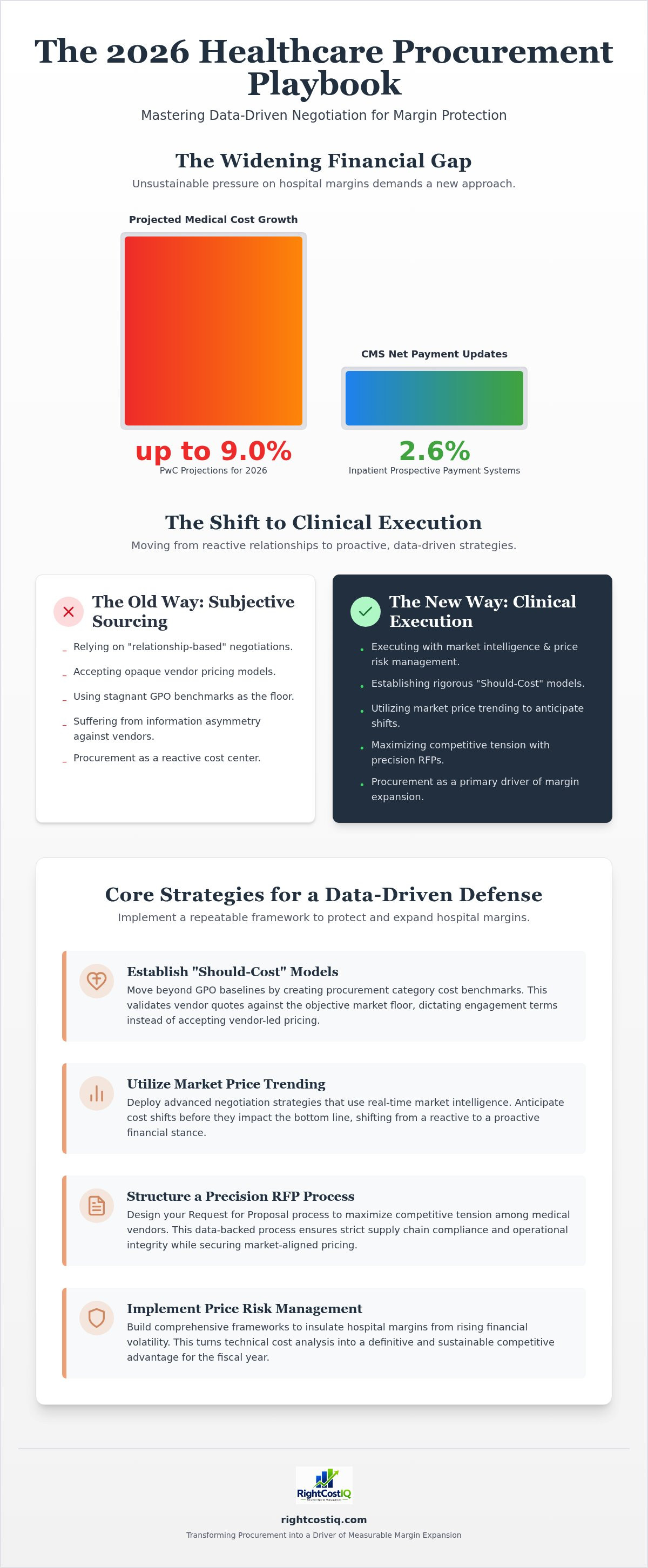
- Establish rigorous "Should-Cost" models through procurement category cost benchmarking to ensure GPO pricing remains competitive in a volatile market.
- Deploy advanced healthcare contract negotiation strategies that utilize market price trending to anticipate cost shifts before they impact the bottom line.
- Structure your RFP process to maximize competitive tension among medical vendors while maintaining strict supply chain compliance and operational integrity.
- Implement comprehensive price risk management frameworks to insulate hospital margins from the rising financial volatility expected throughout the 2026 fiscal year.
The Shift from Subjective to Clinical Negotiation in Healthcare
The 2026 fiscal landscape has reached a critical inflection point where traditional procurement models are no longer viable. CMS has set net payment updates for inpatient prospective payment systems at just 2.6% for the year. Meanwhile, PwC projects medical cost growth between 8.5% and 9.0%. This massive delta creates an unsustainable pressure on hospital margins that cannot be solved through incremental savings. Relying on "relationship-based" negotiation is a liability in this high-stakes environment. Clinical negotiation replaces subjective rapport with objective data analysis. It treats every contract line item as a clinical variable to be optimized for maximum financial health. Within the complex structure of healthcare finance in the United States, CFOs must view data transparency as their most potent strategic asset. Implementing rigorous healthcare contract negotiation strategies is the only way to bridge the widening chasm between reimbursement rates and supply chain expenses.
Evolving Beyond the GPO Safety Net
Group Purchasing Organizations (GPOs) provide a baseline, but they rarely secure the actual market floor. Standard benchmarks often mask the "best available" price rather than the true competitive minimum. Over time, multi-year supply agreements suffer from price creep, where incremental increases erode the initial savings. Precision benchmarking validates whether your current rates are truly competitive or merely convenient. You can't assume a GPO tier is the lowest possible cost; it's often just the lowest cost available within a specific, limited framework. Clinical execution requires looking past these pre-negotiated bundles to find deeper efficiencies.
The Cost of Information Asymmetry
Vendors maintain high margins by leveraging superior market intelligence. They know the price floor; most hospitals don't. This information asymmetry forces health systems into a defensive posture during the sourcing cycle. By utilizing professional RFP management and proprietary cost analytics, hospitals can reclaim the power dynamic. Data-driven sourcing identifies exactly where vendor margins are inflated. Shifting from a reactive to a proactive stance ensures that procurement decisions are based on market reality, not vendor-supplied narratives. High-level healthcare contract negotiation strategies must prioritize the elimination of these data gaps to restore operational efficiency. When you operate with the same level of market insight as the vendor, the negotiation shifts from a request for concessions to a demand for market alignment.
This transition toward a data-driven framework is not merely a preference; it's a survival mechanism. As financial volatility remains high, the "Strategic Architect" approach to procurement ensures that every dollar spent is backed by a verifiable benchmark. We'll explore how to build these Should-Cost models in the next section.
Benchmarking and Analytics: The Foundation of Strategic Sourcing
Strategic sourcing requires a foundation of absolute data accuracy. Retrospective reporting is merely a lag indicator; modern health systems require real-time market intelligence to remain solvent. You can't manage what you don't measure with precision. By quantifying the variance between contracted rates and actual market trends, CFOs can identify immediate opportunities for margin recovery. This technical approach moves procurement from a support function to a primary financial driver.
Implementing Category-Specific Cost Benchmarking
Normalizing data across disparate medical device categories is essential for clinical precision. You can't compare a high-volume commodity to a specialized implant without adjusting for clinical utility and volume volatility. Utilizing RightCostIQ's benchmarking tools allows procurement teams to validate vendor quotes against objective market floors. This creates a "Should-Cost" model that dictates the terms of the engagement rather than accepting vendor-led pricing. Evaluating vendor performance tracking against industry standards ensures that cost savings don't come at the expense of operational reliability.
Data-Driven Sourcing vs. Traditional Bidding
Traditional bidding is a passive request for a price. Data-driven sourcing is an active dictation of value based on technical cost analysis. Procurement benchmarking is the process of mapping internal spend against verified market indices. Granular spend analytics uncover hidden tail spend, those fragmented, low-volume purchases that collectively erode hospital margins. By aggregating this data, you gain the leverage to consolidate vendors and drive deeper savings. Advanced healthcare contract negotiation strategies rely on this level of technical cost analysis to identify category-specific savings that generic GPO benchmarks miss.
To identify specific leakage points in your current agreements, consider a comprehensive procurement diagnostic to baseline your performance and uncover hidden margin expansion opportunities.
Precision RFP Management for High-Value Healthcare Contracts
The Request for Proposal (RFP) is the primary instrument for generating competitive tension in high-stakes medical sourcing. Without a structured framework, vendors dictate the terms, leading to price inflation and operational rigidity. Professional RFP management ensures that every vendor submission is evaluated against objective benchmarks rather than subjective sales narratives. This process is essential for maintaining supply chain compliance and identifying the most resilient partners for the 2026 fiscal year. By integrating vendor performance tracking directly into the contract, health systems move beyond initial price concessions to ensure long-term value delivery. Structured sourcing cycles act as a defensive barrier against price risk, forcing market alignment at regular intervals.
The RFP Lifecycle: From Strategy to Execution
Defining technical requirements with clinical precision prevents the common pitfall of vendor lock-in. When specifications are too narrow, they favor incumbent vendors; when they're too broad, they invite low-quality bids. Managing complex RFPs for medical technology requires a balance of clinical input and financial oversight. You should consult our RFP Management Pillar for a deeper dive into these strategic frameworks. This approach ensures that the RFP lifecycle transitions seamlessly from high-level strategy to granular execution. It's about building a specification that demands excellence while leaving no room for opaque pricing models.
Mitigating Risk in Vendor Selection
Mitigating risk during vendor selection requires an analytical deep dive into vendor financial stability and market price trending. You can't afford to partner with a supplier whose pricing model is vulnerable to sudden market shifts. Integrating Service Level Agreements (SLAs) that drive accountability is a core component of sophisticated healthcare contract negotiation strategies. These SLAs must be measurable and tied to financial penalties to ensure compliance. In high-stakes healthcare RFPs, utilizing professional negotiation assistance provides the technical leverage needed to close the gap between a vendor's initial offer and the true market floor. This strategic architect approach transforms the RFP from a bureaucratic hurdle into a powerful engine for margin expansion. It's a relentless focus on the bottom line that separates top-performing health systems from those struggling with fiscal volatility.
Advanced Negotiation Levers for the 2026 Healthcare Market
Success in the 2026 fiscal year requires moving beyond static data. While benchmarking establishes the baseline, predictive levers allow health systems to anticipate market shifts before they impact the balance sheet. Utilizing market price trending and forecasting transforms the negotiation from a reactive response into a proactive financial strategy. This is particularly critical in medical equipment sourcing, where a Total Cost of Ownership (TCO) approach must account for maintenance, consumables, and lifecycle depreciation. CFOs should also prioritize tail spend management to consolidate fragmented vendor leverage. By aggregating low-volume purchases, hospitals can drive higher compliance and secure volume-based discounts that are often overlooked in traditional procurement cycles.
Forecasting as a Negotiation Lever
Market price trending dictates the optimal window for contract execution. If data suggests a downward trend in a specific device category, delaying a multi-year commitment can save significant capital. Conversely, forecasting models allow procurement teams to hedge against anticipated supply chain disruptions or inflationary spikes. Price risk management is the mitigation of financial exposure to market price fluctuations. Integrating these predictive analytics into your healthcare contract negotiation strategies ensures that you aren't just buying at today's market floor, but protecting your margin against tomorrow's volatility.
The 5-Step Strategic Negotiation Framework
Implementing a repeatable, high-precision framework ensures consistency across all procurement categories. This methodical approach aligns high-level financial goals with granular technical execution:
- Step 1: Baseline benchmarking and spend analysis. Validate current rates against objective market floors.
- Step 2: Market trend forecasting and risk assessment. Quantify potential price volatility for the contract duration.
- Step 3: RFP issuance with clinical precision. Use technical specifications to eliminate vendor information asymmetry.
- Step 4: Multi-round negotiation assisted by market intelligence. Leverage real-time data to drive vendors toward the "Should-Cost" model.
- Step 5: Ongoing vendor performance tracking and compliance. Monitor SLA adherence to prevent post-contract price creep.
To see how these levers apply to your specific spend profile, you can request a procurement diagnostic to identify immediate margin expansion opportunities.
Clinical Execution: Partnering for Procurement Optimization
Integrating advanced analytics into traditional procurement infrastructure is the definitive requirement for health systems facing 2026 financial volatility. Mercer and PwC forecast medical cost increases between 6.5% and 9.0% this year, making the status quo a direct threat to institutional solvency. RightCostIQ functions as the strategic architect, transforming healthcare supply chains through technical cost analysis and clinical execution. By deploying our data-driven frameworks, healthcare leaders move from reactive purchasing to a model of proactive strategic sourcing that prioritizes long-term resilience. This transition ensures that procurement departments operate with the same clinical precision as the medical teams they support.
The RightCostIQ Advantage in Healthcare
Our negotiation coach platform leverages deep category benchmarking to secure terms that generic GPO tiers simply can't provide. We deliver the market intelligence necessary to validate vendor claims in real-time, ensuring that the "best available" price actually reflects the market floor. The impact of our market price trending and forecasting service extends well beyond immediate savings; it facilitates accurate long-term budgeting in an unstable medical supply chain. This clinical execution ensures every contract is backed by verified data, stripping away vendor information asymmetry and restoring financial balance to the negotiation table. High-level decision-makers gain a powerful tool for technical upskilling and competitive advantage.
Securing the Bottom Line
The ROI of professional RFP management is reflected in measurable margin expansion and the systematic mitigation of price risk. Achieving sustainable growth in the 2026 fiscal cycle requires a repeatable, data-backed process that identifies category-specific savings and eliminates tail spend leakage. Healthcare decision-makers must act with strategic urgency to insulate their organizations from rising operational costs. Resilience is built through the seamless integration of advanced technology into traditional business functions. It's time to replace subjective, relationship-led sourcing with a framework specifically designed for the technical complexities of the modern healthcare market. By mastering these healthcare contract negotiation strategies, you transform procurement into a primary driver of institutional growth.
Optimize your healthcare procurement with RightCostIQ to secure your hospital's financial future through clinical precision and market-led negotiation assistance.
Architecting Procurement Resilience for the 2026 Fiscal Cycle
The financial volatility of 2026 demands a definitive departure from legacy procurement habits. Success now hinges on the clinical execution of RFP management. Integrating specialized market price trending and forecasting into every vendor engagement is no longer optional. By establishing a rigorous "Should-Cost" model through expert procurement category cost benchmarking, you eliminate the information asymmetry that historically favored vendors. These advanced healthcare contract negotiation strategies don't just reduce immediate costs. They insulate your hospital margins against unpredictable supply chain shifts and inflationary pressures. It's time to transition from a reactive purchasing posture to a proactive, data-backed architecture. This framework treats every dollar as a strategic asset for margin expansion. Implementing a repeatable, analytical framework ensures that your institution remains resilient regardless of market fluctuations. You have the technical capacity to transform your supply chain into a primary driver of financial health. Secure your facility's bottom line with RightCostIQ's negotiation assistance. Your path to measurable margin expansion begins with data precision.
Frequently Asked Questions
What are the most effective healthcare contract negotiation strategies for 2026?
Effective healthcare contract negotiation strategies for 2026 center on clinical execution and technical market intelligence. Organizations must move beyond relationship-based sourcing to adopt rigorous benchmarking and real-time cost modeling. This approach ensures that every procurement decision is validated against objective market floors. Implementing these data-backed frameworks allows health systems to mitigate the impact of rising medical costs, which are projected to grow by up to 9.0% this year.
How does procurement benchmarking improve healthcare contract outcomes?
Procurement benchmarking improves contract outcomes by establishing a definitive "Should-Cost" model for specific medical categories. It allows hospital CFOs to identify price variance between their current rates and verified market indices. By mapping internal spend against broader industry data, systems can uncover hidden savings that generic benchmarks often miss. This technical analysis provides the necessary leverage to demand market alignment during vendor discussions, ensuring that contracted rates reflect actual market value.
Can professional RFP management reduce medical supply chain costs?
Professional RFP management reduces medical supply chain costs by generating maximum competitive tension among vendors. A structured RFP process eliminates information asymmetry and prevents vendor lock-in through precise technical requirements. It also ensures strict supply chain compliance by integrating performance metrics directly into the selection criteria. By utilizing professional negotiation assistance during the RFP lifecycle, health systems can systematically drive down costs while maintaining the operational integrity of their high-value technology agreements.
What is price risk management in healthcare procurement?
Price risk management in healthcare procurement is the systematic mitigation of financial exposure to market price fluctuations. It involves using predictive analytics to identify potential cost spikes before they impact the hospital budget. By implementing structured risk management frameworks, organizations can hedge against supply chain disruptions and inflationary pressures. This strategy protects institutional margins from the financial volatility expected throughout the 2026 fiscal year, ensuring long-term fiscal stability in a shifting market.
How do market price trends influence hospital vendor negotiations?
Market price trends act as a critical negotiation lever by dictating the optimal window for contract execution. When health systems utilize market price trending and forecasting, they can anticipate future cost shifts and adjust their procurement strategy accordingly. This data allows negotiators to push for price concessions when market floors drop or to lock in favorable rates before anticipated inflationary spikes. Forecasting transforms procurement from a reactive purchasing function into a proactive driver of financial growth.
Why is vendor performance tracking essential for contract compliance?
Vendor performance tracking is essential for contract compliance because it ensures that negotiated savings are actually realized throughout the contract lifecycle. It involves monitoring service level agreements (SLAs) and clinical outcomes to prevent post-contract price creep. Without rigorous tracking, vendors may fail to meet delivery standards or introduce incremental cost increases that erode initial margin gains. Maintaining a structured performance tracking service holds suppliers accountable and reinforces the strategic value of the procurement department.
How can health systems move beyond GPO pricing for better savings?
Health systems move beyond GPO pricing by using category-specific cost benchmarking to validate whether pre-negotiated tiers represent the true market floor. While GPOs provide a baseline, they rarely account for the granular spend profiles of individual institutions. Implementing independent data analytics allows procurement teams to identify deeper savings opportunities in high-volume categories and specialized technology. This objective analysis empowers CFOs to negotiate custom agreements that outperform standard group contracts and drive measurable margin expansion.
What role does data analytics play in healthcare strategic sourcing?
Data analytics serves as the foundational engine for healthcare strategic sourcing by providing the visibility needed for technical cost analysis. It enables procurement teams to perform granular spend analysis and uncover hidden tail spend leakage. By aggregating disparate data points into a cohesive sourcing strategy, health systems can consolidate vendor leverage and optimize their RFP outcomes. Utilizing advanced analytics ensures that every procurement decision is backed by verifiable data, transforming the supply chain into a clinical instrument.


