
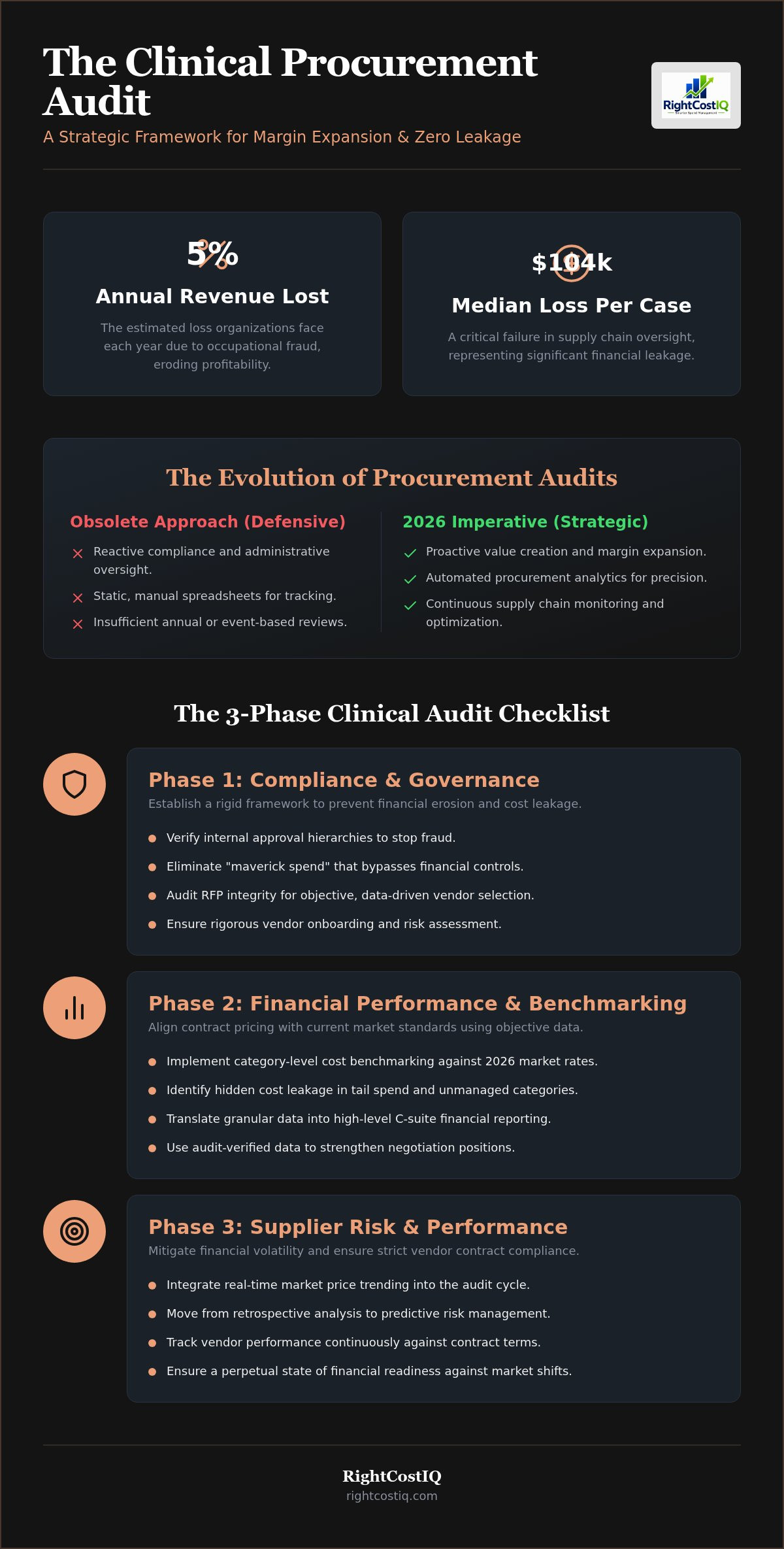
Organizations lose an estimated 5% of their annual revenue to occupational fraud each year, with the median loss per case reaching $104,000. These figures represent a critical failure in supply chain oversight and a direct erosion of corporate profitability. For the strategic architect, procurement is no longer a back-office function; it's the primary engine for financial optimization. You understand that inconsistent RFP execution and hidden leakage in tail spend represent significant risks to your bottom line. This article introduces a clinical procurement audit checklist designed to execute a high-precision diagnostic of your entire supply chain. By adopting this framework, you'll identify specific cost leakages, mitigate unmanaged market price volatility, and optimize vendor performance with surgical accuracy. We provide a repeatable, data-driven methodology for quantifiable margin expansion. The following analysis previews a shift from defensive compliance to offensive strategic diagnostics, utilizing advanced cost benchmarking and market price trending to ensure your procurement department delivers maximum value and zero leakage.
Key Takeaways
- Transition from administrative oversight to a strategic diagnostic framework that prioritizes margin expansion and quantifiable value creation.
- Utilize a comprehensive procurement audit checklist to identify hidden cost leakage within tail spend and unmanaged categories.
- Implement category-level cost benchmarking to align contract pricing with 2026 market standards and objective financial data.
- Integrate market price trending and vendor performance tracking to mitigate financial volatility and ensure strict contract compliance.
- Shift from static manual spreadsheets to automated procurement analytics for continuous supply chain optimization and high-precision risk management.
The Strategic Imperative: Redefining the Procurement Audit in 2026
In 2026, the traditional view of the audit as a defensive compliance exercise is obsolete. High-level decision-makers now recognize the audit as a clinical diagnostic of the entire supply chain. It's a strategic pivot from administrative oversight to proactive value creation. This evolution requires a shift in mindset: the audit isn't something you do to prove you followed rules; it's something you do to find money. To remain competitive, organizations must treat their audit framework as a primary engine for financial optimization and margin expansion.
Value Erosion vs. Strategic Alignment
Value erosion occurs silently across the procurement process. It often manifests as contract non-compliance, unmanaged tail spend, and missed rebates that aggregate into significant financial leakage. A rigorous procurement audit checklist serves as the primary blueprint for identifying these specific points of failure. When clinical execution meets strategic alignment, the audit identifies margin expansion opportunities that standard accounting often misses. This process translates granular operational data into high-level C-suite financial reporting, proving the direct impact of procurement on the bottom line.
The data harvested during these audits is the primary fuel for high-stakes negotiation assistance. Without objective, audit-verified data, sourcing teams enter negotiations at a distinct disadvantage. By identifying exactly where a vendor has drifted from contract terms or where market prices have shifted, procurement teams can leverage precise benchmarks. This clinical approach replaces anecdotal evidence with undeniable financial facts, forcing vendors into compliance and securing more favorable contract terms during the next RFP cycle.
The 2026 Market Context
Market volatility in 2026 has reached a threshold where annual reviews are insufficient. Rapid price fluctuations and supply chain disruptions demand a more frequent, data-driven audit cadence. Organizations can't afford to wait 12 months to discover that their contracts no longer reflect current market intelligence. A modern procurement audit checklist must include triggers for continuous monitoring, moving away from event-based auditing toward a perpetual state of financial readiness.
Managing financial risk in this era requires integrating real-time market price trending into every audit cycle. It's about shifting from a retrospective look at what happened to a predictive analysis of what's coming. This rigorous cadence ensures that the procurement department remains a sophisticated partner in corporate financial growth, rather than a department reacting to market forces it didn't track. Efficiency isn't just about speed; it's about the precision of your data in a volatile economy.
Phase 1: Compliance and Governance Audit Checklist
Phase 1 of a clinical procurement audit checklist focuses on the structural integrity of your sourcing framework. It's the baseline for preventing financial erosion. Governance isn't just about following rules; it's about establishing a rigid environment where cost leakage is impossible. Given that 76% of U.S. organizations experienced attempted or actual payments fraud in 2025, verifying internal approval hierarchies is a financial necessity. This requires a deep analysis of spend authorization levels and the elimination of "maverick spend" that bypasses established financial controls.
RFP Integrity and Sourcing Protocols
The clinical execution of the RFP lifecycle is the primary defense against sub-optimal contracts. Auditors must verify that competitive tension is maintained in all high-value sourcing events. This involves reviewing bid evaluation criteria and ensuring that vendor selection is based on objective, data-driven benchmarks rather than legacy relationships. You can optimize your RFP cycles with professional management to ensure that every sourcing event follows a repeatable, high-precision methodology. Documentation of the decision-making process is mandatory to survive external scrutiny and ensure long-term sourcing integrity.
Vendor Governance and Compliance
Vendor onboarding workflows require a rigorous risk assessment documentation audit. This includes verifying insurance certificates, tax compliance, and security certifications. Referencing the GAO Core Financial System Requirements Checklist provides a high-level framework for auditing these financial systems. Beyond basic compliance, modern audits must track supplier diversity metrics against corporate ESG goals to ensure strategic alignment. This level of oversight prevents the "set it and forget it" mentality that leads to auto-renewal traps and stagnant vendor performance.
Effective contract lifecycle management identifies specific clauses that expose the organization to unmanaged risk. Auditors should specifically look for price escalation triggers and termination for convenience windows. By maintaining a clinical focus on these governance details, procurement leaders can transition from reactive troubleshooting to proactive margin protection. It's about building a robust infrastructure that supports advanced analytics and high-stakes negotiation. If your current governance feels fragmented, a centralized diagnostic can reveal hidden vulnerabilities before they impact your next fiscal reporting cycle.
Phase 2: Financial Performance and Cost Benchmarking Audit
Phase 2 shifts the focus from structural compliance to the clinical extraction of financial value. While governance ensures the rules are followed, this phase uses a procurement audit checklist to determine if those rules are actually delivering competitive pricing. You're no longer just auditing for signatures; you're auditing for margin. The primary objective is to identify exactly where your category costs deviate from real-world market intelligence. This diagnostic approach treats procurement as a profit center rather than a cost center.
Cost Benchmarking and Analytics
Benchmarking is the diagnostic tool that reveals price variance across similar procedure types. In healthcare procurement, for example, the same SKU or service can vary significantly in price across different facilities or regions. A clinical audit compares your internal data against validated market intelligence to expose these discrepancies. You can leverage should-cost analytics for price transparency to move beyond vendor quotes and understand the true cost drivers. This data-driven approach replaces "best-guess" estimates with objective financial standards, providing the leverage needed for high-stakes negotiation.
Tail Spend and Category Optimization
The "hidden 20%" of unmanaged spend often represents the largest source of cost leakage. While high-value categories receive significant attention, tail spend frequently operates without rigorous oversight. An effective audit identifies these unmanaged categories and brings them into a strategic framework. Research indicates the average organization has only 57.1% of its spend under management, while best-in-class performers reach 91.5%. This gap represents a massive opportunity for financial growth. You must address leakage in your tail spend management to ensure every dollar is accounted for.
For a deeper dive into organizing these efforts, refer to our guide on Category Management in Procurement: A Clinical Framework for Margin Expansion (2026). Bringing spend under management isn't just an administrative goal; it's a financial imperative. Every dollar transitioned from unmanaged to managed spend has the potential to create 6-12% in savings. Quantifying this metric allows for accurate financial forecasting and provides the C-suite with a clear roadmap for margin expansion. This clinical analysis ensures that your procurement audit checklist remains an offensive tool for corporate profitability.
Phase 3: Supplier Risk and Performance Infrastructure
Phase 3 of the procurement audit checklist transitions from financial benchmarking to operational resilience. High-level decision-makers must audit the efficacy of their vendor performance tracking systems to ensure strategic alignment isn't lost post-contract signature. It's a clinical assessment of whether the vendor is delivering the value promised during the RFP cycle. In an era where 53.44% of Chief Procurement Officers prioritize spend analytics, failing to audit the underlying data infrastructure represents a significant strategic risk. You can't manage what you don't track with precision.
Performance Tracking and Operational Efficiency
Measuring vendor KPIs against contractually mandated service levels is the only way to identify high-risk suppliers before they cause systemic disruption. Auditors should analyze performance data to spot trends in service degradation or compliance failures. Automated tracking plays a critical role in maintaining supply chain compliance; it replaces the inconsistency of manual oversight with relentless precision. This data infrastructure allows the organization to move from periodic assessments to continuous, AI-powered monitoring that can predict high-impact disruptions with significant accuracy. Without this clinical visibility, your organization remains vulnerable to vendor underperformance that erodes the margins secured during initial negotiations.
Price Risk and Market Intelligence
Auditing the use of market forecasting in contract renewals is essential for managing financial volatility. Organizations must evaluate their price risk management frameworks for agility. This means checking if current protocols allow for rapid adjustments when market price trending signals a shift. You should consult a negotiation coach for high-stakes renewals to ensure these audit findings are translated into superior contract terms. The goal is to ensure that your price risk management isn't just a policy on paper but a functional tool that protects the bottom line during market spikes.
The leverage points derived from these audit findings are the primary drivers for post-audit execution. When you possess clinical data on specific performance failures or objective market price shifts, you control the negotiation narrative. This infrastructure ensures the organization remains a sophisticated, forward-thinking entity rather than a passive recipient of vendor terms. To evaluate the resilience of your current supplier network, access our clinical procurement diagnostic to identify hidden vulnerabilities in your risk infrastructure.
Executing the Audit: Integrating Analytics for Continuous Optimization
The final phase of executing a clinical procurement audit checklist involves the transition from diagnostic findings to operational execution. Static manual spreadsheets are insufficient for the complexities of 2026 supply chains. They create data silos and delay the identification of cost leakage. By integrating automated procurement analytics, organizations move from reactive corrections to a state of continuous optimization. This shift allows for the synthesis of complex datasets into high-level C-suite reporting, positioning procurement as a primary driver of corporate financial health. Successful execution requires a roadmap that links technical analysis to tangible business outcomes.
From Data to Actionable Strategy
Converting audit insights into specific negotiation levers is the hallmark of a sophisticated sourcing function. It's not enough to identify variance; you must weaponize that data during vendor interactions. Implementing a data-driven sourcing culture ensures that every decision is backed by clinical evidence rather than intuition. For organizations looking to integrate advanced technology into their processes, our guide on RFP Management: Strategic Frameworks for AI-Led Procurement Optimization provides a roadmap for this evolution. Professional negotiation assistance acts as the bridge between audit data and realized savings, ensuring that identified opportunities are successfully captured in contract terms. This methodology eliminates the ambiguity of traditional vendor selection and replaces it with a rigorous, results-oriented framework.
The Future of Procurement Analytics
The future of procurement lies in the integration of predictive forecasting into the audit lifecycle. This move from retrospective analysis to forward-looking intelligence builds a resilient infrastructure capable of navigating market price volatility. As 53.44% of Chief Procurement Officers now prioritize spend analytics as their top generative AI use case, the technological gap between laggards and leaders is widening. Scalable efficiency requires a framework that tracks vendor performance and market trends in real-time. This continuous loop of auditing and optimization creates a sustainable competitive advantage and long-term financial growth. Organizations must move beyond the event-based audit and adopt a perpetual state of financial readiness. To achieve this level of operational maturity, you can scale your procurement efficiency with RightCostIQ and transform your audit findings into a strategic asset for margin expansion.
Advancing Your Competitive Advantage Through Clinical Oversight
The transition from administrative compliance to strategic margin expansion requires a relentless focus on data integrity. By utilizing a clinical procurement audit checklist, you've established a framework that identifies hidden leakage and aligns vendor performance with corporate financial goals. You've seen how category-level cost benchmarking and automated analytics replace anecdotal evidence with objective market intelligence. This shift ensures your supply chain isn't just a cost center but a primary engine for growth.
Maintaining this momentum demands the integration of advanced technology and professional expertise. Clinical execution of RFP management and advanced category cost benchmarking provide the leverage needed to dominate high-stakes negotiations. Expert-led negotiation assistance ensures your audit findings translate into tangible savings. Don't let unmanaged market volatility erode the margins you've worked to secure. It's time to transform your audit findings into a permanent strategic asset.
Execute your next RFP with clinical precision at RightCostIQ and secure your organization's financial future. Your roadmap to continuous optimization starts with a single, high-precision diagnostic.
Frequently Asked Questions
What are the essential components of a procurement audit checklist?
Essential components include verification of RFP protocols, vendor onboarding compliance, and category-level cost benchmarking analytics. A robust procurement audit checklist must also evaluate internal approval hierarchies and spend authorization levels to prevent maverick spend. These elements ensure that the sourcing framework remains structurally sound and aligned with corporate governance. By auditing these specific areas, organizations establish a clinical baseline for preventing financial erosion and maintaining long-term supply chain integrity.
How does a procurement audit identify cost leakage?
Audits identify cost leakage by exposing contract non-compliance and unmanaged tail spend that aggregates into significant financial erosion. Organizations lose approximately 5% of annual revenue to occupational fraud, making these diagnostics a financial necessity for the C-suite. By analyzing spend data against agreed-upon terms, the audit reveals missed rebates and unauthorized price escalations. This clinical approach allows procurement leaders to recapture lost margin and implement more rigid financial controls.
What is the difference between a compliance audit and a performance audit in procurement?
A compliance audit verifies adherence to internal protocols and external regulations, focusing on governance and legal integrity. In contrast, a performance audit evaluates the efficacy of procurement outcomes, such as margin expansion and operational efficiency. While compliance ensures the rules are followed, performance analysis determines if those rules actually deliver competitive pricing. Both functions are critical components of a procurement audit checklist to ensure the organization achieves holistic supply chain health and profitability.
How often should an enterprise conduct a procurement audit?
Enterprises should move away from annual events toward continuous monitoring or quarterly diagnostics. The rapid price fluctuations of the 2026 market demand a more rigorous audit cadence to manage financial risk effectively. Waiting twelve months to identify cost leakage or vendor underperformance is no longer a viable strategy for high-level decision-makers. Frequent audits allow for real-time adjustments and ensure that contracts remain aligned with current market price trending data and forecasting.
What role does benchmarking play in the audit process?
Benchmarking provides the objective market intelligence required to evaluate vendor pricing fairness against real-world standards. It replaces anecdotal evidence with clinical data, allowing auditors to spot procedure price variances that signal significant overpayment. This data-driven approach is essential for fueling high-stakes negotiation assistance during contract renewals. Without benchmarking, procurement teams lack the leverage needed to force vendor compliance and secure optimal contract terms that reflect current market realities.
Can automated software replace a manual procurement audit?
Automated software provides the data infrastructure for efficiency, but it doesn't replace the strategic oversight of a human architect. Software excels at spend analytics and dashboarding, which 53.44% of CPOs now prioritize for generative AI use cases. However, professional negotiation assistance is required to translate those automated findings into realized savings. The most effective audits combine technological precision with expert-led strategy to drive continuous procurement optimization and sustainable long-term financial growth.
How do we audit supplier risk in a volatile market?
Auditing supplier risk involves integrating market price trending and predictive forecasting into your risk mitigation strategies. You must assess the agility of your price risk management protocols to ensure they can handle extreme financial volatility. This process includes auditing vendor KPIs against contractually mandated service levels to identify high-risk suppliers. Moving to AI-powered monitoring allows organizations to predict disruptions with significant accuracy, transforming risk management from a reactive to a proactive strategic function.
What are the primary KPIs to evaluate during a procurement audit?
Primary KPIs include spend under management, contract compliance rates, and category-level price variance. Auditors should also evaluate vendor performance metrics and the clinical efficacy of RFP execution protocols. Tracking these specific data points allows for accurate financial forecasting and provides the C-suite with clear evidence of procurement's impact on the bottom line. Focusing on these metrics ensures the audit remains a clinical tool for quantifiable margin expansion and corporate profitability.


