
Sustainable procurement value is not a product of aggressive haggling, but the result of clinical cost benchmarking and precise market price trending. Information asymmetry remains a persistent barrier to favorable terms, as quantifying non-price variables like Service Level Agreements (SLAs) often feels subjective. This leaves the organization exposed to market price volatility and inconsistent vendor compliance. Implementing advanced vendor contract negotiation tips is no longer optional; it's a strategic necessity for maintaining operational efficiency and financial growth.
You'll master the data-driven strategies and clinical frameworks required to secure superior vendor terms and mitigate financial volatility in 2026. This article provides the tools to shift the power dynamic back to the procurement office through sophisticated cost analytics and performance tracking. We'll examine how to leverage cost benchmarking, improve vendor performance compliance, and standardize negotiation frameworks to ensure measurable cost savings across the entire enterprise.
Key Takeaways
- Transition from tactical haggling to strategic analytics to neutralize information asymmetry and reclaim procurement authority.
- Apply clinical category cost benchmarking to develop "Should-Cost" models that drive fact-based negotiation outcomes.
- Implement these vendor contract negotiation tips to optimize Total Cost of Ownership by securing favorable SLAs and risk mitigation clauses.
- Utilize the RFP process as a methodical engine for market discovery, forcing vendors to demonstrate quantifiable value beyond price.
- Leverage advanced analytics to replace subjective decision-making with objective, data-driven negotiation frameworks.
The Evolution of Vendor Negotiation: From Tactical Haggling to Strategic Analytics
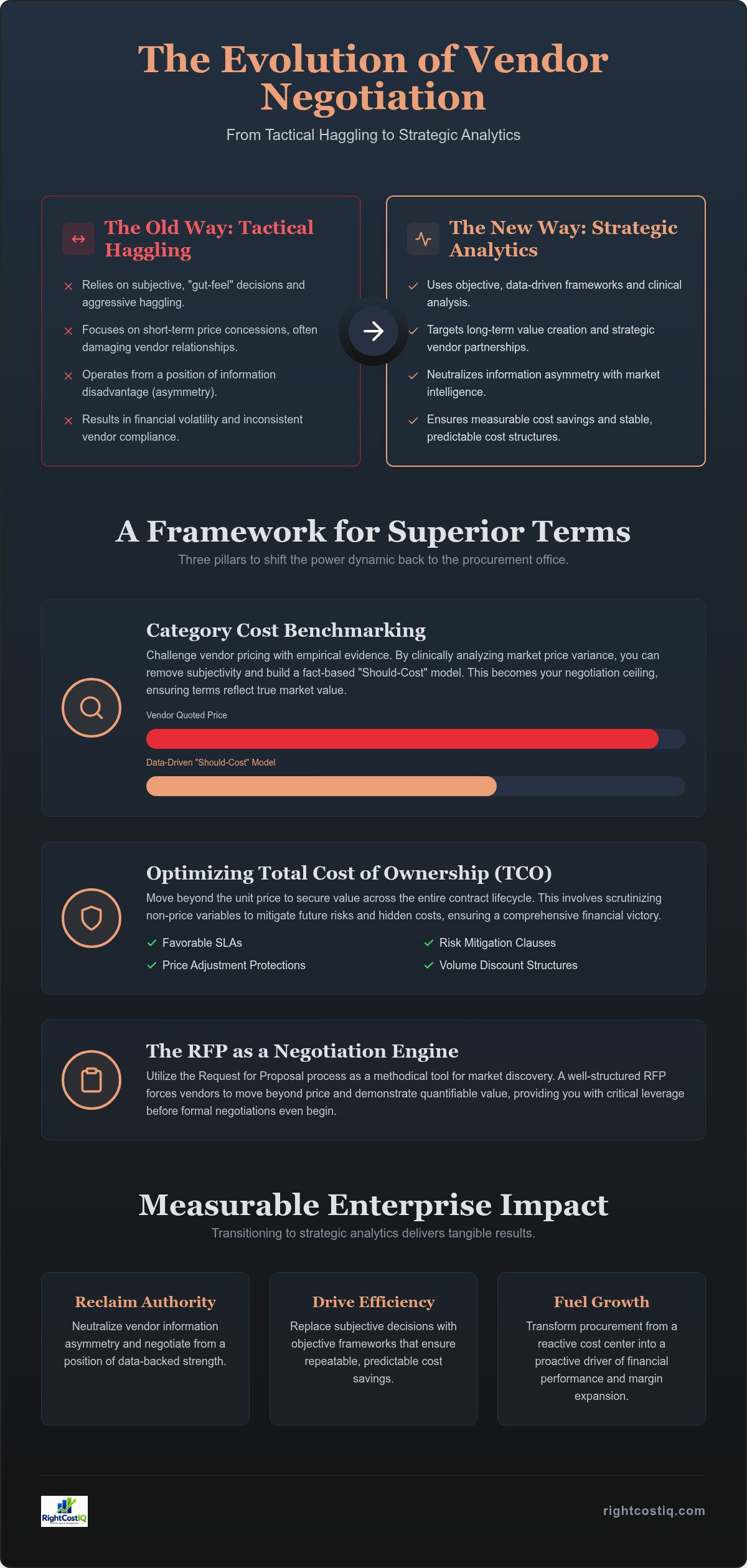
Traditional procurement models often rely on tactical haggling, a subjective process that prioritizes short-term price concessions over long-term value. This "win-lose" approach is inherently inefficient and often damages vendor relationships. Modern enterprise success requires a clinical shift toward strategic analytics and value creation. By adopting advanced vendor contract negotiation tips, organizations can transform procurement from a reactive cost center into a proactive driver of financial growth. This evolution replaces gut-feeling decisions with data-driven frameworks that align vendor performance with long-term corporate objectives.
Information asymmetry remains the primary barrier to procurement efficiency. Vendors typically possess deeper market intelligence regarding production costs and competitor pricing, leaving procurement teams at a disadvantage. Proactive sourcing strategies mitigate this gap by utilizing market price trending and forecasting services. Effective contract management now demands a high degree of strategic urgency. Reactive renewals are no longer viable in a volatile 2026 economy; leaders must utilize proactive, analytics-led architectures to secure superior terms and neutralize the vendor's data advantage.
The Economic Impact of Inefficient Negotiation
Sub-optimal contracts carry significant hidden costs that erode enterprise margins and stall operational progress. Financial volatility often stems from poorly defined price adjustment clauses, lack of volume discounts, or zero visibility into tail spend across different departments. When negotiations lack clinical precision, organizations suffer from inconsistent vendor compliance and unexpected price escalations that disrupt budget cycles. Standardizing negotiation frameworks across the entire enterprise is essential to mitigate these risks and ensure stable, predictable cost structures. It's about building a repeatable architecture for financial success.
The Role of Technology in Closing the Information Gap
Technology serves as the foundation for modern leverage. Implementing sophisticated procurement software allows teams to move beyond manual spreadsheets toward real-time analytics platforms that provide granular visibility into every line item. These automated tracking architectures prevent human errors and provide the transparency needed for rigorous cost benchmarking. Transitioning to a digital-first approach ensures that every negotiation is backed by objective data, effectively closing the information gap between the buyer and the vendor. Using these vendor contract negotiation tips alongside integrated software solutions creates a rhythmic cadence of efficiency and financial optimization.
Building Negotiation Leverage through Category Cost Benchmarking
Category cost benchmarking serves as the analytical core of superior procurement. It involves a clinical analysis of market price variance across specific spend categories to identify where vendor pricing deviates from the true market mean. This data-driven approach removes the subjectivity from discussions, allowing teams to challenge vendor assumptions with empirical evidence. Establishing a fact-based "Should-Cost" model creates a clear negotiation ceiling, ensuring that final terms reflect the actual cost of service delivery plus a reasonable margin, rather than whatever the vendor believes the market will bear.
Relying on independent, third-party data is critical for validating vendor claims during high-stakes discussions. Vendors often present proprietary data that favors their position, creating a skewed perspective of market conditions. By integrating external intelligence, procurement leaders can align their strategies with the principles of Contracting by Negotiation, focusing on achieving best value through objective analysis. Using these vendor contract negotiation tips ensures that every category profile is scrutinized for granular savings opportunities that traditional sourcing methods often overlook.
Executing Clinical Benchmarking for Margin Expansion
Identifying category-specific cost drivers is the first step toward expanding enterprise margins. This process requires a methodical breakdown of labor, materials, and overhead components within each vendor quote. Utilizing a should-cost analysis allows procurement architects to set rigid negotiation ceilings based on objective market data. Historical price trending further enhances this framework, providing a baseline to forecast future costs and prevent "bracket creep" during contract renewals. Organizations that master this granular profiling can typically uncover significant cost-recovery opportunities that remain hidden in high-level summaries.
Utilising Benchmarking to Address Price Volatility
Market price volatility poses a constant threat to financial stability in 2026. Effective risk management requires identifying specific market indices that correlate with your procurement categories. Instead of accepting fixed annual increases, negotiate price adjustment formulas that peg contract rates to these objective trends. These vendor contract negotiation tips ensure that when market prices drop, your organization captures the savings automatically. Integrating market price forecasting into your negotiation framework allows for proactive budget adjustments and mitigates the risk of sudden financial shocks. For teams looking to refine their data strategy, a preliminary cost diagnostic can highlight immediate areas for benchmarking optimization.
Beyond the Unit Price: Optimising Total Cost of Ownership (TCO) and Risk
Fixating on the unit price is a common procurement failure that ignores the structural costs of contract execution. Superior vendor contract negotiation tips prioritize Total Cost of Ownership (TCO) as the primary metric for value. TCO accounts for the entire lifecycle of a service; it includes acquisition, logistics, administrative overhead, and the eventual cost of transition. By accounting for these variables, procurement architects identify hidden drains on capital that a low unit price might otherwise mask. Negotiating non-price levers like extended payment terms or favorable liability clauses directly impacts cash flow and balance sheet health.
Quantifying vendor performance risk is equally vital for maintaining operational continuity. Risk isn't a vague concern; it's a financial variable that requires clinical assessment. High-risk vendors demand higher monitoring costs and greater contingency planning. Integrating supplier diversity programs into this framework also enhances long-term supply chain resilience by reducing dependency on single-source providers. This methodical approach ensures that every contract serves as a tool for financial growth rather than a liability waiting to manifest.
Negotiating Service Level Agreements (SLAs) for Operational Efficiency
Service Level Agreements (SLAs) must be more than aspirational goals. They require clinical execution through performance-linked financial penalties. If a vendor fails to meet uptime or response time guarantees, the contract should trigger automatic credits or rebates. This creates a rhythmic cadence of accountability. Securing favorable guarantees requires a data-driven baseline of previous performance metrics. Effective monitoring architectures ensure that vendor compliance is tracked in real time, preventing the erosion of service quality over the contract term.
Price Risk Management and Contractual Flexibility
Operational agility depends on contractual flexibility. Structuring "termination for convenience" clauses without excessive penalties allows the organization to pivot when market conditions shift. Negotiating volume-based discounts and early payment incentives further optimizes the cost structure. To consolidate leverage across fragmented departments, procurement leaders should implement rigorous tail spend management strategies. Consolidating these smaller, unmanaged transactions into a standardized framework prevents price creep and ensures that even minor contracts adhere to the enterprise's clinical negotiation standards. Using these vendor contract negotiation tips transforms the procurement office into a strategic architect of financial stability.
The RFP as a Negotiation Engine: Methodical Execution for Maximum Value
A Request for Proposal (RFP) is often mischaracterized as a mere administrative formality. In a clinical procurement framework, the RFP serves as a high-precision engine for market discovery and competitive pressure. It's the primary tool for dismantling information asymmetry. By forcing vendors to respond to standardized, data-heavy inquiries, procurement teams shift the burden of proof onto the supplier. This methodical approach ensures that vendors compete on total value, including operational reliability and risk mitigation, rather than engaging in a race-to-the-bottom price war that compromises service quality.
Automated RFP management is the catalyst for accelerating the sourcing cycle and maintaining strategic urgency. Manual processes introduce latency and human error, which erode leverage. A digital architecture allows for real-time comparison of vendor responses against established market benchmarks. Standardized evaluation scoring is the final component of this engine. It provides an objective, audit-ready framework that replaces subjective preference with quantifiable performance data. These vendor contract negotiation tips transform the RFP from a document into a dynamic negotiation asset.
The Clinical RFP Lifecycle
Phase 1 begins with defining precision requirements. Vague specifications invite inflated quotes and scope creep. Procurement architects must benchmark market expectations to ensure requirements are both ambitious and realistic. Phase 2 involves executing the RFP process to filter for high-performance suppliers who demonstrate technical competence and financial stability. Finally, Phase 3 uses the granular data collected in the responses as the absolute baseline for final contract negotiations. This ensures that every concession requested is backed by the vendor's own documented capabilities.
Leveraging Competition without Bashing Vendors
Maintaining leverage doesn't require adversarial tactics. Communicating competitive positioning ethically involves informing vendors of where they stand relative to the market mean without disclosing sensitive competitor data. This transparency builds trust while reinforcing the reality of the competitive landscape. The "Best and Final Offer" (BAFO) stage is the critical juncture for extracting maximum value. It signals to vendors that the window for securing the contract is closing, prompting them to reveal their most aggressive terms. Organizations that struggle to maintain this level of precision should utilize a preliminary cost diagnostic to identify gaps in their current sourcing architecture.
Implementing RightCostIQ’s Negotiation Coach for Enterprise Efficiency
The transition from subjective bargaining to clinical procurement requires a structured technological intervention. The Negotiation Coach acts as a strategic asset, providing the analytical oversight necessary to neutralize vendor information advantages. Data-driven analytics replace gut-feeling in the negotiation room, ensuring that every term is defensible and aligned with market realities. By utilizing these vendor contract negotiation tips, procurement leaders shift from reactive participants to strategic architects of the agreement process. This expert-led approach prioritizes efficiency and results, delivering a rhythmic cadence of successful outcomes across high-value contracts.
Professional negotiation assistance provides a significant ROI by identifying margin expansion opportunities that internal teams might overlook due to resource constraints. Integrating market price trending into the final agreement phase ensures that contracts remain competitive throughout their entire lifecycle. This clinical precision prevents the financial volatility associated with static pricing models. It's about securing superior terms that protect the organization's bottom line while fostering high-performance vendor compliance. Relying on objective data ensures that the final agreement reflects the best possible value for the enterprise.
Quantifying Success: Spend Under Management
Reporting negotiation outcomes to the C-suite requires metrics that transcend simple price savings. Maximizing spend under management serves as a primary KPI for procurement maturity. This metric demonstrates the department's ability to apply standardized, clinical frameworks to all enterprise expenditures. Continuous improvement is achieved through post-negotiation performance tracking, ensuring that the value captured during the negotiation phase is actually realized during contract execution. Accurate reporting builds the internal credibility needed to expand procurement's strategic influence.
Securing Future Growth through Sourcing Precision
Building a scalable procurement infrastructure for 2026 and beyond necessitates a forward-thinking approach to risk. RightCostIQ enables teams to forecast future price risks and adjust sourcing strategies proactively. This precision ensures that the organization remains resilient in the face of market shifts. Establishing these technical analysis frameworks today creates a competitive advantage that compounds over time. It's time to replace manual processes with a sophisticated, data-driven architecture. Optimize your procurement strategy today to secure your organization's financial future.
Accelerating Financial Growth through Clinical Procurement Precision
Procurement success in 2026 requires a transition from tactical haggling to a sophisticated architecture of data-driven analytics. By implementing clinical category cost benchmarking and prioritizing Total Cost of Ownership, organizations can dismantle information asymmetry and secure superior terms. These vendor contract negotiation tips provide the foundation for a repeatable, scalable framework that mitigates financial volatility and ensures long-term supply chain resilience. Methodical execution of the RFP lifecycle further consolidates leverage, transforming the procurement office into a strategic driver of margin expansion.
RightCostIQ provides the expert RFP management and negotiation assistance required to navigate complex vendor landscapes with confidence. Our proprietary tools offer clinical market price trending and forecasting to protect your enterprise from sudden price escalations. Access the RightCostIQ Negotiation Coach to optimize your next contract and begin your journey toward operational excellence. You're now equipped to lead your organization toward a new era of procurement efficiency and measurable cost recovery.
Frequently Asked Questions
What are the most effective vendor contract negotiation strategies?
Effective strategies prioritize clinical data over emotional bargaining. Utilizing advanced vendor contract negotiation tips, such as establishing a "Should-Cost" model, allows procurement teams to lead with objective facts. Successful negotiators leverage category cost benchmarking to identify price variances and force vendors to justify their margins. This objective approach shifts the power dynamic; it ensures that every concession is backed by verifiable market intelligence and long-term financial growth goals.
How does cost benchmarking improve my negotiation leverage?
Cost benchmarking improves leverage by providing a clinical analysis of market price variance. It allows you to compare a specific vendor's quote against the market mean, highlighting overcharges that are often hidden in complex proposals. By using independent, third-party data, you can challenge vendor claims with empirical evidence. This process establishes a rigid negotiation ceiling, ensuring that your organization never pays more than the true market rate for any given category.
What is the difference between price and total cost of ownership (TCO)?
Price represents the initial unit cost, while Total Cost of Ownership (TCO) encompasses the entire lifecycle expense of a service. TCO includes acquisition, administrative overhead, maintenance, and transition costs. Focusing strictly on price often masks hidden structural expenses that erode enterprise margins. Procurement architects use TCO to identify the real financial impact of a contract; this ensures that long-term value and risk mitigation are prioritized over short-term savings.
Can RFP management software actually reduce my procurement costs?
RFP management software reduces costs by accelerating the sourcing cycle and automating market discovery. It replaces manual, error-prone processes with a clinical tracking architecture that forces vendors to compete on objective value. By standardizing evaluation scoring, the software removes subjective bias from the decision-making process. This methodical execution ensures that only high-performance suppliers are selected, ultimately leading to measurable cost recovery and improved vendor compliance across the entire enterprise.
How do I negotiate contracts when a vendor has a market monopoly?
When facing a monopoly, you must shift focus from unit price to non-price levers that optimize the Total Cost of Ownership. Prioritize negotiating favorable Service Level Agreements (SLAs), extended payment terms, and robust liability clauses. Use clinical performance tracking to hold the vendor accountable for service quality. By quantifying the risk of poor performance, you create a fact-based framework for demanding credits or penalties, effectively reclaiming leverage in a restricted market.
What non-price terms should I prioritize in a SaaS contract negotiation?
Prioritize data security protocols, uptime guarantees, and "termination for convenience" clauses. In SaaS environments, operational continuity is as critical as price. Secure contractual penalties for service interruptions and ensure that you have clear paths for data migration if the relationship ends. These non-price terms mitigate long-term financial risk and prevent vendor lock-in. Utilizing expert vendor contract negotiation tips helps you identify which specific clauses provide the highest protection for your operational efficiency.
How often should I re-negotiate long-term vendor contracts?
Re-negotiation should occur at least 12 to 18 months before a contract expires to maintain strategic urgency. This timeline allows for a methodical RFP process and comprehensive cost benchmarking. Waiting for a renewal notice puts you in a reactive position, which significantly reduces your leverage. Establishing a rhythmic cadence for contract review ensures that your terms stay aligned with current market conditions and that you capture any savings resulting from technological innovation.
What role does market price trending play in contract renewals?
Market price trending provides the clinical foresight needed to anticipate cost shifts before they impact your budget. During renewals, this data allows you to challenge vendor price increases by pointing to objective market indices. It serves as a primary tool for price risk management, enabling you to negotiate adjustment formulas that peg rates to market trends. This proactive approach ensures that your organization captures savings automatically when market prices drop, protecting your financial stability.


