
The era of soft-skill bargaining is over; modern procurement negotiation is a high-stakes clinical exercise in data-driven information leverage. You've likely experienced the strategic paralysis that stems from information asymmetry with powerful suppliers or the erosion of margins due to volatile market price trending. These inefficiencies in your RFP cycles don't just delay contracts; they compromise your long-term financial stability and operational agility. Relying on legacy intuition in a 2026 market environment is no longer a viable strategy for enterprise leadership.
Mastering advanced procurement negotiation strategies is the only path to regaining control over your supply chain and securing enterprise-grade financial growth. This article provides a rigorous framework for strategic sourcing that prioritizes predictable cost forecasting and clinical vendor performance tracking. We will examine the integration of proprietary cost benchmarking, market intelligence, and technical RFP management to ensure your procurement function operates as a precise tool for financial optimization. By the end of this guide, you'll have the analytical tools necessary to execute high-value contracts with surgical precision and mitigate price risk across your entire category portfolio.
Key Takeaways
- Transition from reactive bargaining to a clinical negotiation framework designed to drive enterprise-grade financial growth and margin expansion.
- Leverage data-driven cost benchmarking and market price trending to eliminate supplier information asymmetry and define precise "should-cost" targets.
- Deploy advanced procurement negotiation strategies rooted in price risk management to neutralize market volatility and stabilize long-term cost forecasting.
- Streamline the RFP-negotiation lifecycle to maximize competitive tension and ensure the clinical execution of high-value vendor contracts.
- Utilize professional negotiation assistance and performance tracking services to secure vendor compliance and maximize bottom-line operational efficiency.
The Strategic Architecture of Modern Procurement Negotiation
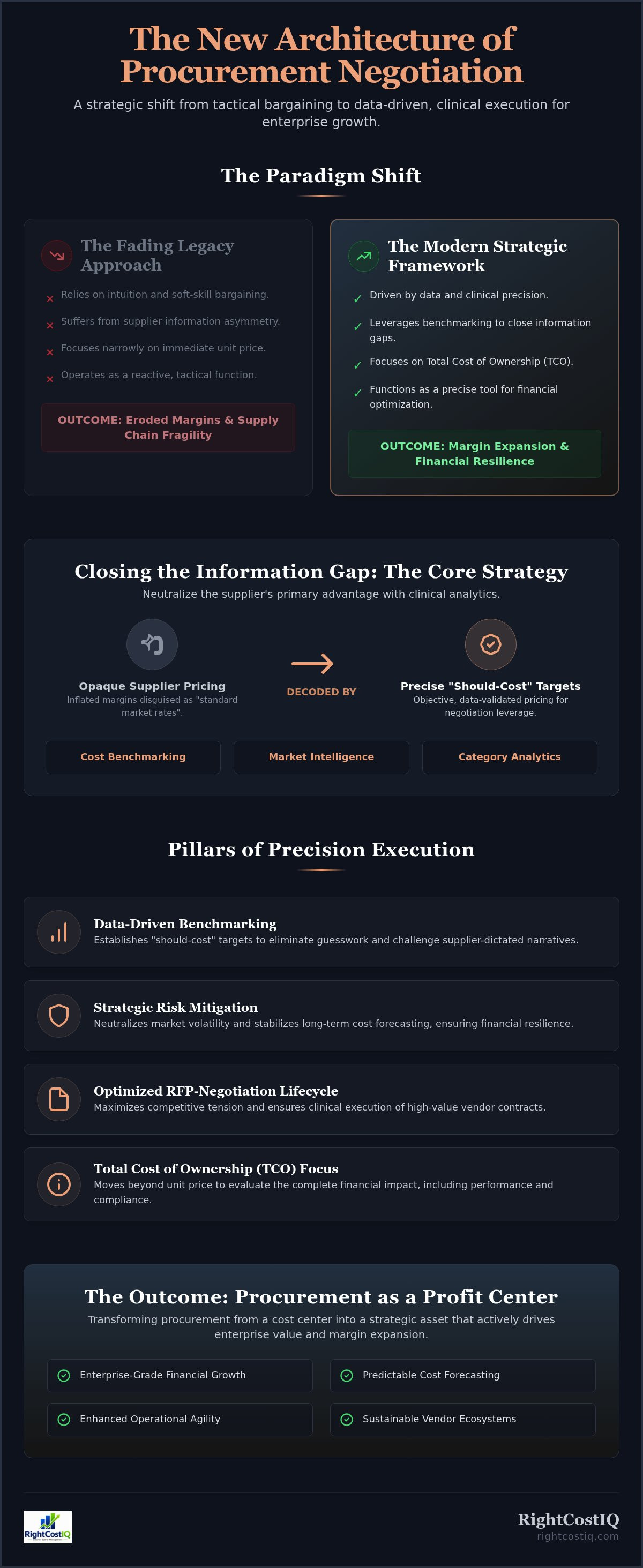
Modern procurement negotiation is a clinical driver of enterprise financial growth and a primary component of price risk management. It functions as a precise mechanism for margin expansion rather than a simple zero-sum exercise. Traditional bargaining relies on intuition and volume leverage; however, sophisticated procurement negotiation strategies in 2026 demand a shift toward data-driven certainty. This transition replaces aggressive posturing with factual benchmarking, ensuring that every contract term reflects actual market conditions rather than supplier-dictated narratives.
Information asymmetry remains the primary barrier to successful sourcing. Suppliers often possess deeper market intelligence and cost-structure visibility than the procurement teams they face. Closing this gap requires a rigorous, analytical approach to the strategic sourcing process. By utilizing objective data sets to challenge supplier assumptions, procurement leaders can neutralize the leverage typically held by dominant vendors and secure terms that align with corporate financial targets.
The Shift from Tactical Bargaining to Strategic Sourcing
Procurement has evolved from a back-office administrative function into a critical strategic asset. A singular focus on unit price often results in long-term supply chain fragility and hidden costs that erode profitability. Clinical execution in vendor dialogues prioritizes financial resilience and operational continuity over short-term savings. Adopting these advanced procurement negotiation strategies transforms the sourcing department into a profit center that actively contributes to the bottom line.
This transition requires a framework that treats every interaction as a data-validation exercise. By moving away from tactical win-lose bargaining, organizations can build sourcing structures that are resistant to external market shocks. This evolution shifts the focus from simple cost-cutting to the creation of sustainable, high-performance vendor ecosystems. The result is a more robust supply chain capable of maintaining margins even during periods of high market volatility.
Defining Success in High-Stakes Vendor Engagements
Success in high-stakes environments is measured by KPIs that extend far beyond the immediate unit price. Total cost of ownership (TCO) serves as the primary metric for evaluating negotiation outcomes. This includes vendor performance metrics, compliance tracking, and risk mitigation profiles. Effective execution relies on a robust RFP Management pillar to create competitive tension and establish baseline data for all subsequent discussions.
True success is defined by the clinical alignment of vendor capabilities with the specific financial requirements of the enterprise. By integrating RFP management directly into the negotiation cycle, organizations can eliminate the variables that typically lead to cost overruns and performance slippage. This structured approach ensures that every dollar spent is optimized for maximum ROI, providing a clear path to predictable cost forecasting and sustainable financial growth.
Benchmarking Analytics: Closing the Information Gap with Suppliers
Information asymmetry is the supplier's greatest advantage in any high-stakes engagement. Closing this gap requires proprietary category cost benchmarking to strip away opaque pricing structures and expose the actual drivers of cost. Organizations that fail to utilize external market data often accept inflated margins disguised as "standard market rates." Effective procurement negotiation strategies in 2026 depend on the clinical application of data to force supplier concessions and eliminate the guesswork from the sourcing process.
Category analytics provide the leverage needed to challenge the "take it or leave it" stance of dominant suppliers. This data-driven approach is essential for achieving enterprise-grade financial growth. When procurement teams enter a negotiation without real-time analytics, they're essentially operating in the dark. Benchmarking is not a one-time event; it's a continuous audit of market conditions that ensures your contract terms remain competitive throughout the vendor lifecycle.
Utilizing Should-Cost Models for Fact-Based Negotiation
Should-cost analytics provide a bottom-up view of supplier expenses, including raw materials, labor, and overhead. Should-cost is the clinical baseline for vendor transparency. By establishing this model, procurement teams can identify hidden margins within complex service categories that traditional bid comparisons miss. Hidden margins often reside in the "miscellaneous" categories of a supplier's bid. Should-cost models dissect these variables, allowing you to challenge specific cost drivers like logistics premiums or inflated labor rates. This analytical depth transforms the discussion from a price debate into a factual audit of value.
Market Intelligence as a Tactical Lever
Market price trending and forecasting services allow teams to identify opportunistic negotiation windows before they close. In a 2026 landscape, market volatility isn't just a risk; it's a catalyst for favorable contract terms. By preempting supplier price hikes through predictive modeling, you can secure fixed-rate agreements when trending data suggests an upcoming spike. Accessing real-time pricing analytics ensures your team never negotiates from a position of historical data. Predictive modeling allows procurement leaders to move from a reactive to a proactive stance. Instead of waiting for a supplier to announce a price increase, you use market intelligence to trigger negotiations during periods of low demand or commodity price drops.
Integrating these analytics into the contract drafting phase is a core component of strategic procurement reform. This approach ensures that price risk management is baked into the legal framework of the engagement. Clinical execution requires that every clause reflects the data-driven reality of the market. You can evaluate your current benchmarking maturity to see where information gaps exist in your current category portfolio.
Strategic Risk Mitigation: Fact-Based Negotiation Frameworks
Strategic risk mitigation requires a transition from reactive bargaining to risk-adjusted clinical frameworks. Price risk management functions as the primary architectural layer of modern procurement negotiation strategies. Unlike traditional methods that rely on static outcomes, fact-based frameworks integrate market volatility into the contract's DNA. Mapping the Zone of Possible Agreement (ZOPA) is no longer a matter of subjective estimation. It's a calculation derived from proprietary cost benchmarking data that defines the hard boundaries of financial feasibility.
Experienced intuition is often cited as a primary asset in negotiation. In a data-driven 2026 environment, intuition without analytical support is a liability. It leads to inconsistent results and emotional concessions that erode enterprise margins. Data-driven models outperform intuition by providing a verifiable audit trail for every decision. This objective approach ensures that procurement outcomes are predictable and aligned with high-level financial growth targets. Clinical execution demands that data, not "gut feeling," dictates the final terms of engagement.
Traditional BATNA vs. Risk-Adjusted Optimization
A traditional Best Alternative to a Negotiated Agreement (BATNA) is frequently too narrow for complex supply chains. A "Risk-Adjusted BATNA" incorporates market price trending and vendor performance tracking to determine the true cost of walking away. Utilizing professional negotiation assistance removes the emotional bias inherent in internal procurement teams. This clinical detachment allows for the execution of high-value contracts that prioritize long-term stability over immediate, short-sighted savings. It's about optimizing for the total cost of ownership rather than the initial sticker price.
Mitigating Financial Volatility in Long-Term Contracts
Long-term contract viability depends on the integration of price adjustment clauses linked to verified market indices. These clauses protect the enterprise from "inflationary" supplier claims that lack empirical support. Using clinical data to defend against opportunistic price hikes ensures that margins remain protected throughout the contract lifecycle. This strategy aligns with the broader Category Management pillar, which treats negotiation as a continuous optimization loop rather than a one-time event. Clinical execution ensures that every contractual protection is backed by real-time market intelligence, preventing margin erosion in volatile economic climates.
The RFP-Negotiation Lifecycle: Precision Execution for Margin Expansion
Treating the Request for Proposal (RFP) and the negotiation phase as distinct silos is a strategic error that compromises enterprise margins. A clinical approach integrates these functions into a single, 5-step execution loop: market benchmarking, RFP issuance, technical evaluation, strategic negotiation, and performance monitoring. This lifecycle ensures that procurement negotiation strategies are informed by the specific data points elicited during the bid phase. By aligning these processes, procurement teams can maintain leverage from the initial market scan through to the final contract execution.
Precision execution requires that the RFP serves as the foundation for all commercial discussions. It's the mechanism that forces suppliers to reveal their cost structures and service capabilities in a standardized format. Without this structure, negotiations devolve into subjective bargaining. A data-driven loop provides the empirical evidence needed to challenge supplier claims and secure terms that align with corporate financial growth targets. This integrated framework transforms the RFP from a simple selection tool into a powerful lever for margin expansion.
Structuring RFPs for Tactical Advantage
Standardized benchmarking within RFP responses is essential to force apples-to-apples comparisons between competing vendors. This technical rigor eliminates the "creative pricing" and opaque fee structures often used to mask high supplier margins. Competitive tension is a structural byproduct of professional RFP management. It ensures that vendors understand their position relative to the market and their peers before the commercial dialogue begins. Furthermore, utilizing tail spend management allows organizations to consolidate fragmented categories into high-leverage opportunities. Consolidating these smaller spends increases your total volume leverage, forcing suppliers to offer more aggressive pricing models that were previously unavailable.
Post-Negotiation: Ensuring Compliance and Value Capture
The negotiation doesn't end at the signature; it merely enters a clinical phase of oversight and value capture. Realized savings are the only valid metric of success in high-stakes sourcing. Many organizations suffer from "contract leakage," where the negotiated terms and discounts are not applied in day-to-day operational transactions. Automated vendor performance tracking ensures that every service level agreement and pricing tier is met with clinical precision. This continuous monitoring provides the empirical data required for the next negotiation cycle, creating a self-optimizing loop. To identify where your current process is failing to capture value, you should run a diagnostic on your RFP and negotiation lifecycle.
Integrating these performance metrics back into your procurement negotiation strategies ensures that future contracts are based on actual vendor behavior rather than theoretical promises. This data-driven feedback loop is what distinguishes a strategic architect from a tactical buyer. By closing the gap between negotiation and execution, you ensure that every dollar of negotiated value reaches the bottom line.
Professional Negotiation Assistance: Driving Enterprise Value
RightCostIQ functions as the strategic architect for organizations seeking high-value procurement outcomes. Internal teams often lack the technical infrastructure or clinical detachment required to challenge sophisticated supplier pricing models effectively. By providing a specialized Negotiation Coach, we enable procurement departments to execute high-stakes contracts with surgical precision. This assistance isn't a replacement for internal expertise but a technical multiplier that ensures procurement negotiation strategies are backed by proprietary analytics and real-time market intelligence.
Professional negotiation assistance integrates benchmarking, RFP management, and risk tracking into a single, cohesive service. This holistic approach eliminates the fragmented data silos that typically lead to contract leakage and missed savings opportunities. By centralizing these functions, organizations maintain a consistent negotiation posture across all spend categories, ensuring that no vendor engagement is left to chance. This technical rigor is what transforms procurement from a back-office necessity into a competitive advantage.
The ROI of Clinical Negotiation Assistance
Quantifying the financial impact of professional benchmarking reveals a direct correlation between data-driven precision and margin expansion. Organizations that utilize external negotiation assistance typically see a significant reduction in price volatility and a stabilization of long-term cost forecasting. Professional benchmarking identifies specific areas where supplier margins exceed market norms, allowing for targeted concessions that directly improve the bottom line. Outsourcing the technical aspects of RFP management allows internal leadership to focus on high-level strategic architecture rather than administrative bid cycles. This shift in focus ensures that the procurement function acts as a primary driver of financial growth rather than a cost center.
Implementing a Data-Driven Sourcing Infrastructure
Integrating RightCostIQ analytics into your existing workflows requires a methodical approach to data ingestion and vendor oversight. C-suite leaders should begin by auditing their current negotiation efficiency to identify where information gaps are eroding margins. This audit serves as the baseline for deploying a more robust, risk-adjusted sourcing framework that prioritizes financial resilience. A data-driven infrastructure ensures that every contract is an optimized asset rather than a liability. To begin this transformation and secure your enterprise's financial future, visit the RightCostIQ Landing Page to request a strategic procurement audit and service inquiry.
Future-Proofing Enterprise Margins through Clinical Sourcing
The evolution of the supply chain in 2026 requires a definitive shift from reactive bargaining to a data-driven sourcing architecture. Success depends on the seamless integration of cost benchmarking, market intelligence, and risk-adjusted frameworks into your core procurement negotiation strategies. By closing the information gap with suppliers and utilizing precise should-cost models, you transform procurement from a back-office function into a primary driver of financial growth.
RightCostIQ provides the technical infrastructure needed for this transition. Our proprietary cost benchmarking database and market price forecasting accuracy deliver the clinical precision required to execute high-value contracts. We utilize rigorous RFP management efficiency metrics to ensure every vendor engagement is optimized for maximum value capture. Implementing these analytical tools ensures your organization remains resilient in the face of market volatility and inflationary pressures. Take the first step toward surgical precision in your sourcing lifecycle. Optimize your procurement outcomes with RightCostIQ Negotiation Assistance. Your path to sustainable margin expansion starts with data-backed certainty.
Frequently Asked Questions
What are the most effective procurement negotiation strategies in 2026?
The most effective procurement negotiation strategies in 2026 prioritize clinical precision over soft-skill bargaining. These strategies involve integrating real-time market price trending with proprietary cost benchmarking to neutralize supplier leverage. By shifting to a risk-adjusted framework, procurement leaders can secure margin expansion through factual data validation. This approach ensures that every contractual term is a result of analytical certainty rather than subjective compromise or historical volume leverage.
How does cost benchmarking improve negotiation outcomes?
Cost benchmarking improves outcomes by eliminating the information asymmetry that suppliers typically exploit. It provides an objective "should-cost" model that serves as the clinical baseline for all commercial dialogues. By comparing internal spend against a proprietary database of market rates, organizations can identify specific areas where supplier margins are inflated. This factual leverage forces vendors to justify their pricing structures with empirical evidence, leading to more transparent and competitive contract terms.
Can professional RFP management reduce vendor pricing?
Professional RFP management reduces vendor pricing by engineering competitive tension into the sourcing lifecycle from the outset. It standardizes bid requirements to ensure apples-to-apples comparisons, stripping away the opaque pricing often found in non-standardized proposals. This technical rigor signals to suppliers that their pricing will be audited against clinical benchmarking data. Consequently, vendors often submit more aggressive initial bids, knowing that creative pricing won't survive a data-driven evaluation.
What is the difference between price risk management and standard negotiation?
Standard negotiation is often reactive and focused on a single transactional unit price. Price risk management is a proactive strategy that utilizes market price forecasting to mitigate financial volatility over the long term. It involves building price adjustment clauses and index-linked terms into the contract's DNA. While standard negotiation seeks a one-time win, price risk management ensures that enterprise margins remain protected against external market shocks throughout the entire vendor engagement.
How do I handle negotiations with a sole-source supplier?
Negotiating with a sole-source supplier requires a clinical audit of their internal cost drivers. Since you lack competitive leverage, you must rely on should-cost analytics to challenge their pricing justifications. Focus on identifying hidden margins in their overhead or logistics costs using objective benchmarking data. Additionally, use vendor performance tracking to document service failures; this provides factual leverage for securing price concessions or more favorable service level agreements during renewal cycles.
What role does vendor performance tracking play in future negotiations?
Vendor performance tracking provides the empirical evidence required to capture negotiated value and prevent contract leakage. It documents actual supplier behavior against contractual promises, identifying where savings aren't being realized. In future negotiations, this data serves as a powerful audit tool to justify price reductions or improved terms. Clinical execution requires that every renewal is informed by a documented history of compliance, shifting the power dynamic back to the procurement department.
How can I identify savings in tail spend categories?
Savings in tail spend are identified by consolidating fragmented, low-volume categories into high-leverage opportunities. Analytics services help uncover pricing variances across different departments or locations for the same services. By applying professional RFP management to these overlooked categories, organizations can eliminate "maverick spend" and secure volume-based discounts. This consolidation increases your total negotiation power, forcing suppliers to offer enterprise-grade pricing for what was previously treated as tactical, unmanaged spend.
Why is fact-based negotiation superior to traditional bargaining?
Fact-based negotiation is superior because it removes the emotional bias and strategic paralysis inherent in traditional bargaining. It provides a verifiable audit trail for every financial decision, ensuring that outcomes are predictable and repeatable. Traditional bargaining relies on the "experienced intuition" of a buyer, which is often inconsistent. Fact-based procurement negotiation strategies utilize technical cost analysis and market intelligence to define the Zone of Possible Agreement with surgical precision, consistently outperforming legacy intuition.


