
Supplier relationship management is not a social exercise; it is a clinical, data-driven architecture designed for margin expansion and risk mitigation. Most procurement leaders recognize that opaque pricing models and inefficient performance tracking create significant financial volatility. You've likely seen how compliance drift quietly erodes projected savings and disrupts operational stability. This guide outlines the essential supplier relationship management best practices required to transform these vulnerabilities into measurable growth.
We'll master the strategic architectures that align procurement functions with high-level financial goals. You will learn how to implement automated vendor compliance and leverage market price trending to secure a competitive advantage. This framework moves beyond basic tracking to establish a sophisticated system of procurement category cost benchmarking and price risk management. By the end of this analysis, you'll have a roadmap for integrating RFP management and negotiation assistance into a holistic vendor performance tracking service. We'll examine the technical requirements for 2026 that turn supply chain data into a primary driver of corporate profitability.
Key Takeaways
- Transition from traditional vendor management to a strategic architecture that prioritizes financial growth and operational resilience.
- Implement clinical supplier relationship management best practices to quantify vendor compliance through KPIs that directly impact your bottom line.
- Integrate market price trending and forecasting into your relationship strategy to proactively mitigate price risk during contract renewals.
- Replace adversarial bargaining with data-driven negotiation assistance based on verified performance tracking and cost benchmarking analytics.
- Evaluate the ROI of professional procurement infrastructure to scale your SRM framework and effectively optimize high-volume tail spend.
Strategic Supplier Relationship Management: Beyond the Scorecard
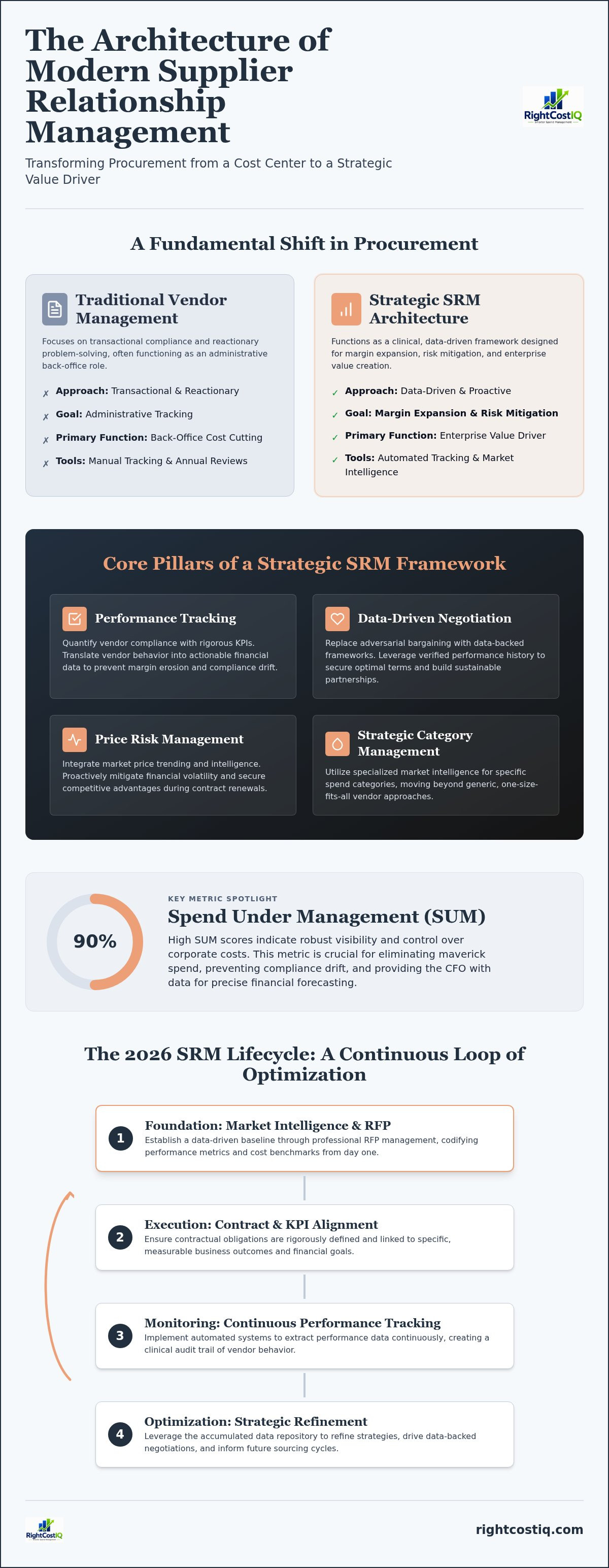
Traditional vendor management focuses on transactional compliance and reactionary problem-solving. Modern Supplier Relationship Management (SRM) functions as a clinical, data-driven architecture. It prioritizes financial growth and operational resilience over simple administrative tracking. By implementing supplier relationship management best practices, organizations move from passive monitoring to active margin expansion. This shift requires a fundamental reclassification of suppliers. They aren't just external entities; they're integrated components of your financial engine. This architecture ensures every link in the supply chain remains resilient against market volatility while contributing to long-term enterprise stability.
Aligning supplier performance with enterprise ROI is a clinical necessity. Relationships that fail to contribute to measurable growth represent a strategic drain on resources. To quantify success, procurement leaders must monitor "Spend Under Management" (SUM). This KPI measures the percentage of total corporate spend actively managed through strategic sourcing frameworks. High SUM scores indicate that procurement maintains visibility and control over costs. This level of oversight effectively eliminates the financial volatility associated with maverick spend and compliance drift. It transforms the procurement department into a high-level consultant for the CFO, providing the data needed for precise financial forecasting.
The Shift from Transactional to Strategic Sourcing
Procurement has evolved from a back-office cost-cutting function into a primary driver of enterprise value. Manual vendor tracking is no longer viable in complex global supply chains. It lacks the granularity required for real-time price risk management and operational agility. Sophisticated category management procurement serves as the foundation for modern SRM. It provides the specialized market intelligence needed to optimize specific spend categories rather than applying a generic, one-size-fits-all approach to diverse vendor types.
Defining the SRM Lifecycle in 2026
The SRM lifecycle in 2026 maps a rigorous journey from initial market intelligence to continuous performance optimization. Establishing a data-driven baseline through professional RFP management is critical during the onboarding phase. This ensures that performance metrics and cost benchmarks are codified within the contract from day one. Without this clinical starting point, subsequent optimization efforts lack a verifiable reference. Adopting supplier relationship management best practices ensures every interaction adds to a growing repository of market data. The SRM lifecycle is a continuous loop of data extraction and strategic refinement.
Performance Tracking Architectures: Quantifying Vendor Compliance
Strategic SRM requires more than anecdotal feedback or annual reviews. It demands rigorous Performance Tracking Architectures that translate vendor behavior into actionable financial data. By codifying supplier relationship management best practices, organizations create a clinical audit trail that prevents margin erosion. This architecture ensures that every contractual obligation is monitored, verified, and linked to specific business outcomes. Without this level of granularity, procurement leaders remain blind to the subtle compliance drift that quietly drains corporate resources. A disciplined approach to tracking transforms vendor management from a cost center into a risk mitigation engine.
Data shouldn't exist in a silo. Every performance metric acts as leverage for future contract renewals. Integrating this data into your next sourcing cycle transforms negotiation from a debate into a presentation of facts. You don't just ask for better terms; you demand them based on verified performance history. For leaders looking to audit their current vendor landscape, exploring a comprehensive platform assessment is a logical next step toward operational excellence.
Metric Selection for High-Stakes Procurement
Effective tracking differentiates between leading and lagging indicators. Lagging indicators like historical spend tell you what happened, but leading indicators like quality variance or delivery precision predict future disruptions. We prioritize three specific pillars: technical quality, logistics precision, and financial stability. Linking these metrics to procurement analytics provides real-time visibility into vendor health. This data directly impacts the bottom line by identifying cost-saving opportunities before they become operational failures. High-stakes procurement requires a focus on financial stability metrics to prevent sudden supply chain collapses that could derail quarterly growth targets.
Automating the Compliance Audit Trail
Manual reviews are obsolete and prone to human error. They create "compliance drift" where vendors slowly deviate from contractual obligations over time. Modern dashboards replace periodic checks with real-time oversight. Using professional vendor performance tracking services ensures that operational efficiency remains a constant. Automation forces compliance by flagging deviations immediately. This clinical oversight mitigates operational risk and secures the savings negotiated during the initial RFP phase. Organizations that automate their audit trails often find significant recoverable costs hidden in invoice discrepancies and service level misses. It establishes a single source of truth that aligns procurement, finance, and operations teams around a unified set of performance data.
Integrating Price Risk Management and Market Intelligence
SRM isn't about interpersonal harmony; it's about financial hedging. Modern Strategic Supplier Relationship Management requires a clinical shift toward integrated price risk management. This is a non-negotiable component for organizations targeting margin expansion in 2026. Financial volatility directly impacts supplier stability and overall relationship health. If a supplier's operational margins are compressed by unmanaged market swings, your supply continuity faces immediate risk. We utilize procurement category cost benchmarking to maintain competitive pricing structures while ensuring the partnership remains economically viable. This data-driven oversight prevents the silent margin erosion that occurs when contract pricing remains static despite falling market indices.
Market Price Trending as a Relationship Lever
Market data identifies exactly when a supplier's pricing decouples from relevant global indices. This transparency prevents overpayment during market downturns and provides a logical framework for price adjustments. Utilizing supplier relationship management best practices involves constant comparison against specialized market intelligence and forecasting services. A rigorous should-cost analysis provides the clinical baseline for these strategic discussions. It replaces traditional, anecdotal negotiations with objective, data-driven cost modeling that accounts for raw material, labor, and overhead shifts. Market price trending acts as the clinical tool for forecasting future relationship costs and securing long-term margin protection.
Mitigating Financial Volatility in the Supply Chain
Financial volatility creates cascading risks across the entire supply network. We implement sophisticated price adjustment formulas into strategic partnerships to automate responses to commodity fluctuations. This mechanism protects enterprise margins without requiring the friction of constant manual renegotiation. Predictive analytics also identify early warning signals of supplier financial distress, such as deteriorating credit scores or extended lead times, before they manifest as total delivery failures. Implementing a professional price risk management service allows procurement teams to hedge against unpredictable market swings effectively. Adopting these supplier relationship management best practices ensures that strategic partnerships survive macro-economic shifts. It transforms the relationship from a static legal contract into a dynamic, risk-adjusted financial asset that supports enterprise growth targets.
Clinical Negotiation Frameworks for Sustainable Partnerships
Negotiation is not a debate. It's a clinical exercise in value alignment. By replacing adversarial bargaining with a structured system of negotiation assistance, procurement teams ensure that every financial concession is grounded in verifiable performance history and market reality. This approach is a cornerstone of supplier relationship management best practices, moving beyond the zero-sum game of traditional purchasing. When you negotiate with objective data, you eliminate the emotional friction that often damages long-term vendor loyalty. You aren't just demanding lower prices; you're optimizing a strategic financial asset based on clinical evidence. Professional negotiation coaching ensures your team maintains this data-driven posture, even during high-stakes renewals or sudden market disruptions.
Successful negotiation creates a sustainable partnership where both parties understand the economic drivers of the agreement. This clarity fosters operational resilience, as suppliers are more likely to prioritize partners who demonstrate a logical and fair approach to margin management. To evaluate how your current negotiation strategies compare to industry leaders, you can access a clinical diagnostic to identify hidden margin opportunities.
The Data-Driven Negotiation Cycle
Execution begins with the clinical aggregation of performance and market benchmarking data. You must identify specific margin expansion opportunities using specialized negotiation-coach frameworks before entering the room. This preparation allows for the execution of the negotiation with precision, using objective evidence to justify every request. This three-step cycle ensures that procurement leaders don't rely on intuition, but rather on a repeatable architecture for financial growth.
Balancing Leverage and Collaboration
Maintaining relationship equity while demanding high performance requires a sophisticated balance of leverage. Competitive pressure is a tool to be used when market trending indicates a decoupling of price and value. However, strategic partnership remains the primary lever for long-term supply chain resilience. We apply clinical RFP management principles to mid-contract renegotiations to ensure the baseline remains competitive. This ensures that supplier relationship management best practices are consistently applied throughout the contract lifecycle, not just during the initial sourcing phase. By treating mid-term shifts as structured sourcing events, you protect your margins without alienating critical vendors.
Scaling SRM with Automated Procurement Infrastructure
Scaling a clinical SRM framework requires the transition from fragmented manual processes to a centralized, automated infrastructure. Professional procurement platforms deliver a high ROI by eliminating the administrative friction inherent in manual vendor performance tracking and data reconciliation. This automation enables procurement teams to operate as strategic architects rather than administrative coordinators. Centralizing supplier data provides the C-suite with the clinical visibility needed for precise financial forecasting and strategic reporting. RightCostIQ positions itself as the sophisticated partner for high-level SRM execution, providing the technical architecture required to turn raw vendor data into a primary driver of enterprise growth. Adopting supplier relationship management best practices at scale is impossible without this unified data architecture. It establishes a single source of truth that aligns procurement outcomes with the bottom-line objectives of the Chief Financial Officer.
Addressing the Tail Spend Challenge
Unmanaged suppliers in the bottom 20% of spend often pose the greatest operational and financial risk due to a lack of oversight. These vendors frequently bypass standard procurement controls, leading to compliance drift and unmonitored price increases that quietly erode projected savings. Implementing automated tail-spend management is a clinical necessity for cleaning up relationship data across the entire vendor base. This process transforms tail spend from a hidden liability into a predictable source of incremental savings and risk mitigation. By applying rigorous tracking to low-volume vendors, organizations close the gaps that frequently erode margins in larger strategic contracts. Clinical spend management ensures that no supplier relationship exists outside the enterprise's strategic control.
The Future of SRM: AI and Predictive Analytics
The evolution of SRM in 2026 centers on predictive modeling and AI-led risk identification. Predictive analytics allow procurement leaders to identify potential supplier failures or financial distress before they manifest as supply chain disruptions. Integrating market price trending into these automated workflows ensures that contract pricing remains perpetually aligned with global indices without manual intervention. This proactive posture replaces reactionary problem-solving with a clinical, forward-looking relationship strategy. It's time to move beyond basic tracking and establish a high-performance procurement engine. Optimize your supplier relationships with RightCostIQ’s clinical analytics to secure your margins and drive sustainable financial growth through advanced data-driven sourcing.
Securing Margin Growth Through Strategic SRM
Mastering supplier relationship management best practices requires a clinical transition from administrative oversight to strategic financial architecture. We've established that modern SRM functions as a non-negotiable tool for mitigating price risk and ensuring operational resilience. By integrating procurement category cost benchmarking with specialized market price trending and forecasting, organizations transform vendor relationships into measurable growth assets. Clinical negotiation assistance for high-value RFPs and automated tracking further secure these gains by eliminating compliance drift across the entire supply chain.
The future of procurement depends on your ability to centralize data for strategic reporting and C-suite visibility. Don't let opaque pricing models or unmanaged tail spend erode your hard-won margins. Implementing a data-driven infrastructure ensures that every partnership contributes directly to enterprise ROI. It's time to move beyond the scorecard and adopt a framework that prioritizes efficiency and financial precision.
Ready to audit your current vendor performance tracking? Access the RightCostIQ Procurement Analytics Platform to identify hidden cost-saving opportunities today. You're now equipped to lead your organization into a more profitable and resilient 2026.
Frequently Asked Questions
What is the most critical best practice for supplier relationship management?
The most critical requirement is transitioning from transactional tracking to a clinical, data-driven architecture. Organizations must establish clear KPIs that align with enterprise ROI during the initial RFP stage. Utilizing supplier relationship management best practices ensures transparency and accountability across the vendor base. This baseline allows for continuous optimization rather than reactive troubleshooting; it transforms procurement into a primary driver of financial growth and operational resilience.
How does price risk management impact supplier relationships?
Price risk management stabilizes partnerships by insulating both parties from financial volatility. By using clinical forecasting and price adjustment formulas, organizations prevent margin erosion and supplier financial distress. This proactive hedging ensures supply continuity even during sudden market swings. It transforms the relationship from a static contract into a dynamic, risk-adjusted financial asset. Proactive risk management fosters long-term loyalty by ensuring the partnership remains economically viable for both entities.
Can SRM be automated with procurement software?
Automation is essential for scaling sophisticated SRM frameworks in complex global supply chains. Professional procurement platforms centralize vendor data and automate performance tracking dashboards. This removes manual errors and provides C-suite visibility into real-time compliance metrics. RightCostIQ integrates market price trending into these automated workflows to ensure contract pricing remains perpetually aligned with global indices. Automation allows procurement teams to focus on strategic architecture rather than administrative data entry.
What is the difference between vendor management and supplier relationship management?
Vendor management is a transactional function focused on administrative compliance and basic order fulfillment. SRM is a strategic architecture designed for long-term margin expansion and risk mitigation. While vendor management monitors what was delivered, SRM analyzes how the partnership drives enterprise value. It requires specialized tools like procurement category cost benchmarking to optimize the total cost of ownership. SRM treats suppliers as integrated components of the financial engine.
How do you measure the ROI of an SRM program?
ROI is measured through quantifiable cost savings, reduced operational disruptions, and improved Spend Under Management (SUM) scores. You should track the delta between negotiated savings and actual realized savings to identify compliance drift. Successful programs also demonstrate a reduction in price variance through effective price risk management. These metrics provide the data-driven evidence needed to justify procurement infrastructure investments and demonstrate procurement's impact on the corporate bottom line.
How should procurement teams handle underperforming strategic suppliers?
Address underperformance through a clinical, evidence-based remediation process. Use vendor performance tracking data to identify specific service level misses or quality variances. Instead of adversarial bargaining, provide data-driven feedback and clear improvement timelines. If performance fails to align with enterprise goals despite structured intervention, use RFP management principles to re-source the category. This disciplined approach ensures that strategic partnerships remain focused on delivering measurable business outcomes.
What role does market price trending play in contract negotiations?
Market price trending acts as the clinical baseline for objective negotiations. It identifies exactly when a supplier's pricing decouples from global market indices. By leveraging these supplier relationship management best practices, procurement teams can demand price adjustments based on verifiable data rather than anecdotal requests. This transparency ensures that contract renewals reflect current market realities. It protects organizational margins while maintaining a fair, data-driven dialogue with critical suppliers.
How can I manage tail spend within my SRM framework?
Manage tail spend by implementing automated tracking for high-volume, low-value vendors that often bypass standard controls. This cleans up relationship data and identifies incremental savings opportunities in the bottom 20% of spend. Centralizing this data ensures that even minor suppliers adhere to corporate compliance standards. Automated tail-spend management transforms unmanaged liabilities into a source of predictable financial growth. It ensures that no supplier relationship exists outside the enterprise's strategic control.


