
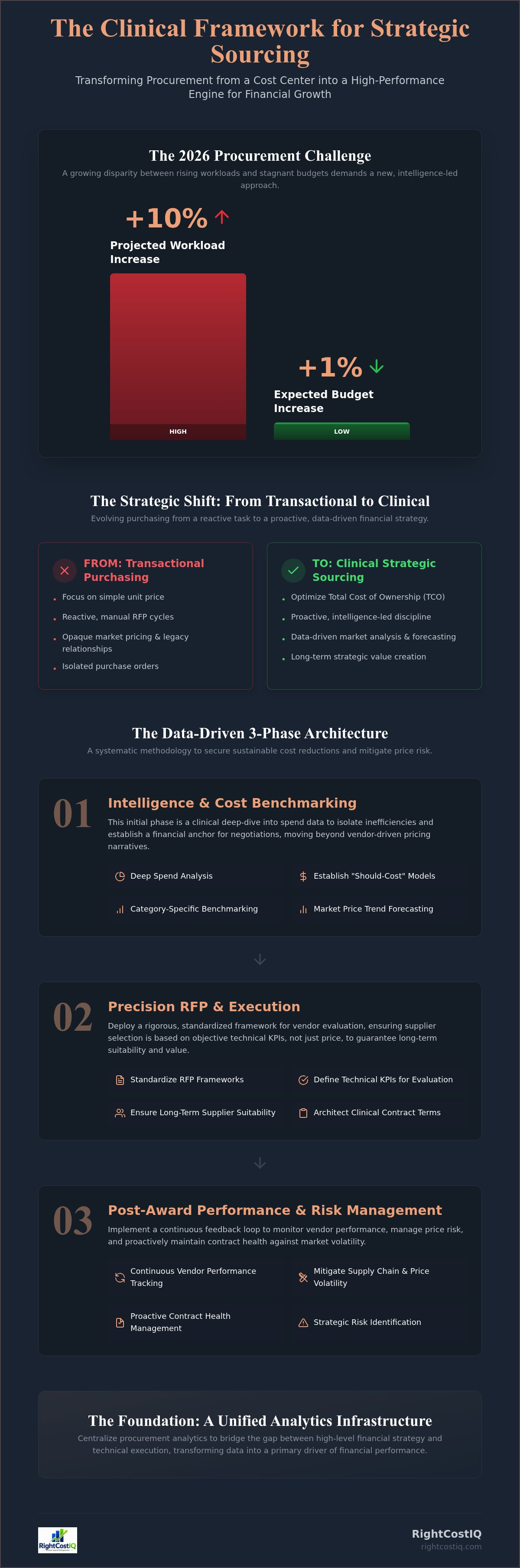
While procurement workloads are projected to rise by 10% in 2026, internal budgets are expected to increase by a mere 1% according to The Hackett Group. This widening gap forces a critical re-evaluation of the traditional strategic sourcing process. You likely recognize that manual RFP cycles and opaque market pricing are no longer sustainable in a volatile global economy. Relying on legacy vendor relationships without deep data integration creates unacceptable financial risk and erodes your competitive margin. Tactical purchasing must evolve into a clinical, intelligence-led discipline to protect the bottom line.
This article provides the clinical framework required to transform your procurement department into a high-performance engine for financial growth. You'll master a data-driven architecture designed to eliminate cost volatility and maximize vendor value through precision analytics. We'll examine the mechanics of market price forecasting, the deployment of clinical negotiation strategies, and the implementation of a scalable procurement infrastructure. By the end of this guide, you'll possess the technical blueprint to secure sustainable cost reductions, mitigate price risk, and achieve superior negotiation leverage in any market condition.
Key Takeaways
- Transition from transactional purchasing to a clinical strategic sourcing process that prioritizes total cost of ownership over simple unit price.
- Utilize category-specific cost benchmarking to establish data-backed price targets and identify hidden savings opportunities within your spend profile.
- Deploy a precision RFP framework using technical KPIs to standardize vendor evaluation and ensure long-term supplier suitability.
- Implement continuous vendor performance tracking and price risk management to maintain contract health and mitigate market volatility.
- Centralize procurement analytics into a unified infrastructure to bridge the gap between high-level financial strategy and technical execution.
What is the Strategic Sourcing Process?
The What is Strategic Sourcing? question is often answered with tactical definitions, but modern finance requires a more clinical perspective. The strategic sourcing process is a data-driven methodology that optimizes the total cost of ownership (TCO) through rigorous, clinical market analysis. It marks a fundamental departure from transactional purchasing. Instead of focusing on isolated purchase orders, this framework prioritizes long-term strategic value creation. It transforms vendor selection from a reactive task into a proactive financial strategy.
In the 2026 business environment, procurement teams face a specific strategic urgency. With workloads rising by 10% and budgets stagnating, a manual approach to vendor selection is a liability. A clinical approach to market volatility is mandatory. The core objectives of this framework include:
- Margin Expansion: Identifying cost-saving opportunities through deep spend analysis and category cost benchmarking.
- Supply Chain Resilience: Diversifying supplier portfolios to mitigate geopolitical and economic disruptions.
- Operational Efficiency: Streamlining RFP cycles and performance monitoring to reduce administrative overhead.
Sourcing vs. Procurement: Defining the Boundary
Procurement serves as the operational execution of goods and services acquisition. It handles the tactical blocking and tackling of purchase orders, invoicing, and logistics. Sourcing, conversely, acts as the strategic architect of supplier selection and contract architecture. When sourcing and procurement synchronize, they drive enterprise growth by aligning daily operations with high-level financial goals. This alignment ensures every dollar spent contributes to a broader strategic intent rather than just fulfilling a short-term need. It's the difference between buying a product and investing in a supply relationship.
The Clinical Shift: Why Efficiency is the Primary Metric
The traditional pursuit of the lowest price is often a false economy that ignores hidden operational costs. The modern strategic sourcing process shifts focus toward optimal value frameworks. This transition relies heavily on market intelligence to define strategic intent before a single RFP is issued. By using data to understand market price trending and forecasting, organizations gain the leverage needed for superior negotiation outcomes. Strategic sourcing is the systematic integration of market data into vendor selection. It transforms procurement from a cost center into a primary driver of financial performance through the relentless pursuit of data-backed efficiency.
Phase I: Intelligence Gathering and Cost Benchmarking
The strategic sourcing process begins with an aggressive intelligence gathering phase. This isn't a passive review of existing invoices. It's a clinical deep-dive into category-specific spend data to isolate inefficiencies. Without this baseline, procurement teams operate in a vacuum, susceptible to vendor-driven pricing narratives. Establishing a "Should-Cost" model serves as your primary financial anchor during future negotiations. This model calculates what a product or service ought to cost based on raw material indices, labor rates, and overhead benchmarks, rather than relying on historical quotes or supplier estimates.
Leveraging procurement category cost benchmarking allows organizations to set realistic, data-backed price targets before engaging suppliers. This phase also sets the groundwork for long-term Post-Award Performance and Risk Management by defining the KPIs that will eventually govern the contract. Analyzing these metrics early ensures that the strategic sourcing process remains focused on tangible business outcomes rather than administrative completion. You can access precise cost benchmarking tools to validate your current savings targets against live market data.
Market Price Trending and Forecasting Models
Successful sourcing requires an analytical view of the future. By analyzing historical price data and integrating macroeconomic indicators, procurement architects can predict supply chain volatility. This forecasting isn't just about price; it's a strategic lever for determining contract duration. If a category shows a downward price trend, a short-term contract is preferable to capture future savings. Conversely, forecasted volatility suggests locking in rates through long-term agreements to ensure budget stability. Utilizing these models transforms procurement from a reactive function into a proactive risk mitigation unit.
Category Management: A Framework for Margin Expansion
Effective category management groups spend into logical clusters to apply specialized sourcing strategies. This approach prevents the dilution of negotiation leverage that occurs when spend is fragmented across disparate departments. A critical component is addressing tail spend, which often accounts for the unmanaged 20% of total costs. Capturing this hidden spend through automated benchmarking drives immediate margin expansion. For a deeper analysis, see our guide on Category Management in Procurement: A Clinical Framework for Margin Expansion (2026). This framework ensures that even low-volume transactions are subjected to the same clinical scrutiny as high-value contracts.
Phase II: Precision RFP Management and Execution
Execution in the strategic sourcing process often fails due to imprecise RFP design. A clinical RFP must elicit granular vendor data to allow for direct, side-by-side financial and technical comparison. Generic proposals invite hidden costs and operational friction that erode your margins. Implementing automated RFP management reduces cycle times while improving the integrity of the data collected. This phase transitions from broad market analysis to a technical evaluation of supplier suitability based on pre-defined KPIs. Shortlisting isn't a matter of intuition; it's a rigorous filtering process driven by data integrity.
Structuring RFPs for Maximum Cost Transparency
Precision begins with rigorous specification. Vague requirements invite scope creep and unmanaged costs that damage your bottom line. A Request for Information (RFI) serves as a necessary filter to narrow the supplier pool before the full RFP launch. This ensures that only capable vendors consume your team's analytical resources. Standardized evaluation matrices ensure that decision-making remains objective and defensible to stakeholders. Effective matrices focus on three primary pillars:
- Technical KPIs: Uptime requirements, quality tolerances, and delivery lead times.
- Financial KPIs: Payment terms, volume discounts, and price escalation clauses.
- Risk KPIs: Cybersecurity posture, financial stability, and ESG compliance.
Clinical Negotiation Assistance: The Final Lever
Negotiation is a data-backed exercise, not a battle of personalities. By using the benchmarking data established in Phase I, procurement teams anchor discussions in market reality. This prevents vendors from inflating margins based on perceived buyer ignorance. A negotiation coach provides the technical support needed to navigate high-value contract discussions with clinical confidence. The objective isn't merely a lower unit price; it's the optimization of total value and the rigorous mitigation of supply chain risk. Shifting the focus from price to total cost of ownership ensures that the final contract reflects the strategic intent defined at the start of the cycle. This approach creates a scalable procurement infrastructure that delivers consistent, repeatable results across all spend categories.
Phase III: Post-Award Performance and Risk Management
The strategic sourcing process doesn't terminate at contract signature. It transitions into a phase of clinical oversight to ensure operational compliance. Many organizations suffer from significant value leakage because they lack the technical infrastructure to track vendor performance against negotiated KPIs. Implementing a rigorous tracking system ensures that the financial growth metrics established during the sourcing phase are realized in daily operations. This phase requires a shift from negotiation to the relentless monitoring of contract health.
Establishing automated feedback loops for supplier relationship management (SRM) facilitates a data-driven partnership. Instead of relying on anecdotal grievances, procurement teams present suppliers with clinical data regarding their performance. This objective approach fosters strategic partnerships that prioritize joint innovation and long-term resilience. By centralizing these analytics, organizations bridge the gap between high-level financial strategy and granular operational execution. You can audit your current vendor performance data to identify high-risk contracts requiring immediate intervention.
Vendor Performance Tracking and Compliance
Defining clear KPIs for delivery, quality, and financial stability is mandatory for maintaining supply chain integrity. Automated alerts for contract non-compliance allow procurement leaders to intervene before minor deviations become systemic failures. This performance data serves as a critical lever for future sourcing cycles, providing an objective record of supplier reliability. Without this record, future negotiations are based on sentiment rather than clinical evidence. High-performance organizations use these metrics to drive continuous improvement and ensure that vendors remain aligned with enterprise goals.
Mitigating Price Volatility in 2026
Price risk management is the clinical differentiator in 2026 procurement strategy. Fixed-price contracts often become liabilities when market trends deviate significantly from contract pricing. A modern framework utilizes index-based or market-linked pricing to maintain margin stability across critical spend categories. Continuous benchmarking identifies these deviations in real-time, allowing for rapid contract adjustments or renegotiations. Price risk management protects the bottom line from market shocks by aligning contract costs with real-time supply chain fluctuations. This proactive stance ensures that the organization remains competitive even during periods of high macroeconomic volatility.
Implementing a Precision Sourcing Infrastructure
Transitioning from a fragmented procurement model to a clinical strategic sourcing process requires a robust technical architecture. It's not enough to perform isolated benchmarking or occasional RFP cycles; these functions must be integrated into a unified workflow. A precision sourcing infrastructure centralizes procurement analytics to drive data-driven decision-making across the enterprise. This centralization eliminates the data silos that often lead to unmanaged cost volatility and poor vendor visibility. By aligning RFP management with real-time benchmarking, organizations create a scalable engine for margin expansion.
The ROI of professional negotiation assistance and clinical analytics becomes evident when comparing automated architectures to manual legacy systems. According to a ProcureAbility report from late 2025, 65% of procurement organizations identified digital transformation as their most critical initiative. This shift is a response to the increasing complexity of global supply chains. A clinical architecture replaces subjective vendor selection with an objective, technical framework. It ensures that every contract is anchored in market intelligence rather than historical precedent or supplier-driven narratives.
The Role of Procurement Analytics
Procurement analytics serves as the foundational intelligence layer for the modern strategic sourcing process. It transforms raw spend data into actionable market intelligence by identifying cost-saving opportunities through automated benchmarking. This technical scrutiny allows procurement teams to present C-suite executives with data-driven reporting that justifies strategic shifts. High-level decision-makers require visibility into financial growth metrics and operational efficiency. Analytics provides the clinical evidence needed to secure C-suite alignment and ensure that procurement remains a primary driver of enterprise value.
Why RightCostIQ is the Strategic Architect
RightCostIQ positions itself as a sophisticated partner by combining clinical precision with advanced procurement technology. Generic consulting firms often provide surface-level advice; RightCostIQ delivers a technical blueprint for financial optimization. The unique value lies in the integration of proprietary benchmarking and clinical negotiation frameworks. This approach ensures that your sourcing strategy is grounded in the pragmatic realities of business finance and market intelligence. We provide the tools to bridge the gap between high-level financial strategy and granular technical execution. You can optimize your sourcing process with RightCostIQ’s precision analytics to secure a competitive advantage in a volatile market. Implementing this infrastructure is the final step in moving from transactional purchasing to a high-performance, automated sourcing engine.
Transforming Procurement into a Financial Growth Engine
Adopting a clinical strategic sourcing process is no longer optional for organizations facing the budget constraints and market volatility of 2026. Realizing sustainable margin expansion requires a transition from transactional purchasing to a data-backed architecture. You've seen how proprietary procurement benchmarking analytics and advanced market price forecasting models provide the necessary leverage to anchor negotiations in reality. Success depends on the systematic integration of these intelligence layers into every RFP cycle and vendor performance review.
By centralizing your procurement infrastructure, you eliminate the visibility gaps that lead to unmanaged cost volatility. Global RFP management expertise ensures that your supplier selection is objective, technical, and aligned with enterprise-wide financial goals. It's time to replace legacy manual workflows with a precision-engineered framework that delivers repeatable results. Scale your procurement efficiency with RightCostIQ’s RFP and Negotiation frameworks to secure your competitive advantage today. You possess the blueprint for clinical optimization; now you must execute.
Frequently Asked Questions
What is the primary goal of the strategic sourcing process?
The primary goal is the optimization of the total cost of ownership (TCO) through clinical market analysis and data-driven vendor selection. It moves beyond simple unit price reduction to focus on long-term financial growth and operational efficiency. By aligning procurement activities with enterprise strategy, organizations achieve sustainable margin expansion and supply chain resilience. This process ensures that every expenditure isn't just a transactional cost but a strategic investment.
How does strategic sourcing differ from traditional procurement?
Traditional procurement is a tactical, reactive function focused on the operational execution of purchase orders. In contrast, the strategic sourcing process acts as the clinical architect of the entire supplier relationship. It's the discipline that utilizes advanced market intelligence and cost benchmarking to define long-term contract structures. While procurement handles the tactical execution of buying, strategic sourcing defines the strategic intent through rigorous analytical frameworks.
What are the 7 steps of strategic sourcing in a modern context?
The modern strategic sourcing process involves seven clinical stages: category identification, market intelligence gathering, supplier portfolio development, sourcing strategy selection, RFP execution, negotiation and contract award, and continuous performance monitoring. Each step requires the systematic integration of market data to ensure clinical precision. This cycle creates a scalable infrastructure that mitigates price risk and ensures that vendor performance remains aligned with pre-defined technical and financial KPIs.
How does RFP management impact procurement ROI?
Precision RFP management directly impacts ROI by reducing cycle times and eliminating hidden vendor costs through rigorous specification. It doesn't just standardize the evaluation process; it forces vendors to provide granular data for objective comparison against financial benchmarks. This clinical approach prevents margin erosion caused by vague requirements or scope creep. By securing high-value contracts from the outset, organizations achieve measurable cost reductions and superior operational stability.
What is procurement category cost benchmarking?
Category cost benchmarking is the clinical practice of comparing internal spend data against live market price trends and historical indices. It establishes a "Should-Cost" model that serves as a baseline for all negotiation activities. This analytical exercise identifies hidden savings opportunities within specific spend clusters, including unmanaged tail spend. Benchmarking ensures that procurement teams enter discussions with data-backed price targets, preventing vendors from inflating margins based on market opacity.
Can strategic sourcing mitigate supply chain risk?
Yes, the framework mitigates risk by diversifying supplier portfolios and implementing continuous performance tracking. Clinical oversight identifies potential disruptions before they become systemic failures by monitoring vendor financial stability and quality compliance. Strategic sourcing also addresses price volatility through index-based pricing and market-linked contract structures. These proactive measures protect the bottom line from macroeconomic shocks and ensure a resilient supply chain capable of withstanding global market fluctuations.
Why is clinical negotiation assistance necessary for high-value contracts?
High-value discussions require more than general negotiation skills; they demand technical support anchored in market reality. Clinical negotiation assistance uses proprietary benchmarking data to challenge vendor-driven pricing narratives. This expertise ensures that contract terms reflect the strategic intent of the organization, focusing on total value rather than just unit price. It provides procurement leaders with the technical confidence needed to secure superior leverage and mitigate long-term financial risks in complex agreements.
How does market price trending influence sourcing strategy?
Market price trending acts as a strategic lever for determining optimal contract duration and timing. Analyzing historical data and forecasting future fluctuations allows procurement architects to lock in rates when markets are favorable or choose short-term agreements during downward trends. It's intelligence that ensures sourcing decisions are proactive rather than reactive. By aligning contract cycles with market realities, organizations protect their margins from unexpected price spikes and capture savings during periods of deflation.


