

Subjective stakeholder opinions are the silent killers of procurement ROI. When high-stakes selection decisions rely on gut feelings rather than clinical data, you expose your organization to unmitigated risk and audit vulnerabilities. Relying on an outdated or fragmented rfp evaluation matrix template often results in hidden vendor risks and missed opportunities for margin expansion. You've likely experienced the difficulty of defending a multi-million dollar contract award when the underlying scoring lacks a transparent, defensible architecture.
This article provides the blueprint for mastering objective vendor selection through a sophisticated, data-driven framework. You'll learn to architect a scoring system that prioritizes strategic alignment and financial growth while stripping away the noise of internal bias. We'll analyze the mechanics of weighted criteria, the integration of market intelligence, and the specific steps required to create a robust audit trail. By the end of this guide, you'll be equipped to convert complex vendor proposals into quantifiable business outcomes that satisfy both the bottom line and the most rigorous compliance standards. This is the transition from simple evaluation to strategic negotiation assistance.
Key Takeaways
- Transform qualitative vendor claims into quantitative financial assets by adopting a clinical decision-support framework that moves beyond basic checklists.
- Deploy a standardized rfp evaluation matrix template to distinguish between mandatory pass/fail requirements and weighted scorable criteria for maximum technical precision.
- Eliminate interpersonal bias and stakeholder subjectivity through the implementation of blind scoring phases and direct allocation weighting methodologies.
- Utilize scoring data to identify specific vendor weaknesses. This creates strategic levers for negotiation assistance that drive margin expansion and cost savings.
- Establish a defensible audit trail that facilitates a seamless transition from the selection phase into long-term vendor performance tracking and price risk management.
The Strategic Architecture of an RFP Evaluation Matrix
The Request for Proposal (RFP) process is frequently dismissed as a procedural hurdle, but the evaluation phase is where strategic value is either captured or lost. A high-fidelity rfp evaluation matrix template functions as a quantitative decision-support framework designed to neutralize stakeholder bias. This architecture transforms qualitative vendor narratives into objective data points, allowing for a clinical comparison of competing solutions. Organizations that adopt this rigorous approach move beyond the limitations of simple Excel checklists, ensuring that every procurement decision is rooted in technical merit and financial logic.
Establishing a defensible audit trail is a core requirement for modern corporate governance. C-suite executives and internal auditors demand transparency into how high-value contracts are awarded. A structured matrix provides this transparency by documenting the exact rationale behind every score. This process effectively eliminates the "subjectivity tax," which refers to the financial and operational costs incurred when personal preferences or favored vendors override data-driven requirements. By removing these variables, procurement teams mitigate the risk of litigation and internal friction while ensuring that the selected partner aligns with broader business objectives.
The Economic Impact of Subjective Selection
Subjective selection methods introduce unnecessary procurement volatility and operational friction. When a selection process lacks a clinical framework, the organization often faces a massive gap between a vendor's perceived value and their actual performance. This misalignment causes margin erosion through hidden costs, such as poor implementation support or failure to meet service level agreements. Inconsistent standards across different departments further exacerbate this issue, leading to a fragmented vendor landscape. Identifying these gaps early through an rfp evaluation matrix template prevents the long-term financial bleed associated with ill-fitted partnerships.
Aligning Sourcing with Financial Growth Metrics
Strategic procurement requires a shift from "lowest price" acquisition to an optimized total cost of ownership (TCO) model. This transition involves integrating cost benchmarking and market intelligence directly into the scoring phase. By evaluating vendors based on their impact on long-term financial growth metrics rather than just upfront costs, organizations can achieve sustainable margin expansion. Our specialized RFP management and negotiation assistance services provide the data necessary to validate these financial claims during the evaluation stage. The evaluation matrix functions as a strategic asset for margin protection by converting qualitative vendor responses into quantifiable financial impacts.
Anatomy of a High-Precision RFP Scoring Matrix
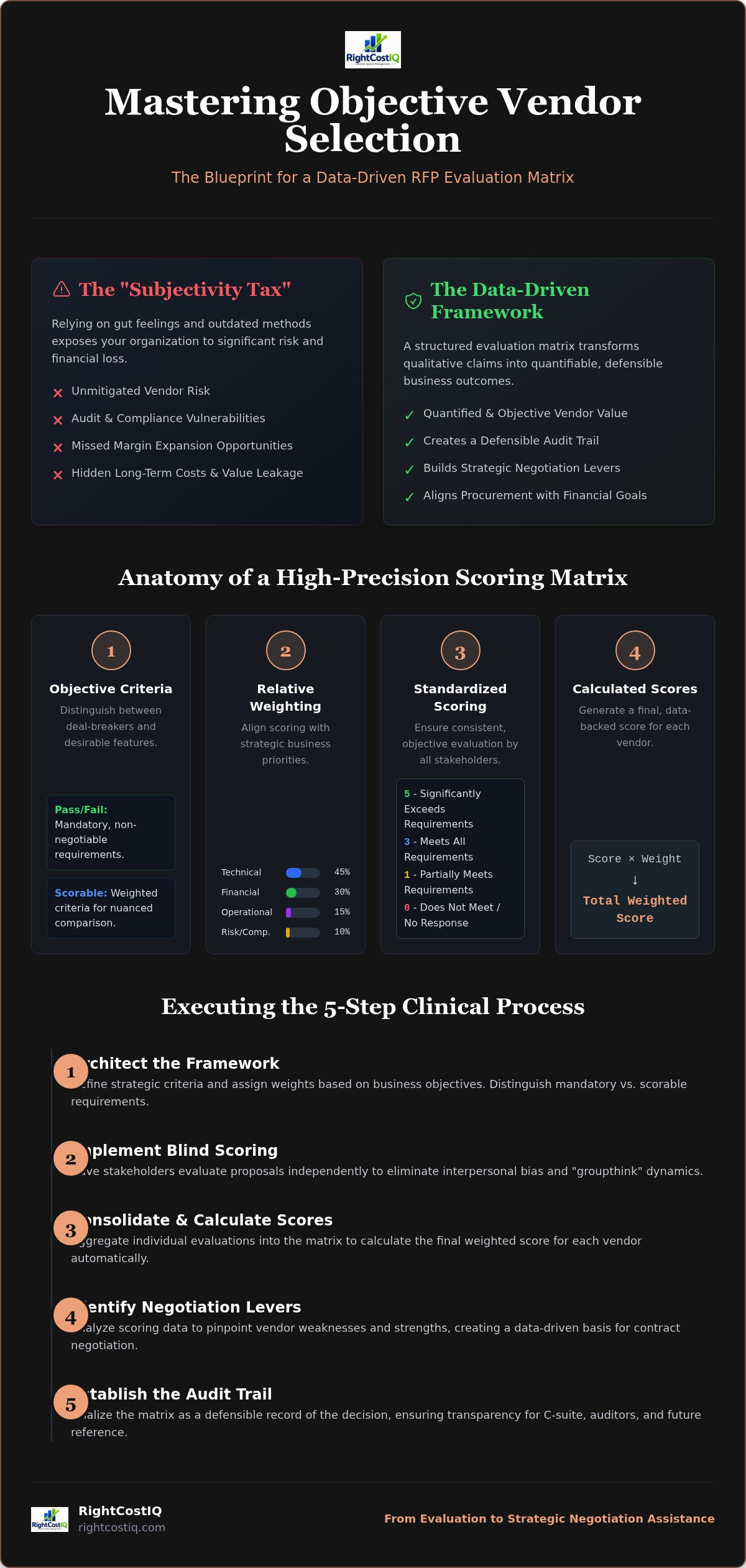
High-precision procurement demands a structured architecture that moves beyond qualitative guesswork. A sophisticated rfp evaluation matrix template must contain four critical pillars: objective criteria, relative weighting, standardized scoring scales, and calculated weighted scores. This framework ensures that every vendor claim is subjected to the same clinical rigor. Distinguishing between mandatory and scorable requirements is the first step in this process. Mandatory requirements act as binary filters; a failure here results in immediate disqualification, regardless of other strengths. For scorable requirements, utilizing a resource like Columbia University's evaluation template provides a baseline for categorizing complex technical and financial needs. Integrating cost benchmarking and analytics into the price pillar ensures your scoring reflects market realities rather than just vendor-provided figures. Finally, a robust matrix must incorporate vendor performance tracking and compliance history to verify past reliability and mitigate future operational risk.
Technical and Operational Evaluation Dimensions
Technical specifications must be assessed with absolute precision to avoid downstream implementation failures. We measure scalability and operational efficiency through specific, quantifiable metrics rather than vague marketing promises. Weighting supplier risk management and diversity programs ensures the vendor ecosystem remains resilient and ethically aligned with corporate governance. This structure prevents the operational friction that occurs when technical capabilities don't scale with business growth. Scoring should reflect a vendor's ability to maintain performance levels under peak demand, ensuring a long-term technical fit that supports operational continuity.
Financial and Risk Mitigation Criteria
Most scoring systems fail to account for future price volatility, creating a significant gap in procurement strategy. A sophisticated matrix integrates market price trending and forecasting to evaluate the long-term viability of a vendor's pricing model. Evaluating a vendor's price risk management capabilities allows you to score their ability to absorb or mitigate market fluctuations effectively. Value-add services should be scored separately to ensure they don't dilute the core financial requirements or inflate a vendor's standing artificially. This level of detail ensures your selection is a catalyst for margin expansion rather than a liability. Refining your scoring logic is essential for capturing true value; you can optimize this process through our RFP management solutions.
Weighting and Scoring Methodologies for Defensible Outcomes
Strategic weighting is the mathematical engine of the rfp evaluation matrix template. It ensures the final selection reflects the actual priorities of the C-suite rather than the personal biases of individual evaluators. Achieving executive alignment on these priorities before the RFP is issued is a non-negotiable step for defensibility. We recommend the "Direct Allocation" method, where stakeholders assign percentage weights to each category until the total reaches 100%. This forced ranking creates a logical hierarchy of needs. Crucially, these weights must be locked and documented before any proposals are opened. This proactive measure prevents legal challenges and accusations of bid manipulation, as it proves the criteria were established without knowledge of specific vendor responses.
Advanced Weighting Frameworks
For high-complexity sourcing, particularly in healthcare financial analytics, a simple percentage split may be insufficient. In these scenarios, the Analytical Hierarchy Process (AHP) allows for pair-wise comparisons between criteria, providing a more granular mathematical foundation for decision-making. High-risk categories, such as data security or regulatory compliance, often require disproportionate weighting to ensure organizational safety. Validating these weights against historical procurement performance data allows for the refinement of the model. This validation ensures that the matrix accurately predicts vendor success based on documented past results. Precision here is the difference between a successful partnership and a costly operational failure.
Standardizing the Scoring Scale
Standardization eliminates the ambiguity that often plagues qualitative assessments. A clinical scoring scale must provide clear, binary-style definitions for every point to ensure consistency across the evaluation committee. For instance, "Meets Requirements" should indicate 100% compliance with stated specs, while "Exceeds Expectations" must be reserved for vendors offering tangible, quantifiable value beyond the baseline. Evaluators often fall victim to "The Middle Effect," where they select neutral scores to avoid making difficult judgments. Clear rubrics for each score point force evaluators to make definitive choices, highlighting the real differences between competing vendors. A 5-point scale is the industry standard for reducing evaluator fatigue while providing enough variance for statistical differentiation.
Executing the Evaluation: A 5-Step Clinical Process
The transition from a static rfp evaluation matrix template to an active decision engine requires a methodical execution strategy. Procurement leaders often fail at this stage by allowing unstructured discussions to dilute the mathematical rigor established in the planning phase. High-stakes vendor selection demands a process that is both repeatable and resistant to internal political pressure. By following a clinical five-step framework, organizations ensure that the final award is based on verified performance data rather than persuasive sales presentations.
- Step 1: Assemble the Cross-Functional Evaluation Committee. Select stakeholders from finance, operations, and IT to ensure a 360-degree view of vendor capabilities.
- Step 2: Conduct the Blind Scoring Phase. Evaluators score technical responses independently without seeing pricing data. This eliminates the risk of cost-biased technical ratings.
- Step 3: Manage the Consensus Workshop. Facilitate structured discussions to resolve score variance greater than two points. This prevents single-evaluator outliers from skewing the aggregate data.
- Step 4: Normalize Financial Bids. Utilize category cost benchmarking to adjust vendor pricing for "apples-to-apples" comparison. This step accounts for hidden fees and varying service levels.
- Step 5: Finalize the Score and Generate the Executive Summary. Aggregate all weighted scores into a final ranking and produce a data-driven justification for the C-suite.
Executing this process with precision ensures your procurement department functions as a strategic architect of financial growth. To identify gaps in your current selection logic, you should perform a procurement diagnostic analysis.
Managing Evaluator Bias and Conflict
Interpersonal bias is the primary threat to procurement integrity. The "Halo Effect" often occurs when a vendor's strong performance in one area, such as a polished presentation, leads evaluators to overrate their technical or financial capabilities. We counter this through data-driven benchmarks that prioritize objective metrics over subjective stakeholder preferences. Instead of simple score averaging, which can hide significant disagreements, implement structured discussion protocols. These protocols require evaluators to justify their scores against the clinical definitions established in the matrix, forcing a focus on documented evidence rather than gut feeling.
From Data to Decision: Presenting to the C-Suite
Presenting results to executive leadership requires a shift from granular data to strategic visualization. The C-suite prioritizes risk mitigation and margin expansion over technical minutiae. Use heat maps and risk-adjusted cost analysis to illustrate why the selected vendor offers the highest total value. This approach links your findings directly to the RFP Management: Precision Frameworks for Sourcing pillar, demonstrating a holistic commitment to operational excellence. By justifying the selection through the lens of long-term financial impact, you secure the high-level buy-in necessary for successful implementation and vendor performance tracking.
Beyond the Matrix: Leveraging Results for Negotiation
The rfp evaluation matrix template is not a static archival document. It serves as a dynamic map for the final stage of procurement optimization. While many firms treat the final score as the end of the process, sophisticated decision-makers view it as the beginning of strategic negotiation. This transition requires a clinical analysis of the score variances to identify where a vendor’s proposal fell short of the ideal benchmark. By extracting these specific data points, you transform a simple selection tool into a high-leverage asset for margin expansion. The matrix identifies precisely where a vendor is vulnerable, allowing you to bridge the gap between their proposal and your business requirements.
Identifying Negotiation Levers in the Scorecard
Successful procurement teams target categories where the preferred vendor underperformed relative to their competitors. For example, if your top-ranked vendor scored low on "Service Level Agreement (SLA) Penalties" or "Implementation Timelines," these become primary targets for negotiation assistance. You don't just ask for a generic discount. Instead, you use the benchmarking data to demand a contract that mitigates the specific risks identified in the matrix. This ensures that the promises made during the competitive phase are codified into enforceable performance KPIs. By the time the contract is signed, the matrix data has already forced the vendor to improve their offering to meet the highest standards set by the field. This clinical approach eliminates the ambiguity that vendors often exploit during the final contracting phase.
Integrating Matrix Data into the Procurement Lifecycle
The value of the rfp evaluation matrix template extends far beyond the initial award. This data should feed directly into your vendor performance tracking systems, creating a baseline for long-term operational audits. Maintaining this clinical record of selection logic allows for more informed future category strategies. It also helps in managing tail spend management by applying standardized scoring logic to smaller, unmanaged contracts. This continuity is why the matrix serves as the foundation of Category Management in Procurement. Automated platforms further protect this integrity by ensuring that scoring logic remains consistent across different departments and years. This methodical approach ensures that every dollar spent is backed by a defensible architecture that prioritizes financial growth and operational efficiency.
Mastering the Architecture of Strategic Procurement
Transitioning to a high-fidelity rfp evaluation matrix template is a mandatory step for organizations seeking to eliminate procurement volatility. You've established the clinical framework necessary to neutralize stakeholder bias and convert qualitative vendor claims into quantifiable financial assets. By implementing standardized weighting and rigorous blind scoring, you create a defensible audit trail that satisfies both internal compliance and C-suite performance metrics. This methodology ensures that every selection decision is an engine for margin expansion rather than a source of operational risk.
The true value of this framework emerges when you leverage evaluation data as a strategic tool for expert negotiation assistance and long-term price risk tracking. Our approach integrates clinical precision in healthcare financial analytics with automated cost benchmarking to ensure your vendor ecosystem remains optimized. You can now move beyond static spreadsheets to a dynamic procurement lifecycle that prioritizes financial growth and technical excellence.
Optimize your sourcing outcomes with RightCostIQ RFP Management
Start building your defensible selection architecture today.
Frequently Asked Questions
What is the most effective scoring scale for an RFP evaluation matrix?
A 5-point Likert scale is the most effective for reducing evaluator fatigue while maintaining statistical differentiation. A 1-10 scale often leads to "score creep" where evaluators struggle to justify the difference between a 7 and an 8. By using a 5-point scale with clinical definitions for each level, such as reserving a 5 for "Exceeds Requirements with Quantifiable Value," you ensure high inter-rater reliability across the entire evaluation committee.
How do you handle a tie-breaker between two vendors in a scoring matrix?
Tie-breakers should be resolved by referencing the highest-weighted category, such as price risk management or technical fit. If the total scores are identical, the vendor with the superior score in the most strategically significant category is awarded the contract. This hierarchy must be established in the rfp evaluation matrix template before proposal submission to maintain the integrity of the selection architecture and prevent post-hoc stakeholder bias.
Should price be weighted more heavily than technical capabilities?
Weighting depends on category maturity, but technical fit typically accounts for 30-40% while price covers 25-35%. For complex healthcare financial analytics, technical capability often outweighs price to mitigate operational risk. A "lowest price technically acceptable" model is only appropriate for commoditized goods where vendor differentiation is minimal. For high-value strategic sourcing, prioritizing total cost of ownership over upfront price protects long-term margins and operational efficiency.
How do you prevent stakeholder bias from influencing the RFP results?
Preventing bias requires implementing a "Blind Scoring" phase where technical evaluators cannot access pricing data until their functional scores are locked. You should also utilize a cross-functional committee and facilitate consensus workshops to resolve score variances greater than two points. This clinical approach forces stakeholders to justify their ratings against documented requirements rather than personal preferences, ensuring the rfp evaluation matrix template remains an objective, data-driven decision-support framework.
Can I use an RFP evaluation matrix for small-scale procurement projects?
Scaling the matrix for smaller projects involves simplifying the criteria while maintaining the core weighting logic. For purchases below federal thresholds, such as the $15,000 micro-purchase limit, a full matrix might be excessive. However, for any competitive bid where multiple variables exist beyond price, a lean matrix ensures a defensible selection. This practice builds a consistent audit trail and prevents "gut feeling" decisions from creeping into your tail spend management strategy.
What is the difference between an RFP matrix and a weighted scoring model?
An RFP matrix is the comprehensive document containing the criteria, responses, and scoring logic, while a weighted scoring model is the specific mathematical algorithm used within that matrix. The weighted model assigns relative importance to different categories, ensuring that a high score in a minor area doesn't overshadow a poor performance in a critical requirement. Most modern procurement architectures use these terms interchangeably, but the matrix represents the broader qualitative-to-quantitative transformation tool.
How often should the evaluation criteria be updated for recurring RFPs?
Evaluation criteria should be reviewed before every RFP cycle to reflect current market intelligence and shifting business goals. In volatile sectors, quarterly updates may be necessary to account for new price risk management factors or technological innovations. Static criteria lead to "spec drift," where you continue to measure vendors against outdated standards. Validating criteria against recent vendor performance tracking data ensures the matrix remains a relevant tool for margin protection and strategic alignment.
Is it better to use consensus meetings or average the scores from all evaluators?
Consensus meetings are superior to simple averaging because they force the resolution of fundamental disagreements. Averaging can mask significant outliers or misunderstandings of a vendor's technical capability. A facilitated consensus workshop requires evaluators to discuss their reasoning for disparate scores until they reach a shared understanding. This process produces a more robust and defensible result, as the final score reflects a unified organizational perspective rather than a mathematical compromise.


