
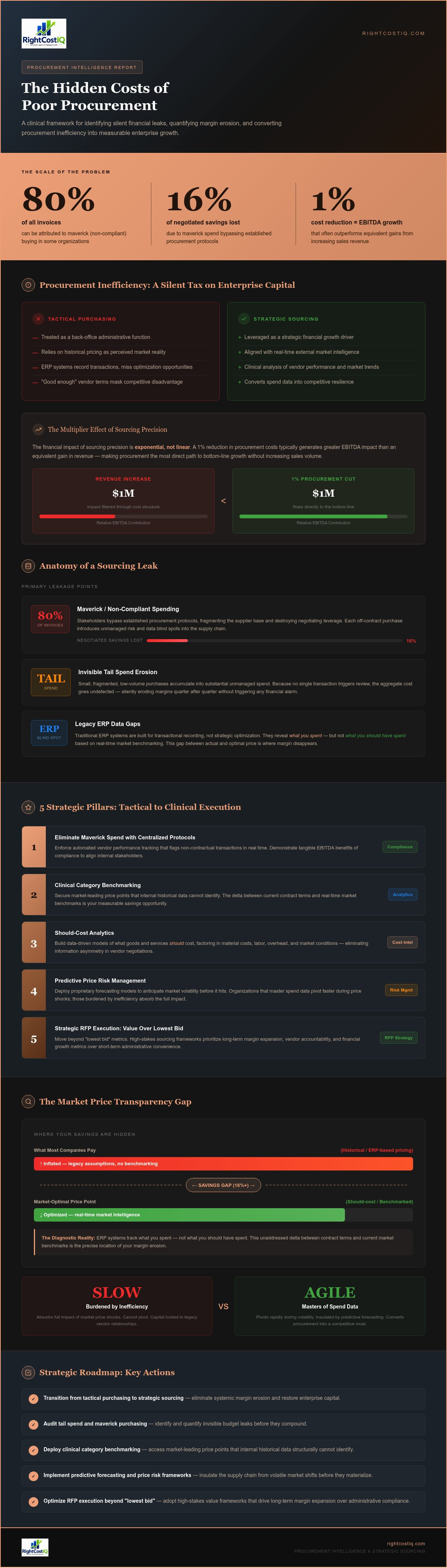
At many organizations, maverick buying accounts for up to 80% of all invoices, resulting in a loss of up to 16% of negotiated savings. You likely recognize that your supply chain isn't operating at peak efficiency, yet the exact location of these leaks remains obscured by a systemic lack of market price transparency. These hidden costs of poor procurement act as a silent tax on enterprise capital, eroding margins while your team executes inefficient RFP cycles that fail to secure optimal terms.
This analysis provides the diagnostic framework required to identify and quantify these silent financial leaks, offering the precision tools needed to convert procurement inefficiency into measurable enterprise growth. We will examine the transition from tactical sourcing to clinical execution, focusing on advanced price risk management, "should-cost" analytics, and proprietary forecasting models to stabilize your bottom line. By the end of this clinical analysis, you'll possess the strategic roadmap to eliminate invisible tail spend erosion and implement high-stakes sourcing methodologies that prioritize financial growth metrics over mere administrative compliance.
Key Takeaways
- Transition from tactical purchasing to strategic sourcing to eliminate systemic margin erosion and restore enterprise capital.
- Identify and quantify the hidden costs of poor procurement by auditing invisible budget leaks within tail spend and maverick purchasing cycles.
- Leverage clinical category benchmarking to secure market-leading price points that internal historical data cannot identify.
- Deploy predictive forecasting and price risk management frameworks to insulate the supply chain from volatile market shifts.
- Optimize RFP execution by moving beyond "lowest bid" metrics toward high-stakes value frameworks that drive long-term margin expansion.
Quantifying the Financial Impact of Procurement Inefficiency
Procurement inefficiency isn't a minor operational friction; it functions as a systemic driver of margin erosion that compromises enterprise liquidity. Most organizations operate within a tactical purchasing framework, treating Procurement as a back-office administrative function rather than a strategic lever for financial growth. This approach creates a silent tax on corporate liquidity, where unmanaged spend and suboptimal vendor terms slowly bleed capital that should be reinvested into innovation or expansion. Many decision-makers fall into the psychological trap of "good enough" vendor terms, assuming that historical pricing represents market reality. In truth, these hidden costs of poor procurement often stem from a failure to align internal requirements with external market intelligence. Settling for these terms creates a false sense of security that masks the gradual erosion of competitive advantage, leaving capital on the table that competitors are actively reclaiming through data-driven sourcing.
The Anatomy of a Sourcing Leak
A sourcing leak occurs when the delta between current market-leading price points and actual contract terms remains unaddressed. Research indicates that maverick spending can account for up to 80% of all invoices in some organizations, leading to a 16% loss of negotiated savings. Traditional ERP systems are designed for transactional recording, not strategic optimization; they fail to capture the granular sourcing opportunities that define modern profitability. These systems track what you spent, but they don't reveal what you should've spent based on real-time benchmarking. Efficiency is no longer optional. Procurement margin erosion is the quantifiable loss of enterprise value resulting from the misalignment of sourcing execution with optimal market conditions. Identifying these gaps requires moving beyond static data to clinical analysis of vendor performance and market trends.
The Multiplier Effect of Inefficient Procurement
The financial impact of sourcing precision is exponential rather than linear. For most mid-to-large enterprises, a 1% reduction in procurement costs can translate to significant EBITDA growth, often outperforming the impact of revenue increases. This multiplier effect makes procurement the most direct path to improving bottom-line performance without increasing sales volume. Precision in this area also correlates directly with supply chain resilience. Organizations that master their spend data can pivot faster during market volatility, whereas those burdened by inefficiency remain vulnerable to price shocks. Implementing RFP Management: Precision Frameworks for Sourcing ensures that every sourcing cycle converts these potential leaks into tangible financial assets. Beyond immediate savings, precision sourcing acts as a diagnostic tool for organizational health, revealing whether a company is operating on legacy assumptions or leveraging modern market intelligence to drive its financial trajectory.
Identifying Silent Budget Leaks: Maverick Spend and Tail Spend
Non-compliant purchasing, or maverick spend, represents a primary leakage point where negotiated savings dissolve into operational noise. While procurement departments invest significant capital in securing optimal contract terms, decentralized buying behaviors frequently bypass these protocols. This fragmentation creates a direct financial impact. Organizations often lose up to 16% of their negotiated savings due to maverick spending. These hidden costs of poor procurement are not merely administrative inconveniences. They are structural failures in cost control that weaken the organization's overall negotiating leverage and fragment the supplier base. Fragmented sourcing data further obscures the true cost of vendor performance, making it impossible to hold suppliers accountable to the terms established during the RFP cycle.
Maverick Spend as a Compliance Failure
Maverick spend is a clear compliance failure that signals a breakdown between strategic sourcing and frontline execution. When stakeholders procure goods outside of established frameworks, they introduce unmanaged risk and data blind spots into the supply chain. Automated vendor performance tracking serves as a clinical solution here, enforcing compliance by flagging non-contractual transactions in real time. Aligning internal stakeholders requires more than just policy updates. It demands a centralized sourcing protocol that demonstrates the tangible EBITDA benefits of compliance over the perceived convenience of bypass-procurement. By establishing rigid adherence to centralized contracts, enterprises can reclaim the liquidity lost to these invisible leaks.
The Hidden Complexity of Tail Spend
Tail spend constitutes the high-volume, low-value purchases that typically account for 80% of an enterprise's supplier interactions but only 20% of total spend. This unmanaged segment is the primary source of procurement "noise," creating a massive administrative burden that distracts from high-stakes category management. Failure to drive value from tail spend leads to a bloated vendor list and inconsistent pricing across different departments. Implementing Tail Spend Management Solutions allows for the consolidation of these suppliers, converting fragmented data into a cohesive strategic asset. Addressing these hidden costs of poor procurement through clinical consolidation reduces the cost-to-serve and improves overall vendor performance transparency. Organizations seeking to reclaim these margins can benefit from a systemic audit of unmanaged spend to identify immediate consolidation opportunities and restore financial discipline.
The Role of Category Benchmarking in Cost Transparency
Internal historical data is a deceptive baseline for competitive sourcing. Many organizations rely on previous contract cycles to determine current value, failing to recognize that market dynamics have shifted significantly since those terms were established. This reliance creates a strategic vacuum where the hidden costs of poor procurement thrive. Businesses inadvertently benchmark against their own past inefficiencies instead of competitive, market-leading price points. Clinical category benchmarking removes this internal bias by providing objective, data-driven insights into what a service or product should cost in the current economic climate. Transitioning from a passive price-taking posture to an active price-shaping strategy requires a clinical understanding of these external variables, ensuring that every dollar spent is aligned with actual market capability.
Market Intelligence vs. Internal Analytics
Internal analytics focus on spend history, which only reveals what was paid, not what was possible. Market intelligence identifies specific windows of opportunity for RFP execution by tracking real-time price fluctuations and supplier margin trends. Relying on static data from legacy ERP systems often masks the hidden costs of poor procurement, as these systems lack the external context necessary to identify overpayment. Leveraging Procurement Category Cost Benchmarking allows procurement leaders to redefine "fair market value" based on verified market data rather than historical precedent. This shift ensures that sourcing teams enter negotiations with a "Should-Cost" model that acts as a clinical lever, forcing vendors to justify price deltas against objective benchmarks. When price risk management is grounded in real-time trending, procurement becomes a proactive driver of enterprise value rather than a reactive administrative function.
Executing a Benchmarking-Led Sourcing Strategy
Integrating benchmarking at the earliest stages of the RFP lifecycle is essential for sustained margin expansion. By establishing market-aligned targets before engaging vendors, procurement teams can set assertive negotiation boundaries that prioritize enterprise growth. This precision-led approach eliminates the guesswork inherent in tactical sourcing and replaces it with a methodical framework for cost optimization. A benchmarking-led strategy enables several critical operational advantages:
- Identification of category-specific price ceilings and floors using real-time market trending data.
- Utilization of "Should-Cost" analytics to dismantle generic vendor pricing models and secure optimal terms.
- Execution of RFP cycles with predefined financial outcomes based on clinical benchmarking rather than bid averages.
Adopting a clinical framework for category management ensures that procurement remains a primary driver of financial growth. This strategy converts transparency into a competitive advantage, allowing for the precise identification of margin erosion before it impacts corporate liquidity. By utilizing data-driven insights to shape the market, organizations can protect their margins from volatility and secure long-term financial resilience.
Mitigating Price Risk and Market Volatility through Forecasting
Static procurement models are a significant financial liability in an environment characterized by rapid market shifts. When organizations rely on fixed-term contracts without the support of market intelligence, they expose themselves to substantial price risk. These hidden costs of poor procurement often remain invisible until a market spike forces a budget reconciliation that erodes projected margins. Clinical price risk management transitions the department from a reactive cost center to a strategic architect of financial stability. By utilizing predictive modeling, enterprises can identify price floors and ceilings, ensuring that procurement cycles are timed for maximum margin protection. This approach moves beyond simple cost-cutting, focusing instead on the preservation of enterprise capital through every phase of the market cycle.
The Mechanics of Price Risk Management
Identifying categories most susceptible to market fluctuations is the first step in clinical risk mitigation. Predictive analytics provide the data necessary to determine the optimal contract duration, weighing the benefits of long-term price stability against the potential for spot-market savings. This analytical rigor prevents the organization from being locked into uncompetitive rates during a market downturn. Precise forecasting models allow procurement leaders to dictate contract timing, forcing vendors to align with favorable market windows rather than arbitrary expiration dates. By establishing these data-driven boundaries, sourcing teams can insulate the supply chain from the hidden costs of poor procurement that arise from poorly timed RFP execution.
Forecasting for Strategic Resilience
Anticipating disruption is the hallmark of a resilient supply chain. Moving from a reactive to a proactive posture requires the integration of real-time market price trending into the core sourcing strategy. This visibility allows procurement to act as a diagnostic tool for the C-suite, informing long-term capital allocation decisions based on projected price swings rather than historical spend. Vendor performance tracking also plays a critical role here, as it identifies which suppliers are most prone to passing through volatility as price increases. Integrating these insights into the C-suite reporting cycle ensures that leadership remains aligned with the strategic realities of the supply chain. To ensure your organization is insulated from these risks, you can audit your current price risk exposure through our precision diagnostic framework.
Market price trending informs long-term contract structures by identifying the underlying drivers of cost. This level of transparency prevents vendors from utilizing generic "market volatility" as a justification for margin expansion. When procurement operates with clinical precision, it converts market noise into a structured roadmap for financial growth, ensuring that every sourcing decision contributes to the organization's long-term competitive advantage.
Strategic RFP Management: Transitioning from Tactical to Clinical Sourcing
The RFP process is often the final stage where the hidden costs of poor procurement are either locked into a multi-year contract or surgically removed. Tactical sourcing focuses on the "lowest bid," a metric that frequently ignores total cost of ownership and long-term price risk. Clinical sourcing, conversely, utilizes the RFP as a precision instrument for financial growth. RightCostIQ aligns this process with enterprise efficiency by integrating "should-cost" analytics and market intelligence into every sourcing cycle. This transition ensures that vendor selection is based on optimal value frameworks rather than administrative convenience, protecting margins from future erosion. By treating the RFP as a strategic asset, organizations can convert a routine administrative task into a high-stakes lever for capital preservation.
The Clinical RFP Lifecycle
High-performance RFP cycles require more than just a list of technical requirements. They demand the integration of clinical benchmarking and forecasting data into the core documentation to set assertive, market-aligned boundaries. This lifecycle begins with a diagnostic audit of current market conditions to identify favorable entry windows, ensuring the organization isn't sourcing during a peak volatility period. By operationalizing these insights, sourcing teams can force vendors to justify their pricing against objective standards rather than bid averages. Utilizing RFP Management and Negotiation Coaching allows enterprises to move beyond generic templates, ensuring that every contract is structured to capture maximum enterprise value while minimizing operational friction. This methodical approach eliminates the data blind spots that typically allow vendor margins to expand at the expense of the buyer.
Negotiation as a Data-Driven Discipline
Negotiation isn't an emotional exercise in haggling; it's a clinical discipline grounded in data-backed assertive positions. When procurement teams enter the room with proprietary market trending models, the dynamic shifts from a passive request to a strategic demand for market-leading terms. Professional Negotiation Coaching provides the technical upskilling necessary to dismantle vendor pricing strategies that profit from information asymmetry. These high-stakes sourcing methodologies eliminate the hidden costs of poor procurement by ensuring that negotiated savings are realized in the final contract execution rather than lost to vague clauses or unmanaged escalations. Moving away from legacy negotiation tactics allows for a more objective, results-oriented relationship with the supply base, where performance is measured against clinical benchmarks.
Reclaiming lost margins requires a transition from tactical purchasing to a clinical sourcing architecture. RightCostIQ provides the precision frameworks and market intelligence needed to convert procurement inefficiency into a primary driver of EBITDA growth. Stop allowing silent budget leaks to erode your corporate liquidity. You can optimize your procurement outcomes with RightCostIQ and secure the competitive advantage your enterprise demands.
Converting Procurement Inefficiency into Enterprise Growth
Margin preservation requires a fundamental shift from administrative purchasing to a clinical sourcing architecture. By neutralizing the hidden costs of poor procurement through data-driven benchmarking and predictive forecasting, organizations can reclaim lost liquidity and stabilize their financial trajectory. This analysis has demonstrated that precision in RFP management and the clinical elimination of maverick spend are essential for converting procurement into a primary driver of EBITDA expansion. Strategic resilience is no longer optional in a volatile market; it's a structural requirement for sustained profitability.
RightCostIQ provides the strategic tools necessary to execute this transition with unwavering focus. Our platform leverages Proprietary Market Price Trending analytics, Specialized RFP Negotiation Coaching, and Global procurement benchmarking data to ensure every sourcing cycle delivers market-leading results. Don't allow unmanaged spend and information asymmetry to continue eroding your enterprise value. You possess the roadmap to transform your supply chain into a high-performance financial asset.
Execute your procurement strategy with clinical precision at RightCostIQ. Your path to optimized margin resilience begins with a clinical audit of your current sourcing lifecycle.
Frequently Asked Questions
What are the most common hidden costs in enterprise procurement?
Maverick spend, tail spend erosion, and administrative bloat from fragmented sourcing data are the primary hidden costs of poor procurement. These leaks manifest as price variance across departments or the failure to capture negotiated savings due to non-compliant buying. This lack of transparency forces organizations to pay a silent tax on corporate liquidity, eroding margins that should drive growth. Identifying these gaps requires moving beyond static data to a clinical analysis of market trends.
How does maverick spend impact a company’s bottom line?
Maverick spend erodes a significant portion of negotiated savings by bypassing centralized sourcing protocols. When stakeholders procure goods outside of established frameworks, they introduce unmanaged risk and data blind spots. This fragmentation weakens the enterprise's overall negotiating power and inflates the cost-to-serve. Beyond immediate financial loss, it creates an administrative burden that prevents procurement teams from focusing on high-stakes category management. It's a structural failure in cost control that directly compromises corporate liquidity.
Is procurement software enough to eliminate hidden costs?
Software automation provides transactional recording but it's not a complete solution for identifying the hidden costs of poor procurement. While P2P systems track what was spent, they don't reveal what should've been spent. Effective margin preservation requires a combination of advanced technology and strategic human expertise. Precision benchmarking and professional negotiation assistance are necessary to convert raw data into actionable sourcing strategies that drive long-term, measurable capital preservation.
What is the difference between cost benchmarking and spend analysis?
Spend analysis examines historical internal data to identify where capital was allocated, whereas category cost benchmarking provides an external market comparison. Relying solely on internal history is deceptive because it benchmarks against past inefficiencies. Benchmarking utilizes real-time market trending to identify market-leading price points. This clinical approach ensures you don't benchmark against legacy errors. It allows procurement leaders to move toward an active price-shaping strategy where every contract aligns with current market capabilities.
How can price risk management protect against market volatility?
Price risk management utilizes predictive analytics and market price trending to insulate the supply chain from market volatility. By identifying price floors and ceilings, organizations can time their RFP cycles to coincide with favorable market windows. This proactive strategy prevents the organization from being locked into uncompetitive rates during price spikes. It transforms procurement from a reactive cost center into a strategic architect of financial stability, protecting projected margins from sudden, unpredicted inflationary shifts.
Can poor procurement impact vendor performance and compliance?
Poor procurement processes lead to fragmented sourcing data that obscures the true cost of vendor performance. Without clinical tracking, it's impossible to hold suppliers accountable to the terms established during the RFP cycle. This lack of transparency often results in service creep and non-compliant billing. Implementing a clinical vendor performance tracking service ensures that suppliers meet established KPIs. This rigorous oversight enforces compliance and prevents the gradual erosion of negotiated contract value over time.
What is "Should-Cost" analysis and why is it essential for negotiations?
"Should-Cost" analysis is a clinical diagnostic tool that determines the objective market value of a product or service based on underlying cost drivers. It's essential for high-stakes negotiations because it dismantles generic vendor pricing models. By entering negotiations with data-backed assertive positions, sourcing teams can force vendors to justify price deltas against verified benchmarks. This methodology eliminates information asymmetry, allowing procurement to secure optimal terms that prioritize financial growth metrics over simple administrative compliance.
How do I calculate the ROI of professional RFP management services?
Calculating the ROI of professional RFP management requires quantifying the delta between standard bid averages and the optimal value secured through clinical sourcing. A 1% reduction in procurement costs can translate to significant EBITDA growth. ROI isn't just about the initial price; it's measured through reduced administrative overhead and improved supply chain resilience. Utilizing specialized negotiation coaching ensures that every sourcing cycle converts potential budget leaks into tangible, long-term financial assets for the enterprise.


