
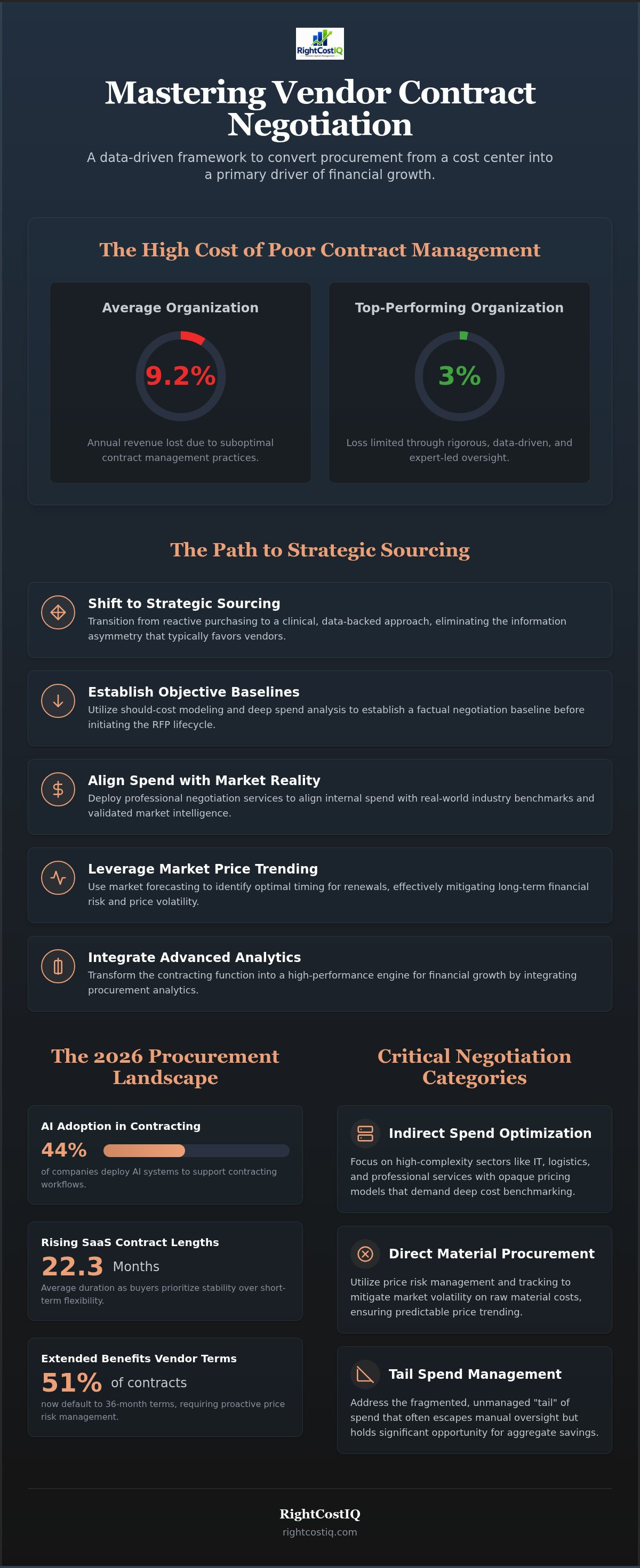
Did you know the average organization hemorrhages 9.2% of its annual revenue solely due to suboptimal contract management? For high-level decision-makers, the frustration of opaque vendor pricing models and inefficient manual RFP processes isn't just an operational hurdle; it's a direct threat to bottom-line growth. You likely recognize that relying on anecdotal evidence or historical precedent during renewals leaves significant capital on the table. Top-performing organizations, however, limit these losses to just 3% through rigorous, data-driven oversight.
This article provides the clinical framework necessary to master vendor contract negotiation services by shifting from reactive purchasing to strategic, data-backed sourcing. We'll examine how to leverage cost benchmarking and market price trending to secure market-leading terms while mitigating financial volatility. You'll learn to utilize proprietary price risk management models and performance tracking to transform procurement into a primary driver of financial growth. We'll preview the integration of advanced analytics into the RFP lifecycle to ensure every negotiation is anchored in objective reality rather than vendor-driven narratives. By the end of this guide, you'll have the tools to convert procurement data into a competitive advantage.
Key Takeaways
- Transition from reactive purchasing to clinical strategic sourcing to eliminate the information asymmetry that typically favors vendors during renewals.
- Establish objective negotiation baselines by utilizing should-cost modeling and deep spend analysis before initiating the formal RFP lifecycle.
- Deploy professional vendor contract negotiation services to align internal category spend with real-world industry benchmarks and validated market intelligence.
- Utilize market price trending and forecasting to identify optimal timing for contract renewals, effectively mitigating long-term financial risk and price volatility.
- Integrate advanced procurement analytics to transition the contracting function from a traditional cost center to a high-performance engine for financial growth.
What are Professional Vendor Contract Negotiation Services?
Professional vendor contract negotiation services define a specialized discipline leveraging market intelligence and benchmarking to optimize vendor agreements. This goes beyond traditional purchasing. It's a clinical application of data-driven sourcing designed to eliminate the information asymmetry that typically favors the seller. In 2026, the negotiation process has evolved into a high-stakes analytical operation. These services provide the strategic architecture required to manage complex enterprise contracts, integrating Request For Proposal (RFP) management, cost benchmarking, and vendor performance tracking into a single, cohesive framework.
The necessity for professional assistance is underscored by current market data. World Commerce & Contracting reported in March 2026 that the average business loses 9.2% of its annual revenue due to poor contract management. By contrast, top-performing organizations limit this loss to 3% through rigorous, expert-led oversight. Professional services act as a force multiplier for procurement teams, ensuring that every agreement is anchored in objective market reality rather than vendor-driven narratives.
The Evolution of Data-Driven Sourcing
The transition from reactive purchasing to clinical strategic sourcing focuses on structural margin expansion. While legacy procurement models sought one-time discounts, modern frameworks prioritize long-term financial stability and operational efficiency. Technology now plays a pivotal role in this evolution. Tools like the Negotiation Coach bridge the gap between raw data and executable strategy. This allows decision-makers to move beyond simple cost reduction toward sophisticated value creation. By integrating advanced analytics into the RFP lifecycle, organizations can identify hidden cost drivers and secure terms that reflect true market value.
Key Categories for Specialized Negotiation
High-stakes negotiations require specific expertise tailored to diverse spend types. Professional vendor contract negotiation services are particularly critical for managing the following categories:
- Indirect Spend Optimization: This includes high-complexity sectors like IT, logistics, and professional services. These areas often feature opaque pricing models that require deep cost benchmarking to decode.
- Direct Material Procurement: Professionals use price risk management and tracking services to mitigate the impact of market volatility on raw material costs, ensuring predictable price trending.
- Tail Spend Management: Expert-led frameworks address the unmanaged "tail" of spend. This fragmented category often escapes manual oversight but represents a significant opportunity for aggregate savings.
With 44% of companies deploying AI systems to support contracting workflows as of 2026, the gap between leaders and laggards is widening. Specialized negotiation services provide the technical upskilling and analytical precision necessary to maintain a competitive advantage in an increasingly automated procurement landscape.
The Clinical Anatomy of High-Value Procurement Negotiations
High-value procurement negotiation is not an exercise in persuasion; it's a financial engineering project rooted in data symmetry. Effective vendor contract negotiation services begin with should-cost modeling to establish an objective baseline before the first offer is even exchanged. This clinical approach replaces reactive guesswork with a structured analysis of vendor margins and market realities. By defining requirements with surgical precision, procurement teams can shift the dialogue from price concessions to structural margin expansion.
Identifying the correct negotiation levers is critical for long-term financial stability. In 2026, contract durations are lengthening as buyers prioritize stability over short-term flexibility. Data from Vertice indicates SaaS contract lengths rose to 22.3 months this year. Similarly, 51% of benefits vendor contracts now default to 36-month terms. Mastering these levers requires a proactive price risk management strategy. This mirrors the 2026 federal shift toward fixed-price contracts, which agencies now use to insulate against market volatility. Procurement teams that utilize AI-driven decision-making tools can speed up this supplier selection process by 30%, according to McKinsey research.
RFP Management as a Negotiation Foundation
A well-structured RFP forces competitive transparency by requiring vendors to disclose granular cost drivers. By automating the bid evaluation process, organizations remove subjective bias and focus on objective comparison metrics. This foundation prevents vendors from hiding premium costs within bundled services. You can explore our RFP management framework to see how clinical execution during the bidding phase sets the stage for market-leading terms. This systematic approach ensures that every vendor response is evaluated against a standardized performance and cost model.
Leveraging Vendor Performance Tracking
Historical performance data is a powerful lever during renewal discussions. When vendors fail to meet service level agreements (SLAs), it creates a quantifiable cost-recovery opportunity. Organizations using AI-powered negotiation tools have seen total savings increase by 281% by identifying these non-compliance gaps. Establishing data-backed penalties for future breaches ensures that performance remains a financial obligation rather than a vague promise. Clinical performance tracking allows you to transform past failures into future leverage. To identify your specific savings potential, consider a preliminary procurement diagnostic. Using performance data as a negotiation coach ensures that renewals are based on proven value rather than marketing claims.
Benchmarking vs. Market Price Trending: Leveraging Data as a Negotiation Coach
Strategic procurement distinguishes between static benchmarking and dynamic price trending to eliminate vendor-driven price inflation. Category cost benchmarking provides a clinical baseline by comparing internal rates against validated industry standards. While benchmarking identifies the current market floor, market price trending forecasts future cost trajectories. Professional vendor contract negotiation services integrate these two datasets to create a comprehensive negotiation posture that accounts for both current overspending and future financial risk.
Should-cost analysis functions as a primary tool for dismantling opaque vendor margins. By calculating the actual cost of production or service delivery, procurement teams reveal the delta between a vendor's price and their underlying costs. This analytical precision identifies "outlier" pricing in complex portfolios where specific line items deviate significantly from the category average. Organizations that utilize these data-driven insights move beyond general requests for discounts toward specific, non-negotiable cost corrections based on objective reality.
Transforming Data into Negotiation Levers
Benchmarking data allows organizations to challenge the "standard" 5-10% annual price increases often built into legacy agreements. Industry data from 2026 confirms that companies that benchmark vendor pricing before every renewal achieve 15% to 30% better outcomes than those that do not. You can access our negotiation coach tools to automate this intelligence gathering and establish firm baselines for your next RFP cycle. Case studies in category analytics consistently demonstrate that identifying outlier pricing within high-volume portfolios yields 15-20% immediate savings through structural margin correction.
Forecasting and Price Risk Management
Forward-looking market intelligence is essential for mitigating the impact of commodity price swings on long-term contracts. By tracking market price trending, firms can negotiate flexible pricing tiers that adjust automatically with validated indices. This prevents the organization from being locked into premium rates during deflationary periods or market corrections. High-level decision-makers analyze market price trending to time their negotiations with surgical precision, ensuring that multi-year agreements remain competitive regardless of macroeconomic shifts. This proactive approach transforms price risk management from a defensive function into a strategic driver of predictable financial performance.
A 5-Step Framework for Executing Complex Vendor RFP Negotiations
Executing complex negotiations requires a structured methodology to ensure consistency and maximize financial recovery. This 5-step framework provides the clinical blueprint for transforming procurement from a manual task into a strategic asset. By following a methodical approach, organizations can eliminate the emotional variables of the negotiation process and replace them with objective, data-driven outcomes.
- Step 1: Baseline Audit. Perform a clinical spend analysis of your current state. This step identifies hidden fees and volume-based pricing discrepancies that often go unnoticed in standard accounting.
- Step 2: Market Intelligence. Integrate the benchmarking and price trending data established in previous phases. This intelligence informs the "should-cost" baseline required for objective negotiation.
- Step 3: RFP Execution. Launch a structured, competitive sourcing event. This process forces vendors to defend their pricing models in an environment of high transparency.
- Step 4: Negotiation Strategy. Vendors don't lower prices voluntarily. Deploy vendor contract negotiation services to translate raw data into specific negotiation levers. This step focuses on securing optimal terms by challenging vendor-led narratives with objective market facts.
- Step 5: Performance Baseline. This ensures negotiated savings aren't just theoretical. Formalize KPIs and tracking mechanisms within the new contract to monitor realization throughout the agreement's lifecycle.
Optimizing the RFP Lifecycle for Efficiency
Efficiency's a competitive advantage in modern sourcing. Automated sourcing platforms reduce the time-to-contract and ensure C-suite alignment on negotiation objectives before any vendor contact is initiated. This prevents internal fragmentation that vendors often exploit during the bidding phase. For a deeper analysis of these methodologies, read our sibling article on RFP Management: Strategic Frameworks for AI-Led Procurement Optimization.
Addressing Tail Spend in the Negotiation Cycle
The bottom 20% of spend often escapes rigorous oversight because the individual contract values are perceived as too low to justify manual intervention. However, aggregate tail spend represents a significant cost-recovery opportunity. You can manage your tail spend effectively by automating small-contract renewals through expert-led frameworks. This allows your team to focus resources on high-value negotiations where data-driven coaching provides the highest return on investment.
To identify immediate cost-recovery opportunities within your current vendor portfolio, get a free procurement diagnostic today. Using an analytical approach ensures your next negotiation cycle is grounded in financial precision.
RightCostIQ: Optimizing Procurement Outcomes Through Analytical Precision
RightCostIQ functions as the strategic architect for high-level decision-makers who demand elite vendor contract negotiation services. We don't provide casual partnerships; we deliver a clinical framework that integrates proprietary technology into traditional business functions. This approach ensures that every negotiation is backed by rigorous financial strategy and absolute operational efficiency. By utilizing our "Should-Cost" modeling, organizations gain a clinical advantage in the boardroom, effectively forcing vendors to justify their pricing against objective manufacturing and service delivery data. Our commitment to transparency and verifiable financial growth transforms procurement from a traditional cost center into a primary driver of corporate margin expansion.
Advanced Benchmarking and Analytics Infrastructure
Accessing market-leading data is the only way to validate a sourcing strategy in an increasingly complex economy. RightCostIQ's infrastructure allows firms to move beyond the legacy metric of "spend under management" toward a more sophisticated model of "spend optimized by analytics." You can view our should-cost analysis tools to understand how we deconstruct vendor pricing into granular components. This infrastructure provides the market intelligence necessary to challenge arbitrary price increases and secure terms that reflect true market value. Our analytics don't just track spend; they dictate it. We bridge the gap between traditional business functions and cutting-edge digital innovation, ensuring your procurement team operates with the precision of a high-level consultant.
Securing Your Competitive Advantage in 2026
Waiting for the next renewal cycle is a significant risk to operational resilience. In 2026, the speed of market shifts requires a proactive stance on price risk management. Organizations that delay their procurement transformation leave themselves vulnerable to the 9.2% revenue loss identified by World Commerce & Contracting. RightCostIQ provides the technical upskilling and analytical precision needed to maintain a competitive edge. The next step in your procurement evolution is a clinical audit of your existing vendor portfolio to identify immediate cost-recovery opportunities. We don't just suggest improvements; we architect the specific technical analysis frameworks required for market leadership.
Take control of your category spend by scheduling your procurement optimization consultation today. Our framework ensures that your high-level strategy and technical execution are perfectly aligned to deliver market-leading financial outcomes. This isn't just about negotiation; it's about the clinical application of data to secure your organization's financial future.
Architecting Financial Resilience Through Analytical Precision
Transitioning from reactive purchasing to clinical strategic sourcing is a prerequisite for organizations aiming to protect their margins in a volatile market. By integrating should-cost modeling and market price trending into your RFP lifecycle, you eliminate the information asymmetry that vendors have historically exploited. This data-driven approach ensures that every agreement is anchored in objective reality, effectively mitigating financial risk and securing market-leading terms through professional vendor contract negotiation services.
Founded in 2023 with a foundation in healthcare financial analytics, RightCostIQ provides the analytical precision required for modern procurement. Our proprietary Should-Cost and Tail-Spend management tools allow you to identify and capture savings that traditional consulting firms overlook. We don't just suggest improvements; we architect the specific technical frameworks needed to drive verifiable financial growth. It's time to transform your procurement function into a high-performance engine for financial optimization. Optimize your vendor contracts with RightCostIQ and secure your organization's competitive advantage today.
Frequently Asked Questions
What is the difference between procurement and vendor contract negotiation services?
Procurement encompasses the end-to-end lifecycle of acquiring goods and services, while vendor contract negotiation services focus specifically on the tactical execution of securing optimal financial and legal terms. Procurement involves requirement gathering and ordering; negotiation services utilize clinical data benchmarking and should-cost modeling to dismantle vendor margins. This specialized assistance ensures the final agreement reflects actual market value rather than a vendor's opening bid, directly impacting bottom-line growth.
How much can a business save by using professional negotiation assistance?
Organizations leveraging professional assistance typically achieve substantial cost recovery. Research from World Commerce & Contracting in March 2026 indicates that top-performing organizations limit revenue loss to just 3%, compared to the 9.2% average. By utilizing category cost benchmarking before renewals, businesses often realize outcomes that are 15% to 30% better than those relying on internal historical data. These savings are achieved through clinical spend analysis and the elimination of outlier pricing.
Can negotiation services help with existing contracts or only new ones?
Negotiation services are highly effective for both new agreements and mid-cycle contract management. For existing contracts, vendor performance tracking identifies non-compliance with service level agreements (SLAs), creating immediate cost-recovery opportunities. These services also manage the renewal lifecycle by applying market price trending to prevent automatic price escalations. This proactive oversight ensures that current agreements remain competitive and that vendors are held accountable to the financial terms negotiated during the initial engagement.
What data is required to perform effective vendor benchmarking?
Effective benchmarking requires granular, line-item spend data rather than aggregated invoice totals. Analysts need specific unit pricing, volume metrics, and service level requirements to establish an objective baseline. RightCostIQ utilizes proprietary should-cost modeling to deconstruct these inputs, comparing them against validated industry standards. This data-driven approach reveals hidden margins and identifies where an organization's specific pricing deviates from the category average, providing the necessary leverage for a successful negotiation cycle.
How does market price forecasting impact contract negotiation strategy?
Market price forecasting dictates the optimal timing for initiating a competitive sourcing event. By analyzing market price trending, procurement teams can identify deflationary periods or commodity price swings that warrant a contract renegotiation. This intelligence allows for the integration of flexible pricing tiers that adjust with validated indices, protecting the organization from being locked into premium rates. Forecasting transforms price risk management from a reactive exercise into a strategic driver of predictable financial performance.
Is RFP management software necessary for effective vendor negotiation?
While not strictly mandatory, RFP management software is essential for maintaining competitive transparency and operational efficiency. Automated platforms reduce the time-to-contract and ensure that all vendor bids are evaluated against an objective, standardized performance model. This technology eliminates the manual errors and subjective biases often found in traditional spreadsheet-based processes. Integrating software with vendor contract negotiation services ensures that C-suite objectives are perfectly aligned with tactical execution during the high-stakes bidding phase.
How do negotiation services handle specialized categories like IT or healthcare logistics?
Specialized categories require a clinical understanding of unique cost drivers and opaque pricing models. RightCostIQ, founded in 2023 with a specific focus on healthcare financial analytics, applies proprietary analysis frameworks to deconstruct complex IT and logistics agreements. These services address specialized service level agreements (SLAs) and volume-based tiers common in enterprise environments. By leveraging deep category expertise, negotiation architects identify specific cost-recovery opportunities that generic consulting firms often overlook during a standard audit.
What are the key KPIs for measuring the success of a vendor negotiation?
Success is measured through a combination of financial and operational metrics. Key KPIs include the total reduction in category spend, the percentage of "spend optimized by analytics," and the realization rate of negotiated savings. Additionally, procurement teams track vendor performance metrics and the frequency of SLA breaches to ensure long-term value. Measuring the effectiveness of price risk management models also provides a quantifiable baseline for assessing how well the organization has mitigated financial volatility.


