
While the global supply chain finance market scales toward $14.6 billion by the end of 2026, most procurement leaders remain trapped behind opaque vendor pricing models and stagnant market intelligence. You're likely managing RFPs that feel more like guesswork than strategic execution, leading to missed savings and eroded margins. It's a frustrating reality where vendor leverage outweighs your internal data, yet the pressure to deliver tangible EBITDA improvement only intensifies. Traditional sourcing methods simply can't keep pace with the volatility of a market facing shifting trade policies and "China plus one" restructuring.
Mastering category cost benchmarking is the only way to reclaim control and shift the power dynamic during contract renewals. This article provides a clinical framework for applying data-driven sourcing to identify hidden cost drivers and secure a decisive edge in negotiations. We'll explore how to integrate "should-cost" analysis and real-time market trending into your procurement workflow, transforming your department from a cost center into a sophisticated engine for margin expansion. By the end of this guide, you'll have the technical roadmap required to achieve precision in cost estimation and drive superior financial outcomes.
Key Takeaways
- Transform procurement from a cost center into a margin-expansion engine by aligning internal spend with real-world market variables and economic indicators.
- Deconstruct vendor pricing through a multi-dimensional "Should-Cost" model that isolates raw materials, labor, and overhead to expose hidden markups.
- Validate performance across business units using a dual framework of internal and external Category Cost benchmarking to identify systemic pricing outliers.
- Arm negotiation teams with objective market data to neutralize vendor price increases and regain leverage during the RFP lifecycle.
- Integrate proprietary price risk management and market forecasting to maintain clinical precision in cost estimation and strategic contract renewals.
The Economic Imperative of Category Cost Benchmarking in 2026
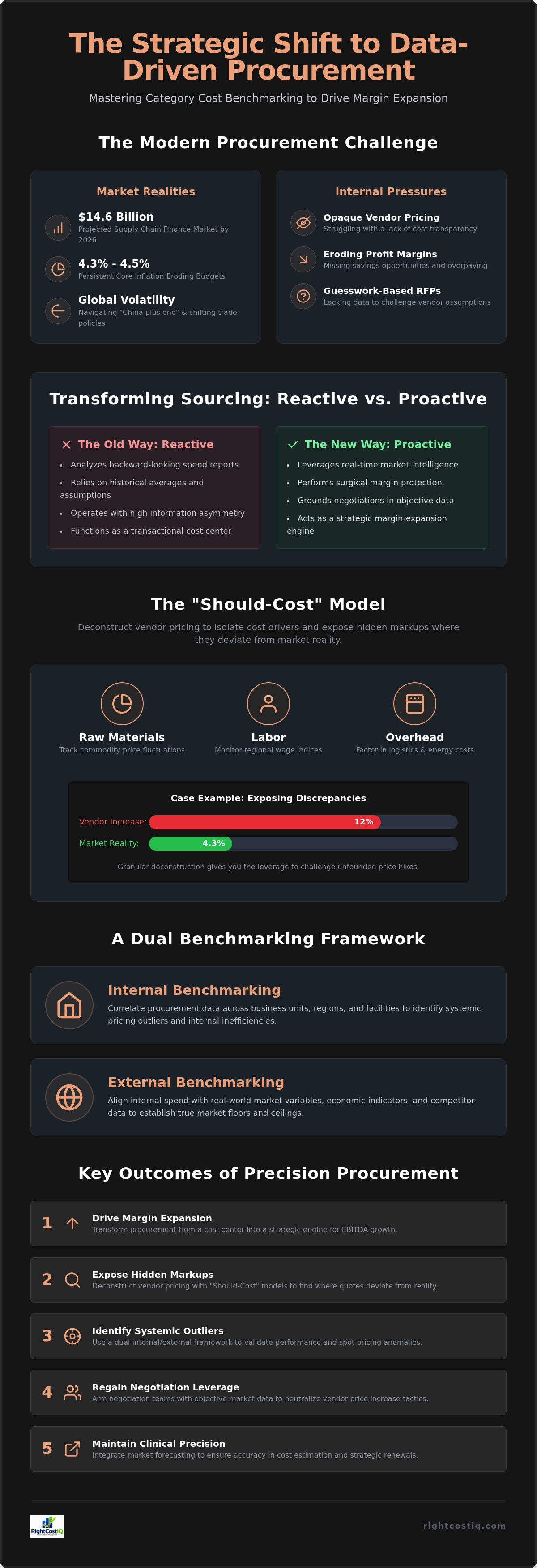
In a fiscal environment defined by core inflation persisting between 4.3% and 4.5%, procurement teams can't rely on the historical averages of previous cycles. Category Cost benchmarking has evolved from a periodic reporting task into a mandatory strategic alignment of internal spend against real-world market variables. This process demands a clinical deconstruction of cost drivers, including raw material fluctuations, labor indices, and the logistical volatility triggered by the 2026 USMCA review. Organizations that fail to achieve this level of precision find their margins eroded by opaque vendor pricing models that capitalize on information asymmetry.
Traditional spend analysis functions as an autopsy of past performance. It tells you what you paid, but it offers zero insight into what you should pay right now. Effective benchmarking bridges this gap by correlating internal procurement data with external market intelligence to drive enterprise EBITDA growth. When procurement leaders possess a granular understanding of market floors and ceilings, they transform from cost administrators into strategic architects of financial health. This level of oversight is essential as the global supply chain finance market reaches a projected $14.6 billion, requiring more sophisticated oversight of working capital.
Shifting from Reactive to Proactive Sourcing
Analyzing backward-looking spend reports often masks systemic inefficiencies. These reports don't account for the rapid "China plus one" sourcing shifts or the 8.6% growth rate in supply chain finance solutions. Real-time market price trending provides the necessary visibility to challenge vendor assumptions during the RFP cycle. Category cost benchmarking serves as a surgical instrument for proactive margin protection by reconciling internal procurement data with real-time market fluctuations.
Benchmarking as a Risk Mitigation Asset
Market intelligence functions as a primary defense against "surprise" cost escalations in long-term contracts. By identifying price risk before it impacts the balance sheet, teams can negotiate fixed-price agreements or index-based adjustments that reflect actual market conditions. Integrating these insights into a broader supplier risk management framework ensures that contract renewals are driven by objective data rather than vendor-dictated timelines. It secures strategic leverage in an era where trade policy volatility and shifting tariffs have become the baseline for global trade.
Technical Architecture of Multi-Dimensional Category Analytics
Effective Category Cost benchmarking relies on a sophisticated technical architecture that moves beyond basic price comparisons. At its core, the "Should-Cost" model deconstructs a product or service into its constituent parts: raw materials, labor, and overhead variables. By isolating these components, procurement teams can identify exactly where a vendor quote deviates from market reality. If core inflation persists at 4.3% but a supplier demands a 12% increase based on vague "market pressures," a granular deconstruction exposes the discrepancy immediately. This clinical approach ensures that negotiations are grounded in objective fiscal data rather than supplier narratives.
Leveraging big data allows for the rapid identification of pricing outliers across massive datasets. Automated tracking architectures now permit continuous category monitoring, flagging deviations the moment they occur. However, the utility of this data depends entirely on normalization. Without converting fragmented global data into a standardized format, an "apples-to-apples" comparison is impossible. Achieving this level of data hygiene is the first step toward reclaiming strategic leverage. You can assess your current data precision to see how these architectures might improve your margin expansion efforts.
Market Price Trending and Forecasting
Predictive models are essential for anticipating future category cost movements. By using historical data to validate future-state price assumptions, teams can build a reliable "Truth Source" for long-term planning. AI plays a critical role here, refining forecasting accuracy by processing thousands of market variables simultaneously. This integration of advanced technology into procurement analytics allows leaders to move from reactive budgeting to proactive price risk management. It ensures that 2026 financial targets remain achievable despite the volatility of shifting trade policies and interest rate fluctuations.
Granular Spend Visibility
Drilling down into sub-category levels is necessary to uncover hidden inefficiencies that aggregate reports often miss. Fragmented data across global supply chains frequently hides localized price gouging that erodes EBITDA over time. Granular visibility serves as the non-negotiable foundation of clinical procurement by providing the transparency required to execute high-stakes negotiations with total confidence. Without this level of detail, Category Cost benchmarking remains a theoretical exercise rather than a functional tool for financial growth. Precision at the sub-category level allows for the surgical removal of excess costs without compromising service quality.
Comparative Frameworks: Internal vs. External Benchmarking
Clinical execution of Category Cost benchmarking requires a dual-track approach that reconciles internal performance with external market realities. Internal benchmarking identifies "best-in-class" performance within your own business units, exposing discrepancies in how different departments or regions manage identical categories. This internal audit reveals immediate "quick wins" by standardizing pricing and service levels based on your most efficient existing agreements. It provides a baseline of what's achievable within your current operational constraints before you ever approach a vendor.
External benchmarking moves beyond internal limitations to validate performance against industry peers and market leaders. This external lens is critical for identifying whether your "best" internal price still lags behind the real-world market floor. When you combine both frameworks, you maximize negotiation leverage by proving that your demands aren't just market-aligned but are also operationally feasible. This dual-track strategy transforms procurement from a reactive function into a strategic architect of margin expansion.
Relying solely on internal historical data is a high-risk strategy in 2026. With core inflation persisting between 4.3% and 4.5% and interest rates stabilizing in the 4% to 5.25% range, yesterday's pricing benchmarks are effectively obsolete. In an inflationary market, historical data leads to accepting "less-bad" price increases rather than identifying true cost-saving opportunities. In a stabilizing market, it prevents you from capturing the full value of falling raw material costs or improved logistical efficiencies. You need real-time data to ensure your financial targets remain grounded in current economic conditions.
Competitive Peer Analysis
Accuracy in external benchmarking depends on selecting a peer group with comparable volume, regional presence, and regulatory requirements. For example, a UK-based entity must account for the specific Procurement Act 2023 financial thresholds that took effect in January 2026, such as the £135,018 limit for central government supplies. You can't compare a local authority's supply chain with a global private enterprise without normalizing for these variables. Identifying the "Gold Standard" requires a technical deconstruction of peer performance to ensure benchmarks are both aggressive and realistic.
Functional vs. Generic Benchmarking
Generic benchmarking data often fails to address the complexities of specialized industries like manufacturing or healthcare. These broad reports lack the sub-category depth required to analyze technical specifications or specialized labor requirements. Functional benchmarking provides the clinical precision needed to build a robust category management procurement strategy. It ensures that your cost models reflect the unique variables of your specific sector rather than broad industry averages that mask systemic inefficiency.
Operationalizing Benchmarking Data in RFP and Negotiation Cycles
Data-driven sourcing transforms the RFP from a procedural hurdle into a strategic filter for margin expansion. By establishing a "Truth Source" during the initial design phase, procurement leaders eliminate the information asymmetry that vendors typically exploit during the bidding process. Category Cost benchmarking provides the objective baseline required to challenge incoming bids immediately. This shifts the burden of proof directly to the supplier, requiring them to justify any deviation from verified market floors. It's a transition from asking what a vendor can offer to telling them what the market demands.
Utilizing these insights doesn't just improve the quality of bids; it redefines the entire engagement model. When you lead with market-aligned data, you signal a level of sophistication that discourages opportunistic pricing. This clinical approach ensures that your internal financial targets are baked into the RFP requirements from the outset, preventing the erosion of EBITDA through poorly structured agreements.
RFP Design and Vendor Selection
Robust benchmarking data allows for the imposition of realistic price ceilings before the first bid is received. This proactive stance enables the clinical execution of RFP management cycles, filtering out non-competitive vendors before they consume internal resources. By defining Key Performance Indicators (KPIs) based on market-leading performance rather than historical averages, you ensure that new contracts are engineered for maximum financial contribution. You aren't just selecting a vendor; you're architecting a high-performance supply relationship grounded in current economic realities.
The Negotiation Leverage Framework
The negotiation table is where analytical insights translate into tangible financial growth. Utilizing granular "Should-Cost" models allows procurement teams to dismantle opaque vendor quotes by questioning specific line-item variances in labor, materials, or overhead components. This technical deconstruction creates a data-backed narrative that forces vendor transparency and prevents the use of generic inflation claims as a blanket justification for price hikes. It replaces defensive posturing with assertive, fact-based positioning that vendors cannot easily dismiss. Objective benchmarking data shortens negotiation timelines by removing subjective debate and focusing conversations on verifiable market indices.
Securing market-leading terms requires more than just data; it demands the clinical application of that data through expert negotiation assistance. This ensures that every contract renewal acts as a primary driver for margin expansion rather than a simple administrative task. You can't afford to enter high-stakes discussions without a clear understanding of the market floor. To see how your current procurement data stacks up against 2026 market standards, you can access a free category diagnostic to identify immediate savings opportunities and reclaim your strategic leverage.
Executing Precision Procurement with RightCostIQ Analytics
RightCostIQ eliminates the systemic inefficiencies of manual data entry by integrating Category Cost benchmarking directly into the RFP lifecycle. While manual spreadsheets often result in fragmented oversight and missed saving opportunities, automated analytics provide the clinical precision required for high-stakes decision-making. This transition enables procurement leaders to move from reactive price-taking to proactive market-shaping. By leveraging proprietary price risk management and market price trending services, organizations can navigate the 2026 economic landscape where core inflation persists at 4.3% with total confidence.
Achieving sustainable margin expansion requires more than just identifying cost outliers. It demands expert-led negotiation support that translates analytical insights into contractually binding savings. RightCostIQ acts as a sophisticated strategic architect; providing the technical architecture needed to secure market-leading terms. This holistic approach ensures that every sourcing event contributes directly to enterprise EBITDA growth, reinforcing procurement’s role as a primary driver of financial performance. It's no longer enough to manage spend; you must architect it.
Unlocking Tail Spend Opportunities
Precision isn't reserved for high-volume categories. RightCostIQ applies the same clinical rigor to the often-ignored "tail spend" areas where high fragmentation usually hides systemic price gouging. By identifying savings in these low-volume categories, we help businesses capture the portion of spend that typically escapes strategic oversight. You can learn more about our tail spend management solutions to see how granular visibility transforms the bottom line. Capturing these hidden efficiencies is essential for maintaining a competitive edge in a volatile market.
Your Diagnostic Path to Savings
The first step in a clinical procurement overhaul is a professional category cost audit. Our diagnostic process identifies immediate savings opportunities and provides a roadmap for long-term margin expansion. It replaces guesswork with a data-driven assessment of your current vendor compliance and market competitiveness. Don't leave your margin to chance during the 2026 fiscal cycle. Get started with a Free Procurement Diagnostic to identify your category savings and reclaim your strategic leverage today. This professional evaluation sets the stage for a data-backed negotiation strategy that delivers tangible financial results.
Architecting Future Margins through Data Precision
The transition from reactive spend analysis to proactive Category Cost benchmarking defines the next era of procurement excellence. You've seen how clinical precision in RFP management and proprietary Should-Cost analysis frameworks dismantle opaque vendor pricing models. By aligning internal performance with real-world market variables, you transform your department into a primary driver of enterprise EBITDA growth. It's time to replace manual spreadsheets with automated, technical descriptors that secure a decisive edge in high-stakes contract renewals. This shift isn't just about cost reduction; it's about the strategic architecting of your long-term financial health.
Expert negotiation assistance ensures that your analytical insights translate directly into tangible financial results. Don't let information asymmetry erode your operational efficiency or compromise your 2026 fiscal targets. You can identify your hidden procurement savings with our Free Diagnostic Tool to start your journey toward clinical procurement today. Reclaiming your strategic leverage begins with a single, data-backed step toward total category transparency. You've the tools required to lead with confidence and precision in every negotiation cycle.
Frequently Asked Questions
What is the difference between spend analysis and category cost benchmarking?
Spend analysis is a retrospective review that identifies what your organization paid in the past. Category Cost benchmarking is a forward-looking strategic alignment that compares your internal spend against real-world market variables. While spend analysis provides a historical autopsy, benchmarking establishes a competitive "Should-Cost" baseline. It allows procurement leaders to identify hidden savings and reclaim leverage by reconciling internal data with current market floors rather than stagnant historical averages.
How often should a company update its category benchmarks?
Organizations should update their benchmarks quarterly or when significant market triggers occur. In 2026, with core inflation persisting near 4.5% and shifting trade policies, annual reviews are insufficient for margin protection. Volatile categories like raw materials or logistics require more frequent monitoring to maintain strategic leverage. RightCostIQ recommends real-time tracking for high-impact categories to ensure your negotiation teams aren't operating on obsolete data during sudden market escalations.
Can category benchmarking be applied to services as well as physical goods?
Benchmarking is highly effective for complex services such as IT, logistics, and professional consulting. Service costs are deconstructed into labor rates, overhead, and margin variables using the same clinical precision applied to physical goods. This technical deconstruction exposes hidden markups in service-level agreements. It enables procurement teams to negotiate based on objective market indices for specialized labor rather than accepting generic vendor price increases that lack fiscal justification.
What are the most common mistakes in procurement benchmarking?
The most frequent errors include relying on outdated historical data and using generic peer groups that don't reflect your specific volume or region. Many teams fail to normalize data for regulatory requirements, such as the 2026 UK Procurement Act thresholds. Another critical mistake is treating benchmarking as a static report rather than a dynamic negotiation tool. Without clinical execution, benchmarking remains a theoretical exercise that fails to deliver tangible EBITDA improvement.
How does benchmarking help in managing price risk?
Benchmarking identifies the market floor and ceiling, allowing teams to anticipate cost escalations before they impact the balance sheet. By correlating internal spend with market price trending, you can negotiate index-based contracts or fixed-price agreements with total confidence. This visibility prevents "surprise" vendor increases during the contract lifecycle. RightCostIQ integrates these benchmarks into a broader price risk management framework to protect corporate margins from the volatility of shifting trade policies.
Is external benchmarking data reliable for niche industries?
External data is reliable when it's normalized for technical specifications and specialized labor requirements. Generic benchmarks fail in niche sectors, but functional benchmarking provides the necessary precision for specialized industries like manufacturing or healthcare. RightCostIQ focuses on clinical procurement analytics to ensure that even highly specialized categories are compared against accurate, sector-specific indices. It’s about utilizing the right peer group rather than relying on broad industry averages that mask systemic inefficiency.
How does RightCostIQ ensure the precision of its benchmarking data?
RightCostIQ ensures precision through proprietary "Should-Cost" analysis frameworks and real-time market price trending models. We deconstruct costs into raw material, labor, and overhead variables to validate vendor quotes against objective market data. Our platform integrates Category Cost benchmarking directly into the RFP lifecycle, ensuring that data hygiene and normalization are maintained at every stage. This clinical execution removes the guesswork from procurement analytics and provides a reliable truth source for negotiations.
What is the ROI of professional category benchmarking services?
The ROI is realized through tangible EBITDA improvement and significantly reduced procurement cycle times. By identifying hidden savings and securing market-leading terms, professional benchmarking often pays for itself within the first RFP cycle. Beyond direct cost savings, the ROI includes mitigated price risk and improved vendor compliance. It transforms procurement from a traditional cost center into a sophisticated engine for margin expansion, providing a decisive edge in high-stakes contract renewals.


