
In a 2026 fiscal environment where aggregate logistics costs have surged to their highest levels since March 2022, a botched vendor handover is a structural failure that actively erodes the 10-12% of revenue typically allocated to supply chain operations. Most leaders recognize that the gap between contract termination and new vendor activation is where operational friction and hidden costs proliferate. You've likely experienced the erosion of historical price leverage the moment a legacy contract expires. This guide provides the clinical architecture required for how to transition to a new supplier smoothly, utilizing precise RFP management and data-driven benchmarking to eliminate financial volatility.
We'll move beyond generic advice to master the mechanics of zero-downtime knowledge transfer and the immediate realization of cost savings through automated performance tracking. By treating the transition as a strategic reset rather than a tactical hurdle, you ensure that your bottom line remains insulated from the 18% increase in combined inventory and transportation costs currently impacting the market. This framework transforms a high-risk operational shift into a controlled exercise in financial optimization and vendor accountability.
Key Takeaways
- Identify and mitigate "Incumbent Inertia" by redefining supplier transitions as strategic financial opportunities rather than just operational burdens.
- Utilize clinical procurement category cost benchmarking and market price trending to determine the optimal timing and fiscal targets for a vendor switch.
- Master the architecture of high-precision RFP management to learn how to transition to a new supplier smoothly while maintaining historical price leverage.
- Establish cross-functional transition protocols that utilize negotiation assistance to secure robust Transition Service Agreements (TSAs) and clear knowledge transfer timelines.
- Implement automated vendor performance tracking and procurement analytics to verify that projected contract savings are realized immediately after the handover.
The Strategic Risks of Unstructured Supplier Transitions
Supplier transitions are frequently misclassified as routine administrative migrations. This categorization is a fundamental error in strategic planning. A transition is a high-stakes financial event that dictates your margin health for the next contract cycle. When organizations lack a clinical framework for how to transition to a new supplier smoothly, they often fall victim to "Incumbent Inertia." This is the tendency to remain with suboptimal vendors due to a perceived risk of disruption. However, with U.S. business logistics costs reaching $2.6 trillion in 2024, representing 8.7% of the national GDP, the cost of staying with a poor partner is often higher than the cost of moving.
Financial volatility is the primary byproduct of an unmonitored handover. Unstructured transitions lead to unbudgeted cost spikes and the loss of historical price leverage. This instability compromises supply chain resilience and threatens operational continuity. Without a data-driven approach, the handover phase becomes a period of financial blindness where price risk management is ignored in favor of immediate logistics needs.
Quantifying the Cost of Transition Friction
Administrative overhead costs escalate rapidly during poorly managed data transfers. When knowledge transfer is decentralized, departments often engage in "shadow spend," procuring emergency services outside of negotiated frameworks to bridge operational gaps. This fragmentation obscures the true cost of the vendor switch. Procurement transition success is the alignment of cost, quality, and continuity.
Operational vs. Financial Transition Risks
Effective Supplier Relationship Management requires a clear distinction between physical logistics hurdles and contract price risks. Operational risks involve inventory stockouts or IT integration failures. Financial risks involve exposure to market volatility. For example, between August 2025 and August 2026, the Producer Price Index (PPI) for truck transportation rose by 14.3% and water transportation by 16.7%. Utilizing market price trending allows leaders to anticipate these shifts during the handover. Integrating category management ensures that department-specific disruptions don't derail the broader fiscal objectives of the transition. High-precision RFP management acts as the primary tool to mitigate these risks before they manifest as balance sheet liabilities.
Phase 1: Data-Led Pre-Transition Benchmarking
Effective leaders don't initiate a vendor switch based on operational frustration alone. They use clinical procurement category cost benchmarking to establish a data-driven target state. This phase is critical for understanding how to transition to a new supplier smoothly by eliminating price ambiguity before the Request for Proposal (RFP) process begins. By aligning with McKinsey's Sourcing Framework, organizations move from a reactive posture to a strategic one, ensuring every incoming bid is measured against objective market realities rather than arbitrary incumbent baselines.
Identifying Market Price Benchmarks
Procurement analytics expose hidden savings by comparing internal spend against global market trends. If incumbent pricing remains static while the Producer Price Index for your category softens, your margins are eroding. Establishing a Should-Cost analysis provides a precise baseline for negotiation. This model deconstructs the fundamental cost drivers, such as raw materials, labor, and overhead, to reveal the "true" market price. This is also the optimal moment to analyze Tail Spend. Consolidating fragmented, low-volume purchases into the new contract allows for immediate volume leverage and simplified vendor management post-transition. By capturing these unmanaged expenses during the switch, you turn a routine transition into a comprehensive cost-optimization event.
Forecasting Financial Outcomes
Market price forecasting acts as a strategic buffer against future volatility. In 2026, logistics managers saw transportation prices expand at the fastest rate in the history of the Logistics Manager's Index, hitting a sub-index of 96.0 in May. Understanding these trajectories allows you to negotiate index-linked contracts that ensure long-term stability rather than short-term gains. Cost benchmarking is the primary defense against overpaying during a vendor switch. By setting financial KPIs during this benchmarking phase, you create a scorecard that the new supplier must meet post-handover. This data-led approach ensures that the financial benefits of the transition are visible on the balance sheet from day one. To ensure your baseline is accurate, you can audit your current category spend to identify immediate benchmarking gaps.
Phase 2: RFP Management and Negotiation Architecture
Successful market engagement transforms benchmarking data into enforceable contract terms. The selection phase is the primary engine for determining how to transition to a new supplier smoothly. Leaders must utilize a high-precision RFP that treats the handover period as a specific service deliverable with its own technical requirements. By embedding transition protocols directly into the sourcing process, organizations eliminate the ambiguity that typically triggers operational friction and financial volatility. This stage requires a clinical focus on vendor capability rather than just unit pricing.
Engineering the Precision RFP
A precision RFP functions as a strategic blueprint for the entire vendor lifecycle. It must include granular data migration protocols, personnel training milestones, and clearly defined liability shifts for the implementation period. Professional RFP management reduces the time-to-value for new partnerships by ensuring these transition-specific SLAs are non-negotiable from the first interaction. Selection committees should utilize weighted scoring that balances 'ease of transition' against price and technical capability. This ensures the chosen partner possesses the operational maturity to manage a complex handover without compromising supply chain continuity.
Strategic Negotiation for Transition Support
Final talks must focus on securing Transition Service Agreements (TSAs) that insulate the organization from implementation-phase disruptions. These agreements should mandate dedicated project management resources from the supplier and secure price stabilization during the first 90 days. Securing these terms is the baseline for how to transition to a new supplier smoothly while maintaining the cost advantages identified during the benchmarking phase. Using negotiation coaching empowers teams to utilize benchmarking data as a clinical lever for securing these concessions. Contracts must explicitly address price risk mitigation, especially given the 14.3% increase in truck transportation PPI recorded in 2026. Evaluating a vendor's native performance tracking capabilities at this stage is essential. A supplier unable to provide automated compliance reporting will inevitably create administrative drag once the contract is active.
Phase 3: The Clinical Execution of the Transition Plan
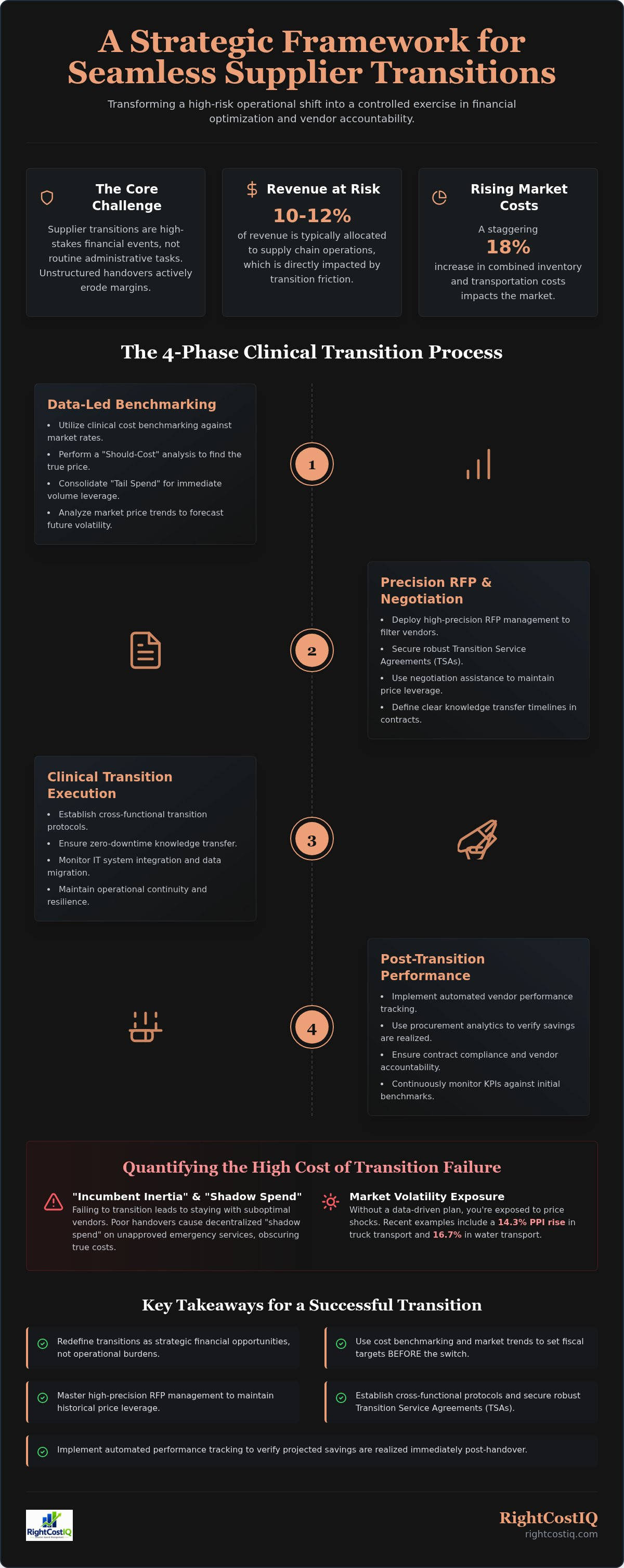
Clinical execution is the stage where strategic architecture meets operational reality. Mastering how to transition to a new supplier smoothly requires the mobilization of a cross-functional transition team comprising Procurement, Finance, Operations, and IT. This group ensures that data migration, financial reporting, and logistics workflows remain synchronized throughout the handover. The primary objective is to eliminate operational friction during the transfer of institutional knowledge from the incumbent to the new vendor. This process isn't a simple handover; it's a controlled migration of technical documentation and service standards.
Step-by-Step Implementation Framework
- Step 1: Finalize the Transition Service Agreement (TSA): Define the exit strategy with the incumbent to ensure they maintain contractually mandated service levels during the wind-down period.
- Step 2: Initiate Data Migration: Transfer historical spend analysis and technical specifications to the new vendor's platform to maintain data continuity and historical context.
- Step 3: Conduct Pilot Phases: Execute small-batch orders or regional pilots to test the new supplier's performance against the benchmarks established in the early planning phases.
Risk Mitigation and Contingency Planning
A dual-run period is essential for maintaining supply chain resilience during high-stakes migrations. Running systems or vendors in parallel during the initial onboarding phase allows for real-time comparison of service levels and prevents total operational downtime. If the new vendor fails to meet critical KPIs during the first 90 days, a predefined 'Rollback' plan ensures you can revert to the legacy provider or a secondary source without system failure. Clear communication protocols for internal stakeholders are mandatory to maintain operational buy-in and prevent the emergence of shadow spend.
Continuous monitoring of supply chain compliance during this window is non-negotiable. Automated vendor performance tracking acts as a clinical early warning system, identifying deviations in lead times or quality before they escalate into structural disruptions. In an era where logistics costs represent nearly 9% of the national GDP, you can't afford a "wait and see" approach to vendor performance. To ensure your execution plan is technically sound, you should access a transition readiness diagnostic to identify potential friction points before the dual-run begins.
Phase 4: Post-Transition Vendor Performance and Compliance
The transition lifecycle concludes only when the projected financial outcomes are verified on the balance sheet. This post-handover phase serves as the clinical validation of the entire sourcing event. Organizations must implement automated vendor performance tracking to ensure that the operational excellence promised during the RFP translates into sustained contract adherence. This is the final safeguard in understanding how to transition to a new supplier smoothly; it moves the partnership from a honeymoon period into a state of permanent accountability. Without this analytical oversight, the savings identified during the benchmarking phase often remain purely theoretical.
Tracking ROI and Savings Realization
A rigorous audit of the first six months of invoices against the original benchmarking data is mandatory to identify any instance of leakage. Price leakage occurs when a new supplier deviates from negotiated rates through unapproved surcharges or incorrect SKU pricing. Given that median supply chain costs currently hover between 10-12% of revenue, even a minor deviation represents a significant erosion of the business case. Procurement analytics verify that the projected savings are being realized in real-time, allowing for immediate corrective action. This is also the optimal period to integrate Tail Spend management strategies to capture residual efficiency from low-volume, fragmented spend categories that may have been overlooked during the primary migration.
Maintaining Strategic Supply Chain Compliance
Long-term supply chain resilience depends on continuous price risk management and market price trending. With 2024 U.S. business logistics costs reaching $2.6 trillion, leaders must use forecasting tools to anticipate the next wave of volatility. Establishing automated alerts for KPI slippage or compliance breaches ensures that minor operational friction doesn't evolve into a structural failure. In the current market, where transportation prices saw the fastest expansion in index history in May 2026, manual tracking is no longer a viable strategy for high-level decision-makers who prioritize the bottom line.
Quarterly Business Reviews (QBRs) should focus on data-driven performance metrics rather than qualitative relationship assessments. These reviews act as the mechanism for closing the loop, feeding performance data back into the next category management cycle to inform future benchmarking. This methodical approach ensures that the organization remains a strategic architect capable of managing its vendor ecosystem with clinical precision. Ready to optimize your procurement outcomes? Get your free diagnostic now.
Strategic Resilience Through Analytical Transition Architecture
A supplier transition isn't an operational burden; it's a strategic reset for your financial growth. By moving from legacy-based decision-making to a clinical framework, you insulate your margins from the supply chain volatility currently impacting global markets. Mastering how to transition to a new supplier smoothly requires the integration of data-driven benchmarking and high-precision RFP management. These tools ensure that unit price savings aren't lost to implementation friction or price leakage post-handover.
The final stage of a successful transition is the implementation of automated performance tracking. This closes the loop between strategic intent and realized ROI. You don't have to navigate these complexities alone. Optimize your next supplier transition with a Free Procurement Diagnostic. Our platform provides expert RFP management, data-driven cost benchmarking, and advanced price risk forecasting to ensure your supply chain remains a primary driver of financial performance. Take the first step toward a friction-free vendor ecosystem today.
Frequently Asked Questions
What is a Transition Service Agreement (TSA) in procurement?
A Transition Service Agreement is a legally binding contract where an outgoing supplier provides specific services for a set period to ensure continuity. It defines the scope, duration, and fees for support during the handover. This document is the primary tool for mitigating operational risk when legacy systems are deeply integrated. It prevents service gaps by mandating incumbent cooperation until the new vendor is fully operational.
How long does a typical enterprise supplier transition take?
Enterprise supplier transitions typically span three to nine months, depending on category complexity and integration depth. Simple commodity shifts might conclude in 90 days, while highly integrated IT or logistics switches often require a multi-phase approach. The timeline includes benchmarking, RFP execution, and the dual-run period. Rushing this cycle increases the probability of data loss and financial leakage during the implementation phase.
How can I prevent operational downtime when switching suppliers?
Preventing operational downtime requires a controlled dual-run period where both suppliers operate in parallel. This redundancy allows for real-time troubleshooting of data migration and logistics workflows. You can learn how to transition to a new supplier smoothly by establishing clear milestones for knowledge transfer and technical onboarding. Continuous monitoring of vendor performance during this window ensures that any service deviations are addressed before the legacy contract expires.
What are the most common hidden costs in a supplier transition?
Hidden costs often manifest as administrative overhead, emergency off-contract spending, and data migration fees. Organizations frequently underestimate the cost of internal resource reallocation during the knowledge transfer phase. Another common expense is "shadow spend," where departments procure services externally to bridge perceived gaps. These costs can be mitigated through precise RFP management that accounts for implementation-specific liabilities and resource requirements from the outset.
How do I communicate a supplier change to internal stakeholders effectively?
Effective communication with internal stakeholders relies on a data-driven narrative that highlights long-term fiscal benefits and operational improvements. Use cost benchmarking data to justify the switch and provide a clear roadmap of the transition phases. Establishing a cross-functional team ensures that department-specific concerns are addressed early. This approach minimizes resistance and prevents the operational friction that occurs when teams are unprepared for a change in vendor protocols.
What data should I request from an outgoing supplier before they exit?
Request comprehensive historical spend data, technical specifications, and service level performance logs from the outgoing vendor. You must also secure access to proprietary documentation, integration maps, and any outstanding compliance reports. Ensuring this data is transferred in a structured format prevents the loss of institutional knowledge. This information acts as the baseline for your new supplier's onboarding and is essential for maintaining historical price leverage.
How does price risk management apply to a new supplier contract?
Price risk management integrates market price trending and forecasting into the new contract's terms to insulate the business from market volatility. This strategy involves negotiating index-linked pricing or volume-based discounts that reflect real-time market shifts. In 2026, where logistics costs reached 8.7% of the national GDP, this oversight is critical. It ensures that the savings identified during the RFP aren't eroded by unforeseen spikes in transportation or raw material costs.
Can I use RFP management services for small category transitions?
Yes, professional RFP management services are highly effective for small category transitions to capture "tail spend" efficiencies. Small categories often suffer from fragmented spending and lack of oversight, leading to significant margin erosion. Applying clinical sourcing architecture to these smaller transitions ensures that even minor contracts are optimized for cost and performance. This approach provides a blueprint for how to transition to a new supplier smoothly across the entire procurement ecosystem.


