
Market price trending is not a passive observation of data; it is a strategic architectural lever that dictates the entire RFP lifecycle's success. Procurement leaders recognize that relying on historical averages in a 2026 economy, where material prices fluctuate up to 50 percent, is a direct path to margin erosion. It's frustrating to enter high-stakes vendor negotiations while lacking the data-driven leverage necessary to challenge unjustified cost increases or navigate inefficient category benchmarking.
This article provides the rigorous framework needed to master the clinical execution of Market Price Trending. By integrating predictive intelligence into your sourcing strategy, you'll gain the ability to forecast volatility with precision, optimize RFP outcomes, and secure tangible margin expansion. We'll examine how to leverage advanced cost benchmarking and real-time risk management to transform procurement from a reactive function into a primary driver of financial growth. Our analysis covers the shift toward predictive category management and the specific methodologies required to mitigate financial risk under the current Revolutionary FAR Overhaul regulations.
Key Takeaways
- Shift from reactive cost-cutting to a proactive procurement discipline by leveraging macroeconomic indicators to anticipate 2026 market shifts.
- Construct a clinical architecture for forecasting that replaces intuition with a data-driven intersection of historical trends and real-time market intelligence.
- Differentiate between static benchmarking and dynamic Market Price Trending to identify significant category savings that traditional methods overlook.
- Integrate precise price risk management into the RFP lifecycle to maximize negotiation leverage and ensure tangible margin expansion.
- Deploy advanced analytics to bridge the gap between traditional sourcing and automated financial optimization for superior vendor performance tracking.
The Strategic Importance of Market Price Trending in 2026
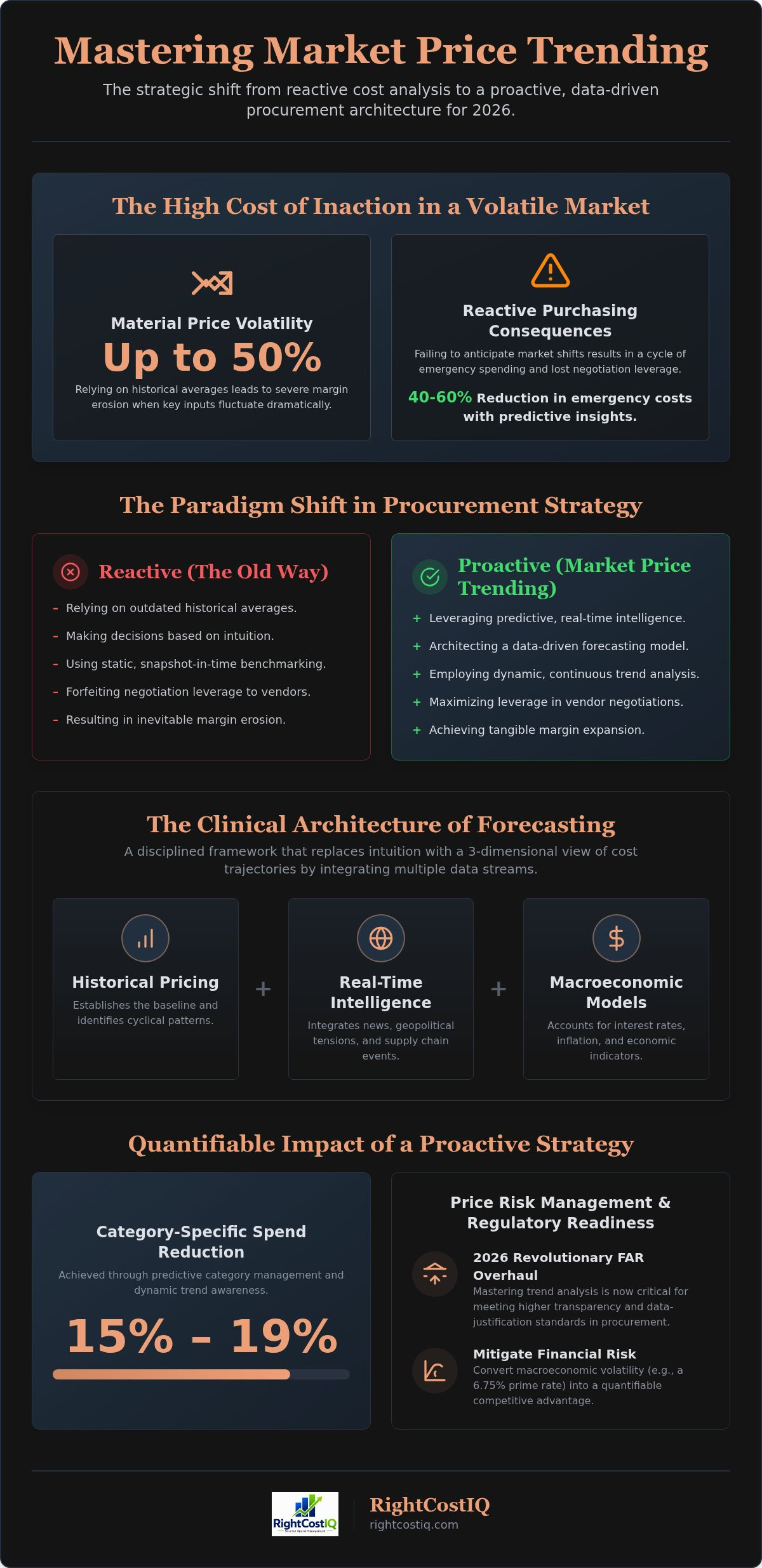
Market price trending is a proactive procurement discipline designed to eliminate the financial blind spots inherent in static cost analysis. In 2026, where key raw material inputs fluctuate between 5 percent and 50 percent, the cost of reactive purchasing is no longer sustainable. Procurement leaders must transition from tracking historical ticks to architecting a forward-looking price risk management framework. This strategic shift serves as the primary foundation for enterprise resilience, ensuring that external shocks don't compromise corporate profitability or operational continuity.
Relying on outdated procurement models in high-volatility markets creates a cycle of emergency spending. Predictive insights can reduce these emergency procurement costs by 40 percent to 60 percent. When organizations fail to anticipate market shifts, they surrender their negotiation leverage to vendors who possess superior data. Establishing a clinical approach to price movement allows firms to secure margin expansion even when macroeconomic conditions are unfavorable.
Beyond Commodity Ticks: A Holistic View
A clinical approach to market volatility requires more than monitoring simple spot prices. It demands the integration of geopolitical tensions and US economic data into sophisticated price models. With the Bank Prime Loan Rate reaching 6.75 percent as of September 2026, procurement costs are directly tethered to Federal Reserve expectations and broader Pricing Strategies across global markets. Market price trending is a clinical tool for financial growth that converts macroeconomic volatility into a quantifiable competitive advantage.
The Economic Impact of Inefficient Trend Analysis
Delayed market responses lead to immediate margin erosion. When procurement teams fail to synchronize their sourcing with shifting price trajectories, they forfeit the leverage required for effective vendor negotiations. Research indicates that predictive Category Management in Procurement can reduce category-specific spend by 15 percent to 19 percent. This efficiency is directly linked to trend awareness; without it, supply chain compliance suffers as vendors capitalize on information asymmetry.
The strategic urgency of Market Price Trending is amplified by the 2026 Revolutionary FAR Overhaul. This regulatory shift demands higher levels of transparency and data-driven justification in procurement cycles. Organizations that lack a rigorous trend analysis framework will find themselves struggling to meet compliance standards while their competitors use the same data to optimize RFP outcomes. Mastering this discipline isn't just about cost savings; it's about maintaining a dominant position in a data-centric economy.
The Clinical Architecture of Market Price Forecasting Models
Building a clinical architecture for procurement requires discarding intuition in favor of structured data. The intersection of historical pricing, real-time news cycles, and macroeconomic models creates a three-dimensional view of cost trajectories. Relying on simple spend analysis is a reactive posture that ignores the hidden price drivers dictated by the 2026 fiscal environment. Predictive cost optimization uses these data points to anticipate shifts before they impact the bottom line, allowing procurement architects to maintain control over vendor negotiations.
Modern Market Price Trending frameworks rely on granular data integration to identify anomalies in supplier quotes. The Federal Open Market Committee's decision to raise the federal funds rate by 25 basis points in September 2026 directly influences borrowing costs and vendor pricing models. A rigorous Federal Procurement Analysis highlights that competition and price analysis are the primary safeguards against margin erosion in complex acquisition cycles. By standardizing these inputs, organizations transform market intelligence into a repeatable strategic advantage.
Data-Driven Sourcing and Predictive Analytics
The transition from manual tracking to AI-led optimization significantly reduces forecasting error margins. By utilizing advanced procurement analytics, teams can validate vendor quotes against objective market benchmarks. This framework enables "Should-Cost" modeling, which identifies where supplier margins are expanding at the buyer's expense. Predictive tools analyze supply chain disruptions and geopolitical shifts to recommend alternative sourcing routes. This ensures that RFP outcomes remain optimal despite high material price volatility, which has fluctuated between 5 percent and 50 percent throughout 2026.
Quantifying Financial Volatility and Risk
Standardizing risk metrics across diverse categories is essential for enterprise resilience. Organizations must move from fragmented spreadsheet-based tracking to integrated, automated platforms that offer real-time visibility. This clinical execution in data gathering ensures that every procurement decision is backed by verified market intelligence. Standardized metrics allow for a direct comparison of risk profiles between different raw materials or service categories, facilitating a more strategic allocation of resources. It's no longer enough to track spend; you must quantify the probability of future price shocks.
Accurate Market Price Trending enables procurement architects to pinpoint specific triggers for cost increases. This level of precision allows for more aggressive negotiation stances during vendor renewals. If you're ready to move beyond reactive spending, you can utilize advanced should-cost analysis to benchmark your current category performance and identify immediate savings opportunities.
Benchmarking vs. Trending: Identifying Category Savings
Static cost benchmarking provides a fixed snapshot of peer performance, yet it lacks the predictive velocity required to navigate the high-volatility markets of 2026. While benchmarking establishes a baseline of what others are paying, Market Price Trending maps the trajectory of costs over time. This distinction is critical; a price that appears competitive today based on a static benchmark might be grossly inflated tomorrow if the trend trajectory is downward. Procurement architects must evolve their category management strategies to prioritize dynamic data over historical anchors to capture maximum margin expansion.
Relying solely on benchmarking in a 2026 economy, where material prices fluctuate by up to 50 percent, is insufficient because it treats a volatile, moving target as a stationary data point. Professional category management requires a clinical understanding of how these fluctuations impact specific contract terms. By shifting the focus to trend-aware analytics, organizations can identify precise windows for renegotiation that static models routinely miss.
Advanced Benchmarking Standards
Establishing a rigorous baseline for procurement category cost benchmarking requires the integration of real-time market data to identify pricing outliers. When vendor quotes deviate from the established trend line, it signals an opportunity for immediate intervention. This level of scrutiny is particularly effective when applied to unmanaged spend categories. Addressing the hidden 20 percent of enterprise spend through Tail Spend Management allows procurement teams to uncover significant savings in areas often overlooked by traditional benchmarking. By identifying price drivers within these smaller categories, firms can implement high-efficiency sourcing controls that aggregate into substantial financial gains.
Identifying and Quantifying Category Variance
Variance analysis serves as the diagnostic tool for uncovering overspending in complex contracts. By calculating the delta between Market Price Trending data and actual vendor performance, procurement leaders gain the objective leverage needed for aggressive negotiation. This variance data acts as a primary driver for sophisticated RFP Management, ensuring that contract awards are based on projected market realities rather than vendor-supplied narratives. Predictive category management, supported by these insights, typically reduces category-specific spend by 15 percent to 19 percent. This methodical approach transforms negotiation from a battle of intuition into a clinical execution of data-driven strategy, securing margins against unpredictable financial volatility.
Implementing Price Risk Management in Complex RFP Cycles
Effective price risk management transforms the RFP from a tactical procurement event into a high-stakes financial hedge. In the 2026 economy, where raw material price volatility reaches 50 percent, the entire RFP lifecycle must be anchored in clinical market intelligence. Integrating forecasting models directly into sourcing workflows allows decision-makers to dictate terms rather than accept them. This methodical approach ensures that contract awards reflect objective market trajectories rather than supplier-biased projections.
Securing enterprise resilience requires procurement architects to move beyond static bid comparisons. By embedding Market Price Trending into the evaluation phase, organizations can identify which vendors are offering sustainable pricing and which are masking future cost increases. This level of scrutiny is essential for maintaining margin stability in a fiscal environment where the Bank Prime Loan Rate remains at 6.75 percent. Sourcing teams that fail to account for these macroeconomic pressures during the RFP cycle often find their savings projections dismantled by mid-contract price adjustments.
The RFP Lifecycle and Market Intelligence
Pre-RFP research is the strategic foundation for timing the market. If trend data indicates a cooling period for specific categories, delaying the RFP launch can yield immediate leverage. Conversely, when Market Price Trending signals an upward trajectory, procurement leaders must accelerate sourcing to lock in current rates. Evaluating vendor responses against market-driven cost models exposes "margin padding" hidden within complex quotes. Utilizing specialized RFP Management Services provides the technical precision needed to strip away these hidden costs and ensure every bid is benchmarked against real-time data.
Negotiation Strategies for High-Value Procurement
Negotiations must be anchored in objective data to be effective. When a vendor cites "inflationary pressures" to justify a rate hike, procurement teams should counter with category-specific trend data. While the Federal Funds Effective Rate is 3.63 percent, specific material inputs may show a different trajectory entirely. Using trend data as a psychological and financial anchor forces vendors to justify their pricing against verifiable reality. For complex, high-value deals, deploying a Negotiation Coach refines procurement tactics and ensures the team maintains an assertive, data-backed stance throughout the process.
Mitigating future financial volatility requires the implementation of indexed contract clauses. These clauses tie pricing to specific market benchmarks, ensuring the enterprise captures savings automatically if the market cools. This structural protection eliminates the need for constant, reactive renegotiation. To ensure your current sourcing strategy is optimized for the 2026 market, you can access a clinical diagnostic of your RFP processes to identify immediate risk mitigation opportunities.
RightCostIQ: Precision Analytics for Market Price Optimization
RightCostIQ functions as a high-level consultant for procurement teams seeking to bridge the gap between traditional sourcing and digital innovation. By deploying a specialized Market Price Trending and Forecasting Service, we provide the clinical precision required to navigate the financial volatility of 2026. Our platform doesn't just track data; it translates macroeconomic shifts into actionable negotiation leverage. This integration ensures that every RFP outcome is optimized for long-term margin stability and operational efficiency.
The value of professional RFP management and negotiation assistance lies in the ability to challenge vendor-supplied narratives with objective market intelligence. RightCostIQ provides the technical framework to validate cost structures against real-time benchmarks, ensuring that enterprise margins remain protected. Our Price Risk Management and Tracking Service allows procurement leaders to anticipate price shocks before they impact the bottom line. This proactive posture is essential in a fiscal environment where the Bank Prime Loan Rate has reached 6.75 percent, necessitating a more rigorous approach to capital allocation.
The Strategic Architect of Your Supply Chain
We position ourselves as the strategic architect of your supply chain, moving beyond generic consulting to a high-level strategic partnership. Generic firms often offer surface-level advice that fails to account for the 5 percent to 50 percent material price swings observed throughout 2026. RightCostIQ delivers clinical execution of procurement analytics, targeting specific category drivers to secure tangible margin expansion. By refining corporate strategy through data-driven price risk management, we help decision-makers transform the procurement department into a primary engine for financial growth.
Securing long-term operational efficiency requires more than just initial cost savings. It demands continuous Procurement and Vendor Performance Tracking to ensure that suppliers meet their contractual obligations. Our analytics engine identifies performance gaps and price variances in real-time, allowing for immediate corrective action. This level of oversight ensures that the savings identified during the RFP phase are actually realized throughout the life of the contract, preventing the "savings leakage" that plagues less sophisticated sourcing models.
Next Steps for Enterprise Optimization
Enterprise optimization begins with a rigorous assessment of your current spend under management. Procurement leaders must integrate market intelligence into their existing infrastructure to maintain a competitive advantage in a data-centric economy. RightCostIQ provides the tools and expertise required to benchmark category performance and identify immediate opportunities for cost reduction. Our methodology focuses on technical upskilling and the implementation of advanced technology into traditional business functions.
If you're ready to secure your financial growth metrics and mitigate the risks of an unpredictable market, it's time to upgrade your sourcing infrastructure. You can optimize your procurement outcomes with RightCostIQ by accessing our full suite of precision analytics and negotiation support. Don't leave your margins to chance; utilize a clinical framework designed for the complexities of 2026.
Mastering the Future of Strategic Sourcing
Mastering Market Price Trending is the definitive requirement for procurement leaders navigating the high-volatility landscape of 2026. This article has detailed the transition from reactive spend analysis to a clinical architecture of predictive forecasting. You've identified how dynamic trending uncovers category savings that static benchmarking ignores; while integrating market intelligence into the RFP cycle provides the leverage needed to challenge vendor pricing effectively.
RightCostIQ, founded in 2023 with a specialization in healthcare financial analytics, provides the proprietary RFP management and negotiation frameworks necessary for this evolution. Our comprehensive category cost benchmarking and analytics ensure your sourcing remains grounded in objective data rather than vendor-supplied narratives. It's time to replace intuition with technical precision to secure your corporate margins and drive operational efficiency.
Execute a precision procurement strategy with RightCostIQ
Your organization is now equipped to transform market volatility into a measurable competitive advantage.
Frequently Asked Questions
What is the primary difference between market price trending and cost benchmarking?
Market price trending focuses on the trajectory of costs over time, whereas cost benchmarking provides a static comparison against peer averages at a single point. Benchmarking identifies current performance gaps, but trending predicts future cost movements to inform strategic timing. This distinction is vital in 2026, where material price volatility reaches 50 percent. Organizations use trend data to move beyond historical anchors and capture savings as market conditions shift.
How can procurement teams use market forecasting to improve RFP outcomes?
Procurement teams utilize market forecasting to synchronize RFP launches with downward price cycles, maximizing negotiation leverage. By evaluating vendor responses against predictive cost models, architects can identify "margin padding" that traditional bid comparisons overlook. This clinical approach ensures that contract awards reflect projected market realities. It's a method that transforms the RFP from a reactive event into a strategic financial hedge against unpredictable raw material fluctuations.
What are the most critical macroeconomic indicators for procurement in 2026?
In 2026, the most critical indicators include the Bank Prime Loan Rate at 6.75 percent and the Federal Funds Effective Rate at 3.63 percent. Additionally, the US Treasury 1-year constant maturity rate of 4.16 percent dictates broader borrowing costs and vendor pricing structures. Procurement leaders must also monitor the 5 percent to 50 percent volatility in key construction and raw material inputs. These data points serve as the foundation for enterprise price risk management.
How does price risk management mitigate financial volatility in contracts?
Price risk management utilizes indexed contract clauses to tie procurement costs directly to verifiable market benchmarks. This structural protection ensures that organizations capture savings automatically if market prices cool, eliminating the need for constant, reactive renegotiations. By anticipating price shocks through Market Price Trending, teams can secure margin stability even when macroeconomic conditions are unfavorable. It's an essential discipline for maintaining enterprise resilience in a high-interest rate environment.
Can market price trending help in managing tail spend?
Yes, Market Price Trending is highly effective for managing tail spend, which often accounts for the unmanaged 20 percent of enterprise expenditure. Automated analytics identify price drivers within these fragmented categories that traditional benchmarking routines miss. By applying trend-aware scrutiny to tail spend, procurement teams aggregate significant financial gains across low-value transactions. This high-efficiency approach ensures that no category remains insulated from data-driven cost optimization and clinical margin expansion.
Why is clinical execution important in procurement category analytics?
Clinical execution ensures that procurement decisions are based on objective, verifiable data rather than vendor-supplied narratives or internal intuition. In the 2026 fiscal landscape, precise data gathering is necessary to meet the transparency requirements of the Revolutionary FAR Overhaul. It eliminates information asymmetry during negotiations, allowing procurement architects to challenge unjustified price increases with authority. This methodical approach to category analytics is the primary driver for achieving predictable financial growth metrics.
How does vendor performance tracking relate to market price trends?
Vendor performance tracking ensures that suppliers adhere to the price trajectories established during the negotiation phase. It monitors whether vendors are passing on market-driven savings or if they're attempting to sustain inflated margins during deflationary periods. By correlating vendor performance with real-time market trends, procurement leaders maintain operational efficiency and supply chain compliance. This oversight is critical for preventing "savings leakage" and ensuring long-term contract value remains intact.
What tools are essential for tracking market price trending in real-time?
Essential tools include AI-driven spend classification systems and automated market intelligence platforms that integrate macroeconomic data in real-time. Sophisticated market price trending and forecasting services are also vital for validating supplier quotes. These technologies bridge the gap between traditional business functions and digital innovation. RightCostIQ delivers these precision analytics to help decision-makers forecast volatility and optimize procurement outcomes through specialized RFP management and category cost benchmarking.


