
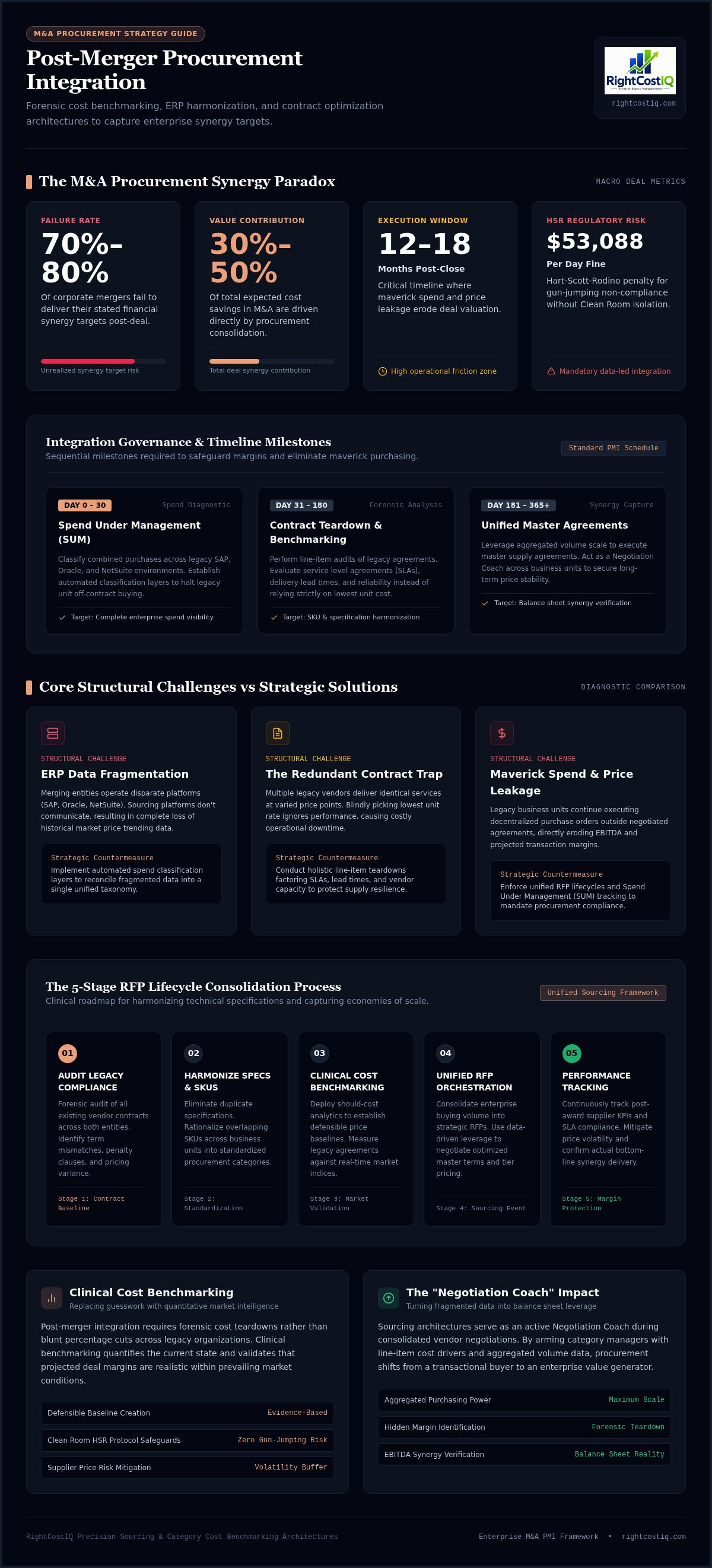
Between 70% and 80% of corporate mergers fail to deliver their stated financial synergy targets, yet procurement consolidation accounts for 30% to 50% of total expected cost savings. This massive gap exists because most organizations struggle with post-merger procurement integration challenges, specifically data fragmentation across disparate ERP systems and the loss of historical market price trending data. You've likely seen how redundant vendor contracts lead to sub-optimal pricing and operational friction during the critical first 12 to 18 months of integration. Without a unified strategy, maverick spend and price leakage quickly erode the deal's projected value.
This guide provides a strategic framework to navigate this complex landscape, allowing you to eliminate data silos and mitigate price risk across the new combined entity. We'll show you how to realize promised financial synergies through clinical cost benchmarking and unified RFP orchestration. You'll learn to implement a data-driven sourcing architecture that transforms procurement from a post-deal hurdle into a primary driver of enterprise growth and long-term price stability. By leveraging forensic cost analysis, your organization can turn fragmented data into a competitive financial advantage.
Key Takeaways
- Define the primary objective of clinical procurement consolidation to capture economies of scale and maximize contract optimization across the enterprise.
- Navigate structural post-merger procurement integration challenges by reconciling fragmented ERP data and rationalizing redundant vendor architectures that threaten synergy realization.
- Deploy a clinical benchmarking framework to quantify the current state of legacy organizations and establish defensible cost baselines for future negotiations.
- Master a five-stage RFP lifecycle consolidation process to audit legacy vendor compliance and harmonize technical requirements for the newly formed entity.
- Utilize specialized analytics and expert RFP management architectures to track vendor performance and mitigate price volatility within the combined corporate structure.
What is Post-Merger Procurement Integration (PMI)?
post-merger integration (PMI) in the procurement context is the clinical consolidation of sourcing strategies, vendor contracts, and procurement infrastructures following an M&A event. It isn't a simple organizational merger; it's a forensic alignment of supply chain assets. The primary objective is capturing synergy savings through aggressive economies of scale and contract optimization. In 2026, regulatory environments like the Hart-Scott-Rodino (HSR) Act require strict data-led integration protocols. Pre-merger teams must use Clean Rooms to avoid gun-jumping penalties, which now reach $53,088 per day for non-compliance. Failing to overcome post-merger procurement integration challenges directly erodes EBITDA and weakens long-term supply chain resilience. Since procurement represents 30% to 50% of total deal synergies, any execution gap here threatens the entire transaction's ROI.
The Concept of Spend Under Management (SUM)
Identifying total spend is the first massive barrier to integration success. Most merging entities operate on incompatible ERP systems, such as SAP, Oracle, or NetSuite, which hide the true volume of combined purchases. Navigating these post-merger procurement integration challenges requires a shift from manual spreadsheets to automated spend classification layers. Spend Under Management (SUM) is the percentage of total enterprise spend actively managed by procurement teams. High SUM percentages correlate with better synergy realization because they eliminate "maverick" spend that occurs when legacy units continue buying outside of new master agreements. Achieving visibility within the first 30 days is now a standard requirement for high-performing integration offices.
Procurement as a Driver of M&A Value
Strategic procurement does more than cut costs; it validates the core financial assumptions of the deal. By moving beyond blunt price reductions, procurement teams drive strategic value creation through SKU rationalization and specification harmonization. They provide the evidence needed to confirm that the projected deal margins are actually achievable in the current market. RightCostIQ enables this by offering procurement category cost benchmarking and analytics that identify hidden savings in legacy contracts. These architectures serve as a "Negotiation Coach" for consolidated vendor discussions, helping teams manage price risk and market volatility across the new entity. This data-driven approach ensures that synergy realization isn't just a projection but a verified balance sheet reality.
Structural Challenges in Post-Merger Procurement Integration
Capturing procurement-driven synergies in mergers requires solving the fundamental problem of data fragmentation. When two entities merge, they often bring disparate ERP systems and sourcing platforms that don't communicate. This technical disconnect creates a vacuum where historical price trending data is easily lost. Organizations face significant post-merger procurement integration challenges when trying to reconcile these systems without sacrificing the granular visibility needed for negotiation. Redundant vendor architectures further complicate the landscape. You often find multiple suppliers providing identical services across different legacy business units, each with varying price points and terms. Without a clinical approach to post-merger integration (PMI), the new entity risks operational friction that stalls synergy realization and degrades supply chain stability.
The Redundant Contract Trap
Simply selecting the legacy contract with the lowest unit price is a strategic error. Price is only one variable in a complex equation that includes service level agreements (SLAs), delivery lead times, and vendor reliability. A cheaper contract with poor performance metrics can cost more in operational downtime than a premium-priced agreement. Procurement teams must use advanced procurement analytics to perform a line-item teardown of every active agreement. This forensic analysis identifies the superior partner based on total cost of ownership rather than surface-level rates. It prevents the harmonization phase from becoming a race to the bottom that compromises quality.
Mitigating Market Price Volatility
Integration timelines typically span 12 to 18 months, a window large enough for significant market shifts to occur. If a merger coincides with a period of high inflation or raw material shortages, the expected synergies can vanish before they reach the balance sheet. Protecting the bottom line requires constant market price trending and forecasting. You can't rely on static due diligence data when the market is moving. Implementing a robust price risk management strategy allows the combined entity to lock in favorable rates and hedge against volatility. This proactive stance ensures that the financial growth metrics promised to stakeholders remain intact despite external economic pressures. For a deeper look at your current exposure, consider a preliminary cost analysis to identify immediate risk areas.
Clinical Benchmarking: The Framework for Synergy Realization
Clinical benchmarking serves as the forensic anchor for synergy realization. You can't achieve economies of scale if you haven't quantified the starting point of both legacy procurement organizations. Establishing a defensible baseline requires a line-item teardown of existing spend, comparing combined purchase volumes against market-leading price points. This data-driven approach allows decision-makers to identify vendor performance gaps before any contract consolidation occurs. Advanced analytics identify which vendors consistently miss delivery windows or fail quality audits, ensuring you don't inherit a legacy partner's operational failures. By using analytical architectures to highlight these discrepancies, you directly address the post-merger procurement integration challenges that typically result in "averaging up" prices rather than driving them down to the lowest common denominator.
Executing Category Management Strategy
Success depends on prioritizing categories based on spend volume and integration feasibility. You don't need to consolidate every category simultaneously; instead, focus on the high-impact areas that offer the greatest margin expansion. Leveraging category management procurement ensures that sourcing decisions are based on forensic market intelligence rather than legacy relationships. Clinical precision in this analysis prevents "synergy leakage," where projected savings disappear due to poor specification harmonization or unmanaged vendor price escalations. This methodical prioritization turns the complexity of integration into a structured roadmap for financial growth and operational efficiency.
Tail Spend Optimization
The bottom 20% of suppliers often represent a disproportionate administrative burden and a significant source of hidden costs. This fragmented, low-value purchasing is a primary driver of margin creep during the transition phase. Implementing aggressive tail spend management during the first 100 days provides an immediate boost to ROI. By consolidating redundant small-scale vendors and automating routine transactions, you eliminate the operational friction that often bogs down procurement teams. This optimization frees your high-level strategic resources to focus on high-value negotiations and complex post-merger procurement integration challenges that require expert-led intervention and sophisticated cost modeling. Capturing these "quick wins" builds momentum for the more difficult stages of the integration process.
Consolidating the RFP Lifecycle: 5 Steps to Unified Sourcing
Unified sourcing is the engine of synergy realization. Organizations must move past fragmented regional renewals to a centralized five-stage pipeline. This methodical approach addresses the most persistent post-merger procurement integration challenges by replacing anecdotal vendor relationships with forensic performance data. To secure the 30% to 50% of total synergies typically found in procurement, integration teams should follow this structured execution framework:
- Step 1: Audit legacy vendor performance and compliance metrics. Identify high-risk suppliers and contract leakage points before entering new agreements.
- Step 2: Define unified technical and financial requirements. Harmonize specifications across the new entity to eliminate redundant SKU variants.
- Step 3: Execute a clinical RFP process. Use centralized RFP management architectures to maintain data integrity and ensure competitive tension.
- Step 4: Leverage combined volume. Drive aggressive negotiation outcomes by targeting the "should-cost" floor identified during the benchmarking phase.
- Step 5: Implement automated vendor performance tracking. Ensure post-award compliance to stop margin creep and verify that negotiated savings reach the balance sheet.
Executing this lifecycle with precision prevents the "synergy erosion" that occurs when legacy business units continue to buy outside of new master service agreements. For a forensic evaluation of your combined sourcing pipeline, you can access a free diagnostic to identify immediate RFP optimization opportunities.
Advanced Negotiation Tactics for Combined Entities
In the 2026 procurement market, simple volume aggregation is a baseline, not a competitive advantage. Sophisticated suppliers anticipate volume-based requests; therefore, procurement teams must use market price trending as a strategic lever. Engaging a professional negotiation coach provides the analytical edge needed to challenge incumbent cost structures. This approach moves beyond blunt price cuts to a forensic discussion about bill-of-materials and tier-2 supplier markups. It transforms the negotiation from a tactical exercise into a strategic value-creation event.
RFP Precision and Compliance
A standardized RFP framework must address the specific risk profiles of both legacy organizations. This requires reducing RFP cycle times to capture synergies within the first 12 to 18 months, before contract normalization degrades potential ROI. By standardizing vendor performance tracking across the integrated supply chain, organizations can enforce strict compliance from Day 1. This clinical focus on precision ensures that the new enterprise operates with the efficiency of a single entity rather than a collection of loosely aligned business units.
RightCostIQ: Precision Architectures for Post-Merger Success
RightCostIQ provides the specialized analytical infrastructure required to solve complex post-merger procurement integration challenges. Our platform operates as a forensic engine, utilizing proprietary benchmarking analytics to identify hidden savings buried within legacy contracts. We don't rely on surface-level comparisons; instead, we perform line-item cost driver analyses to establish "should-cost" floors for every category. By implementing our expert RFP management frameworks, organizations can harmonize disparate sourcing workflows into a single, high-efficiency pipeline. This clinical approach ensures that the combined entity captures maximum leverage during the critical first 18 months of integration.
Financial volatility is a persistent threat during system migrations. RightCostIQ mitigates this risk through real-time market price forecasting and trend analysis. We provide procurement leaders with the intelligence needed to hedge against price escalations and raw material fluctuations. Our vendor performance tracking services establish a clinical audit trail from Day 1, ensuring that negotiated terms are strictly enforced across all business units. This rigorous focus on compliance stops margin creep before it impacts the balance sheet, transforming procurement from a cost center into a resilient driver of enterprise value.
The RightCostIQ Integration Advantage
Bridging the gap between C-suite synergy promises and actual procurement execution requires data-driven sourcing models. Our architecture acts as a "Negotiation Coach," providing the evidence needed to challenge incumbent suppliers and secure best-in-market pricing. We align high-level financial growth targets with granular technical analysis to ensure that every dollar of projected synergy is realized. This methodical approach reduces integration timelines and accelerates the transition to a unified sourcing strategy. To identify immediate margin expansion opportunities in your combined entity, contact our team for a clinical spend analysis.
Strategic Mentorship for Sourcing Leaders
Integration is an opportunity to upskill your newly merged team with advanced procurement analytics and technical sourcing methodologies. RightCostIQ doesn't just provide software; we offer a strategic roadmap for positioning procurement as the primary engine of post-merger financial growth. We help leaders implement a permanent infrastructure for cost transparency and price risk management that persists long after the integration phase ends. By fostering a culture of data-led decision-making, your organization can maintain a competitive advantage in a volatile global market. This sophisticated mentorship ensures your team is equipped to navigate future post-merger procurement integration challenges with clinical precision and unwavering focus on the bottom line.
Operationalizing Synergy for Long-Term Enterprise Growth
The window for capturing procurement synergies is narrow, typically closing within 18 months of the transaction's close. Successfully navigating post-merger procurement integration challenges requires moving beyond surface-level cost-cutting to a forensic, data-led architecture. Organizations must prioritize clinical category benchmarking and the consolidation of fragmented RFP lifecycles to validate deal assumptions. By implementing a unified strategy, you eliminate data silos and protect the balance sheet from market price volatility.
RightCostIQ provides the analytical infrastructure needed to turn these strategic goals into verified financial outcomes. Our platform delivers specialized price risk management and expert negotiation assistance to ensure your combined entity operates with maximum efficiency. You don't have to leave synergy realization to chance when the tools for precision execution are available.
Optimize your post-merger procurement strategy with RightCostIQ's clinical RFP management tools.
Take control of your integration timeline and secure the financial growth your stakeholders expect.
Frequently Asked Questions
What are the most common reasons post-merger procurement integrations fail?
Failures often stem from inadequate baseline quantification and fragmented ERP visibility. Organizations struggle with post-merger procurement integration challenges when they lack a unified sourcing architecture to reconcile disparate vendor masters. Without forensic cost benchmarking, teams often average up contract prices rather than driving them to the lowest common denominator. This leads to synergy leakage where projected savings never reach the balance sheet due to maverick spend and unmanaged price escalations.
How soon after a merger should the procurement integration process begin?
Integration planning must begin during the pre-close phase within a legally governed Clean Room to comply with HSR Act requirements. Once the transaction closes, the execution of consolidated sourcing events should trigger immediately to capture synergies within the golden window of 12 to 18 months. Delaying the integration of procurement departments risks contract normalization and the loss of historical market price trending data, which are critical for effective post-merger negotiation outcomes.
What is the role of tail spend management in post-merger synergy realization?
Tail spend management drives immediate ROI by consolidating the bottom 20% of redundant, low-value suppliers that often bypass strategic sourcing controls. This process eliminates the operational friction caused by managing thousands of small-scale vendors across legacy entities. Automating these transactions frees up high-level strategic resources to focus on complex negotiations and high-volume post-merger procurement integration challenges. Capturing these quick wins builds the financial momentum necessary to tackle larger, more structural integration goals.
How can procurement teams maintain vendor performance during a complex integration?
Procurement teams maintain performance by implementing a unified vendor performance tracking architecture that enforces consistent KPIs across the new entity. This clinical approach involves auditing legacy compliance metrics and harmonizing service level agreements into a single master agreement. Real-time monitoring prevents margin creep and ensures that vendor delivery remains stable during the organizational transition. Centralizing vendor masters within a single procurement intelligence layer provides the visibility needed to track performance against negotiated benchmarks.
What data is required for effective procurement category cost benchmarking?
Effective benchmarking requires granular data including unit rate cards, bill-of-materials breakdowns, and historical purchase order volumes from both entities. Teams also need market-indexed price trending data to establish a defensible should-cost floor. Normalizing this data across incompatible ERP systems is essential for identifying identical or substitute SKUs. This forensic level of detail allows procurement leads to compare combined volumes against market-leading price points with clinical precision and unwavering focus on the bottom line.
How does price risk management differ in a post-merger environment?
Price risk management in a post-merger environment focuses on hedging the combined enterprise volume against market volatility during the high-stakes integration phase. The new entity often has a larger financial exposure to raw material fluctuations and inflationary pressures than the legacy companies did individually. Implementing specialized forecasting services allows CPOs to lock in favorable rates across a broader spend base. This proactive stance protects the promised synergy margins from being eroded by external economic shifts.
Can automated RFP management software accelerate the integration timeline?
Automated RFP management software accelerates integration by standardizing sourcing workflows and reducing the cycle time of competitive bidding events. These tools provide the analytical infrastructure needed to ingest multi-entity data and generate consolidated requirement documents rapidly. By automating routine RFP stages, procurement teams can execute more events in less time. This ensures that synergy capture occurs before legacy contracts renew at sub-optimal rates, maintaining strategic urgency throughout the transition phase.
What metrics should CPOs report to the board regarding integration progress?
CPOs should report quantifiable metrics that link procurement activities to the deal's overall financial growth targets. Key indicators include the percentage of synergy realization against the original business case and the growth of Spend Under Management across the integrated entity. Boards also require visibility into contract harmonization rates and total cost savings achieved through category benchmarking. Reporting on mitigated price volatility provides objective evidence that the new procurement organization is successfully protecting the enterprise's bottom line.


