
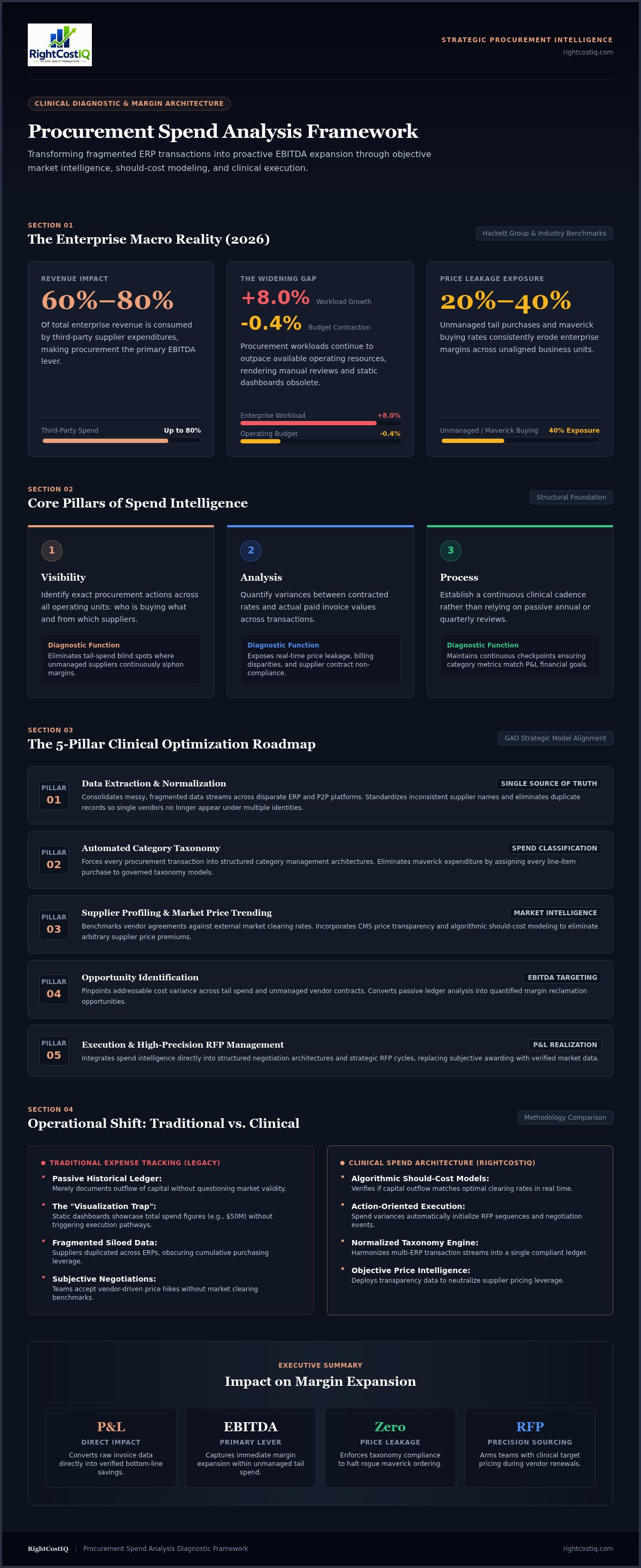
Third-party supplier expenditures account for 60% to 80% of total enterprise revenue in 2026. This reality makes your procurement spend analysis framework the most potent EBITDA lever in the corporate arsenal. You've likely realized that traditional spend visibility is no longer sufficient. Relying on descriptive reports that explain what happened in the past won't protect your margins. With enterprise workloads rising by 8.0% while operating budgets contract by 0.4%, the productivity gap is widening. You're likely struggling with fragmented data across multiple ERPs and maverick buying rates that represent up to 40% of total expenditure.
This article provides a clinical diagnostic for your procurement operations. It's designed to transform messy invoice data into strategic negotiation leverage and measurable P&L impact. We'll outline a five-pillar roadmap that integrates market price trending, should-cost modeling, and RFP management into a single, high-precision architecture. We'll explore how to weaponize CMS transparency data and automated taxonomy engines to eliminate price leakage. You'll master a data-driven approach that replaces subjective vendor awards with surgical precision; ensuring every dollar spent is a deliberate investment in operational efficiency.
Key Takeaways
- Establish a clinical diagnostic foundation that transforms fragmented ERP data into a proactive driver of financial growth and measurable P&L impact.
- Implement a multi-pillar procurement spend analysis framework to normalize disparate data streams and apply rigorous category management structures.
- Utilize market price trending and cost benchmarking to isolate "should-cost" targets, neutralizing supplier price risk through objective market intelligence.
- Transition from descriptive analytics to tactical execution by integrating spend insights directly into high-precision RFP management and negotiation architectures.
- Scale operational efficiency by deploying professional precision diagnostics to identify and capture immediate EBITDA margin expansion within unmanaged tail spend.
What is a Procurement Spend Analysis Framework?
A procurement spend analysis framework is a methodical, forensic architecture designed to cleanse, categorize, and analyze enterprise expenditure. It's not a passive administrative task. It's a strategic diagnostic that extracts unstructured data from fragmented ERP systems to isolate savings opportunities. The primary objective is a shift from reactive, historical reporting to proactive financial growth. By dissecting every line item, organizations move beyond simple cost-cutting and toward sustainable EBITDA expansion.
Clinical spend analysis serves as the essential foundation for achieving high-performance spend under management. Most organizations mistake basic expense tracking for procurement intelligence. Expense tracking merely records the outflow of capital. Procurement intelligence, however, applies algorithmic should-cost models and market intelligence to verify if that outflow represents the best possible market value. It's the difference between seeing a bill and knowing if you're being overcharged.
The Core Components of Spend Intelligence
A high-functioning procurement spend analysis framework relies on three technical pillars to drive results:
- Visibility: This requires identifying exactly who is buying what and from whom across all business units. It eliminates the "tail spend" shadows where unmanaged vendors erode margins.
- Analysis: Effective frameworks quantify the variance between contracted rates and actual paid prices. This isolates price leakage and contract non-compliance in real-time.
- Process: Establishing a clinical cadence is mandatory. Spend reviews aren't annual events. They're continuous operational checkpoints that ensure category performance remains aligned with financial targets.
Why Static Dashboards Fail the C-Suite
Many procurement leaders fall into the "Visualization Trap." They possess beautiful dashboards that show spend totals but offer no path to execution. Seeing a $50 million spend in a category is useless if the data doesn't trigger an RFP or a negotiation event. Static data lacks the strategic architecture needed to force action.
Quarterly reviews are insufficient for 2026 market volatility. The Hackett Group projects procurement workloads will rise by 8.0% while operating budgets contract by 0.4%. You can't bridge this productivity gap with passive, outdated charts. Furthermore, standard ERP reports lack external benchmarking integration. Without comparing internal prices against real-world market clearing rates, procurement teams operate in a vacuum. They lack the leverage to challenge supplier-driven price increases effectively because they can't prove what an item should cost today.
The 5-Pillar Framework for Clinical Spend Optimization
Third-party supplier expenditures account for 60% to 80% of total enterprise revenue. This volume demands a procurement spend analysis framework that functions as a surgical instrument rather than a basic ledger. To achieve measurable P&L impact, organizations must move beyond simple visibility and adopt a five-pillar architecture: Data Extraction, Category Taxonomy, Supplier Profiling, Opportunity Identification, and Execution. This structure aligns with the GAO strategic spend analysis framework, which emphasizes leveraging organizational buying power to eliminate fragmented spending and optimize clinical care procurement.
Step 1 & 2: Data Cleansing and Taxonomy
The foundation of any clinical diagnostic is clean data. Most enterprises operate with messy, fragmented data across multiple ERP and P2P streams. Normalization involves standardizing vendor names and removing duplicate entries to establish a single version of truth. Without this, a single supplier might appear under five different names, obscuring your true negotiation leverage.
Applying a rigorous category management procurement structure ensures that every line item is mapped to a specific strategic objective. Automated categorization prevents maverick spend by forcing every purchase into a pre-defined, compliant taxonomy. This clinical precision eliminates the 20% to 40% of unmanaged purchases that typically erode corporate margins. You cannot benchmark what you haven't correctly classified.
Step 3 & 4: Profiling and Opportunity Mapping
Once data is classified, the focus shifts to supplier density and risk profiling. You must evaluate if you're over-reliant on high-risk vendors or if your supplier base is too diluted to command volume discounts. Spend analysis should link directly to vendor compliance and risk metrics to protect the supply chain from volatility.
Opportunity mapping identifies "Quick Wins" versus "Strategic Shifts." Quick wins often involve consolidating tail spend. This "tail" typically accounts for only 20% of spend volume but encompasses 70% to 80% of vendor relationships, causing massive administrative drag. Strategic shifts require deep-dive RFP management for high-value categories. Quantifying the financial impact of maverick spend across decentralized departments allows you to prioritize the categories with the highest EBITDA potential.
Executing this procurement spend analysis framework requires moving from analytics to action. Before launching your next sourcing event, you should establish a clear roadmap that prioritizes categories based on price variance and contract expiration. To identify these high-leverage opportunities immediately, consider initiating a professional precision diagnostic to isolate price risk within your current spend portfolio.
Cost Benchmarking and Market Price Trending: The Clinical Edge
Cost benchmarking is the clinical process of validating internal price points against external market standards. Within a robust procurement spend analysis framework, this step moves beyond simple data classification to provide actionable intelligence. It's no longer enough to know what you paid; you must know what the market currently demands for that specific category. A recent McKinsey analysis on strategic procurement and spend analytics highlights how leading organizations utilize real-time centralized data to navigate volatile markets and capture bottom-line optimization. This integration ensures that RFP cycles are triggered by market opportunity rather than administrative convenience.
Leveraging Market Intelligence for Negotiation
Market price trending identifies the specific "should-cost" of a category before any vendor interaction occurs. By tracking price indices, freight indexes, and commodity fluctuations, procurement leaders can pinpoint the optimal moment to lock in long-term contracts. This move replaces historical price strategies with market-optimized price strategies. Utilizing a structured should-cost analysis provides an objective baseline that neutralizes supplier-driven inflation narratives. It transforms the negotiation from a subjective tug-of-war into a data-driven verification of market-clearing rates. You don't just ask for a discount; you prove the market rate.
Mitigating Risk Through Forecasting Models
Price risk management is critical for mitigating the financial volatility projected for 2026. The Hackett Group projects a productivity gap where workloads increase by 8.0% while budgets contract. Clinical risk tracking involves predicting price spikes in high-leverage categories to adjust procurement timing proactively. When internal benchmarking is integrated into the procurement spend analysis framework, it allows you to anticipate shifts in labor or raw material costs before they hit your P&L.
Protecting corporate EBITDA requires a relentless focus on vendor performance and contract compliance. This includes monitoring market-indexed pricing and identifying deviations before they impact the bottom line. Organizations that deploy forecasting models can hedge against price risk by identifying when to pivot to firm-fixed-price contracting. This methodical approach ensures that procurement doesn't just manage spend but actively protects the organization's financial architecture against external shocks.
Executing the Framework: From Analytics to RFP Management
Data without execution is merely overhead. Moving from the Analysis Phase to the Action Phase requires a strategic architecture that converts visibility into dollars. A clinical procurement spend analysis framework serves as the engine for a high-precision RFP Management framework. This transition ensures that the 5% to 15% cost-saving opportunities identified during the diagnostic phase are actually captured in the P&L. Without this link, spend intelligence remains a visualization exercise rather than a driver of EBITDA expansion.
The RFP Cycle: Precision Sourcing
Precision sourcing begins by structuring RFPs around the specific price variances discovered in your spend data. Instead of generic bids, you issue RFPs with pre-defined "should-cost" targets based on real-time market indices. This data-driven approach allows you to disqualify non-competitive bidders early in the cycle, reducing administrative drag and focusing resources on high-leverage vendors. Managing the RFP lifecycle with this level of granularity ensures that your sourcing events are timed to exploit market dips, maximizing enterprise efficiency and contract compliance.
Negotiation Assistance: The Final Lever
Professional negotiation assistance is the final step in closing the gap between identified and realized savings. A sophisticated negotiation coach uses your spend intelligence to dismantle supplier-driven price narratives. When a vendor claims inflationary pressure, you counter with objective market price trends as a non-negotiable anchor. This tactical execution forces transparency into supplier margins and secures firm-fixed-price contracting that protects against future volatility.
Closing the loop requires post-negotiation performance tracking. You must verify that the negotiated rates are reflected in every invoice to prevent price leakage. Organizations that pair clinical analytics with professional negotiation execution achieve significantly higher ROI on their procurement technology stack. To begin isolating the specific price risks and negotiation levers within your current categories, initiate a professional precision diagnostic today to map your path to measurable margin expansion.
Scaling Efficiency with RightCostIQ’s Precision Diagnostic
A high-performance procurement spend analysis framework requires a foundation of clinical precision to move from fragmented data silos to a unified procurement strategy. Traditional software-only solutions often fail because they lack the strategic architecture to convert raw data into negotiation leverage. RightCostIQ provides a professional precision diagnostic that acts as the primary catalyst for this transformation. This diagnostic identifies immediate EBITDA expansion opportunities by integrating market price trending and RFP management into a single, cohesive architecture. By treating spend data as a diagnostic asset, leadership can bridge the 8.0% productivity gap projected for 2026 enterprise procurement workloads.
The RightCostIQ Advantage
RightCostIQ distinguishes itself through proprietary cost benchmarking and market intelligence services that provide more than just visualization. The platform utilizes specialized financial analytics to isolate raw material and overhead drivers, giving procurement teams a "should-cost" baseline rooted in real-world market clearing rates. This clinical execution is paired with expert-led negotiation assistance. Unlike generic consulting firms, RightCostIQ acts as a sophisticated partner for high-level decision-makers. The global reach of these services ensures that even complex, high-stakes categories are managed with a zero-defect diagnostic approach, significantly reducing price risk and market volatility.
Begin Your Clinical Diagnostic
The transition to an optimized vendor performance model starts with a forensic review of existing expenditure. The free procurement diagnostic process involves an automated ingest of messy ERP data to identify maverick spend and tail spend fragmentation. This initial assessment isolates price variance and highlights specific categories where contract compliance leakage is eroding margins. It provides a clear roadmap for your next sourcing event, ensuring that your RFP management is backed by objective price justification and should-cost analytics.
Capturing sustainable financial growth requires moving beyond descriptive reporting. By adopting a disciplined framework, organizations achieve an average 6.6x return on investment on their procurement technology stack. You can eliminate subjective gut feelings in vendor awards and replace them with data-driven certainty. Take the first step toward clinical spend optimization and secure your clinical procurement diagnostic today to unlock measurable P&L impact.
Mastering the Architecture of Strategic Margin Expansion
The transition from passive expense tracking to clinical spend optimization is the defining characteristic of elite procurement organizations in 2026. By implementing a rigorous procurement spend analysis framework, you move beyond simple visibility and toward a prescriptive model that isolates price risk and dictates negotiation leverage. You've seen how integrating market price trending with professional RFP management transforms unmanaged tail spend into a significant driver of EBITDA growth. This methodical approach ensures that every sourcing event is backed by specialized price risk management and clinical financial analytics.
Securing these results requires a departure from data silos. You must bridge the gap between diagnostic intelligence and tactical execution. RightCostIQ provides the strategic architecture needed to dismantle supplier-driven inflation narratives and secure firm-fixed-price contracts. You don't have to navigate market volatility with outdated ERP reports. Take control of your category performance and identify immediate cost-saving opportunities by choosing to Execute Your Free Procurement Diagnostic today. Your path to measurable P&L impact starts with a zero-defect diagnostic of your current spend portfolio.
Frequently Asked Questions
What is the difference between spend analysis and spend management?
Spend analysis is the forensic diagnostic process of cleansing and classifying historical expenditure data. It answers exactly who bought what and for how much. Spend management is the broader execution strategy that uses these insights to enforce contract compliance and drive sourcing events. While analysis provides the visibility, management applies the clinical controls necessary to capture identified savings and maintain EBITDA expansion across the enterprise.
How often should an enterprise conduct a comprehensive spend analysis?
Modern market volatility in 2026 demands a continuous or monthly cadence rather than outdated quarterly reviews. Static annual analysis fails to account for the 8.0% increase in procurement workloads and rapid commodity fluctuations. A high-performance procurement spend analysis framework operates as a live diagnostic. This allows leadership to trigger RFPs based on real-time market dips and proactively mitigate price risk before it impacts the P&L.
Can this framework handle messy data from multiple ERP systems?
Yes, the framework is specifically designed to normalize fragmented data across disparate ERP and P2P systems. Clinical data cleansing involves standardizing vendor names and removing duplicate entries to establish a single version of truth. By applying a rigorous taxonomy, the framework unifies unstructured invoice data into a centralized architecture. This process ensures that decentralized departments are benchmarked against the same market standards, eliminating visibility gaps.
What are the most critical KPIs to track in a spend analysis framework?
The most critical KPIs include spend under management, the maverick spend rate, and price variance against market benchmarks. Tracking the ratio of realized savings versus identified opportunities is also essential for measuring P&L impact. Additionally, monitoring vendor density and contract compliance rates within the procurement spend analysis framework allows leadership to quantify the financial drag caused by unmanaged tail spend and decentralized purchasing patterns.
How does market price trending impact the RFP process?
Market price trending transforms the RFP from a subjective bid into a data-driven verification of market-clearing rates. It allows procurement teams to set objective "should-cost" anchors before negotiations begin. By tracking labor and commodity indices, you can time your RFP cycles to exploit market volatility. This strategic architecture prevents vendors from using arbitrary inflationary claims to pad their margins during high-stakes sourcing events.
What is tail spend and why does the framework prioritize it?
Tail spend represents the high volume of low-value transactions that typically account for 80% of active vendor relationships. While it often constitutes only 20% of total spend, it causes disproportionate administrative overhead and price leakage. The framework prioritizes tail spend because these unmanaged categories offer the highest potential for immediate quick wins through vendor consolidation and automated price risk management controls.
How does spend analysis contribute to price risk management?
Spend analysis provides the forensic baseline required for predictive price risk management. By isolating cost drivers like freight or raw materials, the framework identifies which categories are most susceptible to market shocks. This intelligence allows leadership to shift from cost-reimbursement structures to firm-fixed-price contracting. It enables a proactive defense of corporate margins by forecasting price spikes and adjusting procurement timing with clinical precision.
Is software enough to execute a procurement spend analysis framework?
Software provides the visualization, but it isn't enough to execute a clinical procurement strategy. Sustainable margin expansion requires a strategic architecture that includes professional negotiation assistance and expert-led diagnostics. Software often fails to dismantle complex vendor pricing narratives or manage the nuances of high-stakes RFP events. A successful framework pairs advanced analytics with professional negotiation coaching to ensure that identified savings are actually realized in the P&L.


