

Clinical organizations implementing formal, standardized sourcing frameworks capture savings of up to 17.7% across their total addressable spend. Despite this clear financial incentive, many procurement departments remain trapped in inefficient cycles because they fail to recognize the technical difference between RFI RFQ and RFP protocols. Selecting the wrong document doesn't just waste administrative time; it introduces significant financial volatility and leads to chronic vendor misalignment. You've likely seen how a misapplied request leads to overpaying for services that fail to meet critical performance benchmarks.
This article provides a clinical decision framework to eliminate these operational inefficiencies. You'll master the strategic distinctions between exploratory market discovery, rigid price-based competition, and multi-variable solution analysis. We'll examine how current regulatory standards, including the $350,000 Simplified Acquisition Threshold, dictate instrument selection for 2026. This guide delivers the technical expertise required to compress sourcing cycles and secure high-performance partnerships that drive bottom-line growth.
Key Takeaways
- Implement a hierarchical procurement framework to move from exploratory market discovery to final contract award with clinical precision.
- Master the technical difference between RFI RFQ and RFP to align document selection with specific business outcomes and category spend thresholds.
- Eliminate sourcing inefficiencies by utilizing a decision tree that identifies when to bypass resource-intensive RFP cycles for standardized clinical consumables.
- Mitigate financial volatility by leveraging RFQs for immediate cost benchmarking and RFPs for securing long-term price risk management.
- Optimize the 2026 sourcing architecture through automated request processing and rigorous post-award vendor performance tracking.
The Procurement Trifecta: Strategic Roles of RFI, RFQ, and RFP
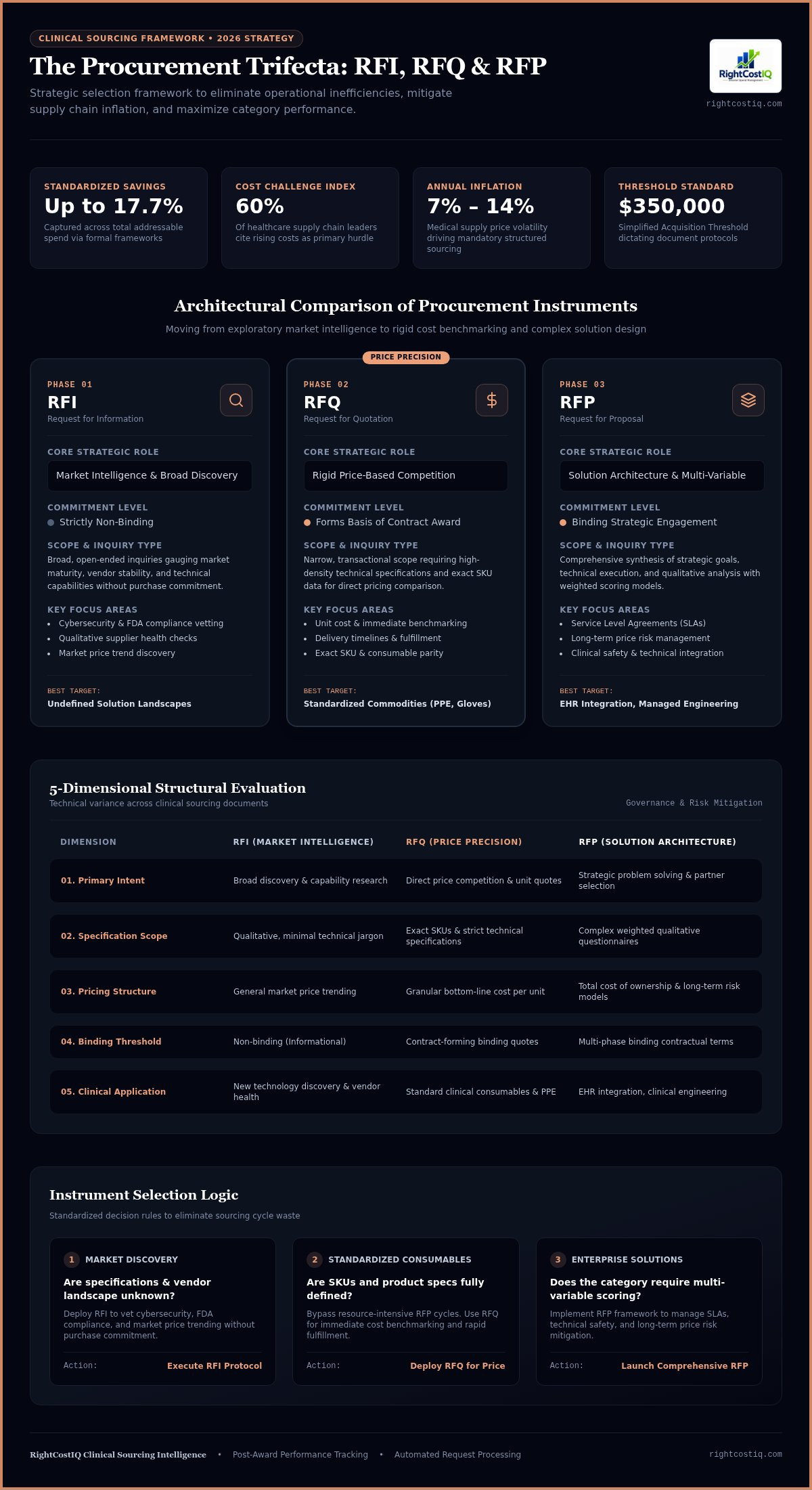
Procurement excellence requires a hierarchical framework to eliminate operational waste. This trifecta, consisting of RFI, RFQ, and RFP, functions as a clinical instrument for information gathering. By establishing a clear difference between RFI RFQ and RFP protocols, organizations expand margins and reduce financial volatility. These documents solve the core problem of information asymmetry. In 2026, where medical supply inflation fluctuates between 7% and 14% annually, data-blindness is a critical liability. Structured requests force vendors to reveal technical capabilities and pricing structures that would otherwise remain opaque.
The 2026 procurement landscape makes data-driven sourcing mandatory. Currently, 60% of healthcare supply chain leaders identify rising supply costs as their primary operational challenge. Organizations implementing formal, standardized sourcing frameworks capture savings of up to 17.7% across their total addressable spend. This success depends on selecting the specific instrument that minimizes risk while maximizing vendor performance.
RFI: The Market Intelligence Phase
The Request for Information (RFI) serves as a non-binding exploratory instrument for broad discovery. It's the primary tool for identifying vendor capabilities and analyzing market price trending without committing to a purchase. An RFI creates the necessary foundation for procurement category cost benchmarking by gathering qualitative data on vendor stability and technological maturity. This phase allows decision-makers to vet vendor cybersecurity and FDA compliance before initiating resource-intensive evaluation cycles. It's an essential precursor for complex categories where the solution landscape is undefined.
RFQ vs. RFP: Price Precision vs. Solution Architecture
Distinguishing between price precision and solution architecture is vital for sourcing efficiency. An RFQ is a transactional document targeting standardized commodities; it focuses strictly on unit cost and delivery timelines for goods like sterile gloves or standard PPE. RFQs target commodities. RFPs target solutions. The request for proposal (RFP) framework is a strategic instrument designed for complex enterprise solutions requiring weighted qualitative scoring.
Organizations utilize our specialized RFP Management services to handle multi-variable engagements, such as EHR integration or managed clinical engineering, where technical safety and service level agreements are as critical as the bottom-line price. Understanding the technical difference between RFI RFQ and RFP ensures that high-stakes projects receive the strategic depth they require while commodity purchases remain streamlined and cost-effective. Selecting the wrong instrument leads to overpayment and vendor misalignment.
Structural Comparison: Quantifying the Functional Differences
Quantifying the functional difference between RFI RFQ and RFP requires an analysis across five critical dimensions: intent, scope, pricing, duration, and outcome. These structural variations dictate how procurement teams manage vendor performance tracking and clinical compliance from the first touchpoint. Citing WHO procurement principles and processes confirms that selecting the specific instrument is a matter of governance and risk mitigation. In clinical environments, where supply integrity is non-negotiable, the document structure must align with the complexity of the category being sourced.
Intent and Scope: From Discovery to Commitment
The journey from an RFI to an RFP represents a shift from exploratory discovery to strategic commitment. An RFI utilizes broad, open-ended inquiries to gauge market maturity and vendor health. It requires minimal technical jargon, focusing instead on general capabilities. In contrast, the RFQ has a narrow scope. It demands high-density technical specifications and precise SKU data to facilitate direct price comparisons. The RFP is the most comprehensive instrument. It synthesizes strategic objectives with technical requirements, often including hundreds of qualitative questions regarding implementation and clinical safety.
The 'Commitment Threshold' is the point where a document transitions from informational to legally binding. While an RFI is strictly non-binding, an RFQ or RFP response often forms the basis of the final contract. Accepting a bid from an RFQ usually creates a binding purchase order immediately. An RFP award leads to a multi-year Master Service Agreement (MSA). Selecting the wrong document early in the cycle can inadvertently lock an organization into suboptimal terms before the full scope of the project is understood.
Evaluation Metrics: Data-Driven Selection Criteria
Data-driven selection criteria differentiate high-performance sourcing from reactive buying. RFQ evaluation is 90% price-driven benchmarking; unit cost is the primary variable. RFP management demands a multi-weighted scoring system that balances financial metrics with qualitative factors like vendor resilience and technical support. This is where procurement analytics becomes the decisive factor for margin expansion. By integrating market price forecasting, teams evaluate multi-year proposals against projected inflation indices rather than current spot prices.
Advanced analytics also allow for rigorous vendor performance tracking post-award. By comparing the 'should-cost' data identified during the RFP phase with actual invoice data, organizations eliminate price creep. This clinical approach ensures that the strategic distinctions established during the request phase translate into tangible financial growth. If your current request process feels manual or lacks this analytical depth, a free procurement diagnostic can identify where document selection and evaluation protocols are failing to protect your margins.
Strategic Selection: Choosing the Right Procurement Instrument
Strategic selection is a core competency for procurement architects. The technical difference between RFI RFQ and RFP determines whether a sourcing cycle delivers cost avoidance or administrative bloat. Many departments default to a full RFP for every requirement; however, this creates unnecessary friction and delays. Efficiency requires a clinical decision tree based on category spend and solution complexity. For acquisitions exceeding the $350,000 Simplified Acquisition Threshold (SAT) effective in 2026, formal competitive solicitations are mandatory. Conversely, for non-complex clinical consumables, the 'RFQ Shortcut' compresses the sourcing cycle from 16 weeks to under six weeks. Consult our guide on RFP Management: Precision Frameworks for Sourcing to align your document selection with these optimized timelines.
When to Deploy an RFI
Deploy an RFI when the vendor landscape is disrupted or when technology shifts demand a new market entry strategy. This instrument is essential for gathering intelligence on vendor resilience and regional supply dependencies. In high-volatility markets where medical supply inflation fluctuates between 7% and 14%, skipping the RFI phase is a critical risk. RFI data feeds directly into price risk management and tracking by identifying which suppliers utilize index-based flexible pricing. Referencing FAR Subpart 15.2 solicitation guidelines provides the statutory baseline for these early market exchanges. Without this discovery phase, organizations enter negotiations with significant information asymmetry, leading to suboptimal contract terms and performance gaps.
The Clinical Use Case for RFPs
The RFP is the mandatory instrument for 'Solution-First' procurement needs where price is secondary to performance and clinical safety. This applies to high-value, high-risk categories like healthcare financial analytics, imaging systems, or multi-year pharmaceutical service contracts. Managing these complex engagements requires a multi-variable scoring grid that weighs technical compliance, training, and SLAs alongside total cost of ownership. Integrating negotiation assistance early in the RFP design phase ensures that performance benchmarks are legally enforceable. While an RFQ targets the lowest unit price for a commodity, the RFP targets a sustainable, high-performance partnership. Selecting the RFP ensures that long-term price risk is hedged through Cost-Plus Incentive Fee (CPIF) or Economic Price Adjustment clauses, protecting the organization from macro-inflationary spikes.
Price Risk Management: Mitigating Financial Volatility via Sourcing
Document choice directly dictates an organization's exposure to market volatility. Selecting the wrong instrument doesn't just create administrative friction; it compromises margin protection. An RFQ is optimized for securing immediate spot pricing in high-liquidity commodity markets. Conversely, an RFP is designed for long-term stability in complex service categories. Procurement leaders who ignore the structural difference between RFI RFQ and RFP protocols often find themselves overpaying for commodities while underspecifying complex services. Understanding these risk profiles allows teams to align their sourcing strategy with the specific volatility of each category.
Market price trending validates vendor quotes in real-time. This data prevents vendors from building excessive risk premiums into their bids. Without this validation, organizations often overpay for perceived reliability. Effective document management also serves as a critical lever for Tail Spend optimization. By standardizing the request process for low-value transactions, teams eliminate the financial leakage associated with unmanaged spending. It's a clinical approach to cost containment that treats every dollar of spend with equal rigor.
Forecasting and Trending in RFPs
Predicting future contract costs requires a rigorous analysis of historical data during the RFP phase. Benchmarking ensures that multi-year service agreements remain competitive throughout their duration. It prevents 'price creep', where costs incrementally rise without a corresponding increase in value. Price risk management is the strategic mitigation of market volatility through data-driven contract structures. By embedding index-based pricing clauses into the final RFP award, organizations shift the burden of inflation back to the market. This protects the bottom line from the 7% to 14% supply cost inflation currently impacting the 2026 clinical landscape.
Negotiation Levers: Turning Data into Leverage
Data harvested during the RFQ phase provides a precise 'Should-Cost' baseline for final negotiations. This baseline acts as a clinical anchor, preventing emotional or subjective decision-making. When managing an RFP, procurement architects leverage response variance to drive competitive tension between top-tier vendors. High variance in qualitative scores indicates a lack of market standardization, providing a clear opening for expert-led negotiation assistance.
Final vendor selection requires clinical precision. It's not enough to select the lowest bidder; the partner must demonstrate long-term financial viability and performance compliance. Successful sourcing teams use the following negotiation levers:
- Identify Should-Cost baselines through granular RFQ data comparisons.
- Exploit RFP response variance to isolate specific negotiation leverage points.
- Implement index-based price adjustments to hedge against projected 2026 market shifts.
Organizations that fail to integrate these analytical layers into their sourcing cycles remain vulnerable to market shocks. To identify specific vulnerabilities in your current procurement framework, schedule a direct procurement diagnostic to analyze your spend data against current market benchmarks.
Execution Strategy: Optimizing the Request Cycle for 2026
Transitioning to a 2026-ready sourcing architecture requires moving beyond manual spreadsheet management. With 68% of enterprise sourcing teams now incorporating automated request processing, manual workflows represent a significant operational risk. Procurement excellence isn't achieved through administrative volume; it's achieved through the clinical integration of market intelligence into every phase of the request cycle. High-performance organizations treat document selection as a strategic lever rather than a clerical task. Understanding the technical difference between RFI RFQ and RFP protocols is the baseline. The real competitive advantage lies in the execution of the data harvested from these instruments to drive margin expansion.
Integrating Benchmarking into the Lifecycle
Optimizing the lifecycle starts with a methodical step-by-step approach. Discovery begins with the RFI to vet vendor compliance with critical standards like HIPAA or 21 CFR Part 11. This intelligence flows into an RFQ or RFP where a Should-Cost analysis acts as the financial anchor for all incoming bids. Post-award, the feedback loop must be automated. Vendor performance tracking ensures that the SLAs negotiated during the RFP phase actually translate into operational results. Organizations implementing these rigorous standards capture up to 17.7% in total addressable spend savings. This isn't a one-time event. It's a continuous cycle where historical performance data informs the next RFI discovery phase, ensuring supply chain resilience through rigorous document standards.
The Path to Procurement Excellence
C-suite decision-makers must view procurement as a primary driver for financial growth. A final checklist for excellence includes three non-negotiable pillars: clinical document selection, real-time cost benchmarking, and expert-led negotiation assistance. Mastering the difference between RFI RFQ and RFP allows leaders to bypass the 16-week RFP cycle for commoditized goods, saving thousands in administrative labor. However, for high-stakes clinical IT or imaging contracts, professional negotiation coaching is a strategic imperative. It ensures that the multi-weighted scoring grid used during evaluation results in a contract that hedges against the 7% to 14% supply cost inflation currently impacting health systems.
Professional RFP management delivers a clear ROI by eliminating information asymmetry and securing index-based price protection. RightCostIQ provides the technical framework to transition from reactive buying to strategic architecting. To identify specific inefficiencies in your current request cycle and uncover hidden margin expansion opportunities, secure your procurement margin with a free diagnostic today. This diagnostic serves as the first step in migrating your procurement function from a cost center to a high-performance financial engine.
Architecting Your 2026 Sourcing Strategy
Procurement excellence is no longer optional in a landscape defined by 14% supply cost inflation. Mastering the technical difference between RFI RFQ and RFP protocols is the first step toward eliminating information asymmetry and securing long-term price protection. By selecting the clinical instrument that aligns with your specific category spend, you eliminate administrative friction and prevent financial leakage. This strategic precision ensures that your sourcing architecture functions as a high-performance engine for financial growth rather than a mere cost center.
RightCostIQ provides the specialized healthcare financial analytics expertise and professional RFP management required to navigate these complex cycles with confidence. Our approach integrates rigorous procurement category cost benchmarking and expert-led negotiation assistance to ensure every contract delivers maximum bottom-line impact. Don't let inefficient request cycles or poor vendor alignment compromise your organizational margins. Execute a Clinical Procurement Diagnostic today to identify hidden optimization opportunities and secure your competitive advantage. It's time to transform your procurement department into a strategic architect of corporate profitability.
Frequently Asked Questions
Is an RFI mandatory before issuing an RFP?
An RFI isn't legally mandatory under general commercial law, but it's a strategic necessity for market discovery. For projects with undefined specifications or new vendor landscapes, skipping this phase introduces significant risk. Clinical organizations often mandate an RFI to vet vendor compliance with standards like HIPAA before initiating a resource-intensive evaluation. This preliminary step ensures that only qualified entities participate in the formal bidding cycle, protecting administrative resources and project timelines.
Can an RFQ be used for professional services procurement?
An RFQ is rarely appropriate for professional services because it focuses strictly on unit price for standardized commodities. Services require a multi-variable analysis of qualitative factors like expertise, safety protocols, and service level agreements. Attempting to source complex services via an RFQ leads to vendor misalignment and poor performance. Professional services demand the strategic depth of an RFP to evaluate the solution architecture and long-term financial viability of the partnership.
What happens if a vendor fails to respond to an RFP?
Failure to respond typically results in immediate disqualification from the current sourcing cycle. This lack of participation reduces competitive tension and limits the data available for cost benchmarking. If a critical incumbent vendor fails to respond, procurement architects must analyze whether the RFP requirements were overly restrictive or if market conditions have shifted. Maintaining a robust vendor performance tracking service helps identify these risks early, ensuring a healthy pipeline of responsive, qualified bidders.
How much time should be allocated for a complex RFP cycle?
A complex clinical RFP cycle generally requires 8 to 16 weeks from requirement drafting to final award. This timeline accounts for the 30-day bidding window mandated for formal negotiated contracts above the $350,000 Simplified Acquisition Threshold. Evaluation phases for specialized imaging or clinical IT systems often take an additional 2 to 6 weeks on the buyer side. Rushing this cycle compromises the depth of the technical analysis and increases the probability of post-award financial volatility.
What is the primary difference between RFQ and RFP pricing models?
The primary difference between RFI RFQ and RFP pricing models lies in the scope of the financial commitment. RFQs focus on firm-fixed unit pricing or spot pricing for immediate delivery of standardized goods. In contrast, RFPs utilize Total Cost of Ownership (TCO) models and index-based flexible pricing. This allows organizations to hedge against inflation through Economic Price Adjustment clauses, securing long-term price stability for complex, multi-year service agreements that involve significant operational risk.
How do procurement analytics improve RFI response evaluation?
Procurement analytics transform qualitative RFI responses into actionable market intelligence. By utilizing automated data processing, teams identify capability outliers and regional supply dependencies that aren't visible through manual review. These analytics allow for real-time market price trending, which validates vendor capability claims against industry benchmarks. This data-driven approach ensures that the subsequent RFP phase is targeted toward vendors with the highest probability of delivering margin expansion and clinical compliance.
Can an RFP be legally binding upon submission?
An RFP document itself is a solicitation for offers and is non-binding, but the vendor's submitted proposal often constitutes a legally binding offer. If the organization accepts that proposal, it forms the basis of the final contract. This is why professional RFP management and negotiation assistance are critical. Ensuring that all technical safety and performance benchmarks are clearly defined in the response protects the organization from future liability and ensures that vendor performance matches the initial submission.
Why is price risk management critical in the 2026 procurement landscape?
Price risk management is vital because medical supply inflation is currently fluctuating between 7% and 14% annually. Without data-driven contract structures, organizations absorb the full impact of these macro-inflationary spikes. Utilizing specialized market price trending and forecasting services allows procurement teams to embed protective clauses into their agreements. This clinical approach to financial volatility ensures that margins remain protected even during periods of extreme market instability, transforming procurement into a primary driver for financial growth.


