
Leverage in a monopoly isn't a gift from the market; it's a forensic construction built on data your supplier assumes you don't possess. Most procurement leaders feel systematically disadvantaged when negotiating with a single-source supplier, particularly as raw material volatility fluctuates between 5% and 50% in 2026. You're likely facing aggressive price escalations while internal stakeholders demand cost reductions without a secondary source to provide a competitive baseline. It's a high-stakes environment where intuition fails and only clinical precision yields results.
This guide provides a structured framework to manufacture leverage and optimize margins even when you're locked into a single-source relationship. You'll learn to deconstruct supplier quotes using should-cost modeling and navigate the updated $10 million TINA disclosure thresholds to force transparency. We'll outline how to shift the negotiation from subjective haggling to an objective analysis of cost drivers. By the end of this article, you'll have a roadmap to reduce total cost of ownership and implement continuous performance tracking that prevents post-award margin leakage.
Key Takeaways
- Distinguish between market-driven monopolies and strategic source selection to identify latent leverage points within the supply chain.
- Deploy should-cost modeling and market price trending to forensicly invalidate supplier price hike justifications through granular cost deconstruction.
- Leverage historical performance data and SLA non-compliance metrics to secure financial credits and improved contractual terms.
- Master a clinical framework for negotiating with a single-source supplier that replaces adversarial haggling with data-driven strategic alignment.
- Institutionalize long-term margin protection by integrating automated RFP management and procurement analytics into your core sourcing workflow.
Redefining Leverage in Single-Source Supplier Negotiations
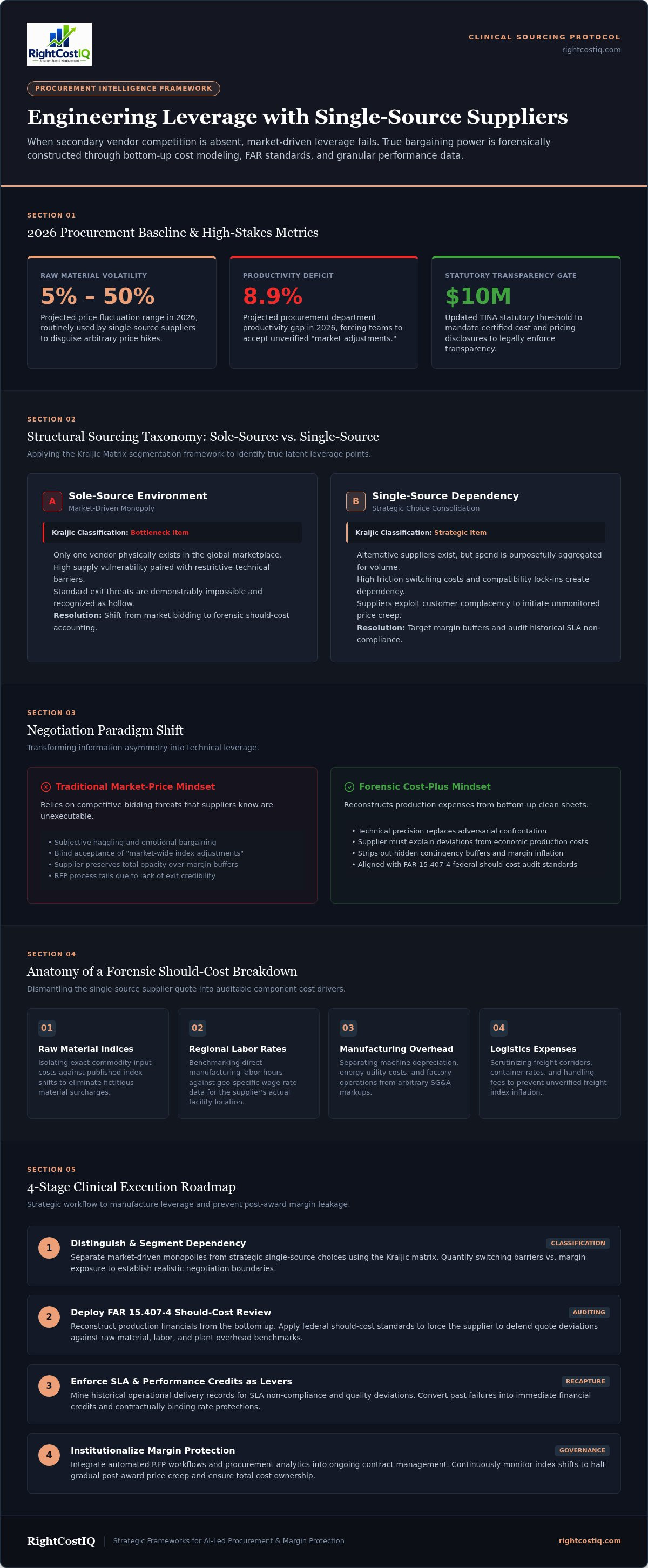
Leverage in procurement is frequently misunderstood as the mere existence of a backup vendor. This narrow definition creates a strategic paralysis when organizations face a monopoly or a strategic dependency. To regain control, decision-makers must distinguish between sole-source environments, where only one supplier exists in the market, and single-source scenarios, where the organization chooses to consolidate spend for volume or compatibility. Utilizing the Kraljic matrix segmentation framework allows teams to categorize these relationships as "strategic" or "bottleneck" items, each requiring a distinct forensic approach. The primary barrier to success when negotiating with a single-source supplier isn't the lack of competition. It's information asymmetry. The supplier understands their cost structure. You don't.
The Single-Source Trap: Why Traditional RFPs Fail
Standard competitive bidding depends entirely on the credible threat of exit. In single-source scenarios, this threat is often hollow, and suppliers know it. They recognize the high switching costs and operational disruption required to migrate business to a new partner. This creates a psychological advantage where the vendor dictates terms based on your perceived helplessness. Complacency in these relationships leads to unmonitored price creep and margin erosion. The 8.9% productivity gap projected for procurement departments in 2026 often forces teams to accept unjustified "market adjustments" without verification. You cannot solve a data problem with a traditional bidding process.
Engineering Leverage Through Data Transparency
Engineering leverage requires shifting from a market-price mindset to a cost-plus mindset. By utilizing procurement analytics, you strip away the supplier's opaque pricing layers. You aren't asking for a discount; you're conducting a forensic audit of their margin buffers. This clinical approach replaces emotional bargaining with technical precision, forcing the supplier to defend specific cost elements rather than vague market trends.
Manufactured leverage uses should-cost modeling to estimate actual production expenses. When you present a breakdown of raw material indices, regional labor rates, and manufacturing overhead, the power dynamic shifts. You're no longer negotiating with a single-source supplier based on their quote. You're negotiating based on the economic reality of the product's manufacture. This data-driven strategy eliminates the supplier's ability to hide behind proprietary cost drivers, turning a perceived monopoly into a transparent, manageable partnership.
Deconstructing the Supplier’s Cost Structure through Analytics
Effective procurement strategy when negotiating with a single-source supplier requires a transition from reactive bargaining to forensic cost analysis. You must dismantle the supplier's quote into its constituent economic parts to identify where margin is being hidden. This analytical deconstruction serves as your primary leverage when market competition is absent. By benchmarking category costs against global standards, you can pinpoint margin outliers that would otherwise remain obscured by the supplier's proprietary claims.
The Role of Should-Cost Modeling
A clean-sheet approach is the most effective method for reclaiming control over the pricing narrative. By utilizing should-cost modeling, procurement teams can reconstruct the supplier's financial requirements from the bottom up. This process involves aggregating raw material costs, regional labor indices, manufacturing overhead, and logistics expenses. Aligning your methodology with federal should-cost review standards ensures your model is defensible and technically sound. Once your model is established, the burden of proof shifts to the supplier. They must explain why their quote deviates from the economic reality of their own production environment. This transparency forces a dialogue based on facts rather than leverage myths.
Market Price Trending and Forecasting
Information asymmetry often allows suppliers to maintain elevated pricing long after raw material costs have stabilized. Leveraging market price trending allows you to track these fluctuations in real time and identify the "lag" between input cost drops and supplier adjustments. In 2026, where raw material volatility ranges from 5% to 50%, this monitoring is critical for margin protection. Price risk management is the ability to forecast and mitigate financial volatility through index-based monitoring and contractual triggers. Identifying these trends allows you to challenge price hike justifications before they're institutionalized into your budget. To identify specific savings opportunities in your current contracts, you can request a cost diagnostic to benchmark your spend against current market intelligence.
Analyzing the supplier's financial health provides additional tactical advantages. Suppliers operating with low utilization rates or significant debt obligations are often more flexible on payment terms or volume-based incentives, even if they hold a monopoly. Identifying these pressure points allows you to negotiate non-price levers that improve your total cost of ownership without triggering a defensive response from the vendor's sales team.
Benchmarking Performance and Risk as Negotiation Levers
When negotiating with a single-source supplier, the unit price is often a rigid variable. Leverage must therefore be engineered through forensic performance auditing and risk quantification. Strategic procurement teams move beyond qualitative relationship management to a clinical assessment of vendor reliability. High-level frameworks for negotiating with powerful suppliers emphasize that value can be extracted by altering how you purchase and hold inventory. By benchmarking current performance against optimized industry standards, you identify the hidden costs of inefficiency that the supplier must compensate for during the contract renewal process.
Vendor Performance Tracking as a Margin Tool
Performance data serves as a direct financial clawback mechanism. Every late delivery, quality defect, or backorder represents a quantifiable breach of the Service Level Agreement (SLA). Procurement professionals shouldn't treat these as mere operational inconveniences. Instead, quantify the downstream economic impact of these failures to create negotiation credits. Automated tracking systems prevent performance drift, where a vendor's service levels slowly decline while costs remain static. Presenting a forensic log of non-compliance forces the supplier to offer price concessions or service credits to maintain the account, effectively lowering your net spend without changing the base rate.
Total Cost of Ownership (TCO) vs. Unit Price
The unit price is often a distraction in monopoly scenarios. True margin expansion occurs when you optimize the secondary layers of the contract. Combined logistics and carrying inventory costs reflect an 18% escalation over historic baselines in 2026. This makes non-price variables critical targets for negotiating with a single-source supplier. If the vendor refuses to move on the sticker price, shift the focus to logistics, payment terms, and inventory holding costs. Moving from Net-30 to Net-90 terms or implementing consignment inventory can significantly improve cash flow without altering the baseline price.
Strategic TCO Optimization Variables:
- Logistics Allocation: Transition from FOB Origin (Buyer Pays) to FOB Destination (Supplier Pays) to transfer transportation risk and cost to the vendor.
- Capital Efficiency: Extend payment terms from Net-30 to Net-60 or Net-90 to optimize working capital and offset unit price rigidity.
- Inventory Management: Implement Vendor Managed Inventory (VMI) or consignment models to eliminate internal carrying costs and warehousing overhead.
- Risk Mitigation: Replace standard replacement-only clauses with automatic financial rebates triggered by specific defect rates or delivery delays.
Incentivizing supplier efficiency through shared-savings clauses creates a path for future reductions. If the vendor can reduce their production costs through process innovation, the contract should dictate a percentage-based price reduction for the buyer. This aligns the supplier's profit motive with your cost-reduction objectives, ensuring that the single-source relationship remains economically viable over the long term.
A Clinical Framework for Executing High-Stakes Negotiations
Execution is the phase where forensic data is converted into contractual savings. When negotiating with a single-source supplier, the primary objective is to signal a level of competence that makes price opacity impossible. This requires a transition from subjective bargaining to a tactical deployment of the intelligence gathered in your should-cost models and performance audits. A successful negotiation doesn't rely on the supplier's goodwill; it relies on your ability to present an undeniable economic reality that forces a correction in their margin strategy.
Phase 1: The Pre-Negotiation Diagnostic
Preparation begins with a comprehensive spend audit to identify systemic margin leakage. Before entering the room, procurement teams must consolidate their transparency data into a single, action-oriented playbook. You can access a free diagnostic to pinpoint exactly where your current contract deviates from 2026 market benchmarks. This phase also requires aligning internal stakeholders on "walk-away" terms. While switching vendors may be difficult, leverage can still be manufactured by identifying "hidden" competitors, such as the feasibility of insourcing or the adoption of alternative technologies that bypass the supplier's proprietary constraints.
Phase 2: The Data-Driven Dialogue
The opening statement must set a clinical tone, immediately signaling that the discussion will be governed by financial metrics rather than emotional appeals. Present your should-cost data early to dismantle the supplier's standard justifications for price hikes. If a supplier claims raw material pressure, present the specific index-based evidence that contradicts their timeline. Utilizing a structured Negotiation Coach framework allows your team to role-play responses to common monopoly objections, ensuring you maintain professional authority throughout the session. By sticking to forensic cost drivers, you neutralize the supplier's psychological advantage.
Strategic framing is essential for long-term margin protection. Rather than treating the vendor as an adversary, reframe them as a partner in cost optimization. This shift encourages the supplier to identify internal efficiencies that can be shared through gain-share clauses. The negotiation should conclude by locking in multi-year price caps and performance-linked incentives. In the 2026 regulatory environment, specifically for awards exceeding the $10 million TINA threshold, you must ensure your contract includes robust audit rights. This clinical approach ensures that the gains achieved during negotiating with a single-source supplier are institutionalized and protected against future cost drift.
To ensure your negotiation strategy is supported by the most accurate category intelligence available, request a clinical spend diagnostic today.
Institutionalizing Cost Transparency with RightCostIQ
Single-source dependencies shouldn't be permanent vulnerabilities for your organization. To ensure long-term margin stability, procurement teams must transition from reactive bargaining to proactive category management. Institutionalizing cost transparency requires a technological infrastructure that monitors market shifts in real-time, preventing the billing drift that often follows even the most successful negotiation. The ROI of professional negotiation assistance is measured not just in immediate price reductions, but in the sustained prevention of unauthorized surcharges and unearned margin creep. In an environment where procurement workloads are expanding by 8.0% in 2026 while budgets contract, automation isn't a luxury; it's a strategic necessity for closing the 8.9% productivity gap.
From Tail Spend to Strategic Sourcing
Break monopolies by identifying latent market alternatives through forensic analysis. While a category might appear locked, comprehensive tail spend management often reveals secondary suppliers capable of fulfilling specific sub-components or regional requirements. Integrating these analytics into your standard procurement infrastructure transforms your team from a cost center into a strategic architect of financial growth. Price risk management services provide the telemetry needed to track commodity movements, ensuring that negotiating with a single-source supplier is always based on current market intelligence rather than outdated contract baselines. This continuous transparency ensures that when raw material costs drop, your pricing follows suit without delay.
Next Steps: Secure Your Procurement Future
Preventing future single-source traps depends on the rigorous implementation of RFP management systems that prioritize supply chain resilience and multi-source optionality. These platforms allow teams to role-play tactics and simulate supplier counter-arguments before live sessions begin. RightCostIQ functions as the sophisticated partner for high-level procurement decision-makers, bridging the gap between traditional sourcing and AI-driven financial optimization. You don't have to accept opacity as an inherent requirement of doing business with a dominant vendor. Organizations using these clinical frameworks realize an average 18% cost reduction and 3x faster RFP cycle times by replacing intuition with empirical data.
Evaluate your current leverage through a data-driven lens to identify where your margins are most at risk. Start your free procurement diagnostic today to uncover hidden savings and secure your supply chain against unjustified price escalations. By establishing a forensic audit trail today, you protect the financial integrity of your procurement function for the 2026 fiscal year and beyond.
Engineering Long-Term Margin Protection
The transition from reactive bargaining to clinical cost management is the only viable path for procurement leaders in 2026. Successfully negotiating with a single-source supplier requires moving beyond the myth of helplessness and deploying forensic data to manufacture leverage. By integrating advanced should-cost modeling and specialized category cost benchmarking, you strip away supplier opacity and force a dialogue based on empirical economic reality. This framework ensures that your organization captures every possible margin improvement while maintaining critical supply security.
Sustainable results depend on institutionalizing these practices through global procurement performance tracking. This prevents post-award value erosion and ensures that your contract terms remain aligned with shifting market indices. You don't have to accept price hikes as an inevitability. Optimize your supplier leverage with a Free Procurement Diagnostic to identify immediate savings opportunities and secure your procurement future. Your path to strategic architect begins with clinical data precision.
Frequently Asked Questions
What is the difference between single-source and sole-source suppliers?
Sole-source refers to a market condition where only one vendor is capable of providing a specific product or service, often due to patents or proprietary technology. In contrast, single-sourcing is a strategic decision to consolidate spend with one vendor despite the existence of other market options. Understanding this distinction is vital when negotiating with a single-source supplier because it defines whether your leverage is market-based or forensic.
How do I find leverage when a supplier knows I have no other options?
Leverage in these scenarios is manufactured through extreme cost transparency rather than market competition. You must utilize should-cost modeling to deconstruct the supplier's margin and identify specific areas of inefficiency. By benchmarking their performance against global standards, you create financial pressure points. Quantifying the cost of their operational failures allows you to secure credits or improved terms. This data-driven approach forces the supplier to defend their pricing against economic reality.
What is a should-cost model and how does it help in negotiations?
A should-cost model is a bottom-up financial analysis that estimates what a product or service ought to cost based on raw materials, labor, overhead, and reasonable profit. It helps in negotiations by shifting the burden of proof to the supplier. Instead of accepting a quote at face value, you present a forensic breakdown of their production expenses. This clinical precision eliminates the supplier's ability to hide behind opaque cost drivers or unjustified price hikes.
Can I negotiate a price reduction mid-contract with a single-source vendor?
Yes, mid-contract reductions are achievable by identifying billing drift or performance failures. If market price trending shows a significant drop in raw material inputs, you can trigger a cost-plus review based on index-linked clauses. Performance tracking often reveals SLA breaches that justify immediate financial clawbacks. RightCostIQ specializes in identifying these mid-term savings opportunities by auditing incoming invoices against contracted baseline pricing to prevent unearned margin creep and protect your bottom line.
How does market price trending affect single-source negotiations?
Market price trending provides the empirical evidence needed to challenge unjustified price increases. In 2026, raw material volatility ranges from 5% to 50%, making real-time monitoring essential. Tracking these fluctuations allows you to identify the lag between a supplier's input cost decreases and your contract price adjustments. This intelligence is critical when negotiating with a single-source supplier to ensure your margins aren't eroded by unmonitored commodity shifts or delayed price corrections.
What are the risks of pushing a single-source supplier too hard on price?
Excessive price pressure can lead to supply chain instability, reduced quality, or vendor de-prioritization during shortages. A clinical approach balances cost reduction with supply security by focusing on the supplier's actual cost drivers. Instead of arbitrary cuts, use should-cost data to target excess margin without threatening the supplier's operational viability. This ensures a sustainable relationship where the vendor remains incentivized to invest in your specific account requirements while maintaining high service levels.
How can procurement software help in monopoly supplier scenarios?
Procurement software provides the analytical infrastructure needed to maintain continuous cost transparency. Platforms like RightCostIQ automate RFP management and vendor performance tracking, closing the 8.9% productivity gap facing modern teams. These tools provide real-time category benchmarking and should-cost models that manual processes cannot replicate. By institutionalizing data-driven sourcing, software prevents the information asymmetry that suppliers typically exploit in monopoly or single-source relationship scenarios to maintain high margins.
What should be included in a single-source negotiation playbook?
A single-source negotiation playbook must include should-cost models, historical performance audits, and market index trending reports. It should also outline specific walk-away terms and non-price levers like extended payment terms or consignment inventory. The playbook serves as a clinical guide for executing high-stakes dialogues, ensuring all stakeholders are aligned on the financial metrics. Consolidating this transparency data signals high competence and forces the supplier into a more transparent and accountable partnership.


