
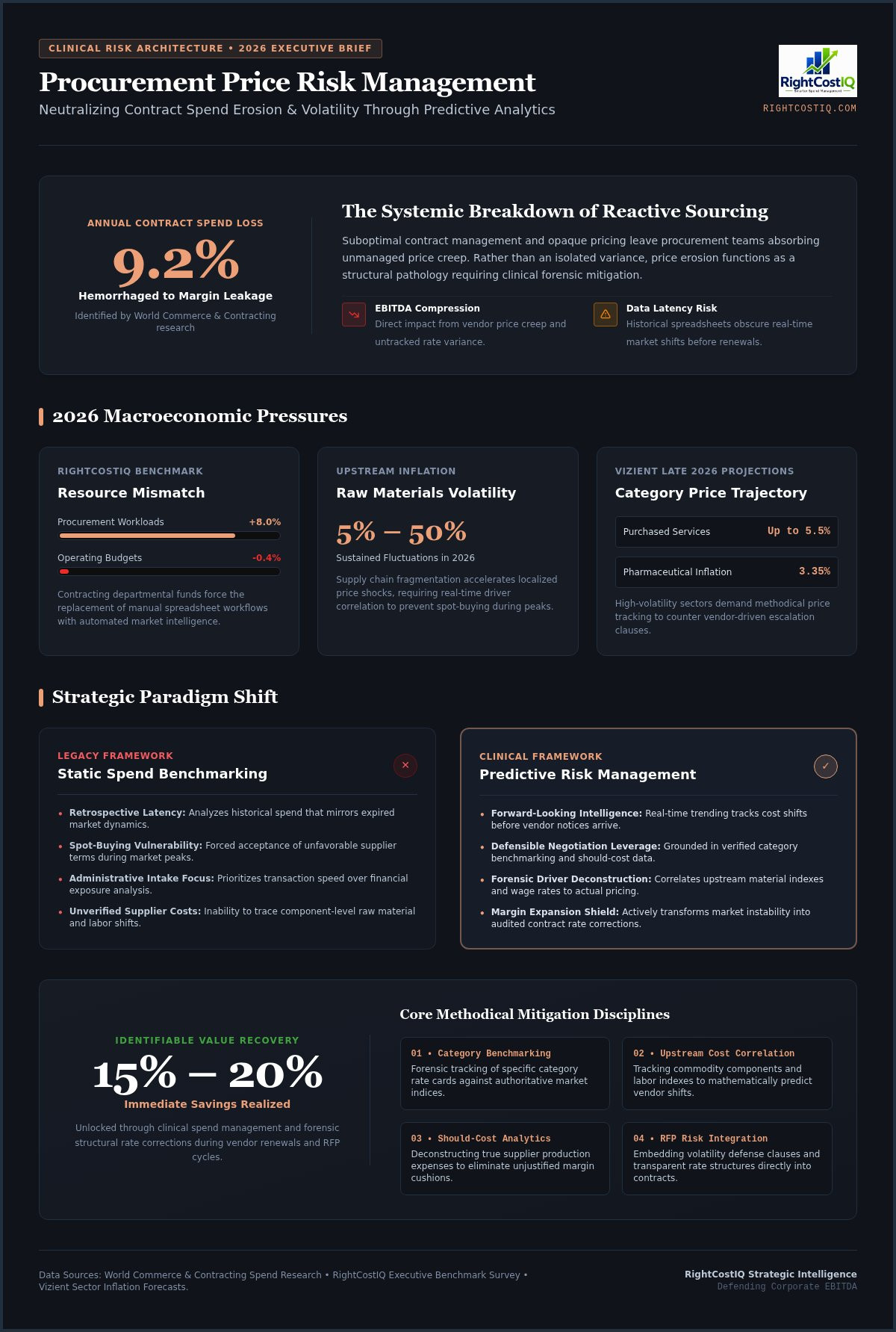
Did you know that the average enterprise currently hemorrhages 9.2% of its annual contract spend to price creep and margin leakage? In a 2026 landscape where procurement workloads are expanding by 8.0% while operating budgets contract, this level of financial erosion is no longer a localized issue; it's a systemic failure of strategy. You're likely facing the relentless pressure of unpredictable cost spikes that erode quarterly margins and undermine long term stability. It's difficult to maintain confidence when a lack of transparency in supplier pricing structures leaves your team vulnerable to sudden market shifts and inefficient RFP processes.
This article provides a clinical framework for procurement price risk management designed to transform market volatility into predictable corporate margin expansion. You'll learn to master the methodical architectures required to replace reactive sourcing with strategic resilience. By adopting these expert led protocols, you can secure data-backed negotiation leverage and protect your organization against global supply chain shocks. We'll examine the integration of advanced cost benchmarking, predictive market trending, and should-cost analytics to build a high performance procurement engine that prioritizes bottom line growth and operational efficiency.
Key Takeaways
- Identify and neutralize systemic cost volatility by transitioning from reactive sourcing to predictive procurement architectures.
- Execute clinical procurement price risk management through the integration of market price trending and forensic category cost benchmarking.
- Replace historical benchmarking with real-time predictive analytics to capture cost-saving opportunities before vendor price escalations occur.
- Leverage should-cost modeling and risk analytics during the RFP lifecycle to secure defensible, data-backed negotiation leverage.
- Transform market volatility into predictable margin expansion by aligning high-level financial strategy with technical execution.
The Economic Imperative of Procurement Price Risk Management
Effective procurement price risk management functions as a clinical diagnostic tool rather than a passive administrative task. It requires the systematic identification and mitigation of cost volatility through evidence-based protocols and forensic data analysis. In 2026, the transition from reactive sourcing to predictive procurement architectures has become a survival mandate for enterprise leaders. Traditional procurement software often fails this transition because it prioritizes transaction speed over financial risk analysis. These legacy systems lack the specialized intelligence required to deconstruct upstream cost drivers, leaving organizations exposed to unmanaged price fluctuations that directly erode EBITDA.
Research from World Commerce & Contracting indicates that suboptimal contract management and price tracking cause the average enterprise to hemorrhage 9.2% of its annual contract spend to margin leakage. Top performing organizations mitigate this risk through objective supply chain risk management frameworks that treat price variance as a pathology to be cured. By utilizing clinical precision in spend management, firms can identify structural rate corrections that yield immediate savings between 15% and 20%.
Market Volatility Drivers in the 2026 Landscape
Geopolitical instability and macroeconomic shifts have created sustained volatility bands for raw materials between 5% and 50% this year. Supply chain fragmentation accelerates these swings, as localized disruptions ripple through global pricing structures. High-volatility categories, particularly in the healthcare and manufacturing sectors, require specialized oversight to counter projected inflation rates. For instance, Vizient projections for late 2026 show pharmaceutical inflation reaching 3.35%, while purchased services lead with escalations as high as 5.5%. Organizations can't absorb these spikes without a methodical architecture for price tracking and forecasting.
The Financial Cost of Reactive Procurement
A "spot-buying" mentality erodes long term contract value by forcing procurement teams to accept supplier terms during peak volatility. This reactive stance correlates directly with significant budget variance and prevents the capture of outlier pricing. According to the RightCostIQ Executive Benchmark Survey, procurement workloads are expanding by 8.0% across 2026 while corporate procurement operating budgets contract by 0.4%. This resource mismatch makes manual spreadsheet workflows obsolete and dangerous. Organizations must utilize market intelligence as a clinical lever to maintain discipline during vendor negotiations and contract renewals. Procurement price risk management is a strategic asset that transforms market instability into a defensible shield for corporate margin protection.
Clinical Architectures of Price Risk Tracking and Forecasting
Transitioning from generic intake-to-pay orchestration to a clinical financial architecture requires a fundamental shift in departmental priorities. Procurement price risk management must be treated as a rigorous financial discipline rather than a clerical byproduct of sourcing. This architecture integrates market price trending and forecasting into the core procurement infrastructure to ensure that every contract renewal is governed by current market realities. By tracking upstream cost drivers such as raw material indexes and labor rates, procurement teams can predict price shifts with mathematical certainty. This methodology moves beyond simple spend tracking, establishing a proactive defense against the margin erosion caused by unmanaged volatility.
Market Price Trending and Intelligence Models
Most procurement teams operate in a state of data latency, relying on historical spend analysis that reflects past market conditions. Clinical architectures replace this retrospective view with forward-looking intelligence models. These models correlate specific category drivers to vendor pricing, providing a predictive window into future cost fluctuations. Strategic insights on navigating procurement price volatility emphasize that digital tracking is the primary defense against external spend escalation. Through RightCostIQ should-cost analysis, organizations deconstruct supplier price structures into their constituent parts. This establishes an objective pricing baseline that empowers negotiators to reject arbitrary price hikes and demand transparency based on actual input costs.
Data-Driven Category Cost Benchmarking
Effective benchmarking requires more than comparing two quotes; it demands a forensic analysis of price variance across the entire vendor landscape. Clinical category cost benchmarking utilizes advanced analytics to identify outliers in high-spend portfolios where margin leakage is most prevalent. By establishing global standards for spend classification, organizations can uncover hidden savings that traditional software misses. World Commerce & Contracting data shows that top-performing organizations limit contract value leakage to 3.0% by using automated price benchmarking, compared to the 9.2% average. Integrating these analytics into the procurement lifecycle ensures that negotiation leverage is always backed by verifiable market data. You can identify these leakage points early by reviewing your clinical cost diagnostic to ensure your current rates align with 2026 market realities.
Static Benchmarking vs. Predictive Analytics: A Strategic Comparison
Static benchmarking acts as a rear-view mirror during a high-speed collision. Relying on historical spend analysis assumes a level of market stability that no longer exists in 2026. Clinical procurement price risk management requires a fundamental pivot toward predictive analytics to capture value before it evaporates. Organizations using backward-looking models often anchor their negotiations to obsolete baselines, failing to account for the 2.78% to 5.5% inflation surges projected for late 2026. This data latency is the primary driver of the 9.2% contract value leakage observed in the average enterprise today.
The Failure of Historical Data in Volatile Markets
Historical data creates a dangerous anchoring bias. Procurement teams often negotiate based on what they paid last year, rather than what the market should cost today. In 2026, input material price fluctuations are experiencing sustained volatility bands of 5% to 50%. Using a static baseline from twelve months ago is mathematically insufficient for high-stakes renewals. Dynamic, real-time market benchmarking is the only clinical methodology capable of neutralizing supplier information asymmetry. It allows you to identify when a supplier is inflating their "uncertainty premium" beyond justifiable market levels.
The Predictive Advantage in Procurement
Predictive analytics empower procurement architects to time market entries and contract durations with forensic precision. By integrating forecasting models, teams can determine whether to commit to multi-year fixed pricing or pivot to dynamic indexation clauses. This level of foresight is a core component of advanced category management procurement strategies. These models identify upstream cost drivers, such as raw materials, energy, and labor, before they manifest as vendor price hikes. Implementing robust supply chain risk mitigation frameworks ensures that your volume commitments are protected against sudden macroeconomic shocks. Algorithmic price tracking identifies the exact moment when a category's risk profile shifts, allowing for immediate structural rate corrections. This clinical approach transforms procurement from a reactive cost center into a primary driver of EBITDA growth and corporate resilience.
Developing a Methodical Risk Mitigation Framework
Methodical risk mitigation requires embedding financial intelligence directly into the operational sourcing cycle. Procurement price risk management isn't a passive monitoring function; it's an active architectural discipline. By standardizing risk mitigation protocols, enterprise leaders ensure that every dollar spent is defended by objective market data. This framework bridges the gap between high-level strategy and tactical execution, converting market volatility into a manageable financial variable. It requires a clinical focus on the entire lifecycle, from the initial bid to post-award savings verification.
RFP Management: Precision Frameworks for Sourcing
Strategic sourcing begins with RFP management that mandates total price transparency. You shouldn't accept blanket quotes that hide supplier margins or "uncertainty premiums." Effective frameworks leverage regulatory shifts, such as the CMS Hospital Price Transparency Standardized MRF Requirement (v3.0.0), to dismantle vendor information asymmetry. By designing RFPs that require vendors to provide payer-specific negotiated charges or certified cost data, you force a level of disclosure that typical sourcing processes ignore. This rigor ensures that vendor proposals are evaluated against forensic market benchmarks rather than subjective sales pitches. For a deeper dive into these methodologies, review our guide on RFP Management: Strategic Frameworks.
Negotiation as a Risk Mitigation Lever
Negotiation serves as the primary clinical lever for neutralizing arbitrary price hikes. When suppliers demand escalations based on vague "market trends," your team must respond with granular cost analytics. Utilizing the RightCostIQ negotiation coach allows sourcing professionals to deploy scripts backed by real-time market price trending and should-cost modeling. This approach is essential for identifying the 15% to 20% immediate savings available through structural rate corrections. If a vendor's quote exceeds the Truth in Negotiations Act (TINA) $10 million threshold for non-commercial acquisitions, you have a financial mandate to demand certified pricing data. This data-driven leverage prevents margin leakage and enforces contract discipline throughout the vendor lifecycle.
Establishing a robust vendor performance tracking service ensures that these negotiated savings actually manifest in your financial statements. It's not enough to win at the negotiation table; you must track ongoing compliance to prevent the "price creep" that consumes 9.2% of average contract spend. Standardizing these protocols across the enterprise creates a resilient procurement engine capable of absorbing global supply chain shocks while maintaining margin stability. You can begin optimizing your sourcing cycles today by accessing a clinical RFP and risk diagnostic.
Optimizing Financial Outcomes with RightCostIQ Strategic Analytics
RightCostIQ functions as the clinical architect of enterprise optimization, bridging the gap between raw data and bottom-line expansion. Procurement price risk management is not merely a software feature but a managed financial discipline that institutionalizes margin protection. By integrating AI-driven benchmarking across 50+ spend categories, the platform delivers an average cost reduction of 18%. This methodology replaces anecdotal haggling with forensic should-cost analysis, ensuring that high-level decision-makers maintain unwavering control over their external spend even during rapid market shifts. It's about converting information asymmetry into a defensible corporate advantage.
Precision Negotiation Assistance
Data alone is insufficient without the clinical execution of sourcing cycles. Expert-led negotiation assistance bridges the strategic gap, applying market price trends to neutralize supplier-side information asymmetry. This synergy mitigates financial volatility by deploying specialized negotiation coaches who utilize proprietary intelligence models to defend every line item. Maintaining operational efficiency requires more than a successful contract award; it demands ongoing vendor performance tracking to eliminate the 9.2% average contract value leakage that plagues unmanaged portfolios. By enforcing strict compliance through automated drift detection and post-award savings verification, organizations secure the financial outcomes negotiated at the outset and prevent the slow erosion of quarterly margins.
Scalable Price Risk Infrastructure
A unified platform for market price trending and forecasting provides the necessary heartbeat for a resilient procurement function. Scalability is achieved by automating the identification of price risk across the entire tail spend landscape, where unmanaged costs often aggregate into significant margin erosion. RightCostIQ benchmarks demonstrate an average realized annual enterprise savings of $2.4 million through these automated architectures. Accelerating RFP cycle times by 3x allows sourcing teams to respond to rapid macro shifts, such as the 2.78% inflation projected for the healthcare supply chain, before they manifest as budget variances. Integrating this clinical precision into your procurement function ensures that every sourcing decision is backed by verifiable market intelligence and strategic foresight. This technical precision transforms procurement from a reactive cost center into a primary driver of corporate profit and strategic growth.
Institutionalizing Strategic Resilience in Procurement
Mastering procurement price risk management is the definitive step toward shielding enterprise EBITDA from the volatility of 2026. You've seen how reactive sourcing erodes value, whereas clinical architectures transform market shifts into predictable margin expansion. By replacing historical benchmarks with predictive analytics, your organization can neutralize supplier information asymmetry and recapture the 9.2% of spend typically lost to contract leakage. This transition requires a fundamental redefinition of procurement as a high performance financial driver.
RightCostIQ provides the technical precision needed to execute this shift. Our specialized Price Risk Management and Tracking Service, combined with Clinical RFP Management and Negotiation Assistance, ensures your sourcing cycles are governed by data rather than guesswork. Leveraging our Market Price Trending and Forecasting Service allows your team to time market entries with forensic accuracy. It's time to move beyond transaction management and toward strategic architecting. Optimize your procurement outcomes with RightCostIQ analytics. You have the tools to turn volatility into a competitive advantage starting today.
Frequently Asked Questions
What is procurement price risk management and why is it critical in 2026?
It is the clinical identification and mitigation of cost volatility through predictive architectures and data-driven protocols. In 2026, procurement price risk management is critical because departmental workloads are expanding by 8.0% while operating budgets contract by 0.4%. This resource mismatch makes manual oversight impossible. Unmanaged price fluctuations cause an average 9.2% spend leakage, so institutionalizing this discipline is essential to transform market volatility into predictable corporate margin expansion.
How does market price trending differ from standard spend analysis?
Standard spend analysis is a retrospective look at historical transaction data; it often results in dangerous data latency. Market price trending is a forward-looking intelligence model that tracks upstream cost drivers, such as raw materials and labor indices, before they manifest as vendor price hikes. While spend analysis tells you what you paid, trending predicts future price shifts. This allows procurement architects to time market entries and contract renewals with forensic precision.
Can price risk management be automated within an existing procurement platform?
Yes, sophisticated risk management can be integrated into existing infrastructure through AI-driven analytics and automated market shift alerts. Automation targets bounded, high-ROI use cases like line-item spend classification and invoice drift detection. RightCostIQ's platform automates benchmarking across 50+ spend categories, providing a 3x acceleration in RFP cycle times. This tech-savvy approach bridges the gap between traditional business functions and cutting-edge digital innovation to ensure unwavering contract discipline.
What are the primary indicators of high price risk in a category?
Primary indicators include sustained volatility bands between 5% and 50% in raw material inputs and high supply chain fragmentation. Categories with projected inflation surges, such as the 3.35% forecast for pharmaceuticals in late 2026, also signal high risk. Additionally, a lack of transparency in supplier pricing structures and reliance on single-source vendors increase exposure to margin erosion. Recognizing these pathologies early allows for structural rate corrections and proactive hedging.
How does category cost benchmarking influence vendor negotiations?
Category cost benchmarking provides the objective evidence needed to dismantle vendor information asymmetry. It establishes a defensible pricing baseline by comparing internal rates against global standards and forensic market data. When negotiators use data-backed leverage, they achieve 15% to 30% superior financial outcomes compared to those relying on historical contract pricing. This clinical approach ensures that negotiation scripts are grounded in current market realities rather than anecdotal supplier claims or arbitrary escalations.
What is the role of should-cost analysis in mitigating financial volatility?
Should-cost analysis deconstructs a supplier's price into its constituent parts, such as material, labor, and overhead. It serves as a clinical diagnostic tool to identify outlier pricing and uncertainty premiums that vendors often embed in multi-year contracts. By establishing what a product should cost based on real-time market drivers, procurement teams can reject arbitrary price hikes. This forensic rigor mitigates financial volatility by ensuring contract rates align with the actual costs of production.
How can enterprise procurement teams implement a risk mitigation framework quickly?
Teams can implement a risk mitigation framework quickly by adopting a clinical RFP management cycle that mandates total price transparency. Integrating proprietary market price trending services allows for immediate visibility into upstream cost drivers. Start by executing objective category cost benchmarking before your next major vendor renewal. RightCostIQ's platform facilitates this transition by providing automated AI cost benchmarking and specialized negotiation coach tools that align high-level strategy with technical execution.
What is the expected ROI of professional price risk tracking services?
Professional price risk tracking services deliver measurable financial growth metrics, including an average cost reduction of 18%. Top-performing organizations that use automated price benchmarking limit contract value leakage to 3.0%, compared to the 9.2% market average. RightCostIQ benchmarks show an average realized annual enterprise savings of $2.4 million. This ROI is driven by forensic should-cost modeling that identifies outlier pricing within high-volume vendor portfolios for immediate and structural rate corrections.


