

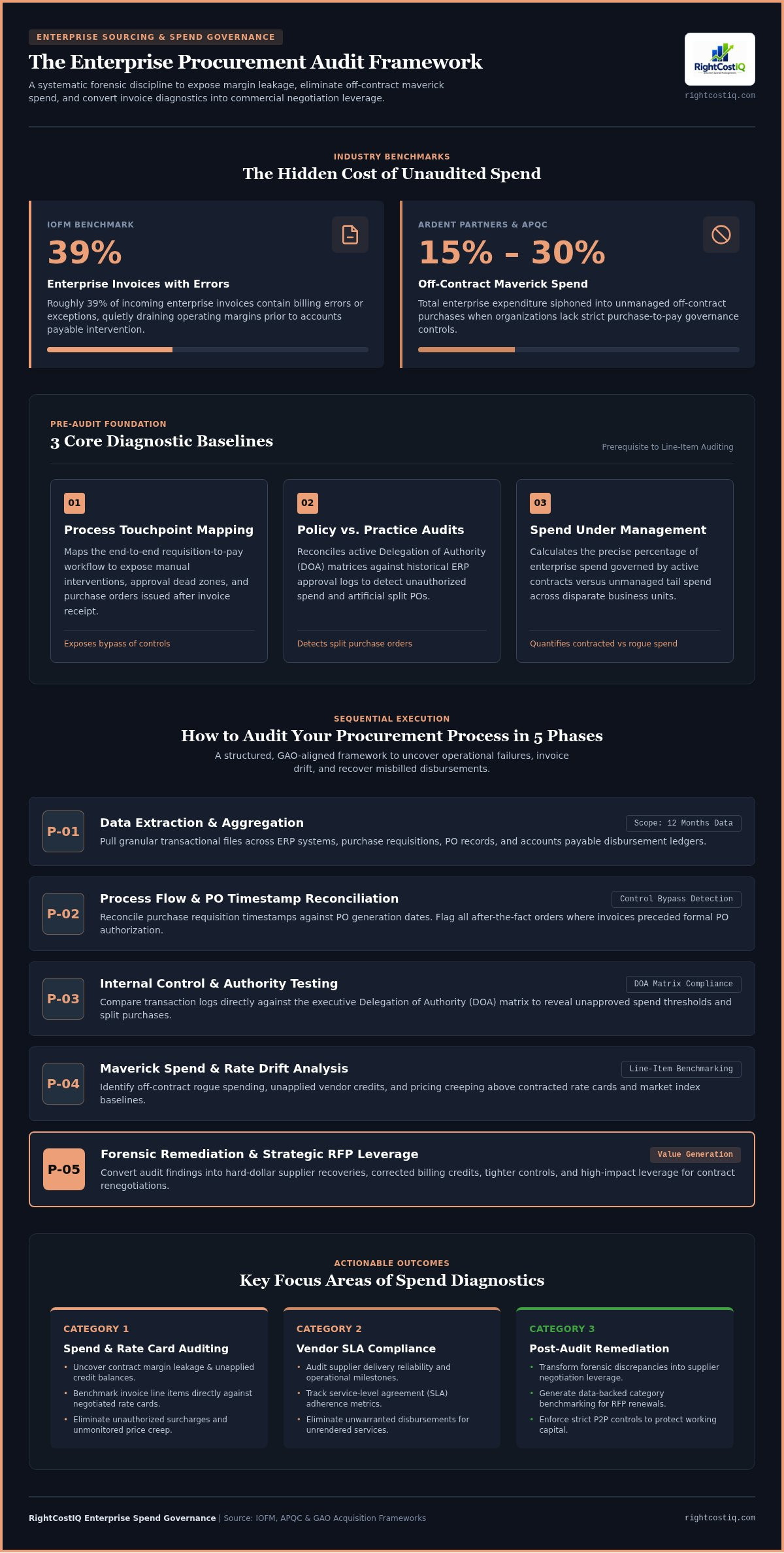
According to IOFM benchmarks, roughly 39% of incoming enterprise invoices contain billing errors or exceptions, quietly siphoning operating margins before finance teams can intervene. If you manage complex spend categories, you already understand the frustration of unmonitored price creep, pervasive off-contract maverick spend, and visibility gaps across disconnected ERP and purchase order systems. Learning how to audit your procurement process is never just about completing an internal compliance checklist; it's an aggressive operational discipline designed to expose hidden margin leakage, correct unapplied credits, and enforce contractual terms across your vendor base.
This guide delivers an enterprise blueprint to help you systematically evaluate procurement workflows, isolate invoice variances, and transform diagnostic findings into commercial negotiation leverage. You will discover how to build a repeatable audit framework across every spend category, recover misbilled supplier disbursements, tighten internal governance controls, and generate rigorous category cost benchmarking data to command your upcoming RFP renewals.
Key Takeaways
- Master how to audit your procurement process across five sequential phases to transition from passive accounting spot-checks to proactive spend governance.
- Uncover hidden contract margin leakage, unapplied credits, and rate card creep by benchmarking invoice line items against contracted pricing and market data.
- Evaluate supplier delivery reliability, operational SLA adherence, and price volatility risks to eliminate unwarranted vendor disbursements.
- Convert forensic audit findings directly into high-impact commercial leverage for structured RFP restructuring and contract renegotiations.
What Is a Procurement Audit and Why Is It Essential?
A procurement audit is a forensic diagnostic examination of organizational spend, purchasing workflows, and contractual compliance. Traditional financial accounting confirms whether an invoice mathematically balances and holds ledger authorization. A true procurement audit digs into the operational mechanics of the entire procurement lifecycle, evaluating whether commercial pricing agreements, service-level terms, and internal delegation protocols were actually enforced before cash left the organization.
Executing an audit without commercial context produces sterile compliance checklists that ignore cash leakage. Understanding how to audit your procurement process requires cross-functional coordination across strategic sourcing, accounts payable, legal counsel, and business unit budget owners. When these stakeholders collaborate around shared diagnostic data, the audit transitions from a punitive accounting exercise into an aggressive value-generation mechanism.
Defining the Strategic Audit Charter and Scope
A successful audit starts with a precise charter that establishes operational boundaries across direct, indirect, and capital expenditure. Sourcing teams must segment target spend into high-volume direct inputs and fragmented, unmanaged tail spend. Direct materials carry exposure to index volatility and volume rebate compliance, while indirect services hide unmonitored scope creep. Establish measurable audit objectives upfront: target hard dollar recoveries, quantify contract non-compliance rates, and benchmark cycle-time inefficiencies against corporate risk governance standards.
Establishing Diagnostic Baselines and Governance Metrics
Before scrubbing line-item data, establish your operational baselines across three diagnostic dimensions:
- Process Touchpoint Mapping: Map the requisition-to-pay workflow to expose manual interventions, approval dead zones, and purchase orders generated after invoice receipt.
- Policy versus Practice Audits: Compare active delegation of authority (DOA) matrices against historical ERP approval logs to expose unauthorized spend thresholds and split purchase orders.
- Spend Under Management (SUM): Calculate the precise percentage of enterprise spend governed by active contracts versus unmanaged purchasing across disparate business units.
Tracking these baselines provides the objective baseline required to evaluate transactional integrity. Without documented baselines, organizations cannot differentiate systemic vendor overbilling from internal procedural failure. Establishing these parameters ensures your team focuses on high-yield recoveries rather than administrative noise.
How to Audit Your Procurement Process in Five Sequential Phases
Executing an enterprise procurement audit requires a structured, repeatable methodology rather than fragmented spot-checks. Following the principles outlined in the GAO acquisition assessment framework, high-performing procurement teams run audits through an integrated lifecycle that uncovers operational policy failure, transaction fraud, and commercial rate drift. Understanding how to audit your procurement process systematically protects working capital while generating data-backed leverage for upcoming supplier renegotiations.
Phase 1 & 2: Data Extraction and Process Flow Mapping
Begin by pulling twelve months of granular transactional data across enterprise resource planning (ERP) platforms, purchase orders, requisitions, and accounts payable disbursement files. Reconcile raw purchase requisition timestamps directly against final PO generation dates. Mark every invoice received before its corresponding purchase order was formally issued; these after-the-fact orders prove that your operational controls were actively bypassed. Map each process handoff to highlight requisition approval delays and identify repetitive manual interventions that slow operational throughput.
Phase 3 & 4: Control Testing and Maverick Spend Identification
Evaluate your internal controls by cross-referencing transactional records against core governance rules. Data from Ardent Partners and APQC shows that off-contract maverick spend accounts for 15% to 30% of total expenditure in organizations without strict purchase-to-pay controls. To pinpoint this leakage:
- Audit Approval Thresholds: Compare invoice approval logs against the executive delegation of authority (DOA) matrix to uncover unapproved spend and split orders designed to evade approval limits.
- Detect Off-Contract Spend: Run vendor master files against actual disbursements to flag payments routed to unapproved suppliers or legacy rate structures.
- Analyze Tail Spend Exposure: Examine tail spend patterns to catch fragmented, small-dollar buys that collectively erode negotiated savings.
Phase 5: Root-Cause Synthesis and Reporting
Raw transaction discrepancies require clinical classification before presenting findings to executive leadership. Segment every discovered anomaly into three distinct failure modes: procedural oversight, contract ambiguity, or deliberate approval bypass. Build executive dashboards that quantify direct cash leakage alongside supplier compliance scores. Presenting definitive transactional evidence to category managers transforms internal audit friction into organizational alignment, preparing your team for structured contract restructuring.
Forensic Spend and Rate Card Auditing: Uncovering Invoice Discrepancies
Automated payment processing frequently accelerates cash leakage instead of stopping it. When accounts payable systems run basic matching without line-item verification, they routinely codify systematic vendor overbilling into standard operating expenses. According to the Institute of Finance & Management (IOFM), duplicate payments alone siphon up to 1.5% of outgoing disbursements, while standard post-payment recovery audits routinely yield between 0.1% and 0.5% of gross auditable spend in direct cash clawbacks. A clinical understanding of how to audit your procurement process requires looking past total invoice totals down into itemized line structures where uncontracted margin erosion occurs.
Reconciling Invoiced Line Items Against Contracted Rate Cards
Basic three-way matching verifies that a purchase order, receiving slip, and invoice match at the aggregate header level. It does not verify whether itemized billings comply with contractual master service agreements (MSAs). Unbundle incoming vendor invoices across these high-risk leakage vectors:
- Rate Card Drift: Reconcile billed unit rates against signed tiered pricing schedules to catch unauthorized rate escalations applied without formal contract amendments.
- Accessory Charge Inflation: Audit pass-through expenses, minimum order fees, and phantom freight or fuel surcharges added to standard delivery orders.
- Unapplied Volume Rebates: Verify earned tier thresholds against actual payments to capture contractual volume credits that vendors omitted from downstream billing statements.
Benchmarking Spend Categories Against Current Market Data
Auditing historical billing records confirms contract adherence, but it cannot tell you if your contracted rates represent competitive commercial terms. Sourcing leaders integrate the classic strategic supply management framework to classify spend by market complexity and bottom-line impact. Comparing internal baseline rates against external commodity indices and real-time category cost benchmarking reveals true supplier cost structures.
Deploy specialized should-cost models to break down bill-of-materials manufacturing inputs, labor rates, and overhead margins. When you evaluate your category exposure, pairing audited invoice variances with bottom-up should-cost analytics strips away vendor pricing opacity. This empirical data arms category managers with irrefutable cost baselines for subsequent contract renewals.
Auditing Vendor Performance, Deliverables, and Contract Compliance
A contract is only as valuable as your operational enforcement of its terms. While accounting teams often confirm invoice arithmetic, they rarely cross-reference billed amounts against actual delivery performance or service execution. Discrepancies between contracted service levels and actual operational output represent silent, cumulative balance-sheet erosion. Understanding how to audit your procurement process requires examining whether suppliers delivered the contracted quality, volume, and operational uptime before finance released payment.
Auditing Service Level Agreements and Operational KPI Delivery
Forensic performance auditing moves beyond subjective vendor reviews by reconciling objective delivery logs against contracted service level agreements (SLAs). Cross-examine purchase order delivery deadlines against warehouse timestamp receipts to calculate true on-time, in-full (OTIF) delivery metrics. Line items marked as fulfilled often mask late shipments that forced internal operational delays or factory downtime.
Scrub return merchandise authorizations (RMAs) and scrap records directly against contractual defect thresholds. When suppliers breach contracted defect rates or missed delivery schedules, enterprise agreements almost always stipulate contractual service credits or financial liquidated damages. If procurement teams never claim these contractually guaranteed deductions, suppliers retain unearned revenue while buyers absorb internal production bottlenecks.
Supply Base Risk Scoring and Concentration Vulnerabilities
Operational auditing also evaluates systemic risk within the active supply base. Overreliance on single-source suppliers in critical direct or indirect categories creates severe balance-sheet vulnerability. Audit spend concentration to pinpoint vendors controlling disproportionate category volume without formal redundancy plans:
- Financial Solvency Audits: Track supplier working capital metrics, credit ratings, and Altman Z-scores to identify balance-sheet instability before mid-contract insolvency disrupts critical operations.
- Regulatory and Governance Compliance: Verify whether active suppliers maintain current certifications against ISO 37001 anti-bribery management standards and regional mandates like the EU Corporate Sustainability Due Diligence Directive (CSDDD).
- Security and Liability Clearances: Audit vendor certificates of insurance, data privacy accreditations, and cybersecurity verifications to eliminate uninsured operational liability.
When vendor performance and compliance drop below acceptable benchmarks, passive monitoring guarantees continued operational decay. Executing a clinical vendor performance tracking diagnostic provides the objective scoring data necessary to demand contractual remedy or initiate immediate supplier replacement.
Post-Audit Remediation: Converting Audit Findings into Strategic Sourcing Leverage
An audit that terminates in an internal memo delivers zero commercial value. The real return on mastering how to audit your procurement process emerges when you translate forensic discrepancies into hard bargaining leverage at the negotiation table. Rather than settling for passive credit memos, enterprise sourcing teams weaponize documented overbillings, SLA failures, and maverick rate variations to restructure supplier agreements, reclaim working capital, and command upcoming category renewals.
Transforming Audit Discrepancies Into Sourcing and Negotiation Leverage
Convert unearned vendor disbursements into contractual concessions through a systematic escalation path. Aggregate historical billing variances and present itemized audit files directly to vendor account leadership. Demand immediate reimbursement via wire transfers or credit balances against upcoming invoices, rather than indefinite billing offsets.
When vendors show recurring non-compliance or refuse baseline price corrections, trigger immediate market testing. Deploy disciplined RFP management strategies to reopen locked categories to competitive bidding. Presenting incumbents with documented audit evidence alongside aggressive market benchmarks removes their pricing leverage. Enterprise category leaders leverage specialized negotiation assistance to structure competitive bidding events that reset bloated baselines and lock down transparent, unbundled pricing schedules.
Institutionalizing Continuous Auditing and Category Optimization
Preventing procurement process decay requires abandoning retroactive sample audits in favor of continuous spend surveillance. Organizations relying on manual periodic spot-checks fail to capture systematic rate creep before it compounds across quarters. Establish programmatic governance mechanisms across the spend lifecycle:
- Automated Price Tracking: Deploy real-time price monitoring engines to catch unauthorized unit-rate inflations and uncontracted surcharges before disbursements are released.
- Dynamic Performance Monitoring: Implement continuous vendor tracking architectures that monitor operational KPIs, shipment timestamps, and defect rates against SLA penalty thresholds.
- Predictive Price Risk Controls: Incorporate price volatility models to anticipate commodity swings and hedge cost exposure before supplier contracts reopen.
Enterprise procurement requires continuous analytical rigor. Strategic sourcing teams leverage platforms like RightCostIQ to execute specialized procurement category cost benchmarking, price volatility tracking, and structured RFP optimization. Turning continuous audit diagnostics into operational policy transforms procurement from a transactional cost center into a dominant driver of enterprise margin expansion.
Transform Procurement Audits into Lasting Commercial Advantage
A rigorous procurement audit is the ultimate operational weapon against unmonitored margin erosion. Knowing how to audit your procurement process with clinical precision allows enterprise leadership to systematically eliminate maverick spend, recover unapplied credits, and enforce master service agreements across every spend tier. When you substantiate billing variances with empirical evidence, internal compliance findings become commanding commercial leverage during supplier renegotiations.
True cost discipline requires continuous analytical rigor rather than periodic spot-checks. Implementing category cost benchmarking backed by clinical data analytics, continuous price risk management, and automated vendor performance tracking guarantees that negotiated savings hit your bottom line. To eliminate contract leakage and command your next sourcing event, deploy strategic procurement optimization with RightCostIQ today.
Frequently Asked Questions
What is a procurement process audit?
A procurement process audit is a forensic evaluation of an enterprise's sourcing workflows, contract compliance, and disbursement accuracy. It inspects purchasing operations from initial requisition through final payment release. Rather than verifying simple general ledger accounting, it examines whether purchasing teams complied with internal approval thresholds, enforced contracted rate cards, and captured all negotiated commercial terms across the vendor base.
How often should an enterprise audit its procurement workflows?
Enterprises should execute comprehensive category audits annually while running continuous transaction monitoring across real-time invoice feeds. High-spend categories and complex direct materials benefit from quarterly rate card reconciliations to catch scope creep early. Organizations learning how to audit your procurement process effectively replace periodic sample spot-checks with ongoing digital surveillance across purchase orders, receiving slips, and accounts payable disbursement files.
What are the most common red flags uncovered during a procurement audit?
Common red flags include recurring split purchase orders designed to evade managerial approval limits, invoices dated prior to purchase order creation, and uncontracted freight or fuel surcharges. Auditors also routinely uncover active payments issued to unapproved vendor records, missing tax documentation, and persistent discrepancies between negotiated Master Service Agreement rate cards and line items billed on transactional invoices.
What is the operational difference between a procurement audit and a financial audit?
Financial audits evaluate balance sheet integrity, general ledger categorization, and regulatory reporting accuracy across historical accounting periods. In contrast, a procurement audit evaluates the operational mechanics of commercial agreements. It inspects supplier pricing tier compliance, fulfillment quality against contracted service level agreements, delegation of authority adherence, and hard dollar overbilling leakage across active purchasing operations.
What key data sources and documents are required to initiate a procurement audit?
Initiating a comprehensive audit requires twelve months of transactional enterprise resource planning (ERP) logs, itemized accounts payable records, purchase requisitions, and vendor master files. Audit teams also require fully executed contracts, rate sheets, supplier statements of work, and warehouse receiving documentation. Reconciling these operational files against bank disbursement records establishes the paper trail needed to isolate commercial discrepancies.
How do you detect and quantify maverick spend during an internal review?
Detecting maverick spend requires cross-referencing accounts payable disbursement ledgers against your approved vendor master list and contracted category catalogues. Calculating the total dollar volume routed through non-contracted suppliers or unapproved purchasing channels reveals off-contract leakage. Mastering how to audit your procurement process allows category managers to quantify the premium paid over contracted baseline rates on rogue transactions.
How do procurement audit findings translate into supplier contract renegotiations?
Documented audit findings provide concrete evidentiary leverage during structured sourcing events and renewals. When category managers confront vendors with historical billing discrepancies, missed delivery schedules, and unauthorized rate increases, the commercial dynamic shifts. These documented breaches support aggressive demands for retroactive credit recovery, elimination of uncontracted fee structures, and immediate category re-benchmarking through competitive Request for Proposal events.


