

Most enterprise vendor scorecards don't eliminate bias; they simply disguise subjective stakeholder preferences behind complex mathematical formulas. Without objective market cost baselines and disciplined risk normalization, typical procurement decision matrix examples collapse the moment executive leadership or financial auditors demand defensible proof.
You've likely fought the uphill battle of reconciling disparate pricing structures across fragmented RFP responses while internal department heads champion their favored suppliers. When static spreadsheets break under multi-tier compliance constraints, defending your final sourcing award becomes an exercise in damage control rather than strategic leadership.
Mastering your scoring architecture changes that dynamic. In this guide, you'll master the structural design, defensible weighting methodologies, and quantitative criteria required to deploy audit-ready evaluation models. We'll examine robust enterprise frameworks across direct and indirect spend categories, detailing how to translate matrix outputs directly into tactical negotiation leverage.
Key Takeaways
- Neutralize committee subjectivity by pairing non-negotiable knockout gates with mathematically weighted scoring tiers.
- Deploy tailored procurement decision matrix examples across direct materials, indirect spend, and complex services to reflect distinct total cost of ownership drivers.
- Protect scoring integrity by normalizing complex, disparate supplier pricing models against independent market cost baselines.
- Isolate and eliminate cognitive vulnerabilities such as incumbent anchoring bias and qualitative score compression before awarding contracts.
- Transform static matrix outputs into structured commercial negotiation leverage to systematically target supplier margin buffers and contract terms.
Architectural Foundations: What Constitutes an Enterprise Procurement Decision Matrix?
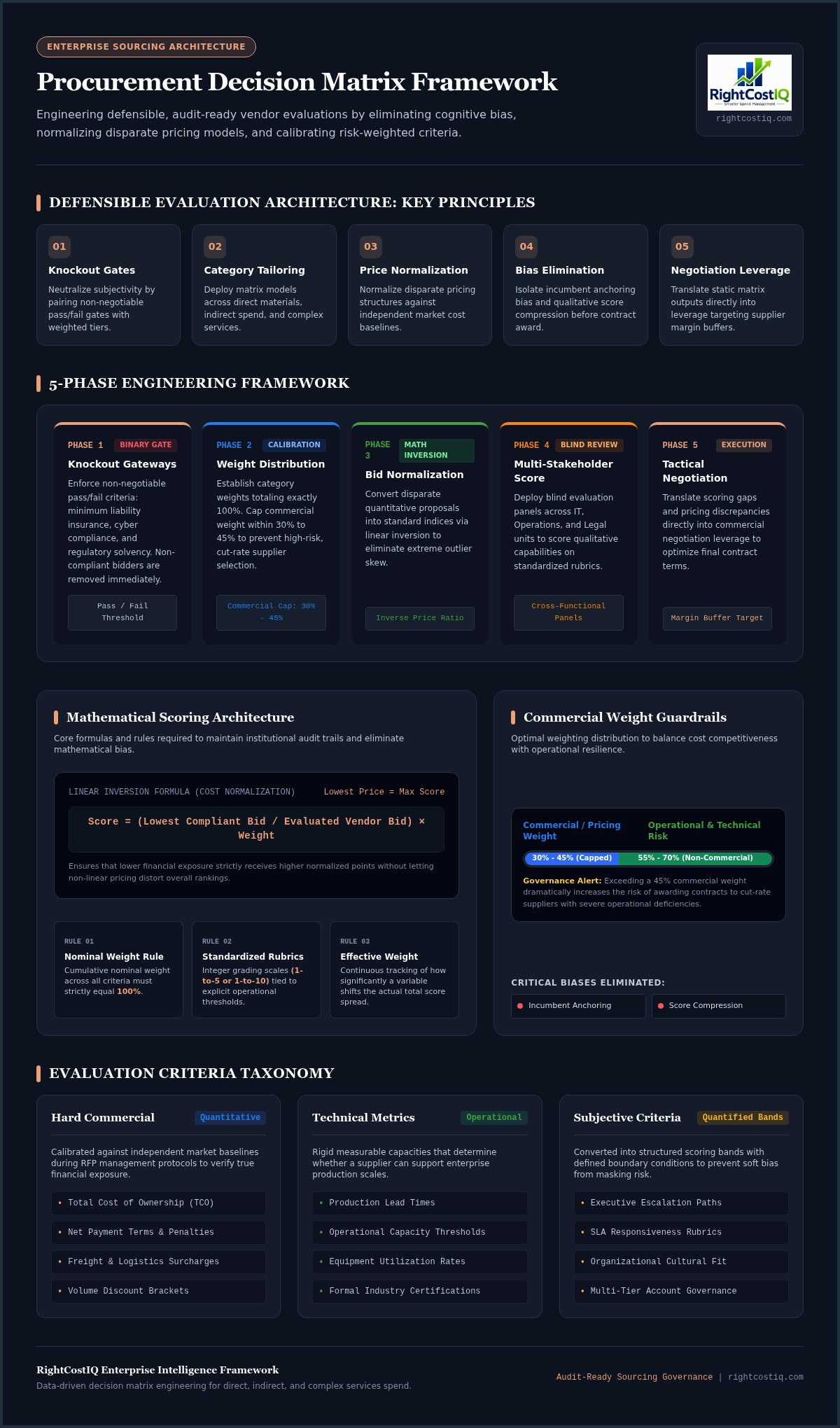
Enterprise strategic sourcing demands defensible governance, not collaborative consensus voting or basic checklist tools. Grounded historically in the classic Decision-Matrix Method, a modern sourcing matrix serves as an analytical engine that systematically scores competing vendor capabilities against quantified organizational priorities. Its core utility lies in neutralizing subjective cognitive bias across cross-functional stakeholder committees while producing an immutable audit trail for internal auditors and executive reviews. Rather than functioning as post-hoc administrative scorecards, high-impact procurement decision matrix examples integrate multi-variable total cost modeling with operational compliance standards to drive strategic award allocations.
Core Mathematical Components: Weights, Raw Scores, and Normalized Values
Mathematical precision separates an institutional scoring model from a generic spreadsheet. Every enterprise framework relies on four interlinked mathematical constructs:
- Nominal vs. Effective Weights: Nominal weight assigns perceived importance to a category; effective weight measures how significantly that variable actually shifts the total score spread. The cumulative nominal weight across all criteria must strictly total 100%.
- Standardized Scoring Scales: Evaluators assign integer scores using explicit 1-to-5 or 1-to-10 rubrics where each point corresponds to documented operational thresholds, eliminating arbitrary grading.
- Linear Normalization: Quantitative metrics such as pricing and lead times require conversion into uniform dimensional indices. For cost parameters where lower figures indicate superior performance, normalization uses a strict linear inversion:
Score = (Lowest Proposal / Vendor Proposal) * Scale Max.
Quantitative vs. Qualitative Evaluation Criteria in Strategic Sourcing
Rigorous procurement decision matrix examples separate mandatory performance baselines from competitive differentiators. Hard commercial variables extend beyond initial bid prices to capture total cost of ownership, net payment terms, freight costs, and volume discount brackets. Calibrating these figures against independent market cost intelligence keeps supplier bids grounded in real economic baselines during RFP management protocols.
Technical competencies quantify operational capacity, equipment utilization rates, and formal certifications. Meanwhile, subjective operational criteria such as cultural fit, executive escalation paths, and responsiveness are converted into quantifiable grading bands with defined boundary conditions. This structured separation ensures soft qualitative impressions never obscure hard financial exposure or commercial risk.
Constructing a Weighted Scoring Model: A 5-Phase Engineering Framework
Ad-hoc scoring sheets introduce fatal variability into enterprise strategic sourcing. While standard industrial applications of decision matrix methodology rely on direct attribute summation, enterprise procurement requires an engineered multi-stage pipeline. Sourcing teams must eliminate non-viable bidders immediately, normalize disparate financial commercial structures, and isolate cross-functional evaluator anomalies before validating final supplier rankings.
Phase 1 & 2: Defining Knockout Gateways and Calibrating Weight Distributions
Execution begins with binary pass-fail gates. Knockout criteria filter candidates based on baseline parameters: minimum liability insurance, cyber compliance standards, and regulatory solvency. Only vendors passing every gateway proceed to active scoring. Next, assign nominal weights across operational excellence, strategic risk, and financial competitiveness. Capping commercial weight within a 30% to 45% band avoids the pitfall of selecting cut-rate suppliers with severe operational risk profiles.
Phase 3 & 4: Normalizing Disparate Bids and Aggregating Multi-Stakeholder Scores
Pricing normalization demands an inverse ratio formula to eliminate outlier skew:
Score = (Lowest Compliant Bid / Evaluated Vendor Bid) * Weight
Blind functional evaluation panels across IT, operational, and legal units score qualitative criteria independently without viewing competitor price tags. To safeguard the mathematical integrity seen in high-performing procurement decision matrix examples, sourcing directors calculate standard deviations across committee scores. An evaluator variance exceeding 1.5 points triggers mandatory review, isolating personal bias before scores merge into the aggregate model.
Phase 5: Conducting Sensitivity Analysis to Validate Ranking Resilience
Static rankings are deceptive. Sensitivity modeling deliberately adjusts variable weightings by ±10% to ±20% across volatile categories like energy surcharge exposure or logistics lead times. This stress-testing reveals whether supplier rank positions survive commodity swings or currency fluctuations. Teams can benchmark these cost tolerances against live category data using category cost benchmarking and analytics to confirm final model defensibility.
Documenting these variance simulations establishes an immutable, audit-proof record. When procurement presents award recommendations to executive leadership, the underlying numbers withstand rigorous financial scrutiny.
Tactical Procurement Decision Matrix Examples: Direct, Indirect, and Service Sourcing
Category dynamics dictate that no universal template fits all corporate spend profiles. Applying a uniform rubric across disparate acquisitions exposes organizations to severe operational misallocations. High-performing procurement decision matrix examples adapt weighting structures, knockout gates, and valuation algorithms to match the specific commercial realities of enterprise indirect spend, direct manufacturing inputs, and specialized service engagements.
Enterprise Software & SaaS Vendor Evaluation Matrix
Software sourcing prioritizes security posture, architecture compatibility, and operational scalability over nominal license fees. A typical enterprise SaaS weighting profile allocates 30% to Security and Regulatory Compliance, 25% to Architecture Integration, 25% to Total Cost of Ownership, and 20% to Functional Usability.
Hard knockout gates mandate SOC2 Type II compliance, GDPR alignment, and seamless identity federation. Commercial scoring must capture hidden deployment expenditures, including legacy data migration, custom API maintenance, and mandatory end-user training. Sourcing teams deploy structured RFP Management protocols to standardize complex technical software evaluations and eliminate vendor-driven scope ambiguities.
Direct Material Supplier Matrix Incorporating Landed Cost Analytics
Direct spend scorecards shift priority toward supply continuity, production scalability, and total landed cost. The evaluation model balances basic unit pricing against cross-border freight tariffs, buffer inventory carrying costs, and multi-tier logistics volatility.
A defensible direct materials weight distribution allocates 40% to Total Landed Cost, 30% to Capacity and Quality Metrics, and 30% to Supply Chain Risk Profile. Quality rubrics establish strict defective parts-per-million (PPM) thresholds and tooling lifespan guarantees. Sourcing managers leverage institutional should-cost analytics to establish empirical cost targets before scoring supplier commercial tiers, preventing arbitrary baseline projections.
Professional Services and Strategic Advisory Selection Framework
Evaluating human capital demands strict milestone governance rather than general agency reputation. Defensible procurement decision matrix examples in professional services deploy a targeted weight distribution: Technical Competency (35%), Delivery Framework (25%), Commercial Terms (25%), and Organizational Culture (15%).
Scoring panels deconstruct proposals by auditing named resource seniority, delivery methodology repeatability, and verified historical case validity. The commercial rubric heavily favors milestone-based deliverable structures with performance holdbacks while penalizing open-ended time-and-materials arrangements. This structural discipline ensures external advisory spend yields verifiable operational returns.
Critical Vulnerabilities in Decision Matrices: Eliminating Bias and Price Distortion
Subjective evaluator tendencies frequently undermine the mathematical integrity of strategic sourcing models. Left uncalibrated, typical procurement decision matrix examples deteriorate into decorative exercises where stakeholders reverse-engineer scores to favor preferred incumbents. Defending an award decision requires identifying these cognitive distortions early and decoupling qualitative capability assessments from commercial fee structures.
Neutralizing Evaluator Subjectivity Through Blind Scoring Protocols
Anchoring bias remains the primary driver of distorted sourcing outcomes. Cross-functional committee members who recognize an incumbent supplier routinely award inflated qualitative scores, rationalizing past performance over objective proposal merits. Sourcing governance must enforce structural isolation through four explicit mechanisms:
- Identity Redaction: Procurement operations teams scrub vendor branding, executive bios, and recognizable corporate identifiers from technical RFP submissions before distribution.
- Domain Partitioning: Subject matter experts score criteria solely within their functional disciplines. IT evaluates infrastructure compatibility, legal assesses regulatory posture, and operations audits delivery timelines.
- Mandatory Outlier Justifications: Any evaluator score assigned at extreme scale boundaries (such as a 1 or a 5 on a standard rubric) requires documented qualitative rationale backed by proposal excerpts.
- Independent Statistical Mediation: Cross-functional variances exceeding acceptable standard deviation thresholds trigger internal reviews before weights consolidate.
Decoupling Nominal Bid Pricing from Total Cost of Ownership (TCO)
Simplistic spreadsheet pricing formulas present equal danger to sourcing integrity. Standard inverse mathematical formulas frequently punish aggressive, market-disrupting pricing structures by compressing the scoring gap between high and low bidders. A proposal featuring an artificially low headline price often masks crippling post-award expenses, from ongoing maintenance fees to painful system cutover overhead.
Rigorous models decouple bid evaluations by evaluating qualitative capability scores before introducing commercial pricing indices. Sourcing teams align these models with institutional category management frameworks to isolate total life-cycle expenditures from nominal quote sheets. To identify margin expansion opportunities and insulate your category sourcing strategy from pricing anomalies, evaluate your scoring framework with RightCostIQ through our spend diagnostics.
Operationalizing Matrix Analytics: Bridging Static Scoring and Active Contract Negotiation
Most sourcing teams treat a completed scorecard as a closing ceremony. Once the winning vendor is selected, the spreadsheet is archived in an audit folder. This practice overlooks significant commercial value. Grounded enterprise procurement decision matrix examples serve not as terminal tallies, but as quantitative roadmaps for commercial contract negotiations. The delta between vendor scores highlights precise operational leverage points, arming procurement teams with empirical data to systematically target supplier margin buffers and contract terms.
Transforming Matrix Discrepancies into Tactical Negotiation Levers
Every scoring deficit in a top-ranked proposal represents an actionable negotiation target. Consider a common scenario: a technically superior supplier achieves the highest aggregate score but lags behind secondary competitors on payment terms, liability caps, or volume rebates. Sourcing leaders don't accept these weak sub-scores as trade-offs. Instead, they present the itemized matrix variances to the preferred vendor during Best and Final Offer (BAFO) rounds, establishing explicit parity demands.
Quantifying these capability gaps prevents suppliers from deflecting commercial requests. Sourcing leaders deploy targeted negotiation assistance to convert these technical score deficits into enforceable price concessions and favorable commercial terms before drafting final agreements.
Continuous Vendor Performance Benchmarking Beyond Contract Execution
An evaluation model's architectural value extends well past the execution date. The same criteria, weights, and scoring rubrics applied during the RFP phase should translate directly into post-award supplier relationship management (SRM) frameworks. Aligning operational scorecards directly with initial evaluation metrics ensures continuity between pre-award promises and post-award delivery.
- SLA Governance: Scoring rubrics for technical capabilities establish the exact baseline metrics for service level agreements and performance liquidated damages.
- Variance Tracking: Quarterly business reviews (QBRs) track real-world vendor execution against original proposal scores, exposing operational slippage immediately.
- Dynamic Baseline Updates: Continuous performance data informs future category refreshes, turning historical evaluation records into predictive intelligence.
Transitioning from static evaluations to dynamic lifecycle tracking prevents contract leakage and protects project ROI. Sourcing organizations achieve this continuity by anchoring their evaluations in institutional RightCostIQ RFP intelligence, standardizing supplier data governance from initial request to multi-year contract renewals.
Transform Sourcing Scorecards into Defensible Commercial Advantage
Enterprise strategic sourcing demands mathematical rigor and absolute defensibility. Implementing robust procurement decision matrix examples elevates sourcing teams from administrative gatekeepers to strategic value drivers. By enforcing non-negotiable knockout gateways, standardizing pricing normalization, and blinding technical evaluation panels, organizations systematically neutralize internal bias and insulate balance sheets against volatile commercial terms.
Your scorecard shouldn't sit idle in an audit archive once an award is confirmed. Market leaders operationalize matrix discrepancies to extract tangible commercial concessions during final negotiations, holding suppliers accountable to initial RFP representations throughout the contract lifecycle. Grounding your criteria in independent category cost benchmarking and predictive price risk analytics ensures every sourcing award withstands executive scrutiny. Take control of your next strategic tender and optimize your enterprise sourcing with RightCostIQ RFP and Negotiation Assistance to engineer lasting commercial advantage.
Frequently Asked Questions
What is the primary difference between a Pugh matrix and a weighted procurement decision matrix?
A Pugh matrix evaluates qualitative options against a single baseline standard using relative symbols, whereas a weighted procurement decision matrix assigns percentage weights and normalized mathematical scores across multi-dimensional criteria. Pugh matrices work well for early concept feasibility studies. Enterprise strategic sourcing requires weighted scoring models to reconcile total landed cost, SLA compliance, and cross-functional technical capabilities into audit-ready financial rankings.
How much weight should commercial pricing hold in an enterprise procurement decision matrix?
Commercial pricing should typically hold between 30% and 45% of the total weight in enterprise sourcing models. Allocating over 50% to price incentivizes vendors to submit artificially low bids with hidden lifecycle fees, while setting it below 25% often creates unviable cost overruns. In specialized procurement decision matrix examples for capital equipment or direct materials, sourcing teams benchmark pricing weights against operational failure risks to protect total margin impact.
How do you mathematically score pricing in a weighted decision matrix without distorting results?
You mathematically score pricing by applying an inverse ratio formula that divides the lowest compliant bid by the vendor's evaluated bid, multiplied by the maximum scale points. This ensures the lowest cost receives full points while progressively penalizing higher rates. Sourcing teams must avoid linear spread models that award zero points to bids exceeding an arbitrary threshold, as that falsely distorts legitimate market tier spreads.
Can a vendor win a procurement RFP if they score low in a specific critical category?
Yes, mathematically an aggregate score can mask severe category deficiencies unless sourcing architects install mandatory knockout gates or minimum score thresholds. Without minimum category floors, a rock-bottom price or perfect IT score can carry a vendor with failing legal or cybersecurity compliance over the finish line. Enterprise governance models require vendors to meet non-negotiable minimum score thresholds in critical operational tiers before aggregate totals count toward final selection.
How many evaluators should participate in an enterprise procurement matrix scoring panel?
An optimal enterprise evaluation panel comprises five to nine cross-functional evaluators representing technical, operational, legal, and finance divisions. Panels smaller than five risk single-stakeholder bias, while committees larger than nine encounter analysis paralysis and diluted accountability. Sourcing directors maintain integrity by partitioning scoring access, ensuring evaluators score only criteria within their operational domain rather than grading entire supplier submissions arbitrarily.
What steps prevent internal stakeholder bias when evaluating an incumbent vendor?
Preventing incumbent bias requires blinding technical proposals, redacting corporate logos, and separating commercial fee analysis from operational capabilities. Evaluators should evaluate anonymous proposal sheets against strict rubric definitions rather than executive reputations. In disciplined procurement decision matrix examples, sourcing leaders mandate written evidentiary justifications for extreme scores and calculate standard deviation across the panel to flag and neutralize statistical outlier bias before consolidating results.
How should total cost of ownership (TCO) be integrated into a weighted scoring matrix?
Total cost of ownership must replace nominal quote figures by aggregating acquisition cost, transition friction, software maintenance, risk premiums, and eventual decommissioning fees into a unified commercial metric. Scoring panels normalize this calculated lifecycle sum against verified category benchmarks rather than superficial unit costs. This prevents suppliers with low initial bids from securing contracts that incur heavy secondary integration or freight expenses later.


