

Commercial leverage doesn't come from aggressive bargaining tactics or charismatic persuasion; it stems entirely from granular cost transparency. Enterprise sourcing teams are routinely outmaneuvered by entrenched vendors who conceal expanding margins behind opaque pricing tiers, complex indexing formulas, and punitive renewal quotes. When internal business stakeholders force rapid execution to satisfy operational timelines, buyers often sacrifice long-term commercial leverage just to finalize the deal. Executing modern procurement contract negotiation strategies requires abandoning intuitive bargaining and treating supplier engagement as an empirical, data-driven discipline.
You already recognize that requesting voluntary cost concessions rarely protects your bottom line. To dismantle unjustified supplier price increases and maximize contract value, your teams need objective category intelligence that neutralizes vendor pushback before discussions even begin. This guide provides an actionable framework to audit vendor cost drivers, implement strict indexation caps, and establish institutional leverage across your distributed sourcing operations in 2026.
Key Takeaways
- Transition from intuitive conversational bargaining to structured procurement contract negotiation strategies grounded in empirical cost breakdown models.
- Deconstruct supplier quotes into underlying cost drivers to neutralize arbitrary margin expansion before entering formal negotiations.
- Structure commercial terms using targeted indexation formulas and adjustment caps to mitigate price volatility across multi-year agreements.
- Align internal business stakeholders around multi-dimensional fallback positions to eliminate leverage cracks during active vendor discussions.
- Establish standardized negotiation frameworks and post-signature tracking systems to systematically eliminate contract spend leakage.
The Modern Procurement Negotiation Landscape: Moving Beyond Positional Bargaining
Enterprise procurement cannot afford subjective conversational bargaining. Modern procurement contract negotiation strategies operate as an evidence-based financial discipline where empirical data, not interpersonal rapport, dictates commercial outcomes. In 2026, persistent macroeconomic volatility and supply chain friction penalize unverified pricing assumptions. Sourcing teams that treat commercial negotiation as an isolated haggling exercise forfeit their advantage long before formal contract reviews begin.
Relying on supplier-provided cost breakdowns during contract renewals introduces massive financial exposure. Suppliers design these summaries to justify baseline price hikes rather than reflect genuine cost shifts. Enterprise value preservation requires systematically and efficiently managing commercial commitments against objective, third-party benchmarks rather than trusting vendor-reported figures.
The Failure Modes of Intuitive Vendor Bargaining
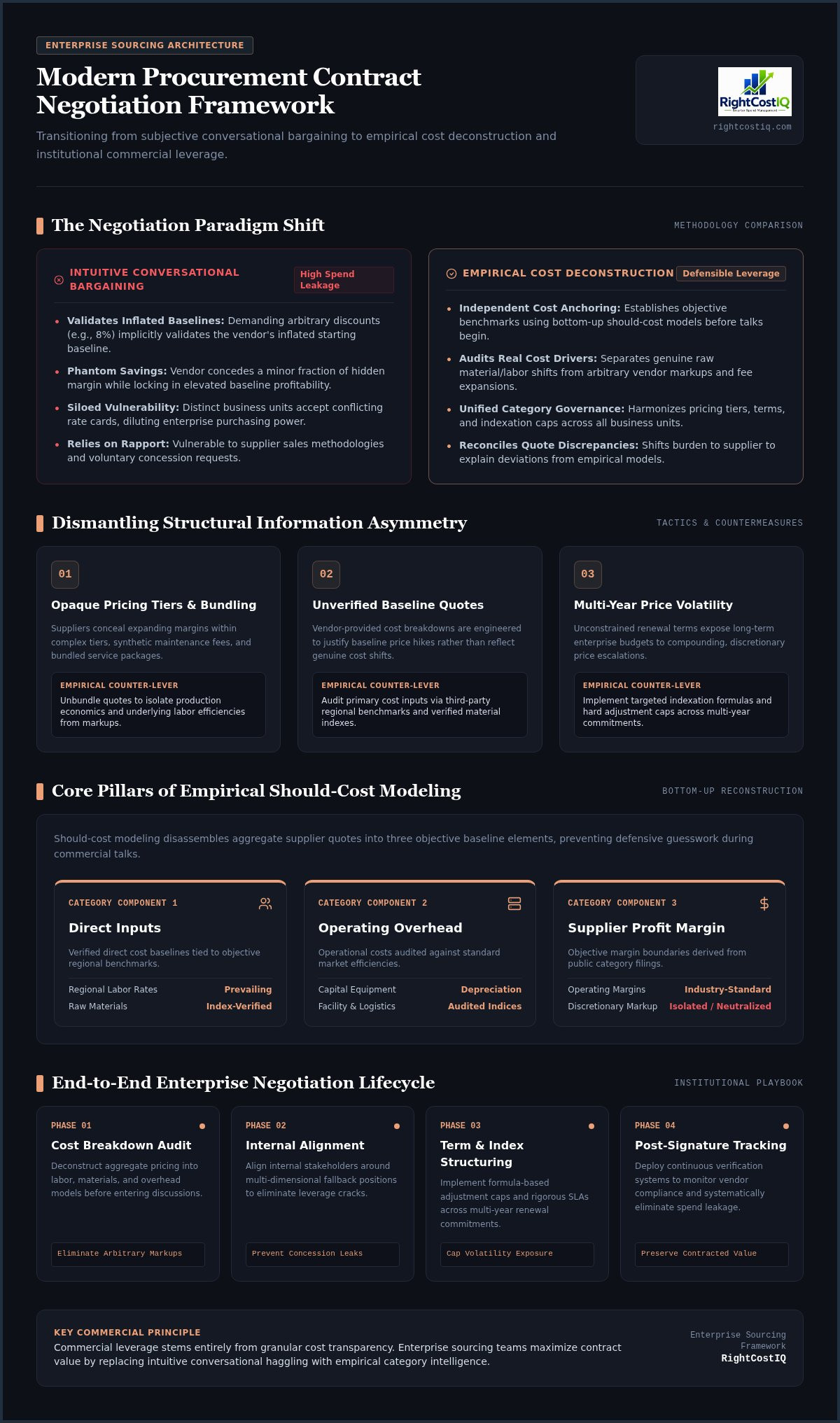
Intuitive negotiation consistently concedes margin to enterprise suppliers equipped with sophisticated sales methodologies. When procurement professionals rely on relationship equity or demand arbitrary concessions, such as an ungrounded 8% discount, they inadvertently validate the supplier's initial baseline price. The vendor concedes a fraction of an inflated margin, securing profitability while the enterprise buyer records a phantom cost reduction.
This tactical failure compounds across distributed enterprises. Siloed sourcing teams routinely negotiate disjointed agreements with identical vendors. Without unified category data, distinct business units accept conflicting rate cards, punitive terms, and inconsistent indexation mechanisms that actively dilute enterprise purchasing leverage.
Deconstructing the Information Asymmetry in Enterprise Renewals
Entrenched vendors preserve expanding margins by engineering structural information asymmetry. Commercial quotes routinely conceal true cost drivers within complex pricing tiers, synthetic maintenance fees, and bundled technology or service packages. Suppliers easily defend unjustified renewals because sourcing teams rarely have visibility into the vendor's actual margin profiles, production economics, or underlying labor efficiencies.
Leveling the commercial playing field requires dismantling this asymmetry prior to supplier engagement. Implementing precise category diagnostics, such as bottom-up should-cost modeling, isolates core vendor cost elements from artificial markups. Advanced procurement contract negotiation strategies replace defensive guesswork with verified category intelligence, allowing enterprise sourcing leaders to establish unshakeable commercial leverage across renewal cycles.
Core Analytical Procurement Contract Negotiation Strategies for Enterprise Sourcing
Defensible negotiation leverage requires empirical deconstruction rather than subjective positioning. Executing analytical procurement contract negotiation strategies begins by disassembling a supplier's aggregate quote into its base elements: direct labor, materials, operational overhead, and net margin. When procurement teams isolate these variables, arbitrary vendor markups collapse under scrutiny.
Deploying Should-Cost Modeling to Anchor Commercial Discussions
Target pricing cannot rely on vendor disclosures. Sourcing teams deploy should-cost modeling to establish an objective baseline before opening commercial talks. This methodology reconstructs a supplier's manufacturing or service delivery cost structure by auditing primary cost inputs:
- Direct inputs: Prevailing regional labor rates and verified raw material benchmarks.
- Operating costs: Capital equipment depreciation, facility overhead, and logistics indices.
- Supplier profit: Industry-standard operating margins based on public category filings.
Presenting this data objectively shifts the conversation. Instead of disputing the total contract price, buyers ask vendors to reconcile discrepancies between their quote and the empirical should-cost model.
Unbundling Total Cost of Ownership (TCO) and Embedded Drivers
Suppliers routinely bury margin expansion in post-signature mechanisms. A low base fee frequently obscures steep consumption overages, mandatory software maintenance tiers, and expensive professional service rates. Sourcing teams calculate the full lifecycle footprint across implementation, continuous support, and contract termination. Unbundling these hidden operational fees isolates genuine inflationary input shifts from vendor profit inflation, neutralizing tier creep before signing master service agreements.
Factoring Market Price Trending into Multi-Year Agreements
Fixed contracts in fluctuating markets expose enterprises to substantial downside risk. When input commodities drop, static contract terms prevent buyers from capturing natural market deflation. Advanced sourcing organizations link multi-year service and supply agreements to verified commodity indices rather than accepting generic Consumer Price Index (CPI) escalators.
Procurement teams should establish mandatory downward rate adjustments that trigger automatically when category indices fall. Eliminating standard inflationary boilerplate protects multi-year operating margins from creeping supplier margins. Enterprise buyers looking to validate legacy agreements against prevailing market conditions can initiate an automated spend diagnostic to identify immediate renegotiation opportunities across active vendor categories.
Structuring High-Impact Commercial Levers: Terms, SLAs, and Risk Allocation
Commercial concessions on base unit rates represent only a fraction of total contract value. Modern procurement contract negotiation strategies leverage non-price contractual terms to capture recurring financial savings and enforce operational accountability. Structuring dynamic risk-allocation mechanisms into master service agreements insulates enterprise operating margins from market shifts and post-signature cost leakage.
Dynamic Indexing vs. Fixed Pricing During Market Volatility
Demanding fixed pricing during volatile periods often produces the opposite of cost control. Suppliers routinely hedge multi-year uncertainty by adding massive contingency premiums to their initial base bids. Replacing rigid pricing with dynamic indexation formulas removes this artificial buffer. Sourcing organizations tie contractual adjustments directly to independent, verified market indices, governing them with collar mechanisms:
- Ceiling caps: Restrict maximum upward price adjustments to a predefined annual threshold regardless of broader inflation.
- Downward capture: Mandate immediate, automatic rate reductions whenever referenced market benchmarks decline.
Structuring Enforceable Performance Guarantees and Credits
Subjective commitments regarding service quality provide zero financial protection. Commercial agreements must establish rigorous Service Level Agreements (SLAs) linked to automated credit mechanisms. Instead of leaving remediation open to lengthy dispute resolutions, agreements should trigger direct invoice credits whenever vendors breach core operational key performance indicators. Defining strict operational cure periods ensures vendors absorb the financial impact of missed targets before service failures jeopardize enterprise operations.
Essential Governance: Benchmark Clauses, Audit Rights, and Exit Terms
Commercial leverage naturally deteriorates over long agreement cycles without binding governance mechanisms. Defensible procurement contract negotiation strategies require mid-term market benchmarking provisions conducted by neutral third-party analysts, compelling suppliers to adjust contract rates to match competitive category medians.
In addition, comprehensive cost-to-serve audit clauses grant enterprise visibility into pass-through expenses and operational fee structures. Establishing capped transition fees and extended disengagement periods eliminates supplier lock-in, preserving credible alternative leverage throughout the contract duration.
Tactical Negotiation Execution: Preparation, Scripting, and Vendor Engagement
Analytical preparation creates zero commercial value if execution cracks under supplier pressure. High-performing procurement contract negotiation strategies translate should-cost intelligence and contractual lever designs into disciplined vendor engagements. Enterprise sourcing teams that align internal stakeholders, define strict trade matrices, and maintain competitive optionality consistently outmaneuver supplier sales tactics.
Constructing Multi-Variable Concession Strategies and Walk-Away Points
Bargaining without a pre-calculated trade matrix quickly turns into unreciprocated value givebacks. Sourcing teams quantify the operational value of every contractual variable before initiating vendor dialogue. If a supplier requests shorter payment terms or volume minimums, the buyer must immediately demand an offsetting commercial concession, such as extended price locks or increased SLA credits. Teams test these scenarios systematically through an automated negotiation coach to model trade impacts and establish cross-functional walk-away boundaries before discussions begin.
Establishing Ironclad Cross-Functional Alignment with Finance and Legal
Suppliers routinely exploit internal misalignment to bypass procurement controls. Sales executives frequently target business unit leaders, lobbying for preferred operational requirements to undermine commercial friction. Sourcing leaders eliminate these vulnerabilities by centralizing all vendor touchpoints through commercial channels:
- Single commercial voice: Direct all pricing, term clarifications, and contract edits exclusively through procurement.
- Synchronized risk thresholds: Align legal risk parameters with commercial objectives before exchanging initial redlines.
- Executive briefing scripts: Equip internal stakeholders with uniform responses to deflect supplier attempts at back-channel escalation.
Maintaining Strategic Competitive Tension Throughout the Sourcing Cycle
Prematurely locking onto a preferred vendor destroys commercial leverage. Sourcing organizations maintain genuine competitive alternatives deep into the procurement process by deploying structured RFP workflows. Integrating strategic frameworks for RFP management enables teams to evaluate supplier bids simultaneously against empirical benchmarks.
Running phased negotiation rounds allows teams to resolve core commercial differences across multiple viable vendors before narrowing down to a single supplier. Preserving this operational tension ensures that procurement contract negotiation strategies yield maximum financial savings. Sourcing teams looking to evaluate their current spend leverage can run an actionable baseline diagnostic to uncover specific commercial vulnerabilities prior to renewal conversations.
Institutionalizing Negotiation Excellence with Data-Driven Procurement Architecture
Isolating commercial wins within individual sourcing events limits enterprise impact. Elite procurement organizations convert transactional bargaining successes into an institutional, scalable corporate architecture. Standardizing procurement contract negotiation strategies across all functional units eliminates rogue purchasing practices and protects operational margins from systemic post-signature spend erosion.
Preventing Post-Signature Value Leakage Through Vendor Performance Tracking
Negotiated savings disappear quickly when contract execution goes unmonitored. Suppliers frequently introduce out-of-scope billing, ignore volume tier discounts, or omit agreed service credits. Preventing this financial drag requires rigorous compliance mechanisms:
- Automated invoice audits: Match live billing line items systematically against contracted rate cards and fee structures.
- Operational SLA monitoring: Track continuous vendor performance against committed thresholds rather than relying on vendor-reported scorecards.
- Evidence-based reviews: Center quarterly business reviews entirely on empirical compliance metrics and credit realization.
Scaling Negotiation Discipline Across Both Core and Tail Spend
Tail spend remains a primary blind spot where margins erode without executive oversight. When sourcing teams focus exclusively on top-tier strategic vendors, distributed stakeholders routinely approve fragmented transactions containing inflated vendor markups. Organizations protect operating margins by deploying our clinical framework for category management across indirect spend categories.
Automating should-cost benchmarks across lower-dollar requisitions neutralizes vendor premiums. Centralizing transactional commercial terms across distributed business units consolidates fractured enterprise volumes, restoring commercial leverage across neglected spend areas.
Auditing Enterprise Agreements via Diagnostic Benchmarking
Commercial leverage naturally declines over multi-year master service agreements when internal teams lack external market context. Sourcing teams cannot enter renewal cycles relying on stale internal data; they must uncover hidden price variances across existing supplier contracts well before formal renegotiation windows open. Third-party category diagnostics establish the baseline intelligence needed to expose supplier cost shifts and challenge arbitrary renewal increases.
High-performing sourcing leaders implement structured procurement contract negotiation strategies by conducting empirical category audits before approaching vendor counterparties. Evaluating your active enterprise agreements establishes an unshakeable commercial foundation, revealing immediate spend recovery opportunities. Sourcing teams can initiate this disciplined baseline review by securing a complimentary procurement diagnostic evaluation to eliminate contract leakage across their active categories.
Transforming Negotiation Intelligence into Measurable Margin Expansion
Sustained enterprise cost reduction requires abandoning anecdotal bargaining in favor of institutional rigor. Modern procurement contract negotiation strategies succeed when category leaders anchor commercial discussions in empirical market price intelligence and category cost benchmarking data. Dismantling unjustified supplier price increases demands granular visibility into true operational cost drivers, disciplined concession trading, and enforceable contract governance that prevents post-signature value leakage across multi-year agreements.
Achieving predictable commercial leverage across volatile market cycles is entirely achievable when you deploy the right analytical infrastructure. Backed by specialized RFP management, professional negotiation execution assistance, and proven price risk tracking and market forecasting architectures, your sourcing teams can systematically eliminate margin compression. Take the definitive step toward operationalizing your commercial advantage today: run a diagnostic on your vendor contracts before your next negotiation to secure your enterprise operating margins with complete confidence.
Frequently Asked Questions
What is the most effective procurement contract negotiation strategy?
The most effective procurement contract negotiation strategies anchor commercial discussions to granular cost transparency rather than conversational haggling. Sourcing teams dissect vendor quotes into fundamental cost components, including direct labor, raw materials, operational overhead, and standard industry margins. Backing these discussions with objective category benchmarking eliminates arbitrary price markups and shifts conversations from subjective disputes to verifiable financial facts.
How do you prepare for a high-stakes vendor contract renewal?
Preparation begins six to nine months prior to renewal expiration by establishing an objective category baseline. Sourcing teams audit historical billing data, analyze volume commitments, and model prevailing market indices against current rate cards. Crucially, procurement must align internal business, legal, and finance stakeholders to establish non-negotiable walk-away thresholds, preventing vendor account managers from exploiting back-channel operational routes during final commercial negotiations.
What is should-cost modeling and how does it create negotiation leverage?
Should-cost modeling is an analytical methodology that reconstructs a supplier's production or service delivery economics from the bottom up. By synthesizing prevailing wage data, material commodity indices, capital depreciation, and fair operating margins, procurement calculates what an offering objectively ought to cost. Presenting these empirical models creates substantial commercial leverage, forcing suppliers to defend their specific cost discrepancies rather than their top-line fee quote.
How can procurement prevent price increases tied to inflation or CPI?
Sourcing teams prevent unjustified increases by rejecting blanket Consumer Price Index (CPI) escalators in favor of customized cost-driver indexation. Contracts should reflect actual underlying cost compositions, such as specific labor or material indices, while enforcing rigid annual ceiling caps. Additionally, procurement must mandate symmetric downward adjustment mechanisms, ensuring contracted rates decline automatically whenever tracked underlying indices experience market deflation.
What should you do if an incumbent supplier refuses to negotiate on price?
When an incumbent vendor stonewalls on unit pricing, procurement teams must expand their procurement contract negotiation strategies across secondary commercial variables. Sourcing professionals negotiate favorable payment terms, extended audit rights, free tier usage expansions, and robust SLA credit structures. Simultaneously, teams unbundle ancillary service packages or alter order cadence to reduce total cost of ownership without changing the base rate card.
How does an organization build an effective BATNA in a single-source market?
Building a Best Alternative to a Negotiated Agreement in a consolidated market requires re-engineering internal demand. Procurement teams evaluate scope reduction, in-sourcing specialized components, or adopting modular open architectures that decouple core dependencies. Demonstrating a viable path toward partial substitution or extended maintenance postponement proves to the supplier that your enterprise possesses credible operational alternatives, restoring critical bargaining tension.
What is contract spend leakage and how do you prevent it post-negotiation?
Spend leakage occurs when negotiated pricing deteriorates post-signature through unmonitored rate creep, incorrect invoicing, unapplied volume rebates, or missed SLA penalty credits. Organizations prevent this loss by deploying automated vendor performance tracking systems that continuously audit incoming invoices against agreed rate cards. Enforcing rigorous quarterly business reviews anchored in verified operational data ensures suppliers deliver full commercial compliance throughout the entire contract lifecycle.


