
Global supply chain disruptions currently siphon an estimated US$184 billion from corporate balance sheets annually, yet most organizations remain blind to the hidden supplier margins buried within their own procurement cycles. Relying on surface-level visibility is a failing strategy when price volatility and shifting regulations like the CSRD demand absolute financial accountability. You likely recognize that legacy sourcing models are insufficient when 65% of companies face persistent bottlenecks and increasing price risk. To protect your bottom line, you need more than just data; you need clinical precision.
This guide establishes a strategic framework to master supply chain cost transparency. By adopting these protocols, you'll eliminate opaque pricing structures and secure predictable procurement ROI through 2026. We'll examine the execution of "should-cost" modeling and market price benchmarks to transform your negotiation leverage and insulate your margins against escalating regulatory pressures. This article previews the transition from simple shipment tracking to granular cost analysis, utilizing data-driven sourcing to optimize every dollar of spend under management. It's time to treat transparency as a high-performance financial instrument rather than a compliance burden.
Key Takeaways
- Distinguish between simple logistics visibility and true supply chain cost transparency by isolating granular cost drivers like labor, materials, and overhead.
- Master the implementation of should-cost modeling and procurement analytics to identify hidden supplier margins and optimize category cost benchmarking.
- Navigate the 2026 regulatory landscape by shifting from reactive compliance to a proactive strategy that treats disclosure as a financial growth driver.
- Apply a clinical framework to leverage cost data during RFP cycles, effectively neutralizing supplier resistance and securing fact-based price reductions.
- Integrate market price trending and predictive analytics to mitigate price risk and ensure consistent margin expansion across all spend categories.
What is Supply Chain Cost Transparency in 2026?
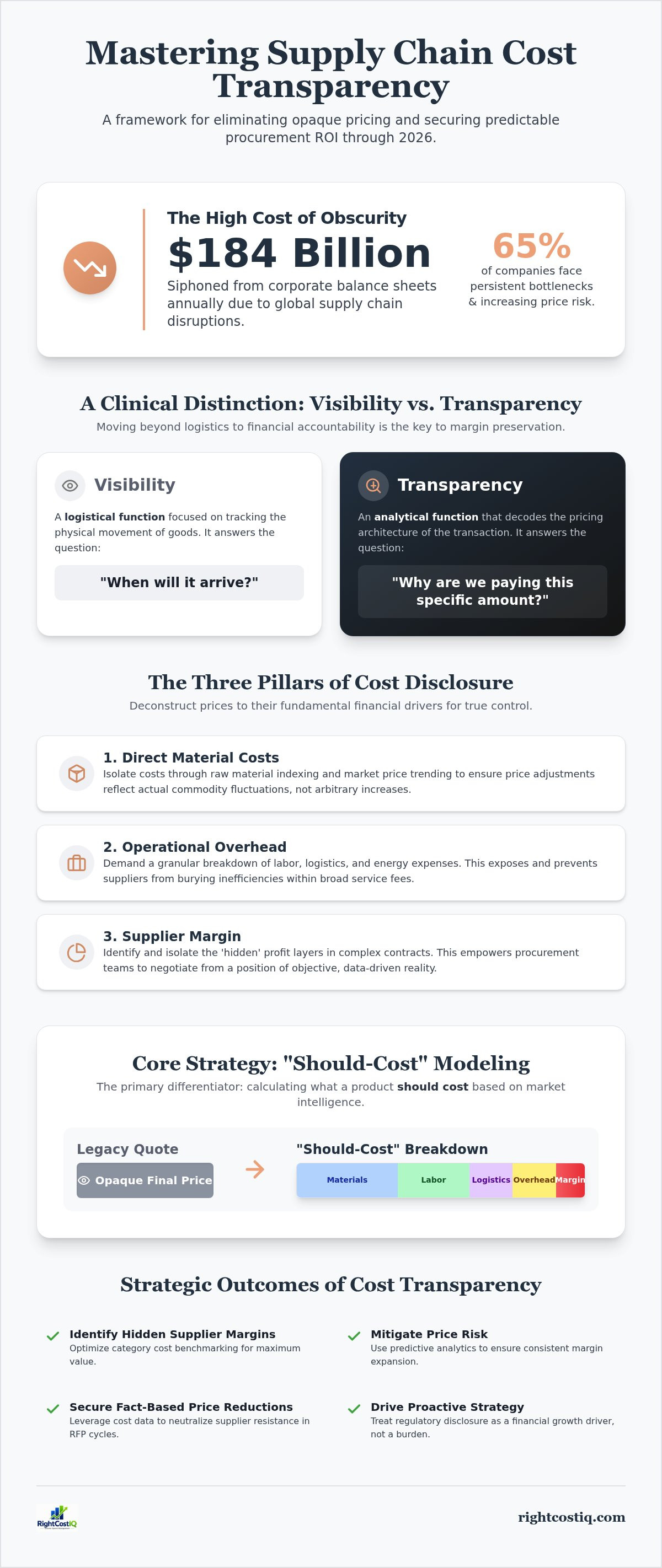
Supply chain cost transparency represents the clinical deconstruction of a product's final price into its constituent financial drivers. Unlike historical procurement models that rely on aggregated quotes, this framework demands total disclosure of labor, raw materials, energy, and logistics overhead. In the 2026 global trade environment, characterized by US$184 billion in annual disruption costs, this level of detail is a prerequisite for margin preservation. It functions as a specialized form of market transparency, where data parity between buyer and seller eliminates the informational asymmetry that traditionally favors the supplier.
Achieving this state requires shifting focus toward Spend Under Management (SUM) as a primary success metric. High-performing organizations don't just track total spend; they measure the percentage of spend where every cost component is fully validated through data-driven sourcing. This transition transforms procurement from a back-office function into a strategic architect of corporate growth. It's no longer enough to know the price; you must understand the pricing architecture that dictates your bottom line.
The Three Pillars of Cost Disclosure
Effective cost disclosure operates across three distinct financial layers. First, direct material costs must be isolated through raw material indexing and market price trending. This ensures that price adjustments reflect actual commodity fluctuations rather than arbitrary supplier increases. Second, operational overhead requires a granular breakdown of labor, logistics, and energy expenses. This exposure prevents suppliers from burying inefficiencies within broad service fees. Finally, identifying the supplier margin is critical. By isolating the 'hidden' profit layers in complex contracts, procurement teams can negotiate from a position of objective reality rather than subjective compromise.
Visibility vs. Transparency: A Clinical Distinction
A common strategic error involves conflating visibility with transparency. Visibility is a logistical function focused on tracking the physical movement of goods across nodes. While essential for resilience, visibility alone fails to protect margins during periods of high inflation or price volatility. Transparency is an analytical function that decodes the pricing architecture of the transaction. It's the difference between seeing the box and knowing the cost of the cardboard, the ink, and the assembly labor.
The implementation of should-cost modeling is the primary differentiator here. While visibility tells you where your shipment is, should-cost modeling tells you exactly what that shipment should cost based on current market intelligence. Transitioning from reactive reporting to proactive cost management requires this shift. It moves the conversation beyond "when will it arrive" to "why are we paying this specific amount." Organizations that master this distinction secure a sustainable competitive advantage by neutralizing price risk before contracts are even signed.
The Anatomy of Cost Transparency: Should-Cost Modeling and Analytics
Achieving true supply chain cost transparency requires a transition from relationship-based sourcing to a rigorous, fact-based methodology. In legacy procurement models, negotiations often rely on historical precedent or anecdotal supplier claims. Modern frameworks replace this subjectivity with high-fidelity data. By deploying sophisticated procurement analytics, organizations can isolate specific cost drivers and identify margin erosion that remains invisible in aggregated quotes. This clinical approach ensures that every dollar spent is justified by objective market realities rather than supplier leverage.
Data-driven sourcing is the foundation of high-stakes procurement in 2026. It allows decision-makers to move beyond simple cost-avoidance and toward active margin expansion. Understanding the Costs and Benefits of Supply Chain Transparency involves recognizing that the initial investment in analytics pays dividends through reduced price risk and optimized spend. When you possess the same market intelligence as your tier-one and tier-two suppliers, the negotiation landscape shifts in your favor.
Building Robust Should-Cost Frameworks
Should-cost modeling is the practice of estimating what a product should cost based on objective market data. This process begins with the systematic deconstruction of a SKU into its fundamental components. To build a reliable model, you must execute the following steps:
- Raw Material Indexing: Map SKU components to global commodity indices to track real-time price fluctuations.
- Labor and Overhead Allocation: Calculate regional labor rates and energy consumption metrics specific to the manufacturing site.
- Logistics and Duty Analysis: Account for freight volatility and evolving trade tariffs.
Real-time adjustments are essential. By integrating market price trending into these models, procurement teams can anticipate cost shifts before they manifest in supplier invoices. This proactive stance allows for the immediate recalibration of targets during contract renewals or mid-term adjustments.
Procurement Category Cost Benchmarking
Benchmarking provides the external validation necessary to verify that supplier quotes align with industry standards. Effective benchmarking identifies outliers by comparing internal spend data against broader market aggregates. This process highlights specific categories where your organization may be overpaying for standard services or materials. When these insights are integrated directly into the RFP management cycle, they serve as a powerful lever for price rationalization.
Spend analytics reveal negotiation opportunities that are often buried in fragmented data silos. By standardizing benchmarks across all procurement categories, you create a unified framework for vendor performance tracking. If your current data set lacks the granularity to challenge supplier pricing effectively, you can access a preliminary cost analysis diagnostic to identify immediate savings opportunities.
Comparing Transparency Frameworks: Voluntary vs. Mandated Disclosure
The global shift toward mandated supply chain cost transparency has transformed corporate disclosure from a voluntary value-add into a strict legal liability. As of 2026, international regulations require companies to treat supply chain data with the same clinical precision as their primary financial balance sheets. Organizations that rely on reactive compliance protocols often face higher operational costs and significant price risk, while proactive entities utilize these frameworks to secure a competitive advantage. Transitioning to a transparent architecture doesn't just satisfy auditors; it drives cost savings by exposing inefficiencies that remain hidden in opaque sourcing models.
Evaluating the ROI of these frameworks reveals a stark contrast between cost centers and growth drivers. Reactive compliance focuses on avoiding penalties, which results in a net loss of resources. Proactive transparency, however, integrates vendor performance tracking with real-time cost analysis to mitigate financial volatility. By establishing a data-driven baseline before mandates take effect, firms can insulate their margins from the sudden price shocks often associated with regulatory shifts.
Regulatory Compliance and Audit Readiness
In 2026, several overlapping mandates dictate the requirements for financial and operational disclosure. The Corporate Sustainability Reporting Directive (CSRD) now enforces "Double Materiality," requiring firms to report on both internal financial impacts and external environmental footprints across all supply chain tiers. Simultaneously, the EU Deforestation Regulation (EUDR) and the US Uyghur Forced Labor Prevention Act (UFLPA) mandate granular geolocation and sourcing documentation. For healthcare entities, the enforcement of CMS Schema Version 2.0 for machine-readable files has standardized price transparency requirements.
Automated tracking systems are no longer optional for maintaining audit-ready data. The cost of non-compliance in 2026 includes not only heavy financial penalties and market access loss but also severe brand damage. Investing in sophisticated transparency tools is a strategic necessity to ensure that every cost component is verifiable and compliant with these evolving global trade standards.
Strategic Advantages of Voluntary Transparency
Moving beyond the minimum requirements of mandated disclosure allows procurement teams to build trust-based relationships through shared data parity. When suppliers understand that their cost structures are being monitored against objective benchmarks, the nature of the partnership shifts toward mutual efficiency. This environment allows for significantly better negotiation outcomes, as discussions are rooted in verified market intelligence rather than speculative quotes.
A primary benefit of voluntary transparency is the elimination of tail spend inefficiencies. In many organizations, unmanaged or fragmented spend categories account for substantial margin leakage because they lack the oversight applied to strategic categories. Implementing a comprehensive transparency framework brings these outliers under management, allowing for the rationalization of vendors and the consolidation of spend to maximize procurement ROI.
Executing Transparency: Negotiation Strategies and Risk Management
Data parity is the ultimate lever in high-stakes procurement. Supply chain cost transparency transforms from a theoretical concept into a financial instrument during the negotiation phase. By utilizing the should-cost models and benchmarking data established in previous stages, procurement teams can execute a clinical RFP optimization strategy that secures long-term margin stability. This approach moves the conversation away from subjective relationship-based quotes toward objective, fact-based pricing structures.
Fact-Based Negotiation Frameworks
Leveraging transparency requires a methodical 5-step framework to neutralize supplier leverage. First, present the validated should-cost model to establish the baseline for discussion. Second, identify and challenge non-standard margin buffers or "hidden" overhead layers that exceed industry benchmarks. Third, align all pricing components to verified market indices to ensure future-proof contract terms. Fourth, address supplier resistance by framing disclosure as a prerequisite for preferred status rather than a punitive measure. Finally, codify these transparency requirements into the final service level agreements (SLAs).
Handling resistance is a critical skill for the strategic architect. Suppliers often shield their pricing architecture by claiming proprietary complexity. You can neutralize this by presenting regional labor rates and commodity indices that are publicly verifiable. When the discussion is rooted in objective market intelligence, the supplier's ability to maintain opaque profit layers evaporates. This shift ensures that negotiations are conducted with clinical precision rather than emotional compromise.
Mitigating Price Volatility and Risk
Price risk management is the secondary objective of a transparent supply chain. Utilizing market price forecasting allows organizations to hedge against commodity fluctuations before they impact the bottom line. By establishing transparent price adjustment formulas directly within the RFP, you create a self-correcting mechanism that protects both parties from extreme volatility. This level of foresight is essential in a 2026 market where disruption costs average US$184 billion annually across global networks.
Effective risk mitigation also extends to unmanaged spend. The impact of tail spend management on your overall risk profile cannot be overstated. Bringing these fragmented categories under the umbrella of supply chain cost transparency ensures that small, unmonitored price hikes don't accumulate into significant margin erosion. To identify where your organization is currently losing leverage, access a clinical spend analysis diagnostic to uncover hidden savings opportunities and optimize your procurement ROI.
Implementing RightCostIQ for Clinical Cost Transparency
RightCostIQ functions as the operational engine for organizations seeking to institutionalize supply chain cost transparency. It bridges the gap between fragmented data collection and high-stakes strategic execution. For C-suite executives, the platform provides a centralized command center to monitor margin health and ensure procurement ROI across global networks. By integrating advanced analytics with real-time market intelligence, RightCostIQ transforms procurement from a reactive cost center into a proactive driver of financial growth. It's the essential tool for the strategic architect of the modern supply chain.
Transitioning to this level of transparency requires more than just software; it demands a shift in how your organization interacts with the global market. RightCostIQ provides the frameworks necessary to maintain data parity with suppliers, ensuring that every contract is rooted in objective reality. This systematic approach eliminates the informational asymmetry that typically leads to margin erosion during volatile market cycles.
The RightCostIQ Advantage
The platform's primary value lies in its ability to convert complex datasets into actionable negotiation leverage. Our negotiation coaching protocols leverage granular should-cost data to provide procurement teams with fact-based rebuttals to supplier price hikes. This clinical precision ensures that discussions remain focused on verified cost drivers rather than subjective claims. Simultaneously, our precision benchmarking services allow for category-specific savings by comparing your spend against industry-standard cost architectures.
Operational excellence is further supported through our automated procurement and vendor performance tracking service. This system monitors supplier compliance with transparency mandates in real-time, identifying performance outliers before they impact the bottom line. By integrating market price trending and forecasting, the platform also provides the foresight needed to manage price risk effectively. You're not just tracking the past; you're engineering the future of your margins.
Next Steps: Achieving Supply Chain Resilience
Achieving total supply chain resilience begins with a diagnostic assessment of your current spend architecture. Executives should prioritize an initial spend analysis to identify transparency gaps and unmanaged tail spend categories. This baseline allows for the targeted deployment of RightCostIQ's analytics to the areas of greatest margin risk. Once the gaps are identified, onboarding the enterprise-wide platform ensures that data-driven sourcing becomes a standardized protocol across all procurement departments.
The path to margin expansion in 2026 is defined by the ability to execute with clinical precision. Organizations that fail to adopt these transparency architectures will remain vulnerable to price volatility and regulatory penalties. Secure your competitive advantage by transitioning to a fact-based sourcing model today. Optimize your procurement outcomes with RightCostIQ's precision frameworks.
Architecting Financial Resilience through 2026
Mastering supply chain cost transparency is no longer a discretionary initiative; it's a financial imperative for organizations navigating the volatility of 2026. By deconstructing pricing architectures and implementing clinical should-cost models, procurement teams move from reactive tracking to proactive margin expansion. This strategic shift ensures that every dollar spent is validated by objective market data rather than supplier leverage. Fact-based sourcing eliminates the informational asymmetry that traditionally erodes corporate profitability.
The integration of advanced price risk management and market-leading cost benchmarking provides the precision necessary to neutralize inflationary pressures and regulatory shocks. Transitioning your procurement function into a data-driven architect of growth requires the right frameworks to challenge hidden margins and secure long-term contract stability. Utilizing professional negotiation assistance further amplifies these efforts, turning transparency into a high-performance financial instrument. It's time to reclaim control over your pricing architecture.
Ready to eliminate opaque cost structures and optimize your procurement ROI? Secure your margins with RightCostIQ's RFP and Negotiation frameworks today. Your path to sustainable financial growth begins with clinical visibility into your cost drivers.
Frequently Asked Questions
What is the difference between supply chain visibility and cost transparency?
Supply chain visibility focuses on the physical tracking of goods across nodes, while supply chain cost transparency isolates the financial drivers behind the final price. Knowing where a shipment is located does not provide insight into its pricing architecture. Transparency requires deconstructing the SKU into labor, raw materials, and overhead to identify margin buffers and ensure that every dollar spent is justified by objective market data.
How does should-cost modeling improve RFP outcomes?
Should-cost modeling establishes a fact-based baseline that neutralizes supplier informational advantages during the RFP cycle. By estimating what a product should cost based on regional labor rates and commodity indices, procurement teams can challenge non-standard quotes with clinical precision. This objective data forces suppliers to justify price discrepancies rather than relying on subjective relationship-based quotes, leading to significantly more favorable contract terms.
What are the biggest challenges to achieving supply chain cost transparency in 2026?
The primary obstacles include navigating overlapping global mandates like the CSRD and managing highly fragmented data across multi-tier supplier networks. Many organizations struggle with informational silos where cost components are buried in legacy systems. Additionally, overcoming supplier resistance to disclosing profit margins remains a significant hurdle for firms attempting to institutionalize transparency architectures that require granular disclosure of all operational cost drivers.
Can supply chain transparency actually reduce procurement costs?
Yes, supply chain cost transparency directly reduces procurement costs by exposing hidden margin layers that suppliers often embed in complex contracts. Isolating these inefficiencies allows for the rationalization of vendors and the consolidation of spend across fragmented categories. Organizations utilizing this framework frequently identify immediate savings opportunities in tail spend categories that were previously unmanaged due to a lack of granular cost data.
How do I convince suppliers to share granular cost data?
Position data sharing as a clinical requirement for long-term partnership rather than a punitive measure. Explain that transparency allows for more accurate price adjustment formulas that protect both parties from extreme market volatility. Suppliers who embrace transparency gain preferred status in RFP cycles, while those who maintain opaque structures are flagged as high-risk entities during vendor performance tracking and price risk management assessments.
What role does AI play in supply chain cost transparency?
AI functions as the analytical engine that standardizes disparate datasets into a unified cost architecture. It automates the tracking of global commodity indices and regional labor fluctuations to update should-cost models in real-time. This technological integration allows procurement teams to predict cost shifts and execute negotiations with a level of precision that manual analysis cannot replicate, ensuring that spend remains optimized.
How often should cost benchmarks be updated for maximum accuracy?
Benchmarks should be updated dynamically through automated market price trending to reflect real-time commodity fluctuations. For more stable categories, a quarterly review is the minimum requirement for maintaining clinical accuracy. Relying on annual benchmarks in a volatile 2026 market introduces significant price risk and renders your negotiation leverage obsolete before the next contract cycle begins, leading to potential margin erosion.
What are the primary KPIs for measuring supply chain transparency success?
Success is measured through Spend Under Management (SUM), specifically the percentage of total spend where cost drivers are fully validated. Another critical KPI is Should-Cost Variance, which tracks the delta between your calculated model and the actual supplier quote. High-performing organizations also monitor the Time to Audit, measuring how quickly they can produce compliant, granular data for global trade and financial mandates.


