

Most procurement leaders treat the RFP as a bureaucratic formality; however, this document is actually your most potent weapon for dismantling opaque vendor pricing models. You've likely felt the frustration of manual sourcing cycles that fail to yield clear cost benchmarks or hold vendors accountable to performance metrics. It's a systemic inefficiency that drains corporate capital and obscures true market value. Learning how to write an effective rfp requires shifting from a checklist mentality to a strategic architecture that forces immediate market transparency.
This guide provides the clinical framework necessary to maximize procurement ROI and secure measurable cost savings through 2026. We'll move beyond generic templates to explore precision-engineered data tools that provide high-level decision-makers with genuine negotiation leverage. By integrating price risk management and market trending into your sourcing documents, you transform the RFP into a primary driver of financial growth. We'll examine the specific components of high-precision sourcing to ensure your next request delivers absolute clarity and operational efficiency.
Key Takeaways
- Redefine the RFP as a strategic data asset to shift from passive solicitation to active, high-precision market testing.
- Master the architecture of how to write an effective rfp by utilizing technical descriptors that eliminate vendor ambiguity and maximize procurement ROI.
- Integrate category cost benchmarking and market price trending to establish data-driven pricing expectations before negotiations commence.
- Implement a methodical sourcing lifecycle that prioritizes enterprise efficiency and rigorous vendor performance tracking.
- Leverage professional RFP management services and automated analytics to scale procurement infrastructure and drive measurable financial growth.
Beyond the Template: Redefining the RFP as a Strategic Data Asset
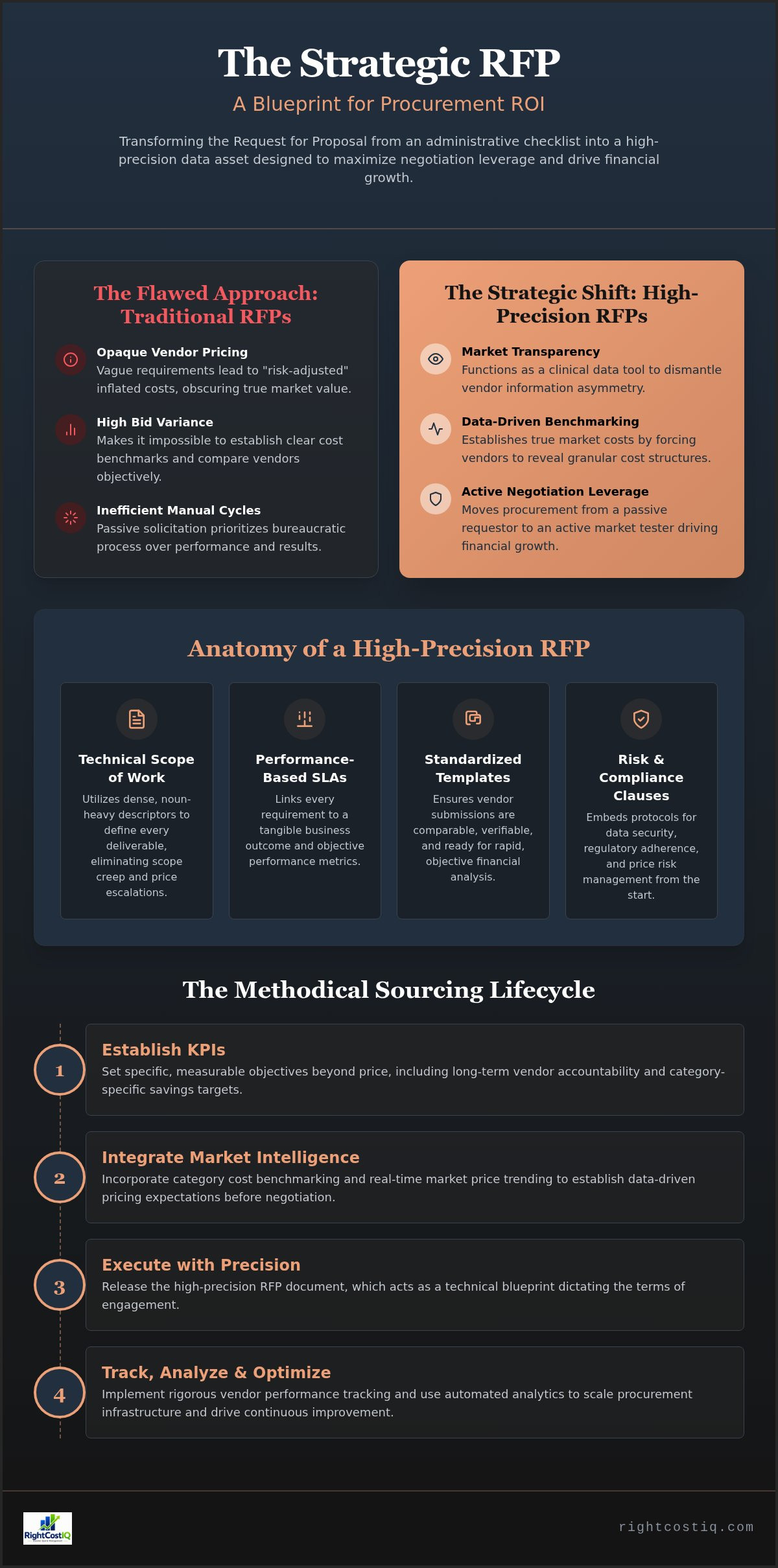
The Request for Proposal (RFP) is often mischaracterized as a clerical formality. This passive solicitation model is a strategic liability that prioritizes process over performance. To achieve competitive advantage in 2026, organizations must redefine the RFP as a clinical instrument for market intelligence acquisition. It's a precision-engineered data tool designed to dismantle vendor information asymmetry. When leadership understands how to write an effective rfp, the document becomes a mechanism for active market testing rather than a simple request for quotes.
Imprecise RFP documentation carries a heavy economic toll. Vague requirements lead to "risk-adjusted" vendor pricing, where suppliers inflate costs to cover undefined scope. This results in high bid variance, making it impossible for procurement teams to establish true market cost benchmarks. A strategic RFP eliminates this noise, forcing vendors to provide granular data that reveals their actual cost structures. Mastering how to write an effective rfp is the first step in building a resilient, data-driven supply chain that prioritizes financial growth over administrative convenience.
The Shift from Administrative to Strategic Sourcing
Precision in drafting requirements is the most effective way to reduce vendor response variance. When technical descriptors are clear and objective, vendors have fewer opportunities to obfuscate their pricing models. This technical rigor ensures that procurement initiatives align directly with C-suite financial objectives, such as EBITDA expansion and operational efficiency. Strategic sourcing success is measured by the quality of spend under management. It requires a transition from administrative document creation to the development of sophisticated data assets that provide long-term negotiation leverage.
Setting Measurable Objectives for Your RFP
High-precision sourcing requires the establishment of specific KPIs before the document is released. These objectives must extend beyond immediate price points to include long-term vendor accountability and category-specific savings targets. An effective framework integrates document requirements with future vendor performance tracking. Organizations utilizing professional RFP management services gain the ability to benchmark responses against real-time market price trending. This methodical approach ensures that every sourcing event contributes to a repository of market intelligence, allowing for continuous optimization and measurable cost reduction across the entire supply chain.
The Anatomy of a High-Precision RFP: Structural Requirements
Clinical precision in document architecture is the prerequisite for market transparency. A high-precision RFP functions as a technical blueprint that dictates the terms of engagement; it doesn't merely ask for pricing. Mastering how to write an effective rfp requires a granular breakdown of every operational requirement to eliminate information asymmetry. The document must include rigorous technical specifications, performance-based service level agreements (SLAs), and standardized response templates. This structural integrity ensures that vendor submissions are comparable, verifiable, and ready for immediate financial analysis.
Risk mitigation protocols and compliance clauses act as the structural framework for vendor accountability. These components must address data security, regulatory adherence, and price risk management strategies. By embedding these requirements into the initial solicitation, procurement teams establish a baseline for vendor performance tracking before a contract is even signed. Standardized response formats are essential for rapid data normalization. Without these controls, vendors often submit disparate data sets that hinder objective comparison and delay the sourcing cycle. Organizations seeking to audit their current sourcing documents can utilize a procurement diagnostic tool to identify structural gaps in their solicitation process.
Drafting the Technical Scope of Work (SOW)
Technical scope of work construction must utilize dense, noun-heavy descriptors to define every deliverable with absolute clarity. Ambiguous language is the primary driver of vendor "scope creep" and subsequent price escalations. Every requirement should link directly to a tangible business outcome, such as reduced machine downtime or improved logistics throughput. By focusing on objective performance metrics rather than vague qualitative descriptions, you force vendors to commit to specific operational results. This level of detail provides the clinical precision needed to hold suppliers accountable throughout the contract lifecycle.
Standardizing the Pricing Proposal Grid
The pricing proposal grid must be engineered for granular transparency to expose hidden vendor costs. Effective grids require suppliers to break down their bids into labor, materials, overhead, and profit margins. This level of detail allows procurement teams to perform advanced category cost benchmarking against market intelligence data. Every response field should be formatted for immediate analytics ingestion, enabling automated comparison across the entire bidder pool. When you understand how to write an effective rfp with standardized pricing structures, you transform raw vendor bids into actionable financial intelligence that drives immediate negotiation leverage.
Integrating Cost Benchmarking and Market Intelligence
High-precision procurement relies on external validation to ensure that vendor bids reflect actual market conditions. Market intelligence integration transforms the sourcing event from a reactive bid collection into a proactive price discovery exercise. Organizations must utilize validated data to establish realistic pricing ceilings before reviewing a single submission. Effective price risk management requires the identification of specific commodity indices or labor rate benchmarks within the RFP document itself. This strategy ensures that the final contract accounts for market fluctuations through 2026. A critical component of this process is should-cost modeling, which provides a bottom-up analysis of supplier costs to validate bid integrity. Learning how to write an effective rfp involves embedding these analytical requirements directly into the document structure.
By identifying these risk factors early, organizations can demand transparency regarding a vendor's supply chain resiliency. This proactive stance prevents the common pitfall of accepting a low bid that later escalates due to unforeseen surcharges. Integrating market price trending into the RFP timeline allows procurement leaders to align their sourcing cycles with favorable market conditions, further optimizing the financial outcome and securing measurable cost savings.
Using Analytics to Drive RFP Precision
Analytics-driven sourcing identifies market outliers by comparing vendor submissions against established category benchmarks. This process highlights suppliers who are overcharging based on historical data or regional variances. Cost benchmarking is the clinical comparison of internal spend against validated market averages. Applying market price forecasting during the RFP stage allows procurement leaders to secure favorable terms for multi-year contracts by anticipating inflationary trends. This methodical approach ensures that the document architecture facilitates high-precision cost analysis and immediate ROI.
Creating a Negotiation Lever within the RFP
The RFP document acts as a primary negotiation lever when it explicitly states that bids will be evaluated against external market benchmarks. This level of transparency forces vendors to align their pricing with competitive realities or risk immediate disqualification. Procurement teams use these data-driven insights to challenge non-competitive pricing structures with clinical precision. Linking these results to a negotiation coach framework ensures that the sourcing team maintains a position of strength throughout the final selection phase. Mastering how to write an effective rfp means weaponizing data to ensure market transparency and maximize procurement leverage.
Clinical Execution: A Step-by-Step Lifecycle for RFP Management
Strategic sourcing initiatives fail not because of poor requirements, but because of fragmented execution. A clinical RFP lifecycle eliminates administrative bottlenecks and ensures every stage contributes to final negotiation leverage. High-precision sourcing isn't just about the document; it's about the execution. Mastery of how to write an effective rfp ensures that every stage, from initial market intelligence gathering to final vendor selection, functions as a high-value data-capture event. Enterprise efficiency depends on a methodical timeline that provides suppliers with adequate response windows while maintaining strict internal deadlines for data analysis.
A high-precision timeline includes a structured Q&A phase to resolve technical ambiguities before final submissions. This prevents vendors from submitting non-compliant bids that require manual correction or multiple revision cycles. Automated performance tracking during this lifecycle ensures that milestones are met and that the sourcing event remains aligned with broader corporate financial goals. Organizations can identify operational gaps in their current execution by using a procurement performance diagnostic to analyze their existing sourcing workflows and identify hidden inefficiencies.
The Evaluation and Scoring Matrix
Objective vendor selection requires a pre-defined scoring matrix that removes subjective bias from the decision-making process. Procurement teams must develop a weighted scoring system based on strategic priorities, such as technical competence, cost-to-value ratio, and risk mitigation capabilities. Blinded technical evaluations ensure that reviewers focus on operational capability rather than brand familiarity. Organizations don't achieve ROI by guessing; they achieve it through data-driven selection. Every scoring decision should be documented to maintain a clear audit trail and ensure compliance with corporate governance standards.
Transitioning from RFP to Contract Negotiation
The transition phase is where the data captured during the RFP becomes actionable financial leverage. Effective sourcing managers identify specific negotiation points discovered during the bid analysis, such as pricing outliers or service level discrepancies. These data points act as a clinical baseline for final contract SLAs and performance tracking metrics. Preparing for high-value procurement negotiations requires a synthesis of vendor performance data and market intelligence to secure the most favorable terms. This methodical approach ensures that the insights gained during the stage of learning how to write an effective rfp translate into measurable bottom-line results.
Optimizing Sourcing Outcomes with Automated RFP Platforms
Procurement optimization in 2026 is fundamentally dependent on the transition from manual documentation to automated analytical platforms. Manual sourcing cycles represent a significant operational risk, often resulting in fragmented data and inconsistent vendor evaluations. Utilizing professional RFP management services provides the clinical framework necessary to eliminate these inefficiencies and maximize procurement ROI. These platforms act as a strategic force multiplier, integrating high-precision analytics into the core of traditional sourcing infrastructure. Organizations that understand how to write an effective rfp within an automated environment gain a decisive advantage in forcing market transparency and dismantling opaque supplier pricing models.
Technology serves as the primary driver for aligning high-level financial strategy with granular technical execution. By digitizing the solicitation process, procurement leaders replace subjective bid assessments with objective, data-driven comparisons. This shift ensures that every sourcing event contributes to a growing repository of market intelligence, providing long-term negotiation leverage. It's a strategic evolution that transforms the procurement department from a cost center into a primary driver of corporate EBITDA expansion.
The Role of Technology in Modern Procurement
Automated platforms streamline vendor performance tracking by providing a centralized repository for objective data points. This centralization is essential for maintaining consistency across global sourcing initiatives and ensuring that SLAs are met with clinical precision. Advanced technology also enables rigorous tail spend management, which is a vital component of enterprise resilience and financial growth. By automating the repetitive elements of the sourcing lifecycle, procurement teams can refocus their efforts on high-stakes strategic analysis. This shift from administrative burden to strategic oversight defines the modern, data-driven procurement department.
Selecting a Strategic RFP Partner
Selecting a strategic RFP partner requires a focus on technical competence and analytical depth. Decision-makers must evaluate potential partners based on their ability to deliver both software integration and expert-led negotiation assistance. The RightCostIQ platform offers a sophisticated intersection of technological innovation and pragmatic financial strategy. It provides the tools necessary to transform the theoretical knowledge of how to write an effective rfp into a relentless engine for cost optimization. By partnering with a firm that prioritizes data-driven sourcing, organizations ensure that their procurement functions act as a primary driver for long-term operational success.
Strategic Architecture for 2026 Procurement ROI
The transition from administrative solicitation to clinical market intelligence acquisition is the defining characteristic of a high-performance procurement department. By redefining the RFP as a strategic data asset, organizations dismantle vendor information asymmetry and secure immediate negotiation leverage. Integrating category cost benchmarking and should-cost modeling ensures that every bid is validated against objective market realities rather than supplier-driven narratives. Mastering how to write an effective rfp isn't just a clerical requirement; it's a financial imperative for organizations seeking EBITDA expansion and operational resilience.
Achieving these results requires a synthesis of advanced analytics and precision-led execution. Organizations must leverage expert vendor performance tracking and precision-led negotiation assistance to transform raw sourcing data into measurable cost savings. You don't have to navigate these complex market dynamics alone. Optimize your sourcing outcomes with professional RFP Management and gain access to the advanced procurement analytics necessary for strategic dominance. Implementing this clinical framework ensures your sourcing events deliver absolute transparency and maximum ROI throughout the 2026 fiscal cycle.
Frequently Asked Questions
How long should an effective RFP document be?
An effective RFP length is determined by technical complexity rather than a specific page count; however, most high-precision documents range from 15 to 25 pages. The focus should be on the density of the Scope of Work (SOW) and the clinical clarity of technical descriptors. Bloated documents lead to vendor fatigue and increased response variance. Prioritize a concise structure that facilitates rapid data ingestion and immediate financial analysis to ensure enterprise efficiency.
What is the difference between an RFI, RFP, and RFQ?
The primary distinction lies in the objective: an RFI is for market discovery, an RFP is for strategic solution acquisition, and an RFQ is for price-based commodity purchasing. An RFP requires vendors to propose complex service delivery models alongside granular pricing structures. This document acts as a clinical instrument for strategic sourcing. Organizations must choose the correct solicitation type to ensure they're capturing the specific data needed for high-level decision-making.
How do you ensure vendor compliance during the RFP process?
Ensure vendor compliance by utilizing mandatory response templates and non-negotiable submission deadlines. These structural controls prevent suppliers from submitting disparate data sets that hinder objective comparison. Including clear disqualification criteria for non-compliant bids forces market transparency from the outset. This methodical approach ensures that all submissions are normalized for immediate analytics and helps you understand how to write an effective rfp that maintains administrative control.
Can I use an RFP for small, tactical purchases (tail spend)?
Yes, utilizing a streamlined RFP framework for tail spend management is essential for capturing hidden savings in non-core categories. Automated templates allow procurement teams to manage small, tactical purchases without the high administrative overhead of a full enterprise sourcing event. This process ensures that even minor spend categories are subjected to competitive market testing. It's a vital component of enterprise resilience that optimizes the entire corporate spend profile.
How many vendors should be invited to participate in an RFP?
Inviting three to five highly qualified vendors is the industry standard for maximizing competitive tension without creating administrative gridlock. This range provides sufficient data points for category cost benchmarking while ensuring the evaluation team can perform a deep clinical analysis of each submission. Inviting too many participants dilutes the quality of vendor engagement and complicates the scoring process. Focus on selecting suppliers who demonstrate the technical competence to meet your specific operational requirements.
What are the most common mistakes when writing an RFP?
The most common mistakes include drafting ambiguous technical scopes and failing to establish a weighted scoring matrix before document release. Vague requirements lead to risk-adjusted pricing where vendors inflate costs to cover undefined variables. Another critical error is ignoring market price trending data, which results in non-competitive contract terms. Learning how to write an effective rfp requires avoiding these pitfalls by prioritizing data-driven precision and objective performance metrics.
How does market price trending affect the RFP timeline?
Market price trending dictates the strategic timing of the RFP release and the structure of price adjustment clauses within the final contract. If commodity indices are volatile, the RFP timeline must be compressed to capture current market lows. This intelligence also informs whether to pursue short-term tactical agreements or long-term strategic partnerships. Aligning your sourcing cycle with favorable market conditions is a primary driver for maximizing procurement ROI and securing financial growth.
Is it necessary to use RFP management software for all sourcing events?
Professional RFP management software is necessary for any organization seeking to scale its sourcing operations and maintain a centralized repository of market intelligence. Manual processes are prone to data fragmentation and lack the analytical depth required for advanced category benchmarking. Automated platforms ensure that all vendor responses are formatted for immediate analytics ingestion. This technological infrastructure is the primary driver for achieving operational efficiency and long-term procurement optimization.


