
Analytics without execution is merely expensive overhead. For high-level decision-makers, the primary frustration remains fragmented spend data buried across disconnected ERP systems and an inability to predict price volatility within the global supply chain. You already recognize that raw data is useless if it doesn't provide a tangible competitive edge at the bargaining table. Sophisticated procurement analytics services bridge this critical gap by converting chaotic datasets into clinical precision for RFP management and objective vendor selection.
This article outlines a strategic framework to master the clinical application of advanced analytics for sustained financial growth in 2026. You'll learn how to transform stagnant spend reports into actionable negotiation leverage while systematically eliminating tail spend leakage. We will examine how predictive accuracy for future market price trends and objective category-specific benchmarking can redefine your sourcing strategy. By the end of this guide, you'll possess the roadmap to integrate high-level financial strategy with technical execution, ensuring your procurement function operates as a primary driver of corporate profitability.
Key Takeaways
- Shift your procurement strategy from reactive spend reporting to predictive market intelligence to proactively mitigate global supply chain volatility.
- Deploy specialized procurement analytics services to centralize fragmented ERP data and identify hidden cost-saving opportunities within your tail spend.
- Master "should-cost" modeling and granular category benchmarking to replace generic industry averages with clinical price precision.
- Integrate automated scoring and real-time market trending directly into your RFP lifecycle to maximize negotiation leverage and vendor performance.
- Transform raw data into a strategic asset that drives operational efficiency and measurable financial growth through 2026 and beyond.
The Evolution of Procurement Analytics: From Reactive Reporting to Predictive Intelligence
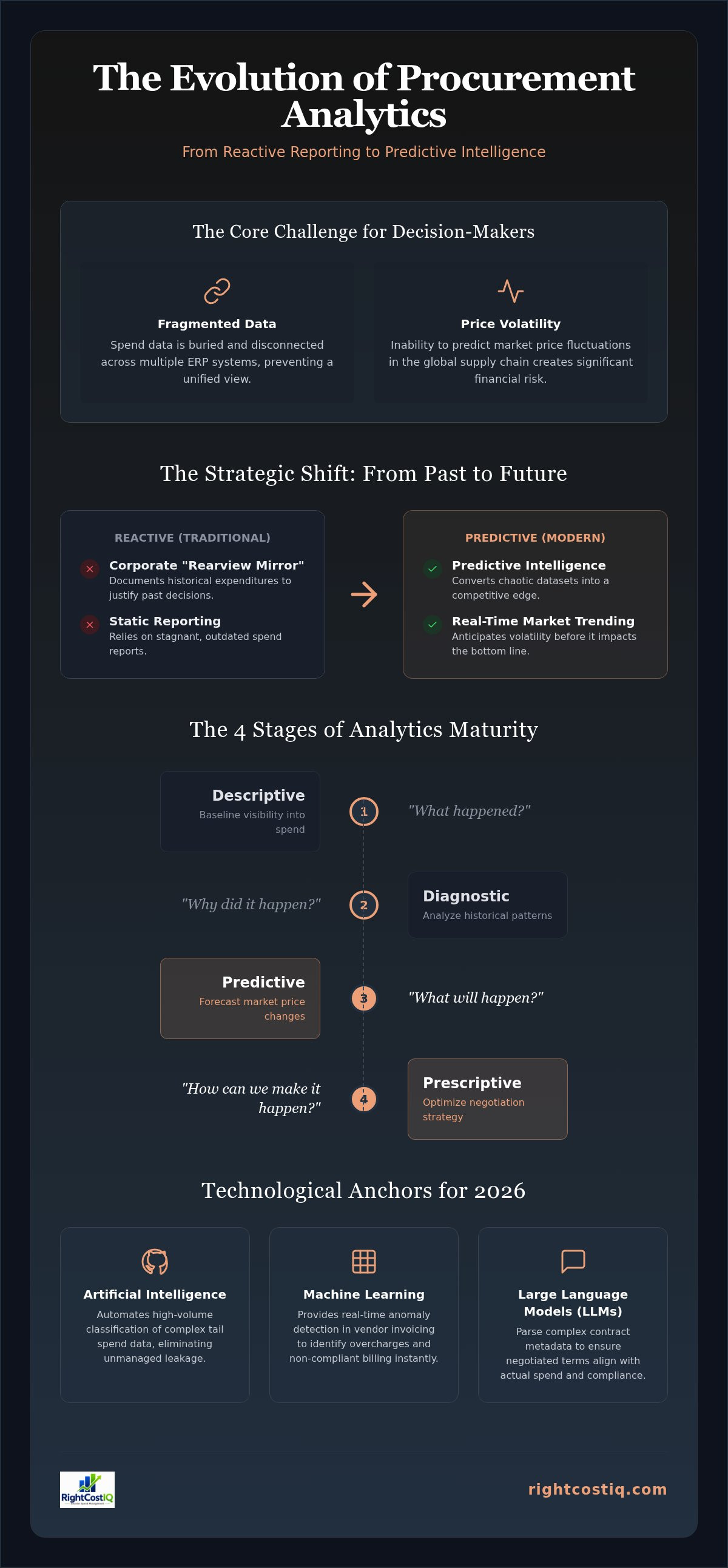
Procurement analytics is the clinical extraction and analysis of spend data to drive sourcing strategy. Traditionally, this function served as a corporate rearview mirror, documenting historical expenditures to justify past decisions. Modern procurement analytics services now prioritize predictive intelligence, moving beyond static reporting to real-time market price trending. In 2026, the massive volume of data across global supply chains necessitates a shift toward automated data cleansing and classification. Manual intervention is no longer viable for high-stakes decision-making.
The economic imperative for this evolution is clear. Organizations face significant financial leakage due to "dark spend" and analytical gaps that standard ERP systems fail to address. By integrating advanced analytics into the strategic sourcing process, firms can reclaim lost margins and convert raw spend data into a source of competitive advantage. This transformation turns procurement from a back-office function into a primary driver of financial growth.
The Four Stages of Procurement Analytics Maturity
Maturity begins with descriptive and diagnostic analytics. These stages establish baseline visibility into category variance and historical spend patterns. However, the true value lies in the transition to predictive and prescriptive models. Predictive analytics utilizes market price forecasting to anticipate volatility before it impacts the bottom line. Prescriptive analytics takes this further, offering specific recommendations to optimize negotiation strategy. This shifts the internal dialogue from a reactive "What happened?" to a proactive "How can we make it happen?".
Technological Anchors: AI and Machine Learning in 2026
The 2026 roadmap for procurement excellence relies on AI-driven automation to handle high-volume, low-complexity tasks. One primary application is the classification of complex tail spend data. Fragmented ERP environments often obscure these smaller transactions, yet they represent a significant portion of unmanaged leakage. Leveraging advanced procurement analytics services ensures that these AI tools translate directly into financial growth.
Machine learning algorithms now provide real-time anomaly detection in vendor invoicing patterns. This clinical precision identifies overcharges or non-compliant billing the moment they occur. Simultaneously, Large Language Models (LLMs) parse complex contract metadata to ensure that negotiated terms align with actual spend. These technological anchors allow procurement leaders to focus on high-level financial strategy while the analytical layer maintains operational integrity.
Core Taxonomy: Essential Procurement Analytics Tools and Architectures
Tactical procurement execution depends on a robust architectural foundation. High-level decision-makers must deploy a specialized taxonomy of tools to move beyond basic spend visibility. Effective procurement analytics services integrate four critical pillars: spend analysis software for reporting spend under management; supplier risk management systems to track financial volatility; market intelligence platforms for external price trending; and contract analytics to eliminate leakage from evergreen clauses. This integrated approach ensures that every dollar spent is visible, categorized, and optimized against market benchmarks.
The distinction between direct and indirect spend tools is vital for strategic precision. Direct spend architectures prioritize bill-of-materials (BOM) accuracy and production continuity. Conversely, indirect spend tools focus on tail spend consolidation and service-level compliance. Utilizing professional procurement analytics services ensures both streams are captured with clinical accuracy, providing the necessary baseline for should-cost modeling and category-specific benchmarking.
Spend Analytics vs. Expense Management
General ledger data serves accounting functions but remains insufficient for strategic sourcing. While expense management tracks total outflows, it lacks the line-item detail required to identify specific cost-reduction opportunities. Strategic category management requires granular visibility into unit prices and volume variances across disparate regions. Integrating specialized analytics into existing ERP infrastructures like SAP or Oracle allows for this clinical precision without replacing core systems. You can evaluate your current architectural maturity by performing a preliminary data diagnostic to identify immediate leakage points.
Evaluating Predictive Procurement Software
Selecting the right platform requires a focus on data ingestion speed and API connectivity. Modern predictive procurement intelligence tools must offer intuitive UI/UX for non-analysts to ensure organizational adoption. Predictive accuracy depends entirely on the quality of inputs. Clean data in a multi-ERP environment is a unified, deduplicated, and enriched dataset where disparate vendor names and item descriptions are mapped to a single, standardized global taxonomy. Without this foundational cleanliness, predictive models will generate flawed strategic recommendations that increase supply chain risk.
Clinical Benchmarking: Achieving Cost Transparency through Should-Cost Analysis
Generic industry averages provide a false sense of security in high-stakes sourcing. True cost optimization requires a "Should-Cost" model, a rigorous analytical framework that determines the theoretical cost of a product or service based on its constituent elements. By deploying sophisticated procurement analytics services, decision-makers can decompose vendor quotes into raw material costs, labor, overhead, and margin. This granular visibility transforms the negotiation process from a defensive posture into an offensive strategy. It allows procurement teams to challenge arbitrary price increases with empirical data rather than anecdotal market sentiment.
Cost transparency tools are the primary mechanism for exposing hidden vendor margins. When an organization utilizes should-cost analysis, they gain the ability to validate RFP responses with clinical precision. If a vendor bid deviates significantly from the calculated baseline, it signals either an inefficiency in their production or an attempt at margin expansion. Identifying these discrepancies early in the sourcing cycle ensures that contracts are awarded based on objective value rather than persuasive salesmanship. This level of scrutiny is essential for maintaining financial integrity across complex, high-value categories.
Price Risk Management and Volatility Tracking
Effective price risk management relies on the ability to forecast future costs with high predictive accuracy. Strategic architects use analytics to build Price Adjustment Formulas (PAFs) tied to objective market indices. This approach mitigates financial volatility by ensuring that contract pricing fluctuates in alignment with actual market shifts rather than vendor discretion. Market price trending provides a distinct strategic advantage during long-term negotiations, allowing firms to lock in favorable terms or build in protection against anticipated inflationary spikes. Relying on procurement analytics services for this level of foresight eliminates the guesswork that typically leads to budget overruns.
Quantifying Category Savings Opportunities
Analytics act as a diagnostic tool to identify "Quick Wins" within fragmented or unmanaged categories. By standardizing cost benchmarking across global supply chain nodes, organizations ensure consistency in their sourcing execution. This standardization prevents price creep and ensures that localized procurement decisions align with broader corporate financial goals. For a deeper dive into these frameworks, see our guide on Category Management in Procurement. This methodical approach to benchmarking ensures that every category contributes measurably to the bottom line, reinforcing the role of procurement as a strategic profit center.
Integrating Analytics into the RFP Lifecycle and Negotiation Strategy
Analytics without application is a sunk cost. High-level decision-makers must move beyond passive observation and integrate data directly into the negotiation cycle. Modern procurement analytics services bridge the gap between raw data and tactical execution by providing a structured framework for high-stakes vendor interactions. This clinical approach ensures that every RFP is backed by empirical baselines rather than subjective estimates.
The lifecycle begins at the pre-RFP stage. Spend analysis defines the strategic scope by consolidating fragmented requirements into a single, high-leverage volume. During the RFP, automated scoring systems compare complex vendor price models. This normalization allows for an objective comparison of bids that often vary in structure. Post-RFP, the focus shifts to tracking vendor performance against contractual SLAs. This ensures that the negotiated savings actually materialize in the financial reports. Without this closed-loop system, "paper savings" frequently evaporate through non-compliant billing or unmonitored price creep.
The Data-Driven Negotiation Framework
Success at the bargaining table requires a methodical transition from data to counter-offer. Strategic architects follow a three-step process to maximize leverage. First, identify price outliers using clinical should-cost benchmarking to determine exactly where a vendor is overcharging. Second, utilize market trending data to challenge unjustified price increases during the contract term. Third, leverage professional negotiation coaching for clinical execution. This framework replaces aggressive posturing with data-backed logic, forcing vendors to justify their margins against objective market indices.
Vendor Performance and Compliance Tracking
Negotiated savings only deliver value if they hit the bottom line. Organizations must deploy automated tracking for vendor compliance and supply chain resilience metrics to prevent leakage. This process verifies that the terms established during the sourcing phase are maintained throughout the contract lifecycle. For a deeper look at optimizing these processes, read more about RFP Management Strategic Frameworks. Closing this loop identifies which vendors consistently meet their obligations and which represent a risk to financial growth. To identify immediate leakage points in your current vendor contracts, access our free diagnostic to benchmark your existing performance data.
RightCostIQ: Architecting Data-Driven Procurement Excellence
RightCostIQ functions as a sophisticated partner for high-level decision-makers who require more than just spend visibility. While generic tools offer snapshots of historical data, we provide a clinical framework for RFP Management and Negotiation Assistance that converts raw datasets into tangible financial growth. Our procurement analytics services act as a strategic catalyst, bridging the gap between fragmented ERP outputs and expert-led sourcing execution.
Global coverage and operational efficiency are our core mission anchors. We prioritize the pragmatic realities of business finance, ensuring that every recommendation is grounded in objective market intelligence. By acting as a data-powered negotiation coach, RightCostIQ helps organizations navigate complex supply chain nodes with unwavering focus. This approach ensures that high-level strategy and technical execution are perfectly aligned to deliver measurable results.
Why Specialized Analytics Services Outperform Generic Software
Generic software platforms often fail because they rely on "black box" AI algorithms that lack the nuanced context of specific industries. Specialized procurement analytics services provide expert-led analysis that accounts for market volatility and category-specific cost drivers. This customized benchmarking is essential for high-value categories where generic averages fall short. We place a heavy emphasis on tail spend management. By capturing the hidden 20% of unmanaged spend typically ignored by standard software, we identify significant margin expansion opportunities that directly impact the bottom line.
The Path to Procurement Optimization
Achieving procurement excellence requires a methodical approach. The process begins with a clinical spend audit and diagnostic to establish a baseline of current performance. This initial phase identifies immediate leakage points and quantifies the ROI of professional negotiation assistance within your complex sourcing cycles. Strategic architects don't wait for market shifts to impact profitability; they proactively engineer their sourcing strategy for resilience. Optimize your procurement outcomes with a free diagnostic and transform your department into a primary driver of corporate financial growth.
Mastering the Analytical Cycle for Sustained Financial Growth
The transition from historical spend reporting to predictive intelligence is no longer optional for high-stakes procurement. You've seen how clinical should-cost modeling and granular category benchmarking provide the objective transparency needed to expose hidden vendor margins. Integrating these insights directly into your RFP management and negotiation strategy ensures that data is used as leverage rather than overhead. By utilizing specialized procurement analytics services, organizations can move beyond basic visibility to architect a resilient, profit-driven sourcing function.
RightCostIQ provides the expert-led analysis and proprietary frameworks necessary to bridge the gap between raw data and operational efficiency. Our approach combines specialized market price forecasting and comprehensive RFP management with expert negotiation assistance to ensure your negotiated savings hit the bottom line. Mastering these clinical applications allows your team to navigate market volatility with confidence and precision. Optimize your procurement outcomes with RightCostIQ’s clinical analytics framework. It's time to transform your procurement department into a primary driver of corporate profitability.
Frequently Asked Questions
What are the primary benefits of procurement analytics services?
The primary benefits include clinical spend visibility, systematic reduction in tail spend leakage, and enhanced negotiation leverage. Professional procurement analytics services convert fragmented data into a strategic asset for financial growth. This process identifies specific cost-reduction opportunities that traditional ERP reporting misses. By centralizing disparate datasets, decision-makers gain the transparency required to eliminate "dark spend" and align procurement activities with broader corporate profitability goals.
How do predictive analytics improve supply chain resilience?
Predictive analytics improve resilience by forecasting market price trends and identifying supplier risk patterns before they disrupt operations. This foresight allows procurement leaders to adjust sourcing strategies in response to anticipated volatility. Utilizing real-time data ensures that supply chain nodes remain stable during global economic shifts. It shifts the organizational posture from reactive fire-fighting to proactive strategic planning, ensuring continuity and price protection in high-value categories.
Can procurement analytics integrate with existing ERP systems like SAP or Oracle?
Integration with SAP, Oracle, and other ERP infrastructures is a standard requirement for modern analytical frameworks. Professional services provide the specialized layer that traditional systems lack, ingesting raw data via secure APIs for advanced classification. This ensures that your existing technology investments are enhanced rather than replaced. The result is a unified data environment where high-level financial strategy and technical execution are perfectly synchronized for maximum operational efficiency.
What is the difference between spend analysis and spend analytics?
Spend analysis refers to the retrospective examination of historical expenditure to identify past patterns. In contrast, spend analytics involves the continuous, real-time application of data to drive future sourcing decisions. While analysis tells you what happened, analytics provides the predictive intelligence to influence what happens next. This distinction is critical for organizations moving toward a predictive maturity model where data functions as a live negotiation tool.
How does should-cost modeling impact contract negotiations?
Should-cost modeling provides a clinical baseline for negotiations by decomposing vendor quotes into raw material, labor, and overhead components. This transparency exposes hidden margins and forces vendors to justify price increases against objective market indices. Procurement teams use this data to drive counter-offers with mathematical certainty. It replaces subjective bargaining with empirical logic, ensuring that contract terms reflect the true market value of the goods or services.
What are the top procurement KPIs for 2026?
Top KPIs for 2026 prioritize realized savings, predictive accuracy for price trends, and supplier risk mitigation scores. Strategic architects also track the percentage of spend under management and vendor compliance with contractual SLAs. These metrics provide a holistic view of procurement’s contribution to financial growth. By focusing on these outcomes, departments demonstrate their value as a profit center rather than a cost-heavy administrative function.
Is AI required for effective procurement analytics?
AI is an essential tool for high-volume data classification and anomaly detection, but it isn't a substitute for strategic expertise. Effective procurement analytics services utilize AI to handle repetitive tasks while relying on human architects for nuanced negotiation and category strategy. While automation increases efficiency, clinical precision requires expert interpretation of complex market dynamics. The most successful organizations combine technological innovation with deep industry knowledge to achieve sustained competitive advantage.
How can small to mid-sized enterprises (SMEs) leverage procurement tools?
SMEs leverage cloud-based procurement tools to access sophisticated market intelligence without the need for massive capital investment. These platforms offer pay-as-you-go models that make advanced analytics accessible for smaller organizations. By adopting these tools, SMEs gain the clinical benchmarking data needed to compete with larger entities during the RFP process. This ensures that smaller firms can optimize their cost structures and protect their margins against larger, more established competitors.


