
Supply chain cost reduction is no longer a matter of logistics optimization; it's a clinical procurement precision problem. Executing effective supply chain cost reduction strategies requires moving beyond surface-level savings to address the structural inefficiencies ingrained in your current sourcing model. You've likely experienced the friction of opaque market pricing and inefficient RFP cycles that fail to capture maximum value while supplier price volatility erodes your margins. These systemic failures represent a significant drain on your organization's financial agility.
This article outlines the high-precision procurement and negotiation frameworks required to drive sustainable margin expansion across your global enterprise through 2026. You'll master category benchmarking to secure quantifiable cost savings and implement a repeatable framework for high-stakes vendor negotiations. We'll also detail how to mitigate financial volatility through technical price risk management and market intelligence. This guide serves as a strategic blueprint to transform your procurement function into a sophisticated engine for bottom-line growth and operational excellence.
Key Takeaways
- Shift from tactical logistics cuts to a clinical procurement framework to execute high-impact supply chain cost reduction strategies.
- Deploy should-cost modeling and data-driven category benchmarking to identify precise market pricing variances across high-value components.
- Optimize the sourcing cycle through clinical RFP management that enforces competitive tension and automates vendor compliance tracking.
- Utilize advanced price risk management and market forecasting to stabilize margins against supplier price volatility and inflationary pressure.
- Transition to a strategic partnership model that integrates professional negotiation assistance and real-time performance analytics for sustainable financial growth.
Beyond Tactical Cuts: Why Strategic Procurement is the Primary Cost Lever
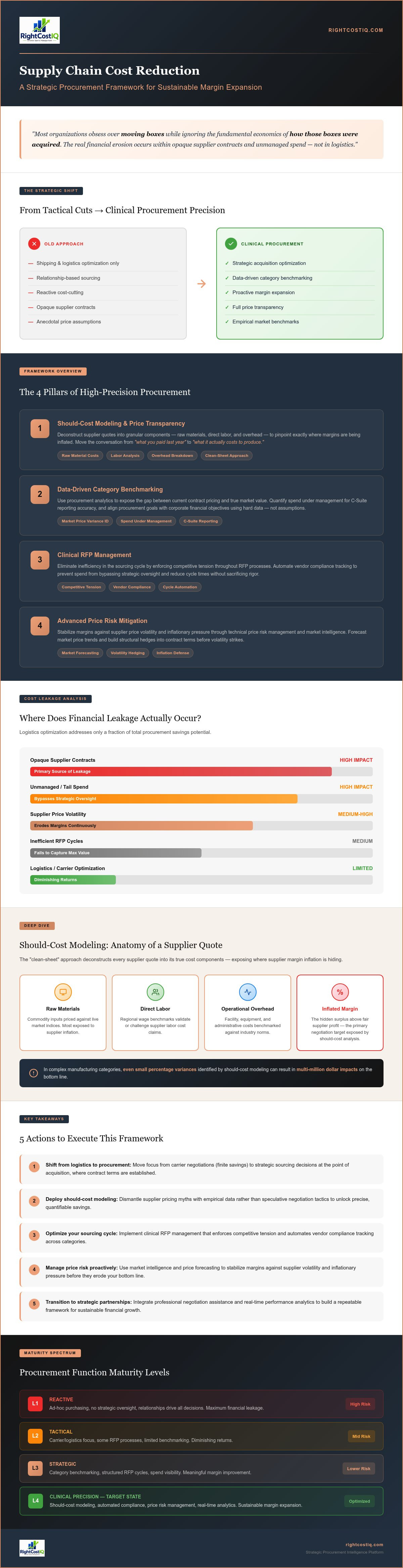
Standard supply chain cost reduction strategies often fail because they prioritize the wrong lever. Most organizations obsess over "moving boxes" while ignoring the fundamental economics of how those boxes were acquired. In 2026, enterprise resilience depends on a clinical shift toward procurement precision. This isn't merely about cutting costs; it's about optimizing the acquisition of value across the entire lifecycle of a category strategy. Inefficient category management doesn't just erode margins; it compromises your ability to respond to market shocks. A data-driven departure from traditional, relationship-based sourcing is the only viable path forward.
Precision procurement requires a sophisticated understanding of supply chain management principles to ensure that every dollar spent is architected for maximum return. When you treat procurement as a high-stakes financial discipline, you move from the periphery of operations to the center of enterprise value creation. The goal is to eliminate the guesswork that leads to overpayment and margin erosion.
The Limitations of Logistics-Only Cost Reduction
Shipping optimization often yields diminishing returns. While carrier negotiations are necessary, they represent a finite opportunity. Carriers have floors, and fuel costs are often outside your control. The real financial erosion occurs within opaque supplier contracts and unmanaged spend that bypasses strategic oversight. By moving from reactive cost-cutting to proactive margin expansion, you address the root cause of financial leakage. You can't solve a procurement problem with a logistics solution. True efficiency starts at the point of acquisition, where the contract terms and price structures are established.
Procurement as a Strategic Architect of Margin
Clinical procurement execution is the primary driver for financial growth in a modern enterprise. It positions procurement not as a support function but as a strategic architect of the bottom line. This approach involves integrating technology-focused prefixes into traditional sourcing, such as using Should-Cost modeling to dismantle supplier pricing myths. When you treat procurement as a high-precision discipline, you gain the ability to forecast market price trending and automate vendor compliance. This isn't just about saving money. It's about building a repeatable framework for sustainable margin expansion. RightCostIQ provides the analytical infrastructure required to execute these high-precision supply chain cost reduction strategies with total confidence.
Data-Driven Benchmarking: Quantifying Category Savings Opportunities
Identifying market pricing variances is the prerequisite for high-precision procurement. You can't manage what you don't measure with clinical accuracy. By utilizing procurement analytics, organizations expose the gap between current contract pricing and true market value. This transparency is vital for quantifying spend under management, a metric that ensures C-Suite reporting accuracy and aligns procurement goals with corporate financial objectives. Implementing strategic supply chain improvements requires moving past anecdotal evidence into the realm of hard data. Your supply chain cost reduction strategies must be anchored in empirical benchmarks to survive the scrutiny of the boardroom.
Should-Cost Modeling and Price Transparency
Should-cost modeling represents the apex of procurement precision. It involves deconstructing supplier quotes into granular components: raw material costs, direct labor, and operational overhead. This "clean-sheet" approach allows you to identify exactly where a supplier is inflating margins. By using Should-Cost Analytics, teams challenge supplier assumptions with empirical data rather than speculative negotiation tactics. This methodology identifies specific savings in complex manufacturing categories where small percentage variances result in multi-million dollar impacts on the bottom line. It's about moving the conversation from what you paid last year to what the item actually costs to produce.
Optimising Tail Spend for Enterprise Efficiency
Most supply chain cost reduction strategies overlook the "hidden 20%" of spend. This tail spend, characterized by low-value but high-volume transactions, represents a significant margin leakage point due to a lack of strategic oversight. Implementing automated tracking architectures is essential to capture these overlooked savings. Without a clinical focus on Tail Spend Management, organizations allow thousands of unmanaged transactions to erode the gains made in core categories. Capturing these savings requires a sophisticated analytical engine that operates at scale. You can evaluate your current category efficiency by visiting our procurement optimization platform to see where your margins are currently vulnerable.
Precision benchmarking doesn't just find savings; it builds a repeatable framework for financial growth. By establishing a data-driven baseline, you create a position of strength for all subsequent vendor interactions. This clinical approach ensures that procurement isn't just a cost center but a primary driver of enterprise value.
Clinical RFP Management: Eliminating Inefficiency in the Sourcing Cycle
Competitive tension is the lifeblood of procurement. Without it, vendors dictate the terms of engagement. Clinical RFP management forces a market-driven reality on suppliers by removing the "wiggle room" that often leads to price padding. This isn't just a process improvement; it's a cornerstone of high-impact supply chain cost reduction strategies. By standardizing requirements and enforcing strict response protocols, you eliminate the ambiguity that suppliers use to hide margin. High-stakes sourcing requires a disciplined architecture that prioritizes data over relationships.
Precision Frameworks for Sourcing
Ambiguity acts as a hidden cost driver. When an RFP is vague, vendors price in the risk of the unknown. Structuring these documents with clinical precision eliminates that buffer. Leveraging Professional RFP Management allows teams to handle complex enterprise requirements without the manual friction of legacy systems. This infrastructure ensures that the vendor selection matrix is based on quantifiable data rather than subjective preferences. It's about creating a level playing field where value is the only metric that matters.
Reducing cycle times is equally critical for enterprise agility. A sourcing cycle that drags on for months loses market relevance and drains internal resources. Sophisticated procurement infrastructure automates the repetitive tasks of data collection and bid comparison. This speed allows your organization to pivot quickly as market conditions shift. It turns procurement into a fast-moving strategic asset rather than a bureaucratic bottleneck. Efficiency in the sourcing cycle directly translates to faster margin realization.
Vendor Performance and Compliance Tracking
The RFP isn't the finish line; it's the baseline for all future interactions. Ensuring operational efficiency requires automated performance dashboards that track vendor adherence to the agreed-upon terms. Real-time compliance monitoring mitigates supplier risk before it impacts your bottom line. For a deeper dive into aligning these efforts with your broader goals, consult the Category Management Framework. This alignment ensures that every vendor relationship is managed with the same precision used during the initial sourcing phase.
Linking RFP outcomes to tangible business growth metrics ensures that procurement's value is visible to the C-suite. It's not just about spending less; it's about acquiring better. When you execute these supply chain cost reduction strategies through clinical RFP management, you build a foundation for long-term financial stability. Every negotiation becomes a data point in a larger framework of margin expansion. This relentless focus on sourcing precision is what separates high-performing supply chains from those merely surviving the market.
Advanced Negotiation and Price Risk Mitigation Strategies
Sophisticated negotiation represents the final mile of a clinical procurement framework. While benchmarking identifies the "what," negotiation secures the "how." Integrating market price trending and forecasting transforms the dialogue from a contest of wills into a technical analysis of market reality. This approach is essential for high-impact supply chain cost reduction strategies that require more than just volume-based discounts. It's about establishing a position of authority through data. You don't win negotiations by being louder; you win by being better informed. When your team enters a room with a clinical understanding of a supplier's margin structure, the power dynamic shifts irrevocably in your favor.
Mitigating financial volatility through strategic price risk management is no longer optional. In a global economy defined by rapid shifts, procurement must act as a financial hedge for the enterprise. This requires moving beyond simple price-point discussions to address the underlying variables that drive cost. By executing professional negotiation assistance in high-value procurement, organizations ensure that their contract terms are architected to withstand market shocks rather than succumb to them.
Market Forecasting as a Negotiation Lever
Suppliers often cite "market conditions" to justify price increases. Data-driven market intelligence allows you to challenge these claims with clinical precision. By predicting price shifts, you can lock in favorable rates before market spikes occur. Integrating market price trending into long-term supply agreements ensures that your organization isn't a victim of volatility but a strategic manager of it. It's the difference between reactive purchasing and proactive margin protection. It forces transparency onto the supplier's cost structure and eliminates the "inflationary padding" often found in multi-year contracts.
The Clinical Negotiation Process
Moving from positional bargaining to data-led value creation requires a structural shift in how your team engages with vendors. Accessing professional Negotiation Coaching provides the high-stakes expertise needed to optimize complex contract terms. This process utilizes multi-variant forecasting models to reduce price risk across volatile categories. It ensures that every negotiation is architected for maximum enterprise value. Key components of this clinical process include:
- Multi-variant Analysis: Evaluating raw materials, currency fluctuations, and labor indices simultaneously.
- Strategic Anchoring: Setting the negotiation floor based on should-cost data rather than the supplier's opening bid.
- Contractual Flexibility: Embedding price-adjustment formulas that protect margins during market downturns.
High-value procurement demands a level of analytical rigor that traditional sourcing models simply cannot provide. You can begin optimizing your negotiation framework today by accessing our procurement performance diagnostic. This tool identifies the specific gaps in your current negotiation strategy, allowing you to deploy targeted interventions that secure immediate and sustainable savings. By treating negotiation as a clinical discipline, you transform it into a repeatable engine for financial growth.
Executing the Framework: Integrating RightCostIQ for Sustainable Margin Expansion
RightCostIQ acts as the sophisticated architect of procurement optimization, bridging the gap between high-level financial goals and granular technical execution. Implementing a clinical framework isn't a one-time event; it's a structural realignment of how your organization acquires value. By integrating advanced analytics and negotiation assistance, you transform procurement from a back-office function into a primary driver of enterprise resilience. Execution is the final hurdle in the transition from tactical purchasing to strategic margin management. Organizations that fail to bridge this gap often find that their supply chain cost reduction strategies dissolve into operational noise. RightCostIQ provides the analytical infrastructure to ensure that every sourcing decision is backed by clinical market intelligence.
The ROI of Procurement Optimization
Quantifying the financial impact of professional negotiation assistance is essential for maintaining C-suite buy-in. When procurement functions operate with clinical precision, the reduction in total cost of ownership (TCO) becomes a predictable outcome rather than a fortunate accident. Category benchmarking allows you to identify exactly where margins are being eroded by supplier inefficiency or opaque pricing structures. This data-led approach ensures that cost savings are sustainable and don't compromise the long-term health of your supply chain. For a detailed roadmap on integrating these processes, review the RFP Management Strategic Framework. Professional analytics services provide the clarity needed to defend procurement budgets and demonstrate quantifiable ROI to financial stakeholders.
Initiating the Clinical Sourcing Cycle
Professional procurement teams must move quickly to capture immediate savings targets. Onboarding RightCostIQ analytics allows for a rapid assessment of current spend categories to identify the most significant opportunities for margin expansion. This modernization of traditional business processes replaces manual spreadsheets with high-precision digital tools. It's about building a repeatable engine for efficiency. The integration of supply chain cost reduction strategies into your daily operations ensures that your organization remains agile in a volatile global market. You can optimize your procurement outcomes today by deploying our clinical framework across your highest-value categories. The next steps for your organization involve a holistic alignment between your financial strategy and technical sourcing execution. This alignment is the only way to secure a competitive advantage in 2026 and beyond. By treating procurement as a strategic discipline, you safeguard your margins and position your enterprise for relentless growth.
Architecting Enterprise Resilience Through Procurement Precision
Securing sustainable financial growth in 2026 requires a departure from traditional, anecdotal sourcing. High-stakes enterprise environments demand a clinical framework that prioritizes data-driven benchmarking and sophisticated price risk management. By implementing these supply chain cost reduction strategies, your organization transitions from reactive purchasing to proactive margin architecture. You've seen how clinical RFP management and should-cost modeling eliminate vendor ambiguity; this ensures that every contract is optimized for maximum value acquisition. Global coverage for enterprise supply chains is no longer a luxury; it's a structural necessity for maintaining a competitive advantage.
RightCostIQ provides the analytical infrastructure and proprietary cost benchmarking analytics required to dismantle opaque pricing models. Our expert-led negotiation assistance ensures your team operates with total confidence during high-stakes contract renewals. It's time to bridge the gap between high-level strategy and technical execution. Execute your clinical procurement strategy with RightCostIQ. Take the first step toward a more efficient, data-led financial future today.
Frequently Asked Questions
What are the most effective supply chain cost reduction strategies for 2026?
The most effective supply chain cost reduction strategies for 2026 prioritize clinical procurement precision over traditional logistics cuts. Organizations must shift focus toward should-cost modeling and real-time market intelligence to identify acquisition value gaps. This approach addresses the structural inefficiencies in how goods and services are sourced. By moving beyond simple shipping optimization, enterprises secure sustainable margin expansion through data-driven decision-making and strategic vendor alignment.
How does RFP management contribute to supply chain cost reduction?
Clinical RFP management ensures competitive tension by standardizing vendor requirements and removing response ambiguity. This process eliminates the price padding often hidden in complex enterprise quotes. By enforcing strict response protocols, procurement teams force a market-driven reality on suppliers. Sophisticated RFP management infrastructure reduces cycle times and ensures that vendor selection is based on quantifiable performance metrics rather than subjective relationships.
What is procurement category cost benchmarking?
Procurement category cost benchmarking is the analytical process of comparing internal contract pricing against real-time market data. This methodology identifies pricing variances across specific spend categories to expose overpayment. By utilizing procurement analytics, organizations quantify savings opportunities and establish a baseline for high-stakes negotiations. It's a fundamental component of high-precision supply chain cost reduction strategies that require empirical evidence to justify strategic shifts.
Can tail spend management significantly impact the bottom line?
Tail spend management captures significant savings by addressing the unmanaged 20% of enterprise spend. These low-value, high-volume transactions often represent a major margin leakage point due to a lack of strategic oversight. Implementing automated tracking architectures allows organizations to gain visibility into these overlooked areas. Capturing these savings requires a sophisticated analytical engine that brings tactical spend under a clinical procurement framework to drive immediate financial impact.
How do market price trending tools mitigate supply chain risk?
Market price trending and forecasting tools mitigate risk by allowing procurement teams to predict price shifts before they impact the bottom line. These tools act as a primary negotiation lever to counter supplier price increase requests with empirical data. By integrating market intelligence into long-term agreements, organizations lock in favorable rates and reduce financial volatility. This proactive approach transforms market fluctuations from a threat into a strategic advantage for the enterprise.
What is the difference between tactical cost-cutting and strategic procurement optimization?
Tactical cost-cutting is a reactive approach that focuses on short-term reductions in headcount or logistics expenses. Strategic procurement optimization is a proactive architecture that focuses on the acquisition of value and long-term margin expansion. While tactical cuts often yield diminishing returns, strategic optimization addresses the root causes of financial erosion. It treats procurement as a primary driver for enterprise growth rather than a mere support function focused on moving boxes.
How can negotiation assistance improve supplier contract outcomes?
Professional negotiation assistance improves outcomes by shifting the power dynamic from positional bargaining to data-led value creation. Using tools like a 'Negotiation Coach' allows procurement teams to enter discussions with a clinical understanding of a supplier's cost structure. This expertise optimizes contract terms and secures more favorable pricing through technical analysis. It ensures that every negotiation is a repeatable process for driving sustainable financial outcomes and protecting organizational margins.
What role does technology play in modern supply chain cost reduction?
Technology provides the analytical infrastructure required to modernize traditional business processes through automation and real-time data integration. It allows for the clinical tracking of vendor performance and compliance at scale. By bridging the gap between traditional functions and digital innovation, technology enables high-precision cost analysis and forecasting. This digital framework is the essential foundation for executing sophisticated supply chain cost reduction strategies in a volatile global economy where data is the primary lever.


