
Most organizations audit their category spend with surgical precision while treating procurement consulting fees as an unquantifiable overhead expense. This disconnect creates a strategic vulnerability where advisory costs outpace actualized savings. You've likely experienced the frustration of opaque pricing models from big-box firms or struggled to quantify the value of intangible process improvements. It's a common pain point for high-level decision-makers who require transparency and a direct link between investment and operational efficiency.
This article provides a clinical breakdown of the 2026 benchmarking standards required to align advisory costs with tangible margin expansion. You'll gain a clear understanding of how to evaluate hourly versus outcome-based pricing structures to prevent budget creep. We'll also establish a strategic framework for auditing consulting bids, focusing on high-ROI activities like RFP management and automated vendor performance tracking. This guide serves as a technical manual for transforming procurement advisory from a sunk cost into a high-performance financial instrument.
Key Takeaways
- Transition from legacy hourly billing to value-based outcome models to align advisory capital with measurable margin expansion.
- Benchmark procurement consulting fees using the "10% Rule" to ensure advisory costs remain proportionate to targeted category savings.
- Differentiate between fixed-fee structures for clinical RFP management and hourly rates for specialized, ad-hoc technical audits.
- Implement a strategic sourcing framework for consultants that prioritizes methodology transparency, data ownership, and performance-linked guarantees.
The Economic Architecture of Procurement Consulting Fees
In the context of modern supply chain strategy, procurement consulting fees represent a deliberate capital allocation designed to acquire specialized sourcing intelligence. This investment isn't a generic administrative cost but a strategic lever for margin expansion. As we enter 2026, the industry is witnessing a decisive shift away from legacy "body-shop" hourly billing toward value-based procurement outcomes. This evolution prioritizes the delivery of measurable financial results over the mere accumulation of billable hours. Effective Procurement management now demands a clinical approach to fee structures to ensure that every dollar spent on advisory services generates a direct, traceable impact on the bottom line.
The valuation of these fees rests on three critical pillars: technical category expertise, access to proprietary benchmarking data, and institutional negotiation leverage. Sophisticated firms maintain clinical objectivity by utilizing client-paid fee structures rather than vendor-paid Group Purchasing Organization (GPO) models. While GPO-funded consulting may appear cost-neutral, it often introduces hidden biases that compromise sourcing neutrality. Choosing a client-aligned model ensures that the consultant's incentives remain perfectly synchronized with your organization's savings targets. This alignment is fundamental for achieving the specific business solutions required in high-stakes corporate environments.
Direct vs. Indirect Fee Models
Direct fee models typically involve transparent retainers or project-based costs that offer predictable budgeting and clear accountability. These architectures allow for a structured, logical approach to resource deployment. In contrast, indirect models rely on commissions or GPO funding, which can obscure the true cost of the engagement and influence vendor selection. Sophisticated procurement leaders are increasingly migrating toward transparent, fixed-fee architectures. This preference stems from the need for absolute neutrality during complex sourcing events. A fixed-fee structure eliminates the incentive for "consultant creep," where project scopes expand unnecessarily to inflate hourly billings.
The Cost of Inaction: Benchmarking the Price of Internal Inefficiency
Internal teams often struggle with "leakage" during RFP management cycles due to a lack of category-specific data or specialized negotiation tools. These inefficiencies represent a silent tax on corporate earnings. Professional advisory fees act as a high-performance insurance policy against sub-optimal vendor contracts and missed cost-reduction opportunities. By engaging external experts, organizations can compress cycle times and secure superior commercial terms that internal resources might overlook. The Procurement Value Multiplier is the ratio of realized savings to total consulting spend.
Comparative Analysis of Procurement Fee Structures in 2026
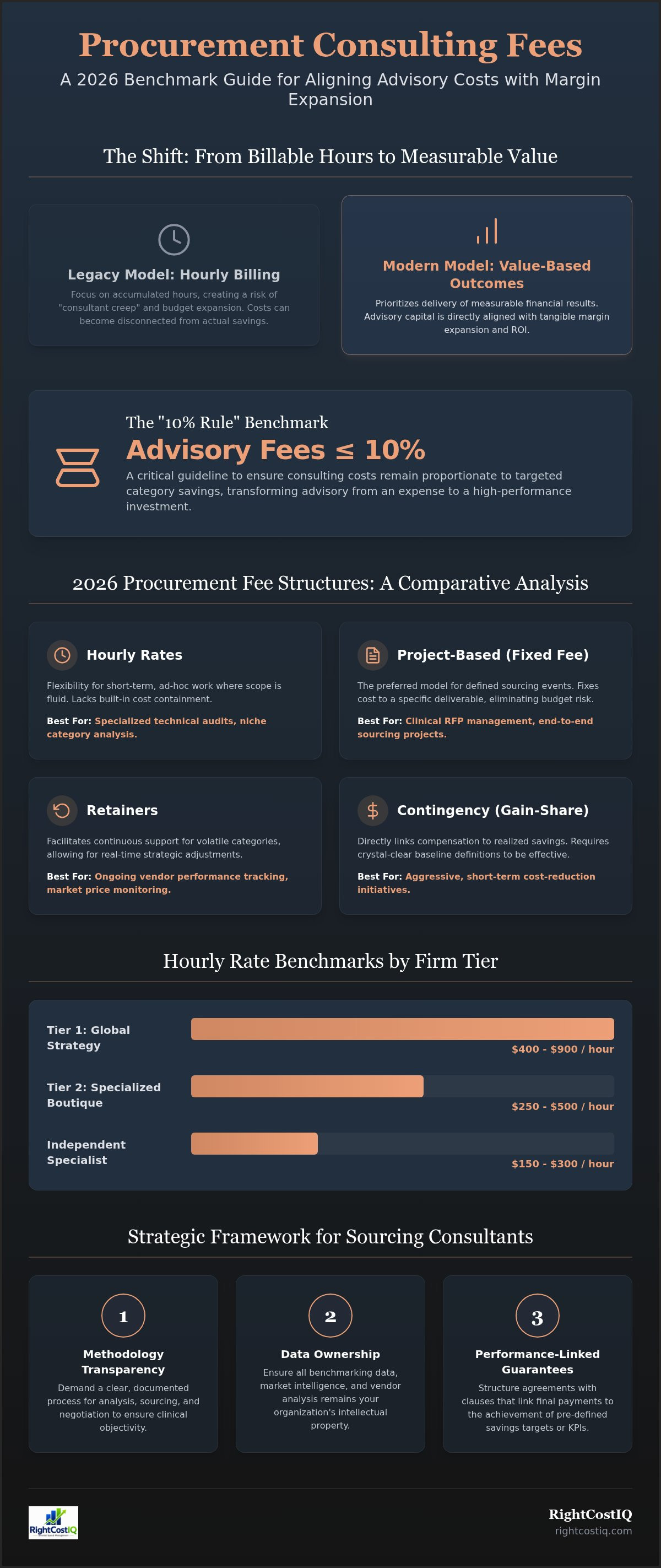
High-level decision-makers must evaluate procurement consulting fees through a lens of structural efficiency and milestone alignment. Hourly rates remain the baseline for ad-hoc technical audits or niche category analysis where the initial scope is fluid. This model provides flexibility for short-term diagnostic work but lacks the cost-containment benefits of more structured architectures. Project-based fees represent the preferred model for clinical RFP management and end-to-end sourcing events. By fixing the cost to a specific deliverable, organizations eliminate the risk of budget expansion and ensure the consultant focuses on rapid execution.
Retainers facilitate continuous vendor performance tracking and market price monitoring. This structure is essential for categories subject to high volatility, as it allows for real-time adjustments to sourcing strategies. Contingency models, or gain-share arrangements, link consultant compensation directly to realized savings. While attractive for immediate cost-reduction targets, these models require clear baseline definitions to avoid disputes over what constitutes a realized saving. Each model serves a distinct strategic purpose within a sophisticated sourcing framework.
Hourly Rate Benchmarks by Firm Tier
Strategic sourcing requires an understanding of the current market rates for professional advisory services. Tier 1 global strategy firms typically command hourly rates between $400 and $900. These firms offer high-level boardroom credibility and broad cross-functional insights. Tier 2 specialized procurement boutiques focus on deep category expertise and operational execution, with rates ranging from $250 to $500 per hour. Independent specialists often provide niche technical skills at a lower price point, generally between $150 and $350 per hour. Selecting the appropriate tier depends on the complexity of the category and the required level of executive visibility.
The Rise of Hybrid Fee Architectures
Modern engagement models increasingly favor hybrid architectures. These combine a lower base retainer with a performance-based payment for specific negotiation outcomes. This structure aligns consultant incentives with enterprise financial goals by rewarding efficiency and actual margin expansion. It prevents the activity trap common in pure hourly models. You can analyze RightCostIQ's transparent pricing framework to see how these models translate into actionable service agreements. Implementing a hybrid model ensures that the advisory partner shares the risk of the sourcing event while maintaining a baseline level of support. Evaluating your category requirements through a clinical spend analysis can help determine the most effective fee structure for your next sourcing cycle.
Benchmarking the 'Should-Cost' of Procurement Advisory
Procurement leaders must apply the same clinical logic to advisory spend that they use for direct materials. Establishing a "should-cost" model for procurement consulting fees requires a data-driven approach that moves beyond subjective value. Organizations should use Spend Under Management (SUM) as the primary denominator for fee justification. This metric provides a structured framework to ensure that the cost of specialized sourcing intelligence remains proportionate to the financial volume it influences. A failure to benchmark these costs leads to budget leakage and diminished returns on advisory capital.
The "10% Rule" serves as a critical threshold for financial discipline. In high-performance sourcing environments, consulting fees typically shouldn't exceed 10% of the targeted category savings. If a project targets $1 million in margin expansion, the advisory investment must be capped at $100,000 to maintain a healthy ROI. Additionally, sophisticated buyers must audit the "Data Premium" associated with modern firms. Organizations that utilize proprietary analytics platforms often command higher upfront fees because they provide accelerated market intelligence and automated tracking capabilities that manual processes can't match.
Fee Benchmarking: Project Type and Cost Ranges
Market standards for procurement projects vary based on data complexity and the required depth of category expertise. These ranges provide a baseline for evaluating consulting bids:
- Category Spend Analysis: Costs typically range from $20,000 to $75,000. The price fluctuates based on the volume of line-item data and the number of disparate ERP systems involved.
- Full RFP Management: High-value events generally command $50,000 to $150,000+. This covers the clinical execution of the sourcing cycle from requirement gathering to final contract award.
- Negotiation Coaching and Assistance: These engagements are often structured as a percentage of incremental savings or a fixed fee based on the complexity of the vendor landscape.
Quantifying the ROI of Negotiation Assistance
The financial impact of expert negotiation often dwarfs the initial investment. A 1% improvement in final contract outcomes can frequently offset the entire consulting fee for a high-spend category. Utilizing professional Negotiation Coaching doesn't just secure immediate savings; it builds durable internal capabilities that persist long after the consultant exits. This technical upskilling transforms the procurement department into a primary driver of financial growth. Negotiation Assistance ROI is calculated by comparing the final contract price achieved through expert intervention against established market benchmarks for the same category. By focusing on these granular metrics, decision-makers ensure that every dollar of advisory spend is an investment in measurable margin expansion.
Strategic Sourcing for Consultants: How to Structure the RFP
Organizations must treat the acquisition of advisory services with the same technical rigor as any high-value material category. Applying a strategic sourcing framework to external advisors ensures that procurement consulting fees are anchored to measurable performance rather than firm prestige. A clinical RFP process for professional services demands absolute methodology transparency and ironclad data ownership. You must ensure that the market intelligence gathered during the engagement remains a permanent institutional asset. Performance guarantees should be integrated into the contract architecture to align the advisor’s financial incentives with your organization’s margin expansion goals.
Avoiding the common trap of scope creep requires the definition of granular milestones. This is especially critical within RFP management cycles where project timelines can easily fluctuate. Each project phase, from requirement validation to final award, must have a fixed cost or a strictly capped hourly limit. This structure prevents the "consultant creep" where projects exceed initial budgets without a proportional increase in value. Additionally, price risk management should be a standard component of the consultant's own service agreement. This protects the enterprise against unforeseen administrative markups or escalating service costs during multi-year engagements.
Essential RFP Criteria for Advisory Partners
Selecting a sophisticated partner requires a deep analysis of their technical toolkit. Your RFP must mandate access to real-time Category Cost Benchmarking to ensure sourcing decisions are based on current market realities rather than historical data. Demand tech-enabled tracking of vendor performance post-contract to prevent the savings erosion that frequently occurs after a consultant exits. You should also evaluate whether the advisor relies on generic public domain information or possesses high-fidelity, proprietary data sets that offer a genuine competitive advantage in complex negotiations.
Negotiating the Consulting Contract
The final service agreement must prioritize financial accountability and clinical precision. Inserting "Right to Audit" clauses is essential for engagements involving gain-share or contingency-based calculations. You must also cap pass-through expenses by standardizing travel and administrative markups to prevent hidden fee inflation. Most importantly, link final success payments to "Realized Savings" confirmed by your finance department rather than "Identified Savings" presented in a project summary. This distinction ensures the advisor is compensated for actual cash-flow impact. To evaluate your current advisory spend against these benchmarking standards, you can access a clinical diagnostic of your procurement architecture.
RightCostIQ: Precision Execution Without the 'Big Firm' Overhead
Traditional advisory models often inflate procurement consulting fees by deploying large teams of junior analysts to perform manual data entry. RightCostIQ replaces this labor-intensive approach with a high-performance technological architecture that compresses the human-hour requirement of complex sourcing events. By automating data ingestion and normalization, we allow decision-makers to focus on strategic capital allocation rather than administrative oversight. This shift ensures that advisory spend is directed toward high-value negotiation intelligence rather than firm overhead. Our approach to clinical RFP Management serves as a primary driver for reducing the Total Cost of Ownership (TCO) across diverse spend categories.
Strategic architects require precision tools to force vendor transparency. RightCostIQ utilizes market price trending and forecasting services to provide a data-driven baseline for every negotiation. This intelligence eliminates the information asymmetry that suppliers typically exploit during contract renewals. By aligning market realities with internal requirements, organizations secure commercial terms that reflect the true should-cost of the category. We position ourselves as a sophisticated partner focused on institutional margin expansion through technical execution.
The Technology Advantage in Fee Reduction
Capturing the value within the "hidden 20%" of corporate spend usually requires massive consulting bills that erode the potential savings. RightCostIQ utilizes automated Tail Spend Management to secure these fragmented categories with minimal manual intervention. Transitioning from manual spreadsheet audits to real-time analytics delivers a documented 50% reduction in sourcing cycle times. This efficiency allows procurement departments to execute more sourcing events per year without increasing headcount or advisory budgets. You can explore our procurement platform to analyze how these automated workflows integrate with your existing financial systems.
Case Study Framework: From Fee to Financial Growth
A clinical approach to sourcing consistently yields a 10x ROI on procurement consulting fees by identifying deep-tier cost drivers. Beyond immediate price reductions, our framework addresses long-term supplier risk by implementing automated performance tracking. This ensures that the commercial advantages secured during the RFP phase don't degrade over the life of the contract. Professional negotiation assistance transforms sourcing from a tactical function into a strategic instrument for financial growth. To begin auditing your category spend for margin opportunities, request an RFP management consultation today.
Transforming Advisory Spend into a Strategic Financial Instrument
The evolution of sourcing strategy in 2026 demands a clinical departure from legacy advisory models. Decision-makers must transition from passive cost acceptance to active capital allocation by enforcing value-based structures and the 10% rule. This framework ensures that procurement consulting fees remain a proportionate investment in measurable margin expansion rather than a ballooning administrative expense. By utilizing technology to automate data normalization and vendor tracking, organizations can finally eliminate the human-hour inefficiency characteristic of traditional strategy firms.
Success in high-stakes sourcing requires the integration of proprietary cost benchmarking analytics and expert negotiation assistance into every RFP cycle. These technical levers provide the market intelligence needed to force vendor transparency and secure durable commercial advantages. Implementing clinical RFP management frameworks allows your team to prioritize strategic growth while maintaining absolute control over advisory budgets. It's time to redefine the value of your procurement department.
Optimize Your Procurement ROI with RightCostIQ
Your organization is now equipped to turn procurement advisory into a powerful engine for sustained financial growth.
Frequently Asked Questions
What is the average hourly rate for a procurement consultant in 2026?
In 2026, average rates depend on firm tier. Tier 1 strategy firms command $400 to $900 per hour, while specialized boutiques range from $250 to $500. Independent specialists provide niche expertise between $150 and $350. These rates reflect the specialized sourcing intelligence required for complex category analysis.
How do contingency-based procurement fees work?
Contingency models link compensation directly to realized financial outcomes. A baseline of current spend is established, and the consultant receives a percentage of the actualized savings. This aligns consultant incentives with your organization's margin expansion goals. It requires clear baseline definitions to prevent disputes during the gain-share calculation phase.
Is it better to pay a fixed fee or an hourly rate for RFP management?
Fixed fees are the superior choice for RFP management. This model prevents budget creep and ensures the advisor focuses on rapid execution rather than accumulating billable hours. Hourly rates are better suited for ad-hoc technical audits where the initial scope remains fluid. Fixed pricing provides the predictability required for high-level capital allocation.
What percentage of savings do procurement consultants typically charge?
Consultants often structure contingency fees around 10% to 25% of first-year realized savings. However, total procurement consulting fees should ideally not exceed 10% of the targeted category savings to maintain a healthy ROI. This "10% Rule" acts as a clinical benchmark for financial discipline. The percentage varies based on the complexity of the category and the level of data-driven analytics required.
How can I justify procurement consulting fees to my CFO?
Justify these expenses by presenting the Procurement Value Multiplier to your CFO. This metric compares the projected margin expansion against the advisory investment. Use proprietary benchmarking data to prove that expert negotiation assistance yields a direct, traceable impact on the bottom line. Emphasize that professional fees act as an insurance policy against sub-optimal vendor contracts.
Do procurement consultants provide their own benchmarking data?
Sophisticated firms utilize proprietary data sets and real-time analytics platforms rather than relying on public domain information. These proprietary tools offer high-fidelity insights that are essential for forcing vendor transparency during complex sourcing events. Access to this "Data Premium" justifies higher procurement consulting fees by accelerating the identification of savings opportunities.
What is the difference between a GPO and a procurement consulting firm regarding fees?
GPOs typically operate on vendor-paid commission models, which can compromise sourcing neutrality. Procurement consulting firms utilize client-paid fee structures to maintain clinical objectivity. This alignment ensures that the advisor's primary objective is your organization's financial growth rather than vendor retention. Client-paid models generally yield higher long-term ROI by prioritizing total cost of ownership.
Can procurement consulting fees be capitalized or are they always OpEx?
These costs are almost always categorized as Operating Expenses (OpEx) because they represent professional services. While they drive long-term margin expansion, they don't typically meet the criteria for capital expenditure (CapEx) unless they are bundled with the implementation of a long-term digital asset. Consult your internal finance department to confirm specific accounting treatments for advisory spend.


